AI Platform
An AI platform is the integrated stack for building, deploying, and operating AI agents and LLM applications in production. Agents reason across multiple steps, call tools and APIs, maintain state, and make decisions autonomously. A complete AI platform provides observability to see what your agent is doing, evaluation to measure whether it's working well, version control for prompts and configurations, and governance to control costs, access, and safety.
MLflow is the largest open source AI platform. It provides end-to-end tracing to debug multi-step agent execution, automated evaluation to measure agent quality, a prompt registry for managing instructions, and an AI gateway for unified access to LLM providers. MLflow is framework-agnostic: it integrates with whatever agent framework you choose, giving you full visibility without locking you into a specific tool.
What Makes Up an AI Platform
An AI platform is not a single product. It is a stack of complementary capabilities that every production agent needs:
Observability & Tracing
Problem: Multi-step agents, tool calls, and retrieval chains create complex execution paths that are difficult to debug.
Solution: OpenTelemetry-compatible tracing captures the full execution graph so you can see every LLM call, tool invocation, and decision branch.
Evaluation & Quality
Problem: Free-form language output can't be validated with unit tests, and quality regressions are hard to catch before they reach users.
Solution: LLM-as-a-judge evaluation with 70+ built-in scorers runs on datasets or continuously on live production traffic.
Version Control
Problem: A small change to a system prompt can alter agent behavior across thousands of interactions, and there's no way to track what changed.
Solution: Prompt registry versions prompts with lineage to traces and evaluation results, plus prompt optimization.
Governance & Safety
Problem: AI systems make decisions that need auditing, and can inadvertently expose PII or violate content policies.
Solution: AI Gateway provides a production-grade proxy for centralized key management, rate limiting, and traffic routing, plus safety scorers and full trace auditability.
Why Your Agents Need an AI Platform
Building an agent is straightforward. Operating it in production is not. Unlike traditional software, agents are non-deterministic: the same input can produce different outputs depending on model state, retrieved context, and multi-step reasoning. This creates challenges that require dedicated platform tooling:
- Debugging is opaque: Agent failures can happen at any step (retrieval, reasoning, tool execution, or prompt construction). Without tracing, you can't see what went wrong or why.
- Quality is hard to measure: Free-form language output can't be validated with unit tests. You need LLM-as-a-judge evaluation to assess correctness, groundedness, and relevance at scale.
- Prompts drift silently: A small change to a system prompt can alter agent behavior across thousands of interactions. A prompt registry versions and tracks the impact of changes on quality.
- LLM and MCP management grows complex: Routing requests across OpenAI, Anthropic, Google, and Bedrock while managing API keys, rate limits, and fallback logic creates compounding overhead. An AI gateway provides a low-overhead, production-grade proxy for all of this.
What MLflow Provides
MLflow is the only open source AI platform that provides all four capabilities in a unified offering. It integrates with any agent framework, programming language, and LLM provider:
- Tracing: Capture complete execution traces including LLM calls, tool invocations, retrievals, and agent decisions. OpenTelemetry-compatible with one-line auto-instrumentation for LangGraph, OpenAI Agents SDK, CrewAI, Google ADK, Pydantic AI, and 30+ other frameworks and providers.
- Evaluation: Measure agent quality at scale with 70+ built-in LLM judges covering correctness, safety, groundedness, tool call accuracy, and custom metrics. Run evaluations on datasets or apply them continuously to production traces.
- Prompt Registry: Version, compare, and iterate on prompt templates. Track which prompt versions are used by which agent versions and measure the impact of prompt changes on quality.
- AI Gateway: A low-overhead, production-grade proxy that routes requests to any LLM provider through an OpenResponses-compatible interface. Manage API keys centrally, enforce rate limits, set fallback routes, and track usage across providers.
- Production Monitoring: Apply automated scorers to production traces continuously. Detect quality regressions, track cost and latency trends, and surface issues before users report them.
- Human Feedback: Collect structured feedback from users and reviewers. Annotate traces with quality assessments, build evaluation datasets from real interactions, and close the feedback loop.
Get Started with MLflow
MLflow integrates with your existing agent framework in minutes. You don't need to change how you build agents. Here are examples showing how to add evaluation, tracing, and gateway routing to common setups. See the integrations documentation for LangGraph, OpenAI Agents SDK, CrewAI, Google ADK, Pydantic AI, Vercel AI SDK, and more.

The MLflow UI displays evaluation results across multiple scorers, making it easy to compare agent performance and identify quality regressions.
Evaluate Agent Quality
Run automated evaluations against your agents using LLM-as-a-judge scorers. MLflow provides 70+ built-in judges for metrics like correctness, safety, and tool call accuracy.
import mlflowfrom mlflow.genai.scorers import (Safety,Correctness,ToolCallCorrectness,)# Evaluate your agent against a datasetresults = mlflow.genai.evaluate(data=eval_dataset,predict_fn=my_agent,scorers=[Safety(),Correctness(),ToolCallCorrectness(),],)
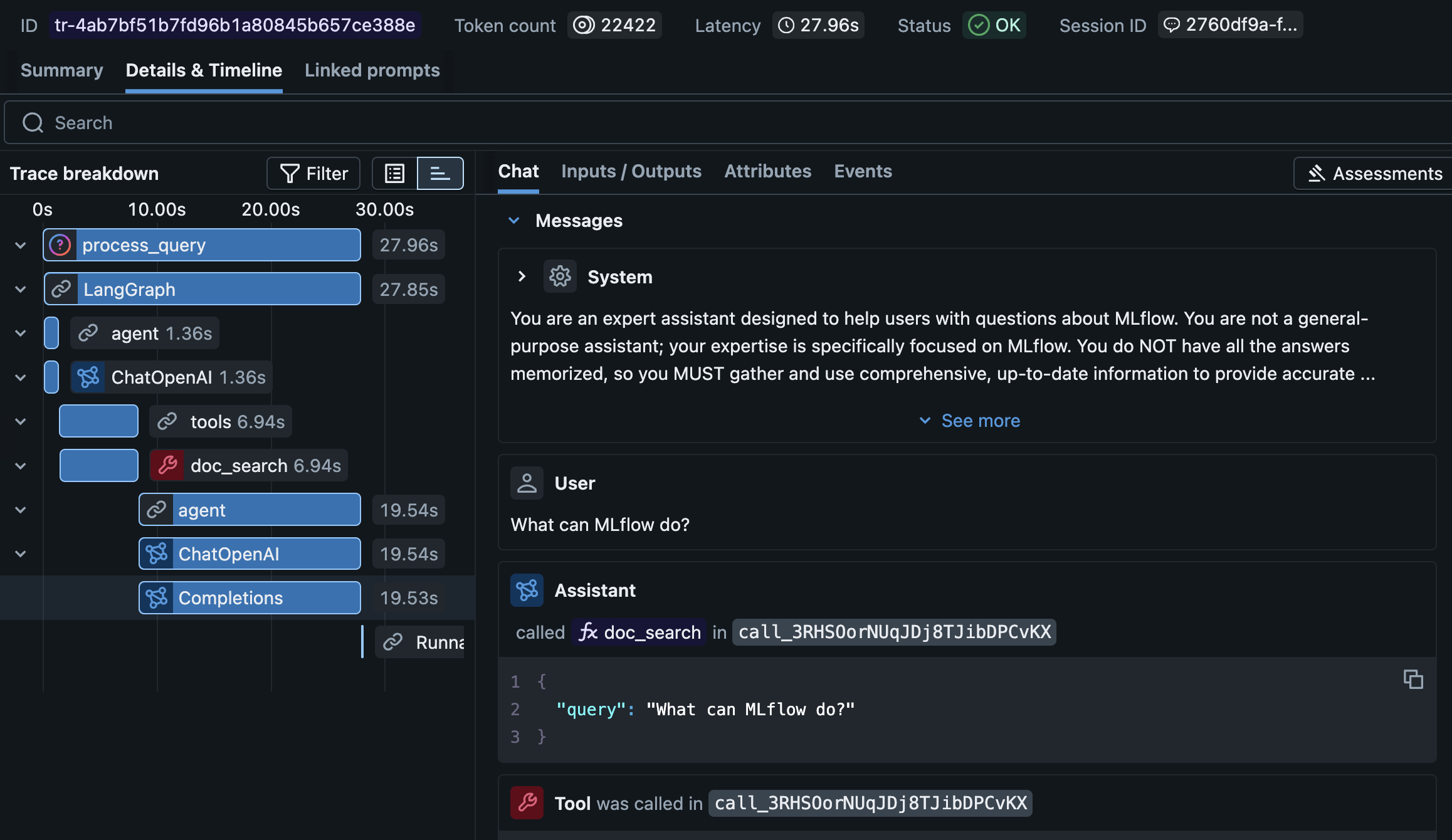
The trace view shows the complete execution graph, including timing, inputs, outputs, and metadata for each step in your agent's workflow.
Trace Multi-Step Agent Workflows
Capture every step of agent execution with automatic tracing. See LLM calls, tool invocations, and decision branches in a visual graph.
import mlflowfrom langgraph.graph import StateGraph# Trace your entire agent workflowmlflow.langgraph.autolog()# Build your agent as usualgraph = StateGraph(AgentState)graph.add_node("planner", planner_node)graph.add_node("executor", executor_node)graph.add_node("reviewer", reviewer_node)# Run the agent - every step is capturedapp = graph.compile()result = app.invoke({"task": "Research competitor pricing"})

The AI Gateway provides a unified interface across OpenAI, Anthropic, Google, and other providers, with built-in support for fallbacks and load balancing.
Route Requests Through AI Gateway
Use MLflow AI Gateway as a production-grade proxy for all LLM requests. Centralize API key management, enforce rate limits, and switch providers without changing your code.
from mlflow.gateway import set_gateway_urifrom openai import OpenAI# Point your client at the MLflow AI Gatewayset_gateway_uri("http://localhost:9000")client = OpenAI(base_url="http://localhost:9000/v1")# Route requests through the gateway# Keys, rate limits, and fallbacks are managed centrallyresponse = client.chat.completions.create(model="gpt-5",messages=[{"role": "user", "content": "Summarize this document."}],)
MLflow is the largest open source AI platform, with over 30 million monthly downloads. Thousands of organizations use MLflow to trace, evaluate, and monitor their AI agents and LLM applications. Backed by the Linux Foundation and licensed under Apache 2.0, MLflow provides everything you need with no vendor lock-in. Get started →
Open Source vs. Proprietary AI Platforms
When choosing an AI platform for your agents, the decision between open source and proprietary SaaS tools has long-term implications for data ownership, cost, and flexibility.
Open Source (MLflow): You maintain complete control over your telemetry data and platform infrastructure. Deploy on your own infrastructure or use managed versions on Databricks or other clouds. No per-seat fees, no usage limits, no vendor lock-in. MLflow integrates with any agent framework and LLM provider through OpenTelemetry-compatible tracing, supports 30+ integrations out of the box, and has an active community with over 30 million monthly downloads.
Proprietary SaaS Platforms: Commercial observability and evaluation platforms offer convenience but at the cost of flexibility and control. They typically charge per seat or per trace volume, which grows expensive at scale. Your trace data is sent to their servers, raising privacy and compliance concerns. You're locked into their ecosystem, and their development roadmap is controlled by the vendor rather than the community.
Why Teams Choose Open Source: Organizations building production agents increasingly choose MLflow because it provides enterprise-grade observability and evaluation without compromising on data sovereignty, cost predictability, or flexibility. The Apache 2.0 license and Linux Foundation backing ensure MLflow remains truly open and community-driven.