Automating AI Model Registry Updates for Engineers

The most reliable approach to automating AI model registry updates combines event-driven triggers (registry webhooks or Git tag pushes) with immutable OCI ModelKits, a CI/CD pipeline that runs automated evaluation gates, and policy-as-code checks using OPA/Rego before any stage transition. The minimum viable implementation requires six components working together:
- Event source: registry webhook or Git tag push that fires on model registration or stage change
- Immutable artifact: an OCI-compliant ModelKit bundling model, prompts, code, and metadata
- CI/CD pipeline: automated build, vulnerability scan, evaluation run, signing, and stage transition
- Policy-as-code gate: OPA/Rego rules enforcing accuracy, F1, drift score, and fairness thresholds
- Canary/shadow window: traffic-split deployment with automated SLO checks before full promotion
- Rollback path: automatic demotion triggered by post-promotion metric regression
Pro Tip: Require automated metric evaluation to pass before any stage transition fires. Wire rollback as a step in the same pipeline that promotes, so the pipeline is the single control point for both directions.
Table of Contents
- How does automated model registry update architecture work?
- What trigger and packaging patterns should you choose?
- How do you gate promotions and automate rollback safely?
- Why do immutable bundles make registry automation reliable?
- How do you implement automated registry updates with Mlflow?
- A minimal end-to-end pipeline you can copy today
- Key Takeaways
- The part most teams skip
- Mlflow gives you the automation foundation, not just the registry
- Useful sources
How does automated model registry update architecture work?
The data flow moves through five layers. Understanding each layer helps you avoid the common mistake of automating only the happy path.
Event sources and triggers sit at the entry point. Registry webhooks fire on model registration or stage change; Git tag pushes signal a new validated version; EventBridge or a similar event bus bridges registries and downstream pipelines; scheduled triggers run drift checks on a cadence independent of training events. Separating trigger policies from data-selection strategies lets you adjust drift thresholds or retraining windows without touching how training data is assembled.
Packaging and storage convert a trained artifact into a reproducible unit. OCI-compliant ModelKits store model weights, prompts, code, and a manifest linking to the Git commit and data snapshot inside a standard container registry. This makes the artifact the deployable truth, not just a pointer to scattered files.
Orchestration is where CI/CD takes over: evaluation runs, vulnerability scans, artifact signing, SBOM generation, and the final API call to transition the registry stage.
Policy and gating enforce non-negotiable thresholds. OPA/Rego policy-as-code governance gates stage changes by accuracy, F1, demographic parity, drift score, and dependency allowlists before any promotion proceeds.
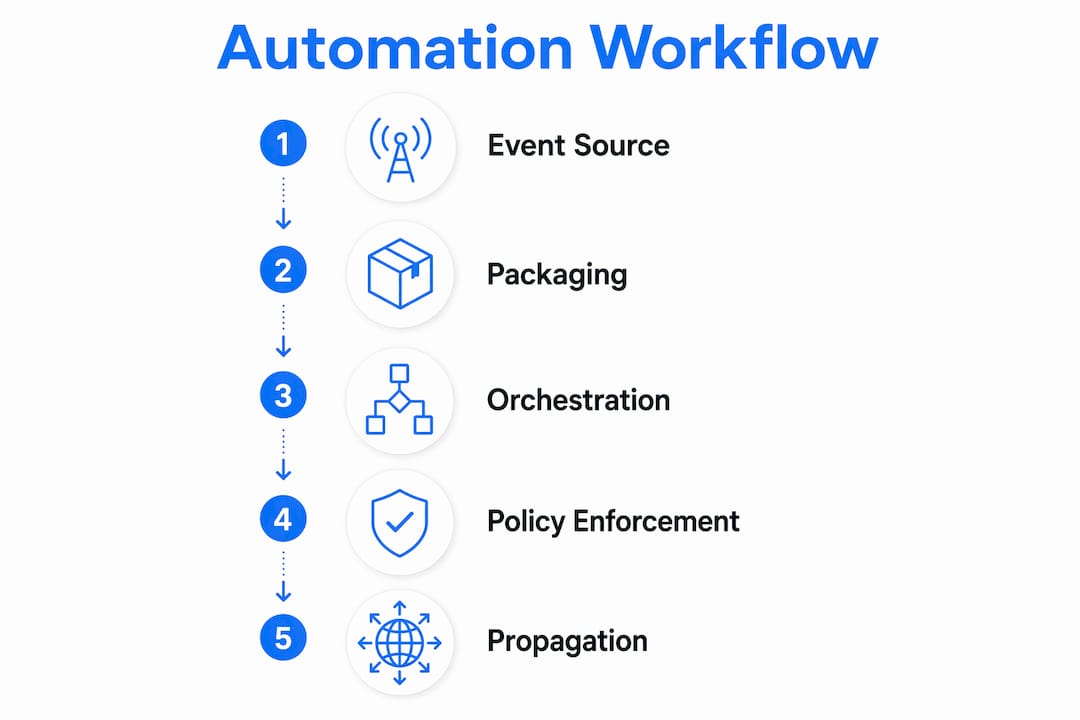
Propagation and sync push metadata across environments (dev → staging → production) without manual edits, using a synchronization CI job or a central registry with environment-specific metadata overlays.
| Component | Responsibility | Typical tech choices |
|---|---|---|
| Event source | Detect registry or code change | MLflow webhook, GitHub Actions, EventBridge |
| Artifact store | Store immutable bundles | OCI registry, S3 + manifest |
| CI/CD orchestrator | Run evaluation, scan, sign, promote | GitHub Actions, Jenkins, Argo Workflows |
| Policy engine | Gate stage transitions | OPA/Rego, custom metric checks |
| Observability | Monitor post-promotion metrics | MLflow tracing, Prometheus, drift detectors |
Pro Tip: Use IAM roles scoped to the CI/CD job identity rather than long-lived credentials. Require non-root images at runtime and attach SBOMs to every signed artifact so automated acceptance tests can verify provenance.
What trigger and packaging patterns should you choose?
Four trigger patterns cover most production scenarios. Pick based on your latency tolerance and safety requirements.
Webhook on stage change fires immediately when a model transitions in the registry. It is the lowest-latency option and maps directly to MLflow webhook → step function → repackage → target registry flows.

Git tag push (GitOps) treats the repository as the source of truth. Stage assignments create specially formatted Git tags; a CI/CD action parses those tags to determine model name, version, and target stage, then fetches the artifact from remote storage and invokes the deployment script.
Scheduled drift-based triggers run independently of training events and check whether production data distribution has shifted enough to warrant retraining. Decoupling this from the training trigger means you can tighten drift thresholds without changing your data-selection logic.
Event-driven step functions chain triggers across services, useful when your registry, training cluster, and serving infrastructure live in different accounts or clouds.
For packaging, ModelKits as immutable OCI artifacts that include model, prompts, code, and metadata are the most portable option. Semantic versioning tied to a Git tag that encodes run_id and commit hash gives you a reproducible handle for every version.
Here is a minimal GitHub Actions trigger that parses an MLflow webhook payload and starts the promotion pipeline:
on:
  repository_dispatch:
    types: [mlflow_stage_change]

jobs:
  promote:
    runs-on: ubuntu-latest
    steps:
      - name: Parse webhook payload
        id: parse
        run: |
          echo "model_name=${{ github.event.client_payload.model_name }}" >> $GITHUB_OUTPUT
          echo "version=${{ github.event.client_payload.version }}" >> $GITHUB_OUTPUT
          echo "stage=${{ github.event.client_payload.to_stage }}" >> $GITHUB_OUTPUT

      - name: Run evaluation gate
        run: python scripts/evaluate_model.py \
          --model ${{ steps.parse.outputs.model_name }} \
          --version ${{ steps.parse.outputs.version }}

      - name: Transition stage if gates pass
        run: python scripts/transition_stage.py \
          --model ${{ steps.parse.outputs.model_name }} \
          --version ${{ steps.parse.outputs.version }} \
          --stage ${{ steps.parse.outputs.stage }}
Treat the registry event as the audit log target. Push everything required to reproduce that model version before allowing any state change — artifact digest, Git commit, data snapshot reference, and evaluation results must all be present before the transition API call fires.
Pro Tip: Store the CI job run ID alongside the model version in registry metadata. When a rollback fires at 2 AM, you want a single field that links back to the exact pipeline run that promoted the model.
How do you gate promotions and automate rollback safely?
Automated promotion without automated rollback is half a system. Both directions must be wired into the same pipeline.
Gate model promotions with policy-as-code checks that enforce:
- Accuracy and F1 thresholds above the baseline of the currently deployed version
- Fairness and demographic parity checks within defined tolerance bands
- Drift score below the configured limit for input feature distributions
- Dependency allowlist validation confirming no unapproved packages are present
- Signed artifact attestation confirming the bundle passed vulnerability scanning
Canary and shadow patterns reduce blast radius. Define a shadow window where the new model receives a copy of live traffic but its responses are not served to users. After the shadow period, shift a small traffic percentage to the candidate and run automated SLO checks. Only promote fully when error rate, latency, and output quality metrics all pass.
Rollback automation should trigger on post-promotion metric regression without human intervention. Failing to automate rollback is one of the most common operational failure points in production ML systems. A CI/CD step that demotes or archives the problematic version and re-promotes the previous one keeps recovery time under minutes.
Monitoring and observability close the loop. Map production metrics, data-drift detector outputs, and explainability traces to registry state changes so alerts carry context about which version caused a regression.
Automated demotion is not optional. A pipeline that can promote but cannot demote gives you a one-way door into production incidents.
Pro Tip: Bake rollback and demotion actions into the same pipeline that promotes models. The pipeline is the single control point for both directions, and that symmetry makes runbooks simple.
Why do immutable bundles make registry automation reliable?
Treating bundles as immutable versioned artifacts makes registry-based automation stable because the pipeline promotes an actual deployable snapshot, not just metadata. When prompts, model weights, code, and configuration drift independently, agentic workflows break in ways that are hard to reproduce. A single versioned object eliminates that class of failure.
Implement bundles as KitOps ModelKits or ModelPack-style OCI artifacts. The manifest links to the Git commit and data snapshot, so any team member or automated system can reconstruct the exact state that produced a given registry entry. Practitioner frameworks recommend treating these bundles as immutable units to prevent environment-to-environment differences.
Versioning strategy: use semantic versions (MAJOR.MINOR.PATCH) with a Git tag that encodes run_id and commit hash. Require the semantic version format in your OPA/Rego policy so malformed versions are rejected before they reach the registry. Registry entries should store artifact digest, Git commit, and provenance fields so the registry functions as a true single source of truth.
Pro Tip: Sign artifacts and store the SBOM and attestations alongside the bundle. Automated acceptance tests can then verify provenance without human review, which is the only way signing actually protects you at pipeline speed.
How do you implement automated registry updates with Mlflow?
Mlflow's model registry supports webhooks, a stage transitions API, and rich metadata fields that map directly to the architecture above. Here is the implementation sequence:
- Register the model with
mlflow.register_model(), attachingrun_id, Git commit, artifact digest, and data snapshot reference as tags. - Configure a registry webhook pointing to your CI/CD endpoint, scoped to
MODEL_VERSION_TRANSITIONED_TO_STAGINGandMODEL_VERSION_TRANSITIONED_TO_PRODUCTIONevents. - CI/CD receives the payload, fetches the artifact using
run_id, repackages it as an OCI ModelKit, and runs automated evaluation. - Policy checks pass: sign the artifact, attach the SBOM, and call the Mlflow transition API to advance the stage.
- Canary deployment fires via your serving infrastructure; Mlflow observability traces capture latency, token counts, and output quality metrics.
- Rollback step monitors post-promotion metrics and calls
MlflowClient().transition_model_version_stage()to archive the version if thresholds are breached.
import mlflow
from mlflow.tracking import MlflowClient

client = MlflowClient()

# Transition to Production after gates pass
client.transition_model_version_stage(
    name="my-llm-agent",
    version="12",
    stage="Production",
    archive_existing_versions=True
)

# Rollback: archive current, restore previous
client.transition_model_version_stage(
    name="my-llm-agent",
    version="12",
    stage="Archived"
)
client.transition_model_version_stage(
    name="my-llm-agent",
    version="11",
    stage="Production"
)
| Mlflow metadata field | Purpose |
|---|---|
run_id | Links registry entry to training run and logged metrics |
source | Points to artifact URI in the artifact store |
Tags: git_commit, artifact_digest | Provenance for reproducibility |
Tags: evaluation_passed, signed | Attestation that gates were cleared |
The Mlflow registry stage is not a deployment target — it is a lifecycle signal. Your CI/CD pipeline reads that signal and acts on it. Keep those responsibilities separate.
Pro Tip: Use automating machine learning pipelines resources on the Mlflow site to find reference implementations that wire webhooks to GitHub Actions and SageMaker step functions.
A minimal end-to-end pipeline you can copy today
This seven-step pipeline covers the full lifecycle from trigger to rollback:
- Trigger detection: registry webhook or Git tag push fires; CI/CD job starts with model name, version, and target stage as inputs.
- Fetch and validate artifact: pull artifact using
run_id; verify digest matches registry metadata. - Automated evaluation: run metric checks (accuracy, F1, drift score, fairness); fail the job if any threshold is breached.
- Repackage as OCI ModelKit: bundle model, prompts, code, and manifest; tag with semantic version and Git commit.
- Vulnerability scan and sign: run SBOM generation, dependency allowlist check, and artifact signing; attach attestations.
- Stage transition: call Mlflow transition API; log CI run ID and artifact digest to registry tags.
- Canary window and rollback monitor: shift traffic incrementally; monitor SLOs; trigger demotion step automatically if metrics regress.
# .github/workflows/model-promote.yml
name: Model Promotion Pipeline
on:
  repository_dispatch:
    types: [mlflow_stage_change]
jobs:
  promote:
    runs-on: ubuntu-latest
    steps:
      - uses: actions/checkout@v4
      - name: Evaluate model
        run: python scripts/evaluate.py --run-id ${{ github.event.client_payload.run_id }}
      - name: Package as OCI ModelKit
        run: kit pack . -t registry.example.com/models/${{ github.event.client_payload.model_name }}:${{ github.event.client_payload.version }}
      - name: Sign artifact
        run: cosign sign registry.example.com/models/${{ github.event.client_payload.model_name }}:${{ github.event.client_payload.version }}
      - name: Transition stage
        run: python scripts/transition.py --stage ${{ github.event.client_payload.to_stage }}
      - name: Start canary monitor
        run: python scripts/canary_monitor.py --timeout 3600 --rollback-on-failure
Idempotency matters. Every step should be safe to re-run without creating duplicate registry entries or double-promoting a version. Design your transition scripts to check current stage before calling the API.
Pro Tip: Store secrets as environment-scoped CI/CD variables, never in pipeline YAML. Scope the CI job's IAM role to the minimum permissions needed: read from artifact store, write to registry, and nothing else.
Key Takeaways
Automating AI model registry updates requires six components working in concert: event-driven triggers, immutable OCI artifacts, a CI/CD pipeline, policy-as-code gates, a canary/rollback mechanism, and production observability.
| Point | Details |
|---|---|
| Event-driven triggers | Use registry webhooks or Git tag pushes to start CI/CD without manual intervention. |
| Immutable OCI bundles | Package model, prompts, code, and metadata together so the pipeline promotes a deployable snapshot, not just metadata. |
| Policy-as-code gates | Enforce accuracy, F1, drift, and fairness thresholds with OPA/Rego before any stage transition fires. |
| Automated rollback | Wire demotion into the same pipeline that promotes so recovery is automatic, not a manual runbook. |
| Mlflow as control plane | Use Mlflow registry webhooks, stage transition API, and provenance metadata fields to implement the full pattern with built-in audit trails. |
The part most teams skip
Teams that struggle with automated registry updates almost always share the same gap: they automate the promotion path and leave rollback as a manual runbook. The asymmetry is understandable — promotion feels like the goal, and rollback feels like an edge case. Production disagrees.
The deeper issue is that automation built on metadata alone is fragile. A registry entry that points to a model artifact without encoding the Git commit, data snapshot, and evaluation results is not reproducible. When something goes wrong at 3 AM, "the model is in Production" tells you nothing useful. The artifact digest, the commit that produced it, and the evaluation run that cleared it — those are what you actually need.
The teams that get this right treat the registry event as an audit log entry, not a deployment command. Every state change carries the full provenance of what produced it. That discipline is what makes automated rollback reliable, because the system always knows exactly what it is reverting to.
Mlflow gives you the automation foundation, not just the registry
If you are building the patterns described here, Mlflow's GenAI and LLM engineering platform covers the full lifecycle: registry webhooks that fire your CI/CD, a stage transitions API that your pipeline calls programmatically, provenance metadata fields for Git commit and artifact digest, and AI observability that feeds post-promotion metrics back into your rollback triggers.
Mlflow also provides LLM-as-a-Judge evaluation as an automated gate for generative outputs, which is the piece most teams are missing when they try to apply traditional ML metric thresholds to LLM agents. The built-in audit trail means every stage transition is traceable without extra instrumentation. Start with the model registry docs and the canary deployment best practices articles to wire your first automated promotion pipeline.
Useful sources
- KitOps overview: Primary reference for OCI ModelKit packaging, manifest structure, and provenance linking. Start here for immutable bundle design.
- MLflow webhook → SageMaker example repo: Proven reference implementation showing the full sequence from registry webhook to step function to target registry update.
- mlifecycle-orchestrator (GitHub): Policy-as-code governance examples including OPA/Rego gate definitions, vulnerability scan integration, and governance policy tables with metric thresholds.
- Modyn retraining trigger design (paper): Research on decoupling trigger policies from data-selection strategies for reproducible continuous updates.
- Automated ML model retraining and updates (course): Practical guidance on canary/shadow patterns, rollback automation, and common operational failure modes.
- opsml practitioner templates (GitHub): Practitioner framework for immutable bundle cards that prevent configuration drift in agentic workflows.
- Mlflow model registry docs: Core reference for registering models, transitioning stages, and using metadata fields for provenance in Mlflow.
- Mlflow GenAI platform: Landing page for Mlflow's GenAI and LLM engineering capabilities, including agent orchestration and evaluation tooling.