Integrating Evaluation into AI Workflows: 2026 Guide

Integrating evaluation into AI workflows is the process of embedding continuous, automated quality assessment directly within AI development pipelines to ensure ongoing performance, safety, and transparency. The industry term for this practice is eval-driven development, a methodology borrowed from test-driven development (TDD) in software engineering. Without systematic evaluation, AI teams operate blind. They ship agents that pass manual spot checks but fail silently in production. The primary bottleneck limiting reliable AI deployment is poor evaluation methodology, not agent capability. Mlflow addresses this gap with production-grade tracing, LLM-as-a-Judge frameworks, and CI/CD-ready evaluation tooling built specifically for GenAI and LLM applications.
What does integrating evaluation into AI workflows actually require?
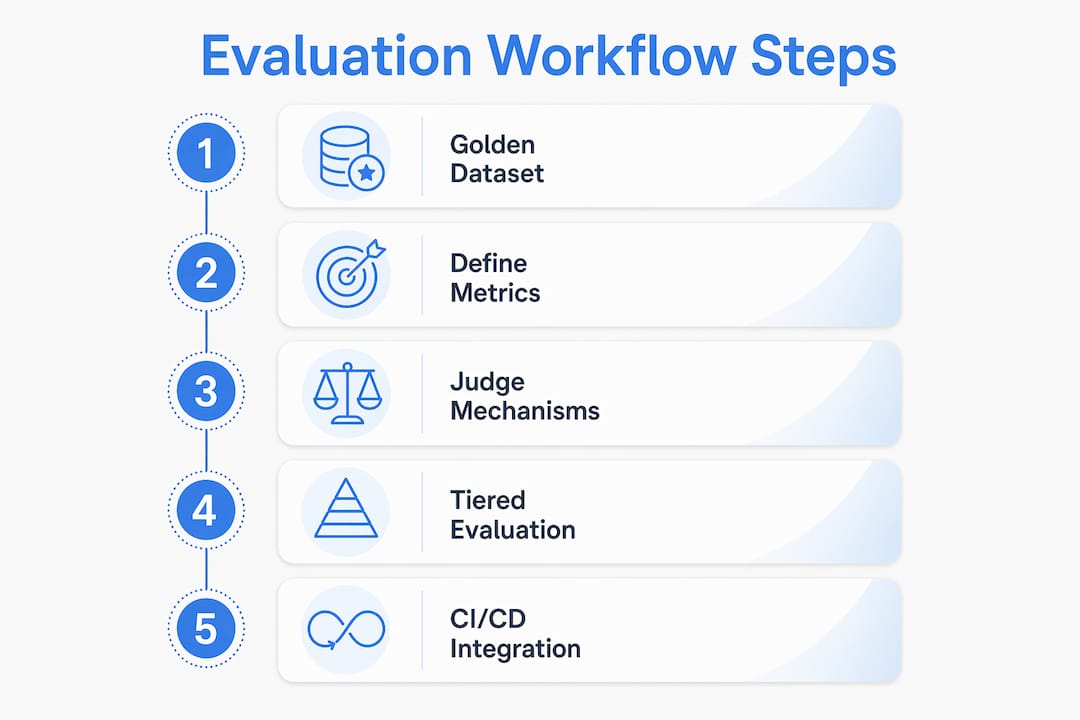
Systematic evaluation starts with three foundational assets: a golden dataset, a set of evaluation metrics, and a judge mechanism. Get these wrong and every downstream step produces misleading results.
Golden datasets are not static files. A golden dataset is a living asset requiring ongoing failure mode classification and updates as production behavior evolves. Start with 50–200 hand-labeled examples covering your core task types. Tag each example with a failure category from your hierarchical failure taxonomy, for example: retrieval failure, reasoning error, format violation, or safety violation. Feed new production failures into this set continuously.

Evaluation metrics must cover both outcome quality and process quality. Task success rate alone is insufficient. A weighted formula captures this better:
| Metric dimension | What it measures | Example threshold |
|---|---|---|
| Task success rate | Did the agent complete the goal? | Block merge below 85% |
| Latency | Did the agent respond within SLA? | P95 under 3 seconds |
| Safety violation rate | Did the agent produce harmful output? | Zero tolerance |
| Weighted success score | Success * (1 - Violation_Rate)^λ | λ=2 for high-stakes tasks |
The weighted success formula penalizes safety violations exponentially in high-stakes domains. This matters because a 95% task success rate with a 5% safety violation rate is not a good result.
Judge mechanisms fall into three categories: deterministic unit tests, LLM-as-a-Judge scoring, and human annotation. Use all three in layers. Deterministic tests catch format and schema errors cheaply. LLM-as-judge evaluation handles semantic quality assessment at scale. Human annotation calibrates the judges.
Pro Tip: Split your evaluation suite into a fast tier (deterministic checks, under 30 seconds) and a slow tier (LLM judges, full regression suite). Run the fast tier on every commit and the slow tier on pull requests only. This cuts CI/CD wait time without sacrificing coverage.
How to embed evaluation step by step in CI/CD pipelines
The six-step process below moves from trace collection to continuous online monitoring. Each step builds on the previous one.
-
Collect and model workflow traces as a DAG. Capture every step of your agent's execution as a directed acyclic graph (DAG) node. Each node represents one discrete action: a retrieval call, a reasoning step, a tool invocation. Mlflow's tracing infrastructure captures this structure automatically for agentic workflows.
-
Write and calibrate LLM judges with structured rubrics. Define a scoring rubric for each node type. A retrieval node rubric might score relevance (0–3), completeness (0–3), and grounding (0–3). Calibrate your LLM judge against 30–50 human-annotated examples. Calibrated LLM judges can match expert human rater agreement, reaching Cohen's κ ≥ 0.84. That level of agreement makes automated scoring trustworthy enough to gate deployments.
-
Run step-level quality metrics and classify failures hierarchically. Score each DAG node independently. A DAG-based evaluation framework achieves 22 percentage points higher failure detection recall and 34 points higher root cause accuracy versus flat end-to-end evaluation. Flat checks hide intermediate failures. Step-level scoring surfaces them.
-
Track error propagation and attribute root causes automatically. DAG dependency edges let you distinguish initial failures from downstream errors caused by upstream problems. Automated error propagation tracking improves root cause accuracy from 38% to 72%. Without this, teams waste hours debugging symptoms rather than causes.
-
Gate CI/CD merges with regression detection thresholds. Block merges when regression suites show performance drops beyond defined thresholds, such as a 3–5% accuracy drop, rather than using simple pass/fail gates. Multi-metric thresholds catch regressions that single-metric gates miss. Mlflow's evaluation framework integrates with GitHub Actions and similar CI/CD tools to automate this gating.
-
Sample production traces for continuous online evaluation. Run a random sample of live production traces through your evaluation suite daily. Tag low-scoring traces with failure modes and add them to your adversarial test suite. This closes the feedback loop between production behavior and your golden dataset.
Pro Tip: When you first integrate step-level evaluation, you will likely discover that 30–40% of your apparent end-to-end successes contain intermediate step failures. This is normal. Use the first two weeks of data to recalibrate your success thresholds before setting CI/CD gates.
What challenges arise when embedding evaluation in AI workflows?
The most common pitfall is treating evaluation as a one-time setup task. Teams build a golden dataset, wire up a judge, and then leave both untouched for months. Production distributions shift. The judge scores drift. The golden dataset stops reflecting real failure modes.
- Static golden datasets decay. Production traces surface new failure patterns that your original dataset never covered. Without continuous tagging and ingestion, your evaluation suite develops blind spots. Schedule a weekly review of low-scoring production traces and add at least five new examples per failure category per sprint.
- End-to-end checks mask intermediate failures. A workflow that produces a correct final answer can still contain a hallucinated retrieval step or a skipped safety check. Flat end-to-end outcome checks hide these intermediate failures. DAG-based evaluation catches them independently at each node.
- Rubric drift degrades judge reliability. As your product evolves, the original rubric criteria become misaligned with current expectations. Re-calibrate your LLM judges against fresh human annotations every four to six weeks. Track Cohen's κ over time. If it drops below 0.75, recalibrate immediately.
- CI/CD evaluation costs spiral without tiering. Running a full LLM judge suite on every commit is expensive and slow. Tier your suite: deterministic checks on every commit, LLM judges on pull requests, full regression suite on main branch merges only.
Pro Tip: Build a failure mode registry as a living document. Every time a new failure category appears in production, add it to the registry with a description, example traces, and the rubric criterion it violates. This registry becomes your specification for agent behavior.
How to measure and maintain evaluation effectiveness over time
Evaluation infrastructure needs its own health metrics. You cannot trust your evaluation suite if you never measure how well it detects real failures.
The two most important health metrics are failure detection recall and judge agreement. Failure detection recall measures what fraction of real failures your suite catches. A DAG-based framework achieves recall of 0.89 versus 0.41 for end-to-end methods. That difference means catching nearly twice as many real problems before they reach users. Judge agreement, measured by Cohen's κ, tells you how closely your automated judges match human expert ratings.
| Health metric | Target value | Action if below target |
|---|---|---|
| Failure detection recall | ≥ 0.85 | Add more adversarial examples to test suite |
| Cohen's κ (judge agreement) | ≥ 0.80 | Recalibrate judge with fresh human annotations |
| Regression detection sensitivity | ≤ 3% false negative rate | Tighten threshold gating |
| Safety violation detection rate | 100% | Audit safety rubric criteria immediately |
Safety metrics deserve special attention. No popular AI benchmarks integrate safety or security metrics into primary scoring. This means your custom safety-aware rubric is the only safety net you have. Build it deliberately and test it against adversarial inputs regularly.
Dashboards and alerts complete the picture. Set up alerts for any single-day drop in task success rate above 2%, any spike in latency P95, and any safety violation in production. Embedding automated tests on every code commit catches regressions proactively and accelerates safe deployment cycles. Mlflow's AI monitoring tools surface these signals in a centralized dashboard, giving teams visibility across the full agent lifecycle.
Key Takeaways
Integrating evaluation into AI workflows requires DAG-based step-level scoring, calibrated LLM judges, and CI/CD gating to catch failures before they reach production.
| Point | Details |
|---|---|
| Build a living golden dataset | Tag production failures weekly and add them to your adversarial test suite continuously. |
| Use DAG-based step-level evaluation | DAG frameworks achieve 22 percentage points higher failure detection recall than end-to-end checks. |
| Calibrate LLM judges against human labels | Calibrated judges reach Cohen's κ ≥ 0.84, making automated scoring reliable enough to gate deployments. |
| Gate CI/CD merges on multi-metric thresholds | Block merges on 3–5% accuracy drops across task success, latency, and safety metrics simultaneously. |
| Monitor evaluation health as a first-class metric | Track failure detection recall and judge agreement on a schedule; recalibrate when either drops below target. |
Why I think most teams underestimate the evaluation problem
The teams I see struggle most with AI reliability share one pattern: they treat evaluation as a QA step at the end of development rather than as a specification language for agent behavior. They write agents first and ask what good looks like second. That order is backward.
When you define your evaluation rubric before you write a single line of agent code, something shifts. The rubric becomes the spec. Every design decision gets tested against it. You stop asking "does this feel right?" and start asking "does this score above 2.5 on the retrieval relevance rubric?" That shift from subjective inspection to traceable measurement is where reliability actually comes from.
The other thing I have seen repeatedly: teams underestimate how much time step-level evaluation saves during debugging. Step-level CI/CD evaluation cut median root-cause identification time from 4.2 hours to 22 minutes in documented cases. That is not a marginal improvement. It changes how teams operate. Engineers stop spending half their day reading logs and start spending it fixing the actual problem.
Start small. Write three evaluation criteria for your most critical workflow. Calibrate a judge against 30 human-annotated examples. Wire it into your CI/CD pipeline on pull requests only. Run it for two weeks and look at what it catches. The results will make the case for expanding the suite better than any argument I could make here.
— Kevin
Mlflow makes evaluation a first-class part of your AI workflow
Mlflow provides the tooling to put everything in this article into practice without building evaluation infrastructure from scratch.
Mlflow's LLM-as-a-Judge evaluation framework lets you define structured rubrics, calibrate judges against human annotations, and run step-level scoring across agentic workflows. Its tracing infrastructure models workflow executions as DAGs automatically, giving you the node-level visibility needed for root cause attribution. The AI monitoring platform surfaces evaluation results, regression signals, and safety alerts in a centralized dashboard. For teams managing the full model lifecycle, Mlflow's open-source platform connects evaluation directly to CI/CD pipelines, model versioning, and production deployment in one place.
FAQ
What is integrating evaluation into AI workflows?
Integrating evaluation into AI workflows is the practice of embedding automated, continuous quality assessment directly within AI development and deployment pipelines. It uses techniques like LLM-as-a-Judge scoring, DAG-based step-level checks, and CI/CD gating to catch failures before they reach production.
How does step-level evaluation differ from end-to-end evaluation?
Step-level evaluation scores each individual node in an agent's execution DAG independently, while end-to-end evaluation only checks the final output. DAG-based step-level evaluation achieves failure detection recall of 0.89 versus 0.41 for end-to-end methods, catching nearly twice as many real failures.
How do you calibrate an LLM judge for AI workflow evaluation?
Calibrate an LLM judge by scoring 30–50 human-annotated examples with both the judge and expert human raters, then measuring Cohen's κ agreement. A well-calibrated judge reaches κ ≥ 0.84, which matches expert human rater agreement and makes automated scoring reliable enough to gate CI/CD deployments.
What metrics should gate CI/CD merges in an AI workflow?
CI/CD merge gates should use multi-metric thresholds covering task success rate, latency, and safety violation rate simultaneously. Block merges when any metric drops beyond a defined threshold, such as a 3–5% accuracy drop, rather than relying on a single pass/fail score.
How does Mlflow support AI workflow evaluation?
Mlflow provides LLM-as-a-Judge evaluation, automatic DAG-based tracing for agentic workflows, and CI/CD-integrated regression detection. Its centralized platform connects evaluation rubrics, human feedback, and production monitoring in a single system for teams building GenAI and LLM applications.