Top 3 Keras.io Alternatives 2026

Gaining full visibility and control over agent and LLM operations is difficult for data scientists, AI developers, and ML engineers. Many agent observability tools lock advanced tracing, prompt management, or self hosting behind closed ecosystems or sales workflows. This comparison covers tracing depth, prompt controls, and deployment flexibility across MLflow, Langfuse, and Arize AI so you can match one to your team's observability needs.
Table of Contents
MLflow
At a Glance
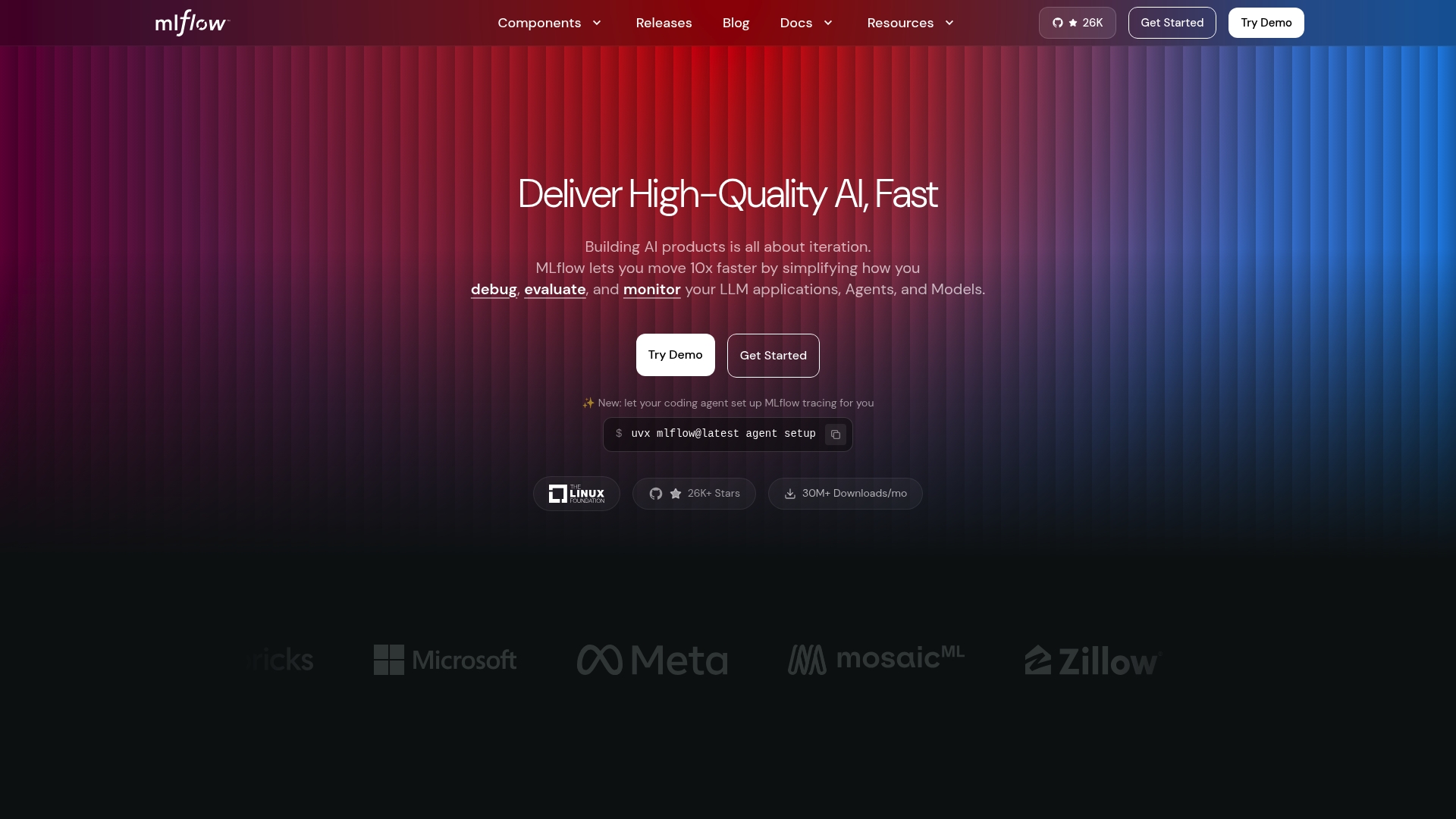
The vendor reports it is used by thousands of organizations worldwide. MLflow targets the full lifecycle for GenAI and LLM applications while also covering classical ML workflows. It emphasizes production-grade observability through deep tracing of agentic reasoning and automated evaluation using LLM-as-a-Judge frameworks. The platform includes a centralized AI Gateway for secure prompt management and cross-provider governance.
Core Features
MLflow implements observability for AI applications and agents, capturing traces and metrics that map agent decisions to outcomes. It tracks evaluation and quality metrics alongside experiment metadata, and it offers a prompt registry for versioning and optimizing prompts across models. The platform exposes a Unified API Gateway that standardizes access to multiple LLM providers and ties model registry, training, and deployment into a single workflow.
Key Differentiator
Open-source and framework-agnostic design makes MLflow usable with any cloud, language, or model runtime. The combination of deep tracing for agentic reasoning and a centralized AI Gateway creates governance controls many toolchains lack. That architecture lets teams enforce prompt controls, record provider calls, and run automated, LLM-based evaluations inside the same lifecycle platform.
Pros
MLflow is community driven and open source, which reduces vendor lock-in and lets teams inspect or extend core components. Its framework-agnostic approach means you can reuse existing training pipelines and existing CI processes. The platform consolidates observability, evaluation, and prompt management so you avoid stitching separate tools for tracing and governance. The reported user count above suggests mature adoption in production environments, which shortens the path from prototype to a governed deployment.
Cons
- Complex initial setup for newcomers, especially when integrating the tracing and gateway components into an existing stack.
Who It's For
Data scientists, ML engineers, AI researchers, and enterprise AI teams who need a framework-agnostic lifecycle system for both classical models and LLMs. Teams that require traceable agent behavior, centralized prompt governance, and an API layer to unify multiple LLM providers will benefit most. Smaller projects without dedicated DevOps support may find the initial configuration heavy.
Unique Value Proposition
The centralized AI Gateway for secure prompt management and cross-provider governance changes how teams operationalize LLMs. With prompts, model calls, and evaluation pipelines registered in one place, you cut the overhead of ad hoc provider scripts. That consolidation reduces auditing effort and makes it practical to run automated, LLM-as-a-Judge evaluations as part of continuous delivery.
Real World Use Case
A research team tracked experiments and model metadata inside MLflow to keep reproducibility across clouds. They used the prompt registry to test prompt variations and the gateway to switch providers without changing application code. The tracing and evaluation hooks let them demonstrate governance and reproduce a deployed chatbot's behavior during audits.
Website: https://mlflow.org
Langfuse
At a Glance
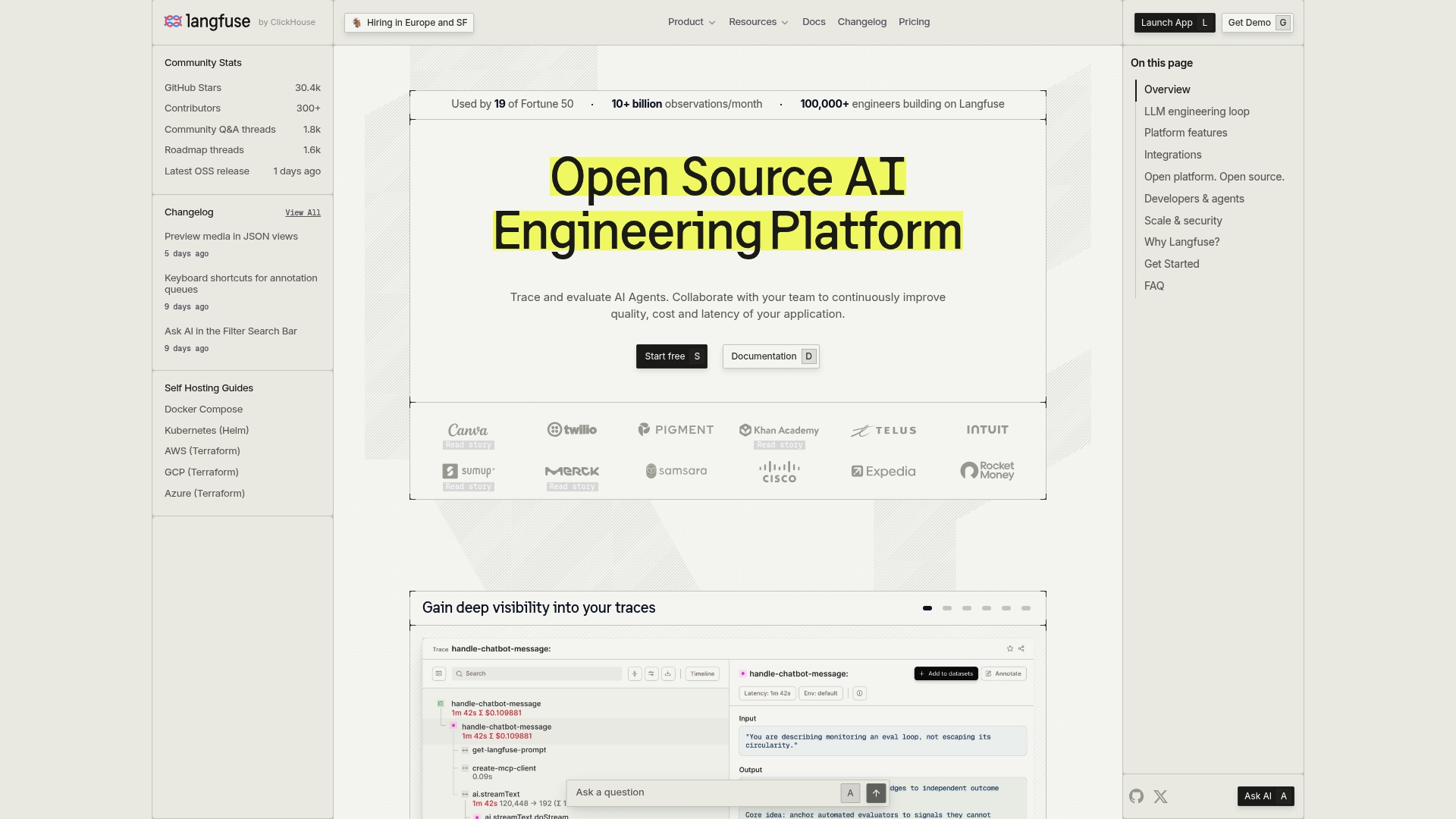
Langfuse reports over 2,300 companies and billions of observations processed monthly. That scale supports robust tracing and prompt versioning for live LLM systems. We found the platform focuses on visibility, giving you full traces and dashboards that tie prompts to downstream metrics.
Core Features
Langfuse delivers open source tooling for LLM engineering, including tracing and observability across model calls and agent actions. It includes prompt management with versioning and rollbacks, automated evaluation and scoring for model outputs, and analytics dashboards that display performance and cost signals. Deployments support both self hosting and cloud to match team infrastructure preferences.
Key Differentiator
The standout is native support for OpenTelemetry inside an open source framework. That combination lets teams connect existing observability stacks to LLM traces while keeping full control of data and retention. We saw how that approach helps integrate AI traces into existing SRE and APM workflows.
Pros
Langfuse ships under an MIT license, so teams can modify code and run the service on their infrastructure. The platform offers SDKs and developer tooling that speed integration with agents and pipelines, and it supports many frameworks and providers. Its focus on continuous monitoring, automated evaluation, and prompt lifecycle control helps teams reduce blind spots in production LLM deployments.
Cons
- Third party reviews point to a steep learning curve for newcomers. Setup and tuning require hands on expertise.
- Pricing information beyond a free tier is not detailed here. That may complicate procurement conversations.
- Some niche frameworks need extra setup work to integrate, which increases initial engineering effort.
When It May Not Fit
If your team lacks SRE or backend bandwidth, Langfuse's advanced features will require significant setup and maintenance. Self hosting at enterprise scale will need dedicated infrastructure and operations. If you prefer a turnkey hosted solution with full vendor pricing and SLAs listed up front, this option may not match your procurement needs.
Notable Integrations
Langfuse connects to OpenTelemetry, LangChain, and the Vercel AI SDK, allowing you to import traces and enrich pipeline data. It also integrates with Google ADK, Pydantic AI, LuaLLM, Azure OpenAI, and Hugging Face to cover major deployment and orchestration patterns.
Who It's For
AI developers and MLOps teams building and maintaining large scale LLM applications will get the most value. Teams that already use observability tooling and want to extend traces into prompt and agent activity benefit immediately. Organizations requiring full data control and self hosting are a natural fit.
Real World Use Case
A company running several customer service chatbots uses Langfuse to trace each conversation, link prompts to model responses, and score outputs automatically. The team uses those scores to roll back prompt changes and to identify regressions in model updates. That workflow cut time spent debugging prompt regressions in production.
Website: https://langfuse.com
Arize AI
At a Glance
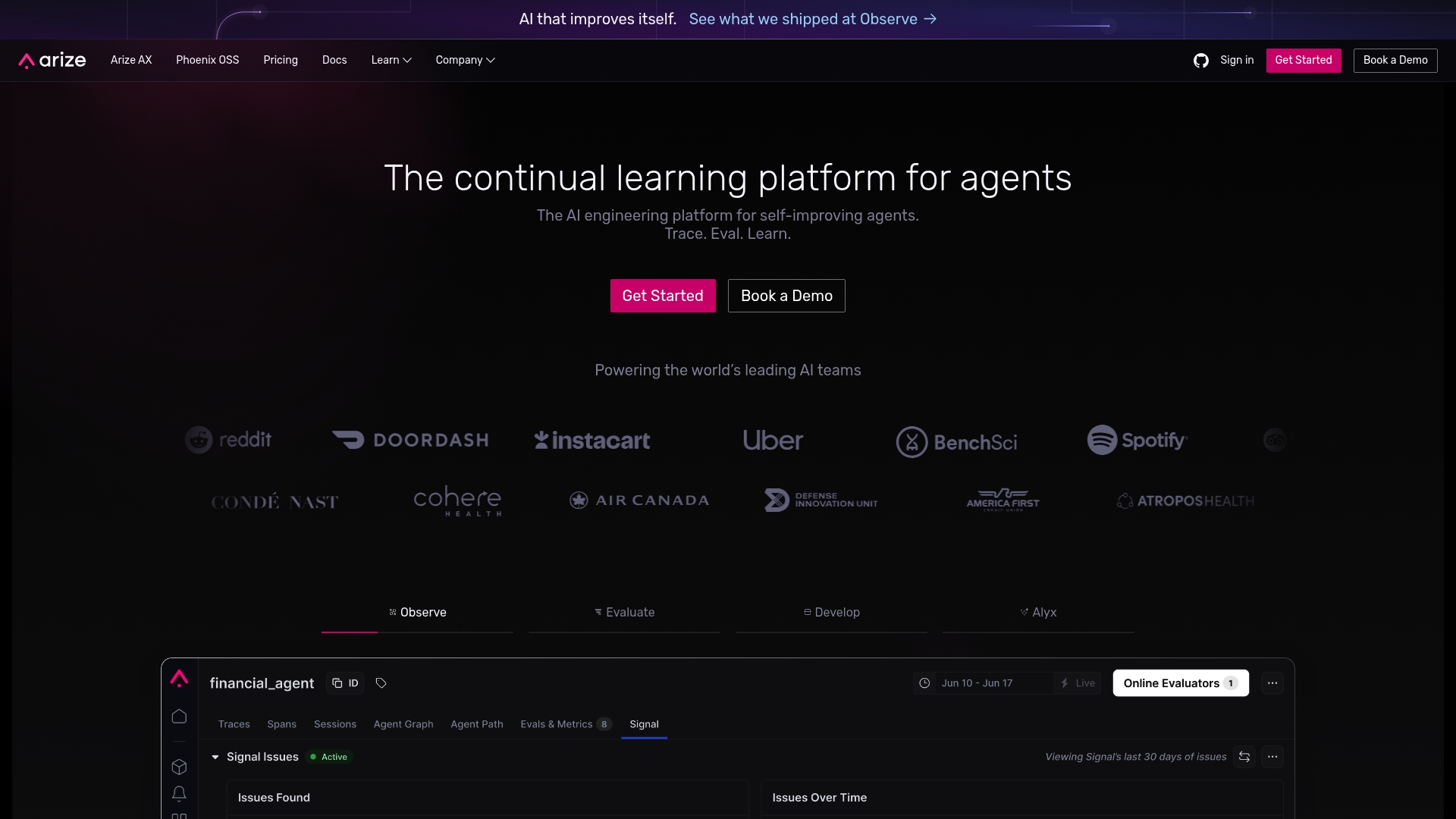
Arize ships a self hosting option called Phoenix OSS for local tracing and evaluation, making on-prem observability practical. The platform pairs that open source stack with a managed offering, Arize AX, for teams that prefer a hosted service. This split model suits teams that need both isolated testing and production observability.
Core Features
Arize centers on production observability and debugging for LLMs and multimodal systems, with tracing, evaluation, and continuous improvement workflows. The platform supports end to end agent debugging and integrates open standards like OpenTelemetry while offering open source tooling for local hosting. Those capabilities combine to monitor model drift, log rich traces, and feed evaluation signals back into retraining or tuning pipelines.
Key Differentiator
Arize’s defining characteristic is its open standards orientation and accompanying open source tooling, which lets teams run tracing and evaluation inside restricted environments. That open stack contrasts with broader lifecycle platforms. Compared with Mlflow, Arize focuses more narrowly on observability and model evaluation for deployed agents rather than full lifecycle orchestration.
Pros
The product emphasizes transparency with open standards and local tooling, which suits privacy conscious teams that need internal audit trails. The evaluation and debugging suite targets hallucinations, data drift, and agent reasoning problems with tracing and test driven workflows. Broad model support reduces friction if you run multiple providers, and the managed offering lets you shift from self hosting to a hosted service without changing tracing primitives.
Cons
- Complex initial integration for legacy systems that do not expose standard telemetry interfaces. This raises setup effort and coordination costs for engineering teams.
- Pricing details are not listed on the public site, which means you must contact sales for a custom quote. That slows quick budgeting for small teams.
- Third party reviews are limited, so independent validation of scaled production behavior is sparse. Teams should plan a pilot before wide rollout.
When It May Not Fit
Arize is not a good match if you need an end to end model lifecycle system with experiment tracking and deployment gates in one bundled tool. It also does not fit organizations that cannot adopt OpenTelemetry or run the Phoenix OSS components. Small research teams on tight budgets may find the sales driven pricing model impractical.
Who It's For
AI engineering teams and data scientists running production agents who need deep observability and evaluation controls will benefit most. Security conscious teams that require self hosting or strict data residency will find the open source stack attractive. Organizations prioritizing broad experiment tracking and deployment automation may prefer a different tool.
Real World Use Case
A company deploying a conversational agent uses Phoenix OSS to collect detailed reasoning traces from agent calls. Engineers reproduce hallucination cases with those traces and run targeted evaluations to compare model variants. The team then pushes scored data back into continuous improvement pipelines to reduce error rates in production.
Pricing
Public pricing is not published on the website, and the vendor lists pricing as likely custom or enterprise tier. Expect quotes to vary by scale, retention, and whether you choose managed hosting or self hosting with Phoenix OSS. Contact sales for exact figures and deployment options.
Website: https://arize.com
Comparison of alternatives
When selecting an AI governance and observability platform, tradeoffs between features such as observability depth, integration scope, and setup simplicity play roles. MLflow, Langfuse, and Arize AI each provide tools to address these challenges, with unique characteristics tailored for specific user needs.
Observability and Integration
Langfuse distinguishes itself through its integration with OpenTelemetry standards, allowing users to augment existing observability frameworks with AI tracing data. This feature is a notable advantage for organizations relying heavily on established monitoring systems and desiring continuity in their infrastructure.
MLflow's distinguishing feature lies in its consolidated design, enabling full-cycle management for various AI models. With its Unified API Gateway and AI Governance tools, MLflow supports transitions between different LLM providers while maintaining centralized control over models and prompts.
Setup and Scalability
Arize AI focuses on providing open-source tooling with self-hosting capabilities, granting organizations with stringent security needs the ability to control their data fully. Though beneficial, this approach demands considerable understanding in system integration, which could be resource-intensive for smaller teams or those without prior backend expertise.
In contrast, MLflow, while requiring an initial investment for integration and setup, offers an improved return through its feature-complete cycle, which includes observability, evaluation, and pipeline management.
Best fit
- Teams managing complex LLM applications and requiring cross-provider governance and secure prompt management will find MLflow best aligns with their requirements.
- Organizations with existing observability software and a need to incorporate LLM-specific metrics effectively would greatly benefit from Langfuse.
- Teams emphasizing localized data control and requiring in-depth debugging facilities may turn to Arize AI, particularly through its self-hostable Phoenix OSS.
Our pick
MLflow stands out for its centralized AI Gateway, offering streamlined cross-provider governance and lifecycle management, effectively handling systems requiring observability and prompt management. However, teams with unique needs or established infrastructure in observability might consider Langfuse or Arize AI as equally competent, depending on their specific requirements.
To select the best tool for AI lifecycle and observability, the table below compares leading platforms based on their key features and limitations.
| Product Name | Core Features | Key Differentiator | Ideal For | Pricing | Notable Limitation |
|---|---|---|---|---|---|
| Mlflow | Observability, evaluation, prompt registry | Open-source with centralized AI Gateway | Enterprise AI and ML teams | Price not published | Complex initial setup for integration |
| Langfuse | Tracing, evaluation, analytics dashboards | Native OpenTelemetry support within an open stack | Large-scale LLM applications | Price not published | Requires significant setup and tuning expertise |
| Arize AI | Tracing, debugging, evaluation workflows | Open standards with managed and self-host options | Teams needing internal audit trails | Price not published | Limited third-party reviews for scaled deployments |
Challenges When Exploring keras.io Alternatives for AI Lifecycle Management
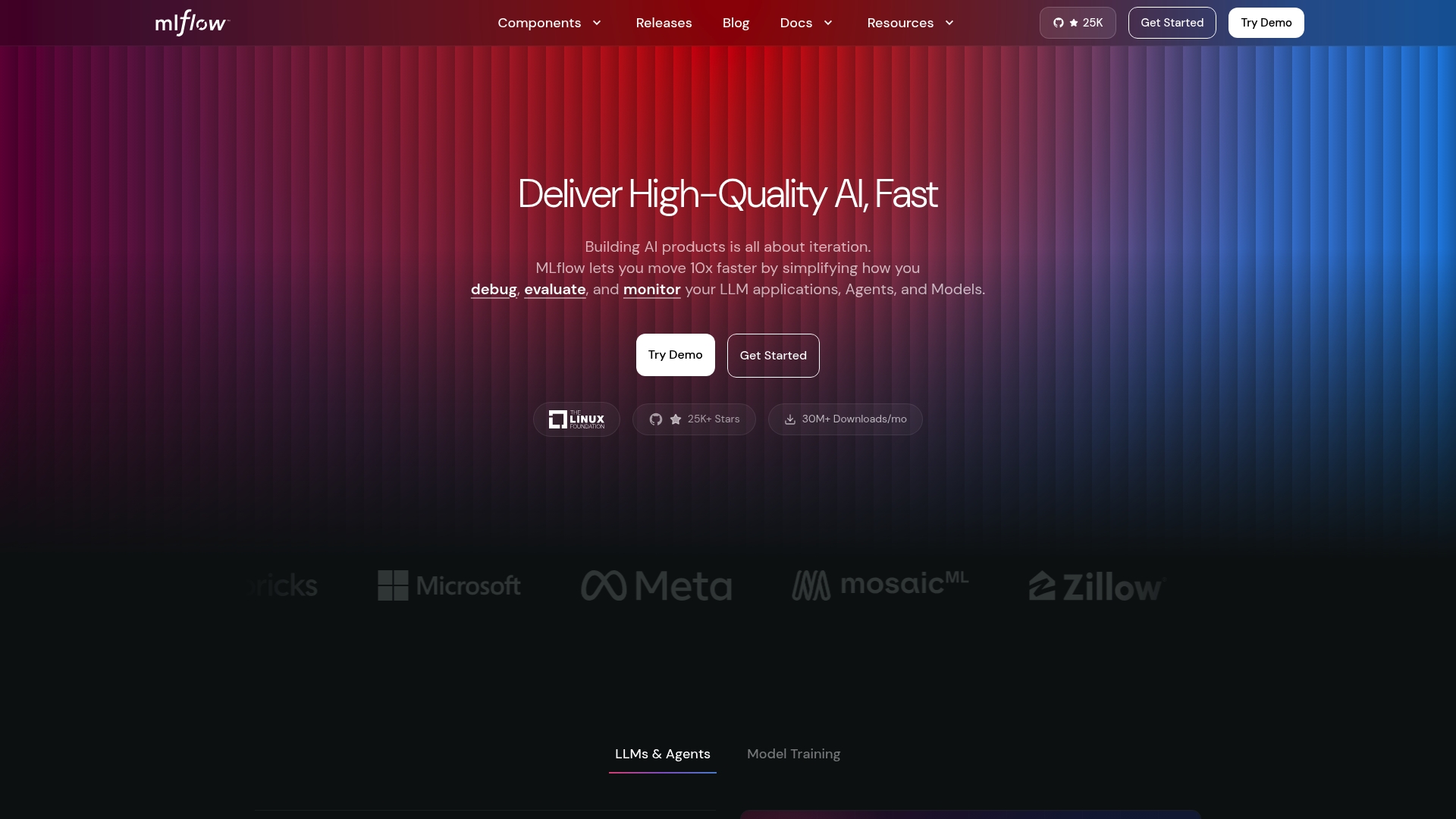
Choosing the right platform beyond keras.io often involves handling complex AI workflows that combine large language models with classical machine learning. Key pain points include tracking agent decisions, managing prompt versions securely, and unifying multiple model providers under one interface. Mlflow addresses these challenges by offering production-grade observability and deep tracing for agentic reasoning, paired with a centralized AI Gateway for prompt governance across providers.
Mlflow supports data scientists, ML engineers, and AI teams needing a lifecycle platform that simplifies experiment tracking and deployment without vendor lock-in. Its open-source, framework-agnostic design fits existing pipelines while enabling automated evaluations with LLM-as-a-Judge tools.
Explore how Mlflow can refine your AI agent workflows at mlflow.org. Start securing your prompt management and aligning evaluation metrics within one unified system today.
FAQ
What features make Mlflow suitable for agent observability?
Mlflow excels in observability for AI applications, capturing traces and metrics that link agent decisions to outcomes. It supports deep tracing of agentic reasoning and tracks evaluation and quality metrics alongside experiment metadata. For readers seeking effective agent observability, Mlflow's capabilities will enhance their monitoring and evaluation processes.
How does Langfuse compare with Mlflow in terms of ease of use?
Langfuse provides an open source framework that simplifies LLM engineering with tools for tracing and observability, which may benefit teams looking for efficient integration. While its user-friendly design is advantageous, Mlflow offers a more comprehensive solution for the full lifecycle observability of both classical ML models and LLMs, making it ideal for teams that require more robust governance and lifecycle management.
Which platform offers a centralized AI Gateway for prompt management?
Mlflow features a centralized AI Gateway designed for secure prompt management and cross-provider governance. This capability helps teams maintain prompt controls and streamline interactions with multiple LLM providers, enhancing governance and operational efficiency. Readers focused on governance should consider using Mlflow for these features.
Can I track model evaluations effectively with any alternative to Mlflow?
Some alternatives may provide tracking capabilities, but Mlflow specializes in capturing evaluation and quality metrics alongside experiment metadata. This means you gain greater visibility into agent performance and can assess quality in a structured way. If evaluating agent behavior is critical, Mlflow remains a practical starting point.
What are the initial setup challenges associated with Langfuse?
Langfuse often presents a steep learning curve due to its complex setup and tuning requirements. This can be a concern for teams lacking dedicated resources for configuration. In contrast, Mlflow also has an initial setup effort, but its open-source nature may appeal to teams wanting to customize their workflow.