Reproducible LLM Evaluation for Engineers: 4 Components and MLflow

An LLM evaluation harness is a repeatable, automated system for testing large language models and agentic applications against defined datasets, metrics, and scoring rules. It replaces one-off notebook experiments with a codebase you can rerun, version, and trust. The immediate payoff is comparability: the same task, the same prompt template, the same scorer, run today or six months from now, producing numbers you can actually compare. Teams use harnesses for three things: benchmarking model choices, catching regressions in CI, and validating agent behavior before it reaches production.
TL;DR:
- Evaluation harnesses should be standardized and version-controlled to ensure reproducibility, as minor implementation differences can significantly alter results.
- Metrics and datasets must be carefully matched to the evaluation goal, combining public benchmarks, human-annotated data, and synthetic sets for reliable insights.
- CI integration with automated regressions, caching, and error handling is essential for reliable, scalable, and observability-focused production evaluation pipelines.
- Secure handling of sensitive data involves encryption, data minimization, and strict access controls, especially when using third-party models or storing logs.
- Regularly updating the evaluation suite, including datasets, metrics, and prompts, is crucial to avoid saturation, contamination, and relevance decay over time.
Table of Contents
- What Does an LLM Evaluation Harness Actually Do?
- Core Components: Datasets, Metrics, Scorers, and Runners
- How Do You Design an Effective Evaluation Suite?
- Implementation Patterns: Runner Architecture and CI Integration
- Reproducibility: Versioning, Templates, and Calibration
- How MLflow Supports These Evaluation Patterns
- Securing Sensitive Data During Evaluation
- Keeping Your Evaluation Suite Current Over Time
- Author Perspective: Practical Tradeoffs and Prioritization
- Put These Patterns to Work With MLflow
- Sources
What Does an LLM Evaluation Harness Actually Do?
An evaluation harness answers a narrow but critical question: does this model, prompt, or agent do what we need it to do, measured the same way every time? That sounds simple until you've tried to compare two runs of the same benchmark six weeks apart and gotten different numbers because someone changed a prompt template or swapped a tokenizer setting.
You reach for a harness in three recurring situations. Research teams use them to compare model checkpoints or fine-tuning runs against public benchmarks. Engineering teams wire them into CI to catch regressions before a prompt change or model upgrade ships. And anyone building agentic systems needs them to validate multistep reasoning, not just final output correctness.
The reason a shared codebase matters more than most teams initially assume comes down to sensitivity. Research on reproducibility in unified evaluation frameworks found that minor implementation details, things like prompt formatting or tokenization choices, can shift measured performance substantially. Two labs running "the same" benchmark on "the same" model can report meaningfully different scores simply because their harnesses handle whitespace, few-shot examples, or answer extraction differently. That's not a footnote. It's the entire argument for standardizing your evaluation code instead of rewriting it per experiment.
At a high level, every harness worth building has four moving parts:
- Datasets — the tasks and examples you evaluate against, whether public benchmarks, human-annotated sets, or synthetic generations.
- Runner — the orchestration layer that loads tasks, sends prompts to models, and manages concurrency, retries, and caching.
- Provider adapters — thin translation layers that let the same task run against different model APIs without rewriting logic per vendor.
- Scorer — the component that turns raw model output into a metric, whether that's exact-match accuracy, a similarity score, or an LLM-based judgment.
Get those four pieces right and you have something durable. Get them wrong, or worse, skip building them and hand-roll a script per experiment, and you're back to unreproducible numbers nobody trusts, including your own team six months later.
Core Components: Datasets, Metrics, Scorers, and Runners
Every harness is a set of choices about tradeoffs. Datasets, metrics, and scorers each come in flavors suited to different questions, and picking the wrong one for your task is the single most common source of misleading eval results.
Datasets fall into three buckets. Public benchmarks like MMLU, GSM8K, and HellaSwag give you comparability against published results and other models, but they're static and increasingly contaminated by training data overlap. Human-annotated sets, built from your own domain, capture the edge cases and failure modes public benchmarks never will. Synthetic datasets, generated by another LLM, scale cheaply but need human spot-checks to avoid baking in the generator's own blind spots. A practical evaluation framework for LLM-reliant systems argues these three types work best combined rather than as substitutes for one another, since each compensates for the others' weaknesses.
Metrics split into three families, and matching the right one to the task matters more than the metric's sophistication:
- Multiple-Classification (MC) metrics work when there's a discrete right answer: accuracy on multiple-choice questions, pass/fail on code execution, exact-match on structured extraction.
- Token-Similarity (TS) metrics like ROUGE, BLEU, and BERTScore measure overlap between generated and reference text, useful for summarization or translation but blind to synonymy and paraphrase. A survey of LLM evaluation metrics notes that token-similarity scores treat all tokens as equally important, missing cases where a model says the same thing in different words.
- QA and task-specific metrics handle open-ended generation where there's no single correct string, things like faithfulness to a source document or relevance to a user query.
Scorers are how you turn a model's output into one of those metric values. Rule-based scorers (regex match, exact string comparison) are fast and deterministic but brittle. Reference-free scorers judge output quality without a ground-truth answer, useful when there isn't one. LLM-as-a-Judge scorers, using patterns like Reason-then-Score or G-Eval, prompt a second model to evaluate the first model's output, often with a rubric and chain-of-thought reasoning before assigning a score. Head-to-head (H2H) comparison, where a judge picks between two candidate outputs rather than scoring each in isolation, tends to be more stable than absolute scoring. Microsoft's evaluation guidance documents known biases in LLM-based evaluators, including positional bias (favoring the first option shown), verbosity bias (rewarding longer answers), and self-enhancement bias (a judge model favoring outputs from its own model family).
Pro Tip: *Never deploy an LLM-as-a-Judge scorer without first running it against a small human-labeled sample.
Runners handle the operational plumbing: batching requests to control cost, caching results so reruns of unchanged inputs don't burn API budget, managing concurrency against provider rate limits, and handling errors (timeouts, malformed responses, refusals) without silently dropping data points. Provider adapters keep this logic reusable across OpenAI, Anthropic, or self-hosted models without rewriting your task definitions for each one.
How Do You Design an Effective Evaluation Suite?
Start with the operational question you're trying to answer, not the metrics available to you. "Is this model good" is not a question a harness can answer. "Does this model correctly extract line items from invoices at 95% field-level accuracy" is.
Once the objective is concrete, map it to specific dataset and metric choices:
- A factual QA system needs grounding metrics that check whether claims trace back to retrieved source documents, not just fluency scores.
- A summarization pipeline needs token-similarity metrics against reference summaries plus an LLM-judge check for factual consistency, since ROUGE alone rewards word overlap over accuracy.
- An agentic workflow needs task-completion rate and step-level correctness, not just final-answer scoring.
From there, assemble a balanced scorecard rather than optimizing for one number. A single accuracy metric hides tradeoffs; a scorecard tracking accuracy, latency, cost per query, and a hallucination rate side by side tells you what you're actually trading away when you swap models. Track these consistently across every run so trend lines mean something over time.
Methodological controls matter as much as metric choice. The OLMES standard for language model evaluations documents specifics that most papers omit but that change results substantially: exact prompt formatting, how many in-context examples to use, and how to normalize probability scores across answer choices of different lengths. Decontamination, checking that your test set isn't leaking into training data, matters especially for public benchmarks that have been circulating for years. And sampling strategy (how many examples per task, whether you sample randomly or stratify by difficulty) determines how much you can trust a small performance delta between two models.
Pro Tip: When measuring hallucination, don't rely on a single "faithfulness" score. Pair a grounding metric (does the claim appear in the source) with an LLM-judge check for unsupported specifics, dates, numbers, names, since those are where hallucinations do the most damage.
Measuring hallucination and grounding reliance specifically usually means retrieval-augmented tasks where you can check generated claims against the exact source passages the model was given, flagging any claim that can't be traced back to that context.
Implementation Patterns: Runner Architecture and CI Integration
A harness that works well in a research notebook often falls apart in production. The fix is treating it as a modular pipeline from day one, not retrofitting modularity after the fact.
- Dataset loader. Pulls tasks from disk, a database, or a versioned artifact store, and normalizes them into a consistent schema regardless of source format.
- Runner. Sends each task to the model or agent under test, managing concurrency and retry logic. This is where batching and caching live, since re-running unchanged prompts against an unchanged model is wasted spend.
- Scorer. Applies your chosen metric, whether rule-based, reference-based, or LLM-judge, to each output and attaches the result to the task record.
- Analyzer. Aggregates scores, computes confidence intervals where sample size allows, and produces the report or dashboard your team actually looks at.
For CI integration, three patterns cover most needs. Smoke tests run a small, fast subset of tasks on every pull request to catch obvious breakage. Regression thresholds gate merges when a metric drops below a defined floor, turning eval scores into an automated pass/fail signal rather than something a human checks manually after the fact. Automated reporting posts results to a dashboard or comment thread so the whole team sees the delta without hunting for a log file.
Observability separates a toy harness from a production one. For agentic systems specifically, scoring only the final answer misses where things actually go wrong. Frameworks built for agent evaluation, like Inspect, structure evaluations around composable tasks, solvers, and scorers so intermediate steps stay inspectable rather than disappearing into a black box. The lm-evaluation-harness project reflects a similar lesson from practitioner use: capturing full transcripts and tool-call traces, not just final outputs, is what actually lets you debug why an agent failed a task. Early stopping, halting a run once a clear failure pattern emerges, saves both time and API spend on tasks that are unlikely to recover.

Cost and performance considerations are not an afterthought here. Batching requests, running providers in parallel up to their rate limits, and caching deterministic outputs can cut evaluation cost by a meaningful margin on large suites, particularly when you're running the same benchmark repeatedly across model versions.
Reproducibility: Versioning, Templates, and Calibration
Reproducibility failures rarely come from the model itself. They come from missing metadata about how the evaluation was run in the first place.
Record, at minimum, a task ID, a hash of the exact dataset version used, the prompt template (verbatim, not paraphrased), the evaluation date, any random seed, and your tokenization configuration. Without these, "we ran GSM8K and got 84%" is not a claim anyone else can verify or reproduce.
- Standardize prompt templates and document normalization rules, including how you handle probability normalization for multiple-choice answers of different token lengths, following the pattern OLMES lays out.
- Store exact provider and model version strings (not just "GPT-4," but the dated snapshot), since providers update models silently.
- Log environment details: library versions, hardware where relevant, and API endpoint versions, so a rerun six months later starts from the same conditions.
- Calibrate LLM-as-a-Judge scorers periodically against human-in-the-loop (HITL) labels rather than trusting them indefinitely once validated.
Pro Tip: Treat every task definition and prompt template as a versioned artifact, checked into the same repository as your model code. If you can't diff two versions of a prompt, you can't explain why a score changed.
Calibration deserves specific attention because LLM-judge drift is real and underreported. Techniques worth building into your process include periodic human-expert-correction (HEC) spot checks and, where feasible, bias-corrected probability (BPC) adjustments that account for known judge tendencies like verbosity or positional bias. Microsoft's evaluation guidance frames this as an ongoing calibration loop, not a one-time validation step.
How MLflow Supports These Evaluation Patterns
Everything described above, tracing, judge pipelines, versioned prompts, works better when it's built into the platform running your models rather than bolted on separately. That's the gap Mlflow's GenAI tooling is designed to close.
The platform can provide observability with tracing of agentic reasoning, so intermediate tool calls and reasoning steps stay inspectable instead of disappearing into a final-answer-only log. It supports automated evaluation through LLM-as-a-Judge pipelines that can be wired directly into your scoring step rather than run as a separate script. And it centralizes prompt management and versioning, addressing reproducibility gaps where undocumented prompt templates can break comparability between runs.
Here's how those capabilities map onto the harness components described earlier:
- Tracing covers the observability layer, capturing tool calls and reasoning traces for agentic evaluation.
- LLM-as-a-Judge pipelines cover the scorer layer, with the calibration and bias considerations discussed above still applying.
- Prompt versioning covers the reproducibility layer, giving you the exact template artifact a rerun needs.
For teams already running evaluations with a custom-built runner, these map cleanly onto existing pipeline stages rather than requiring a rebuild. Mlflow's documentation on GenAI and agent engineering walks through implementation details for each of these areas.
Securing Sensitive Data During Evaluation
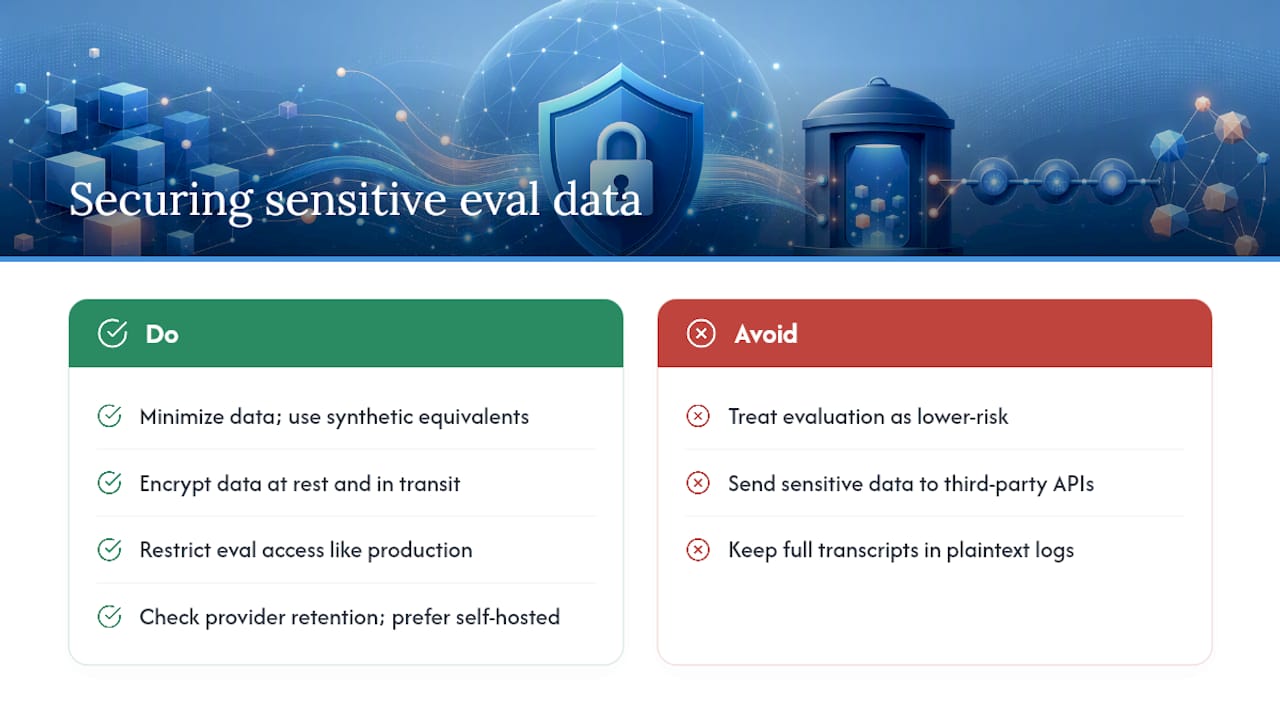
Evaluation datasets often contain exactly the kind of data you don't want leaking: customer support transcripts, medical notes used to test a clinical assistant, financial records for a fraud-detection model. Treating an eval run as lower-risk than a production request is a mistake that shows up in audit findings, not benchmarks.
Start with data minimization. If a task doesn't need a real customer name or account number to test the behavior you care about, replace it with a synthetic equivalent before it ever enters the harness. Where real data is unavoidable, encrypt it at rest and in transit, and restrict access to the evaluation environment the same way you'd restrict access to production data, not a looser standard because "it's just testing."
Provider choice matters here too. Sending sensitive evaluation data to a third-party model API means that data leaves your infrastructure, subject to that provider's retention and training-use policies. Check whether your provider offers a no-retention or zero-data-retention agreement before running sensitive tasks through it, and prefer self-hosted or enterprise-tier endpoints when the data warrants it.
Logging is the quiet risk most teams miss. Full transcripts captured for debugging agentic traces can sit in plaintext logs indefinitely, well past the point anyone remembers they're sensitive. Apply the same retention and redaction policies to eval logs that you apply to production logs, and scrub or hash personally identifiable fields before they hit a dashboard that other teams can see.
Keeping Your Evaluation Suite Current Over Time
An evaluation harness that worked perfectly a year ago can be quietly lying to you today. Datasets go stale, models get better at gaming known benchmarks, and metrics that once distinguished good from bad models start clustering everyone near the ceiling.
Public benchmark saturation is the clearest sign. When most frontier models score above 90% on a benchmark, it's stopped discriminating between them, and you need a harder task or a fresh dataset slice to see real differences. Schedule a periodic review, quarterly is a reasonable cadence for active projects, to check whether your current suite still separates strong runs from weak ones.
Contamination creeps in from an unexpected direction: your own historical outputs. If a model's past responses to your eval set end up in a future training corpus (yours or a provider's), that task stops measuring generalization and starts measuring memorization. Rotating in fresh examples, or holding back a portion of your dataset from any published reporting, protects against this.
Metric relevance shifts too. A metric scorecard built around a model's early weaknesses can become irrelevant once those weaknesses get fixed elsewhere, while missing whatever new failure mode has emerged. Revisit your scorecard whenever you make a material change to the system under test, not just on a fixed schedule. Version your dataset and metric changes the same way you version prompts and tasks, so you can tell whether a score shift came from the model or from your own eval suite changing underneath it.
Author Perspective: Practical Tradeoffs and Prioritization
Most teams get the build order backwards. They chase metric breadth first, wiring up five scoring methods before they've built a runner that reliably reproduces last week's results. Start with reproducibility and a minimal runner. One dataset, one metric, fully versioned, rerunnable on demand. Expand the metric suite only once that foundation holds.
LLM-as-a-Judge is the right call for scale, but treating it as a finished tool rather than a calibrated instrument is where teams get burned. Validate against human labels regularly, not once at launch. Judges drift, model updates shift their behavior, and a rubric that worked in January can quietly degrade by summer.
The unglamorous habit that separates durable harnesses from disposable ones: document every task and prompt as a versioned artifact from the first day, not after the third time someone asks "why did this score change?" The tension between owning your evaluation pipeline and depending entirely on a third-party model is worth sitting with here. A harness you fully control and version is part of how you keep ownership of your product's quality, rather than outsourcing that judgment entirely to whichever provider you're calling.
— Kevin
Put These Patterns to Work With MLflow
Building the four components described here, dataset loaders, a runner, provider adapters, and scorers, from scratch is a real engineering project. A platform can provide a working foundation for all four components without starting from an empty repository, which matters most in the early weeks when reproducibility habits get set for good or get skipped under deadline pressure.
The platform's AI observability tooling handles the tracing layer described in the implementation patterns section, capturing agentic reasoning and tool calls rather than just final outputs. Its LLM-as-a-Judge support covers the scorer layer, including the calibration workflow that keeps a judge model honest against human review over time. Prompt versioning can help close the reproducibility gap that causes many "we can't reproduce last quarter's numbers" incidents.
If you're evaluating whether to build a harness from scratch or extend an existing platform, start with Mlflow's GenAI and agent engineering documentation for a quickstart and a sample repository you can run against your own models today.