LLMOps Workflow Standardization Checklist for AI Teams

LLMOps workflow standardization is the discipline that enforces consistent, auditable, and repeatable processes across every stage of large language model deployment. Without it, teams face silent regressions, runaway costs, and incidents that are nearly impossible to debug. A well-built checklist gives AI development teams a concrete framework to catch failures before they reach production. Mlflow, along with recognized standards like PDCA cycles and CI/CD integration, provides the tooling backbone that makes this checklist operational rather than aspirational.

What does an LLMOps workflow standardization checklist include?
A complete LLMOps standardization checklist covers ten core control points. Each one addresses a specific failure mode that teams encounter when running LLMs in production. Skipping even one creates a gap that compounds over time.
- Prompt versioning in source control. Every prompt change must be tracked in version control, reviewed, and approved before deployment. This creates an auditable history and makes rollbacks fast.
- Automated evaluation gates. CI/CD pipelines must block any prompt or model change that fails quality or safety thresholds. Quality and safety gates target a core task success rate of at least 95% and a safety policy violation rate at or below 0.2%.
- End-to-end request tracing. Every request must capture the input, final prompt, model version, token counts, latency, and tool calls. This is the single most important instrumentation investment for debugging invisible failures.
- Pinned explicit model versions. Never use floating aliases in production. Provider model updates cause silent regressions when aliases mask underlying changes.
- Per-request token caps. Set hard token limits on every request to prevent runaway costs during failure scenarios or adversarial inputs.
- Cost-per-request monitoring with alerts. Treat cost as a runtime signal, not a monthly line item. Automated alerts fire when per-request cost exceeds defined thresholds.
- Provider failover gateways. A provider-agnostic gateway routes traffic to backup providers when primary endpoints fail, maintaining availability without manual intervention.
- Input and output guardrails. Enforce data policies at both ends of every request. Input guardrails block prompt injections; output guardrails filter policy violations before responses reach users.
- Latency monitoring against SLA objectives. Track p95 latency continuously and alert when thresholds breach service-level objectives.
- Incident response automation. Automated paging and runbooks guide teams through consistent, documented responses when quality, latency, or cost thresholds are breached.
Pro Tip: Start with tracing and version pinning before adding the other controls. These two items alone eliminate the majority of "unexplained" production incidents teams face in their first six months.
How standardized evaluation improves workflow efficiency
Evaluation is not a one-time gate. It runs continuously on every prompt or model update, using curated datasets that reflect real production traffic. This approach catches quality regressions before they reach users.
- Build curated evaluation datasets. Collect representative inputs from production logs and label them with expected outputs. Update the dataset quarterly as user behavior evolves.
- Run A/B tests with multiple prompt variants. Testing 3–5 prompt variants in parallel yields 20–40% performance improvements on key quality metrics. This is not optional for teams that care about output quality.
- Measure the right metrics. Track relevance, hallucination rate, latency, and consistency on every evaluation run. A single composite score hides the signal you need to act on.
- Integrate evaluation into CI/CD. Offline evaluation runs on every pull request. Online evaluation samples live traffic and feeds results back into the improvement loop.
- Run red-teaming and adversarial tests. Structured red-teaming detects prompt injections and data leakage before attackers do. Schedule these tests at least monthly, not just at launch.
Pro Tip: Use Mlflow's LLM-as-a-Judge evaluation to automate quality scoring on every deployment. It removes the subjectivity from manual review and scales with your release cadence.
What operational controls manage LLM costs effectively?
Cost control in LLMOps requires treating spend as a real-time operational signal, not a post-hoc accounting exercise. The checklist items below prevent the budget overruns that catch teams off guard.
- Prompt caching for repeated queries. Caching common instructions and multi-turn conversation context reduces compute costs by up to 80–90% for repeated queries. This single control delivers the highest cost-to-effort ratio of any item on the list.
- Per-request token caps with hard limits. Set maximum token budgets per request type. Token costs escalate fast during failure scenarios, and runtime token capping with alerts can reduce spend by 60–80% compared to unmanaged deployments.
- Model routing and downgrade tests. Route lower-complexity requests to smaller, cheaper models. Validate quality on downgraded routes before enabling them in production.
- Continuous batching. Batching requests together improves throughput by 3–5x without adding hardware. This directly reduces cost per inference at scale.
- Cost threshold alerts as incident triggers. When per-request cost breaches a defined threshold, the incident management system pages the on-call owner. Cost is a first-class operational metric, not a finance team concern.
Pro Tip: Validate your LLM output schema on every response before caching it. Caching malformed outputs amplifies errors rather than reducing costs.
Why observability and incident response belong in every checklist
Observability is the difference between knowing your system is failing and finding out from a user complaint. End-to-end tracing captures every dimension of a request, making LLM failures visible instead of invisible.
"LLM failures are often invisible without full instrumentation. End-to-end tracing capturing input, final prompt, model version, token counts, latency, and tool calls is the most important single investment a team can make in production reliability."
The observability layer of the checklist covers four areas:
- Full request tracing. Every request logs input, output, model version, token counts, latency, and tool calls. Mlflow's LLM tracing platform provides this instrumentation out of the box for agentic workflows.
- SLO-based alerting. Define p95 latency thresholds and quality score floors. Automated alerts fire the moment a metric breaches its SLO, not after a human notices.
- Incident runbooks. Every alert type maps to a documented runbook. Runbooks specify who gets paged, what actions to take, and how to verify resolution. Without runbooks, incident response is inconsistent and slow.
- AI observability dashboards. Centralized dashboards show error rates, latency distributions, cost trends, and quality scores in one view. This gives both engineers and team leads the context to act fast.
How to implement and maintain the standardization checklist
Adopting the checklist is a governance problem as much as a technical one. True standardization requires auditing and controlled change processes, not just publishing a document and hoping teams follow it.
- Apply the PDCA cycle. Plan each checklist item with clear acceptance criteria. Do the implementation. Check adherence through automated audits and manual reviews. Act on gaps before the next release cycle.
- Assign explicit ownership. Every checklist item needs a named owner. Explicit handoffs and decision transparency prevent failures even when automation handles the routine work. Ownership without accountability is decoration.
- Integrate into CI/CD and release gates. The checklist must be enforced by the pipeline, not by memory. Automated gates block deployments that skip required steps, such as evaluation runs or version pinning checks.
- Document decision transparency. Record why each model or prompt version was approved. This audit trail is critical for debugging regressions and for compliance reviews.
- Use Mlflow registries for enforcement. Mlflow's model and prompt registries track versions, evaluation results, and deployment history in one place. Teams using LLMOps strategies built on registries reduce the manual overhead of checklist auditing significantly.
Key Takeaways
A complete LLMOps workflow standardization checklist requires prompt versioning, automated evaluation gates, end-to-end tracing, cost controls, and explicit ownership to prevent production failures and maintain operational maturity.
| Point | Details |
|---|---|
| Version pinning prevents regressions | Pin explicit model IDs in production to avoid silent behavior changes from provider updates. |
| Tracing is the top investment | End-to-end request tracing makes invisible LLM failures visible and debuggable. |
| Cost is a runtime metric | Use per-request token caps and real-time alerts, not monthly reviews, to control spend. |
| Evaluation must be continuous | Run automated quality gates on every prompt or model change using curated production datasets. |
| Ownership enforces adherence | Assign a named owner to every checklist item; documentation without accountability fails. |
The checklist gap I see most often
Teams I work with almost always have some version of a checklist. The problem is that most of those checklists live in a Confluence page that nobody opens after the first sprint. The gap is not awareness. It is discipline.
The single most neglected item is the incident runbook. Teams invest in tracing and alerting, then discover during an actual incident that nobody knows what to do when the alert fires. The alert wakes someone up at 2 AM, and they improvise. That improvisation introduces new errors and extends downtime. A runbook that takes two hours to write saves hours of incident time and prevents the secondary failures that come from panicked manual interventions.
The second gap is cost. I have watched teams treat token spend as a finance problem until a single misconfigured agent burns through a monthly budget in 48 hours. Treating cost as a runtime signal, with hard caps and automated paging, is the mindset shift that separates mature LLMOps teams from teams that are still surprised by their cloud bills.
My practical advice for teams starting this process: implement tracing and version pinning in week one. Add evaluation gates in week two. Everything else builds on those two foundations. Do not try to implement all ten checklist items simultaneously. You will get partial implementations of everything and complete implementations of nothing.
— Kevin
Mlflow makes checklist adoption practical
Mlflow's open-source platform is built to enforce the checklist items that matter most in production.
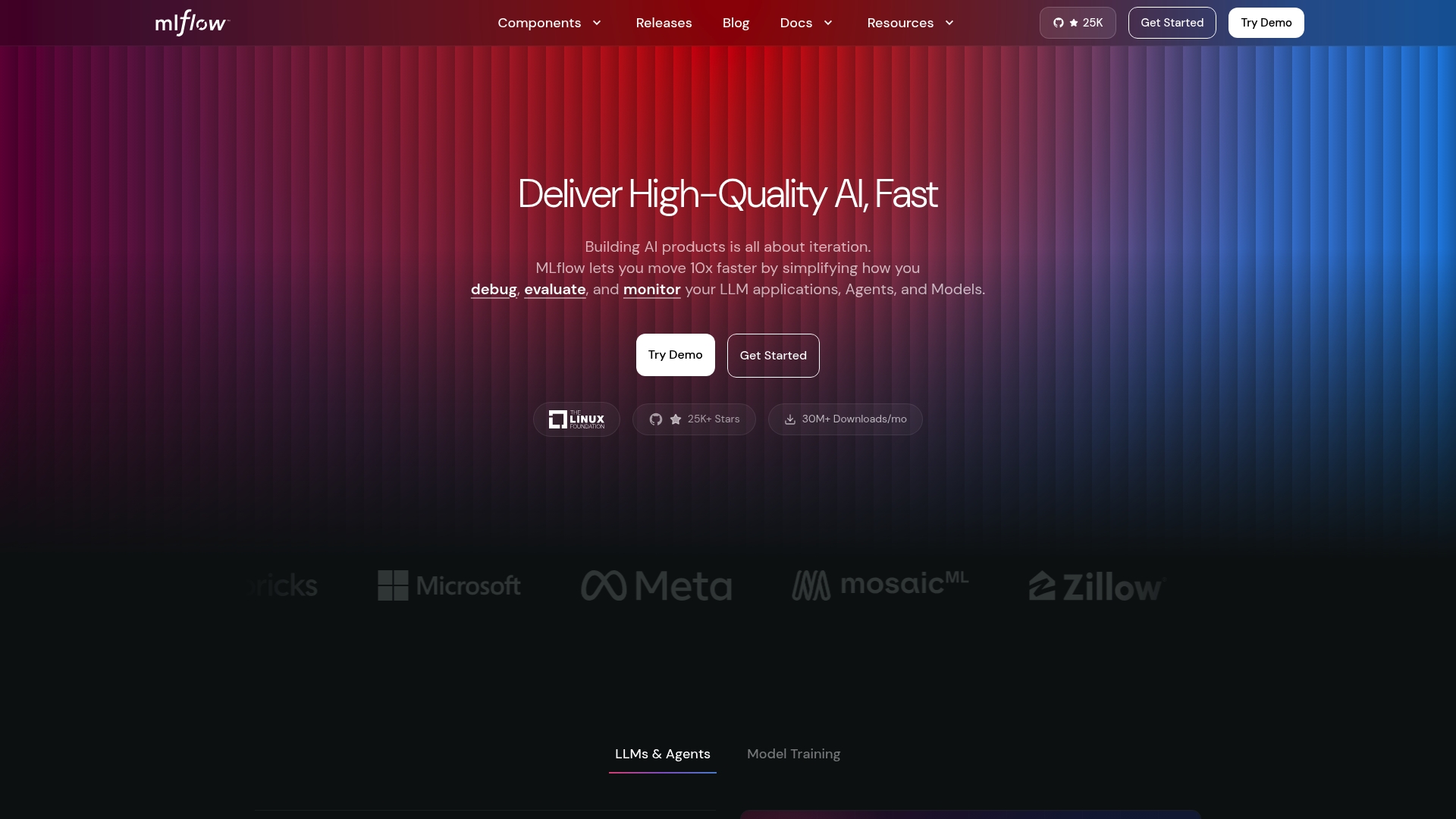
Mlflow's model and prompt registries handle version control and evaluation history automatically, so teams do not manage audit trails by hand. The Mlflow AI Platform provides end-to-end tracing for agentic workflows, LLM-as-a-Judge automated evaluation, and a centralized AI Gateway for cross-provider governance. Cost tracking and quality gate integrations align directly with the best practices in this checklist. Teams that adopt Mlflow as their LLMOps backbone reduce the manual overhead of checklist enforcement and get production-grade observability from day one.
FAQ
What is an LLMOps workflow standardization checklist?
An LLMOps workflow standardization checklist is a structured set of operational controls covering prompt versioning, evaluation gates, tracing, cost management, and incident response. It ensures LLM deployments are reliable, auditable, and consistent across every release.
Why is end-to-end tracing the most critical checklist item?
End-to-end tracing captures inputs, outputs, model versions, token counts, and latency for every request. Without it, LLM failures are invisible and nearly impossible to debug in production.
How do token caps reduce LLM operating costs?
Per-request token caps set hard limits on token usage, preventing cost escalation during failure scenarios or adversarial inputs. Combined with real-time alerts, this approach can reduce spend significantly compared to unmanaged deployments.
How often should evaluation datasets be updated?
Evaluation datasets should be updated at least quarterly using samples from recent production traffic. This keeps quality gates aligned with actual user behavior rather than stale test cases.
What does Mlflow provide for LLMOps standardization?
Mlflow provides model and prompt registries, end-to-end LLM tracing, LLM-as-a-Judge automated evaluation, and a centralized AI Gateway. These features enforce the core checklist items without requiring custom tooling.