MLOps vs. AIOps: A 2026 Guide for IT Decision-Makers

MLOps is defined as the operational discipline for managing the end-to-end lifecycle of machine learning models, while AIOps applies AI and ML techniques to automate and enhance IT operations. These are two distinct fields, and understanding what is MLOps versus AIOps is the clearest way to avoid misallocating budget, misaligning teams, and building AI infrastructure that fails in production. MLOps serves data scientists and ML engineers. AIOps serves site reliability engineers and IT platform teams. Conflating them is one of the most common and costly mistakes in modern AI deployments.
What are the primary functions and workflows of MLOps?
MLOps manages the full lifecycle of machine learning models, from raw data collection through feature engineering, training, validation, deployment, and retraining. It evolved as a direct extension of DevOps, adapted for the non-deterministic nature of ML systems where outputs cannot be unit-tested the way traditional software can. The core challenge MLOps solves is reproducibility: making sure a model trained today can be reliably rebuilt, versioned, and audited six months from now.
The MLOps lifecycle breaks down into six concrete stages:
- Data collection and validation — Ingesting raw data and running schema checks, distribution tests, and quality gates before any training begins.
- Feature engineering — Transforming raw inputs into model-ready features, often managed through a feature store like Feast or Tecton to prevent training-serving skew.
- Model training — Running experiments with tracked hyperparameters, datasets, and code versions. Mlflow's experiment tracking is the standard here for teams that need full reproducibility.
- Validation and testing — Evaluating model accuracy, fairness metrics, and inference latency before promotion to production.
- Deployment — Serving models via REST APIs, batch pipelines, or embedded runtimes, with CI/CD integration to automate promotion gates.
- Monitoring and retraining — Detecting model drift and stale data before they silently degrade production accuracy, then triggering automated retraining pipelines.
Key performance indicators in MLOps are model accuracy, inference latency, and retraining cadence. These metrics tell you whether your model is still doing its job, not whether your servers are healthy.
Pro Tip: Set automated drift detection thresholds on your feature distributions, not just your model outputs. Input drift almost always precedes output degradation, giving you earlier warning and more time to retrain before users notice.

What are the core objectives and processes of AIOps?
AIOps is defined as the application of AI and ML to IT operations, specifically to automate incident detection, root cause analysis, and performance optimization across complex infrastructure. AIOps evolved from SRE and IT operations practices by incorporating AI to manage the scale and complexity that human operators can no longer handle manually. The primary users are site reliability engineers, platform teams, and NOC analysts.
The core processes AIOps handles include:
- Telemetry ingestion — Collecting logs, metrics, events, and traces at scale from distributed systems, often spanning thousands of nodes across cloud and on-premises environments.
- Anomaly detection — Using ML models to identify abnormal patterns in infrastructure behavior before they escalate into outages.
- Intelligent event correlation — Grouping thousands of raw alerts into a small number of actionable incidents, dramatically reducing alert noise for on-call engineers.
- Root cause analysis — Tracing an incident back to its origin automatically, cutting the time engineers spend manually correlating signals.
- Automated remediation — Triggering predefined runbooks or self-healing scripts when specific incident patterns are recognized.
The success metric for AIOps is mean time to resolution, commonly called MTTR. AIOps reduces MTTR by filtering alert noise and surfacing the highest-priority incidents with supporting context. A secondary metric is false-positive rate: an AIOps system that pages engineers for non-issues quickly loses team trust.
Pro Tip: Before deploying an AIOps platform, audit your telemetry coverage. AIOps requires significant historical telemetry data to train effectively. Gaps in log retention or metric granularity will produce unreliable anomaly detection from day one.
How do MLOps and AIOps differ in users, workflows, and success metrics?
The difference between MLOps and AIOps is not just technical. It runs through users, data assets, pipelines, metrics, and failure modes. The MLOps vs AIOps comparison below makes this concrete.
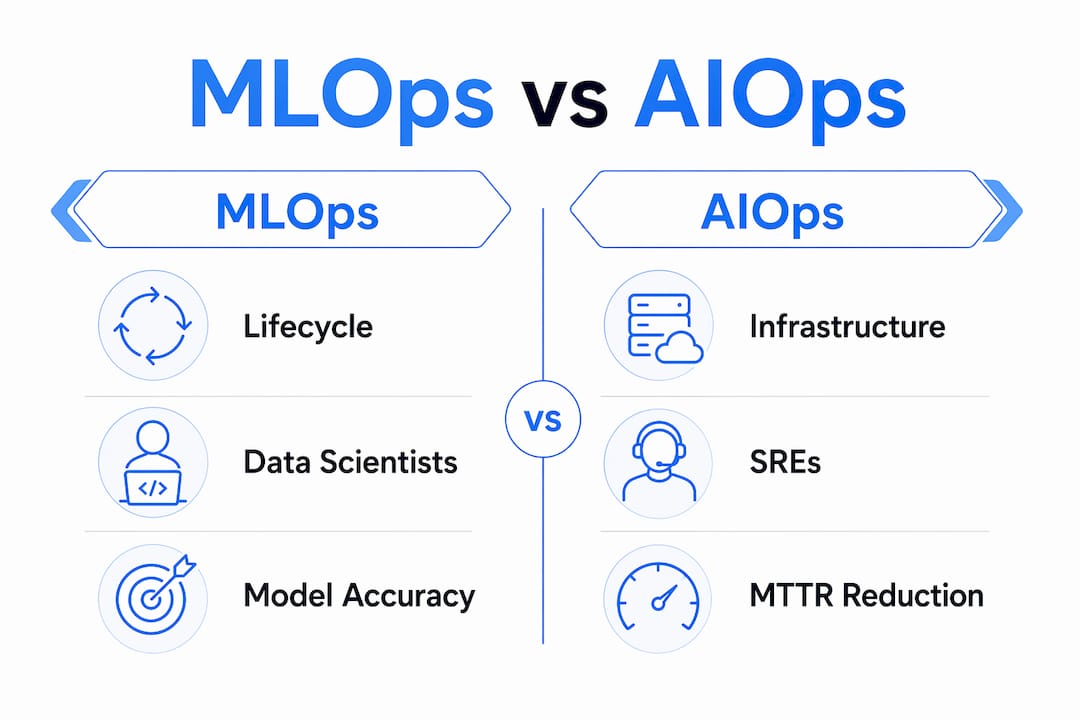
| Dimension | MLOps | AIOps |
|---|---|---|
| Primary users | Data scientists, ML engineers | SREs, platform engineers, NOC analysts |
| Core data assets | Datasets, feature pipelines, model artifacts | Logs, metrics, events, traces |
| Automation goal | Reproducible model training and deployment | Incident detection, correlation, and remediation |
| Key success metrics | Model accuracy, inference latency, retraining cadence | MTTR, alert volume reduction, false-positive rate |
| Primary failure mode | Silent model drift, stale training data | Alert storms, miscorrelated incidents |
| Tooling examples | Mlflow, Feast, Kubeflow, Seldon | Dynatrace, Datadog, PagerDuty, Moogsoft |
Misaligned KPIs are a leading cause of AI project failures. A team measuring an AIOps investment by model accuracy, or an MLOps investment by MTTR, will draw the wrong conclusions and make the wrong decisions. The metrics are not interchangeable because the operational goals are not interchangeable.
The failure modes deserve particular attention. MLOps pipelines can suffer from silent failures: model drift or stale data goes unnoticed by traditional CI/CD because the pipeline completes successfully even when the model's predictions have degraded. AIOps systems face the opposite problem. If correlation rules are not tuned carefully, a single infrastructure event can trigger thousands of alerts simultaneously, creating an alert storm that paralyzes the on-call team. Both failure modes require active, domain-specific monitoring strategies. Neither is solved by the other discipline's tooling.
How do MLOps and AIOps complement each other in modern AI stacks?
MLOps and AIOps are not competitors. In mature organizations, AIOps functions as the infrastructure monitoring layer that supports MLOps pipelines. When a GPU cluster degrades or a data pipeline latency spikes, AIOps detects the anomaly and alerts the platform team before the ML engineer's training job fails silently. That layered relationship is what makes the two disciplines genuinely complementary rather than redundant.
A third discipline is now entering this picture: LLMOps. LLMOps is a specialized layer focused on operationalizing large language models, covering concerns like prompt management, hallucination detection, and token cost governance. These are operational concerns that neither MLOps nor AIOps fully addresses. You can read a detailed breakdown in Mlflow's guide on what LLMOps covers for AI practitioners.
The practical integration looks like this in a production environment:
| Layer | Discipline | Responsibility |
|---|---|---|
| Infrastructure health | AIOps | Detect and remediate compute, network, and storage anomalies |
| Model lifecycle | MLOps | Train, version, deploy, and monitor ML models |
| LLM operations | LLMOps | Manage prompts, evaluate outputs, control token costs |
| Observability | Shared | Traces, metrics, and logs flowing across all layers |
The most common pitfall is organizational, not technical. Teams that assign MLOps and AIOps responsibilities to the same group without clear ownership boundaries end up with neither discipline executed well. The KPIs conflict, the tooling overlaps confusingly, and neither model health nor infrastructure health gets the dedicated attention it requires.
For organizations deciding where to invest first, the answer depends on your current bottleneck. If your ML models are degrading in production without detection, MLOps tooling and pipeline automation practices are the priority. If your on-call engineers are drowning in alerts and your MTTR is measured in hours, AIOps is the more urgent investment. If you are deploying generative AI agents, you need all three layers working together, with AI observability spanning the full stack.
Confusing AIOps with generic AI application features misdirects budget and weakens operational infrastructure reliability. This is a specific and recurring mistake: buying an AIOps platform when what you actually need is better model monitoring, or vice versa. The distinction matters at the procurement level, not just the engineering level.
For incident response workflows that sit at the intersection of these disciplines, the practical guidance at DevOps AI ToolKit on incident triage is worth reviewing alongside your AIOps evaluation.
Key takeaways
MLOps and AIOps serve fundamentally different operational goals, and treating them as interchangeable disciplines will produce failures in both model quality and infrastructure reliability.
| Point | Details |
|---|---|
| MLOps manages model lifecycles | It covers training, deployment, drift detection, and retraining for ML models. |
| AIOps automates IT operations | It reduces MTTR and alert noise using AI-driven anomaly detection and correlation. |
| KPIs are discipline-specific | Measuring MLOps by MTTR or AIOps by model accuracy produces misleading conclusions. |
| LLMOps adds a third layer | Generative AI deployments require prompt management and hallucination detection beyond MLOps scope. |
| Integration requires clear ownership | Assigning both disciplines to one team without defined boundaries degrades both outcomes. |
Where I think most teams get this wrong
I have watched organizations spend six months evaluating AIOps platforms when their actual problem was that no one owned model monitoring. The symptoms looked identical from the outside: production incidents, degraded user experience, on-call engineers overwhelmed. But the root cause was model drift, not infrastructure noise. An AIOps tool would have done nothing for them.
The reverse happens just as often. A data science team invests heavily in Mlflow and Kubeflow to build a rigorous MLOps practice, then discovers their training jobs are failing intermittently because the underlying Kubernetes cluster has resource contention that nobody is monitoring. The MLOps tooling is excellent. The infrastructure layer is invisible. Neither team owns the gap.
My honest recommendation: before you evaluate any tooling in either category, audit your data readiness and your team structure simultaneously. AIOps requires years of historical telemetry to produce reliable anomaly detection. MLOps requires disciplined data versioning and feature pipelines before CI/CD for models adds real value. Skipping those audits and buying software first is how organizations end up with expensive tools that nobody trusts.
The most effective approach I have seen is a layered one. Stand up AIOps for infrastructure observability first, because stable infrastructure is the foundation everything else runs on. Then build MLOps practices on top of that stable base. Then, if you are deploying LLMs or AI agents, add LLMOps tooling like Mlflow's tracing and evaluation capabilities to close the loop on generative AI behavior. That sequence is not arbitrary. Each layer depends on the one below it.
One more thing worth saying directly: the importance of MLOps is not just about model quality. It is about organizational accountability. When a model makes a bad decision in production, MLOps gives you the audit trail to understand why, when the drift started, and what training data was involved. That accountability is what separates experimental AI from production AI.
— Kevin
How Mlflow supports your MLOps practice
Mlflow is the open-source platform built specifically for the MLOps workflows described in this article. It handles experiment tracking, model versioning, artifact management, and deployment across the full model lifecycle. For teams moving into generative AI, Mlflow extends into LLMOps territory with production-grade tracing, automated evaluation using LLM-as-a-Judge frameworks, and a centralized AI Gateway for prompt governance. If you are building or scaling an MLOps practice in 2026, Mlflow's prompt engineering cookbook is a practical starting point for teams that need to operationalize LLM workflows alongside traditional ML models.
FAQ
What is the core difference between MLOps and AIOps?
MLOps manages the lifecycle of machine learning models, including training, deployment, and drift monitoring. AIOps applies AI to IT operations to automate incident detection and reduce MTTR.
Who uses MLOps versus AIOps in an organization?
MLOps is used by data scientists and ML engineers. AIOps is used by site reliability engineers and IT platform teams. The two disciplines serve different operational domains and rarely share the same primary users.
Can MLOps and AIOps work together?
Yes. In mature organizations, AIOps monitors the infrastructure that MLOps pipelines run on, detecting compute or network anomalies before they cause silent model failures. The two disciplines are complementary, not redundant.
What is LLMOps and how does it relate to MLOps and AIOps?
LLMOps is a specialized discipline for operationalizing large language models, covering prompt management, hallucination detection, and token cost governance. It extends MLOps for generative AI use cases that neither MLOps nor AIOps fully addresses on their own.
How do I know whether my organization needs MLOps or AIOps first?
If your ML models are degrading in production without detection, prioritize MLOps. If your on-call engineers are overwhelmed by alert volume and your MTTR is high, prioritize AIOps. Audit your current bottleneck before investing in either platform.