Enforce, Validate, Observe: 3 LLM Structured Output Patterns with MLflow

Structured outputs are machine-readable, schema-constrained responses from an LLM, almost always JSON, that a program can parse without guesswork. For production systems, we recommend schema-constrained generation or function/tool calling as the default over prompted JSON, paired with runtime validation and a fallback path for the cases that still slip through.
TL;DR:
- Schema-constrained generation guarantees syntactic validity and reduces parsing errors better than prompted JSON, but does not ensure value correctness.
- Using only schema-enforced outputs for critical application logic is recommended, while prompt-based JSON is suitable for rapid prototyping with validation logs.
- Keep schemas minimal with required fields, strict types, and enums to prevent ambiguous outputs and simplify validation at scale.
- Regularly log raw and parsed outputs, set validation failure metrics, and incorporate retrials or fallbacks to catch and manage schema violations early.
- Implement observability tools like MLflow to trace, evaluate, and monitor structured outputs over time, preventing silent regressions and enabling timely debugging.
Table of Contents
- What Are Structured Outputs in LLM Applications?
- Which Method Should You Use to Get Structured Output From an LLM?
- How Do You Design a Schema That Doesn't Break in Production?
- What Happens When a Structured Output Call Fails?
- What Tools and Libraries Support Structured Output Generation?
- How Do You Build a Validated Structured Output Pipeline?
- What Are the Most Common Mistakes Teams Make With Structured Outputs?
- Where Does MLflow Fit Into a Structured-Output Pipeline?
- Balancing Enforcement and Iteration Speed
- Try MLflow for Structured-Output Observability
- Sources
- FAQ
What Are Structured Outputs in LLM Applications?
A structured output is any LLM response that conforms to a predefined shape, typically JSON, so downstream code can consume it directly without a human reading it first. Compare a free-text answer like "The invoice total is $432.10, due March 15" against {"total": 432.10, "due_date": "2026-03-15"}. The second version is what your billing system actually needs.
This distinction matters because free-text generation fails in ways that are expensive to debug. A model might phrase a number as "four hundred thirty two dollars," wrap JSON in markdown fences your parser chokes on, or drop a field entirely because the prompt didn't emphasize it enough. Grammar-based outputs, enforced through constrained decoding, go a step further than plain JSON generation: they guarantee the output is syntactically valid before a single token is wasted on something a parser will reject.
Three failure modes show up constantly once you put LLMs into a real pipeline:
- Malformed parse: the model returns valid-looking text that isn't valid JSON, often from stray commentary before or after the object
- Missing fields: the model omits a required key because it judged the field "obvious" or ran out of context budget
- Ambiguous types: a phone number returned as an integer, dropping a leading zero, or a date returned as a string in three different formats across calls
Structured outputs matter most anywhere a machine reads the result: extracting fields into a database, classifying a support ticket for routing, or generating typed arguments for an agent's next action. Anywhere a human reads the output directly, the constraint matters far less.
Which Method Should You Use to Get Structured Output From an LLM?
Three approaches dominate current practice, and each solves a different part of the problem.
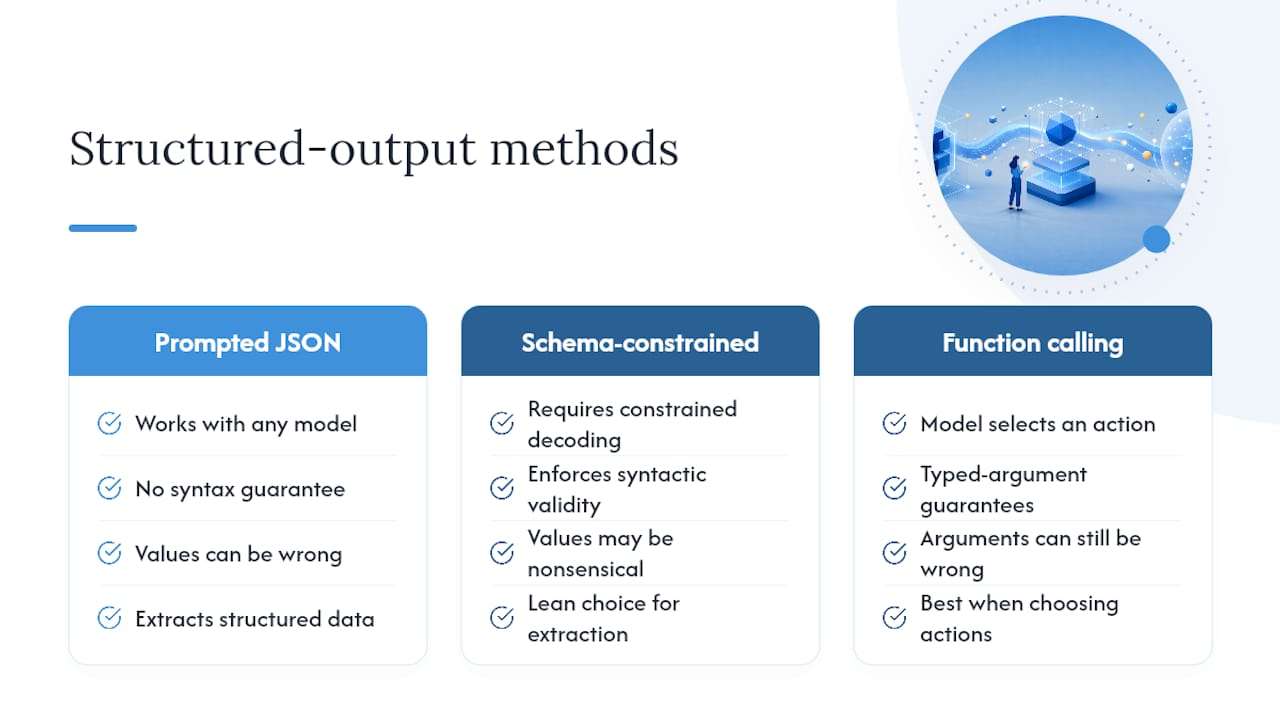
Prompted JSON means asking the model, in plain language, to "respond only in JSON matching this shape." It's the fastest way to prototype and works with any model, but it carries no guarantee. The model can still wrap the object in explanatory text, invent a field you never asked for, or produce JSON that's almost right. Use it for early prototyping, always paired with client-side validation and logging so you can see exactly how often it breaks.
Schema-constrained generation, also called constrained decoding, restricts which tokens the model can emit at each step, so the output can never leave valid syntax. The LLM Inference Handbook from Modular describes this as enforcing syntactic validity during token sampling itself, by masking logits for any token that would break the schema. That's a stronger guarantee than "please output JSON." It doesn't mean the values inside the schema are correct. A phone_number field constrained to a string type will always be a string; it might still be nonsense. Use this approach whenever the output feeds directly into application logic without a human checkpoint.
Function or tool calling asks the model to select an action and supply typed arguments for it, rather than just returning data. This is the right tool when the model needs to decide something, not just extract something, such as choosing whether to escalate a ticket, call a refund API, or query a database with specific parameters. It combines decision-making with the same typed-argument guarantees you get from schema-constrained generation.
A simple decision guide: if the model is only pulling structured data out of unstructured input, schema-constrained generation is the leaner choice. If the model needs to choose among several possible actions and produce arguments for whichever one it picks, function calling is the better fit. Many production systems, as one 2026 developer guide on structured outputs notes, use both: schema-constrained generation for deterministic extraction paths, and function calling for the agentic decision points in between.
How Do You Design a Schema That Doesn't Break in Production?
Schema design decisions made in week one tend to determine how many 2 AM pages you get by month three. A few rules hold up consistently.
- Keep required fields minimal. Every field marked required is a field that can cause a validation failure. If a field is genuinely optional, mark it that way and handle its absence in your application code instead of forcing the model to invent a value.
- Use explicit types everywhere. A
pricefield should be a number, not a string that sometimes contains a currency symbol. Loose typing pushes the parsing problem downstream instead of solving it. - Prefer enums for closed choices. If a
statusfield can only bepending,approved, orrejected, say so in the schema. This removes an entire category of ambiguity, including typos and casing mismatches. - Avoid wide-open string fields when a narrower type exists. A free-text
notesfield is fine. Acategoryfield left as open text invites twelve spellings of the same three categories.
The two validator libraries you'll actually use depend on your stack. Python teams reach for Pydantic, which lets you define the schema as a class and get parsing, coercion, and validation errors in one step. TypeScript and Node teams reach for Zod, which does the same job with a fluent schema-builder syntax that TypeScript's type system can infer from directly. Both integrate cleanly with JSON Schema, the underlying standard for describing JSON shapes that most provider APIs and validator libraries speak natively.
Runtime validation follows a consistent sequence regardless of stack: parse the raw response, validate it against your schema, and on failure either retry with a tightened prompt or route to human review, logging the raw output every time so you have something to debug against.
Pro Tip: Even when a provider guarantees schema enforcement at the API level, keep client-side validation in place. Multi-provider fallback chains and version changes on the provider's end can bypass that guarantee in ways you won't notice until a malformed record turns up in your database.
What Happens When a Structured Output Call Fails?
A validation failure is not an edge case to handle eventually. It's a certainty you should design for from the first call. The workable retry pattern is a single retry with a tightened prompt or stricter schema enforcement, followed by a fallback to a safe default value or a human review queue. Retrying indefinitely just burns tokens on a call that's already shown you it can't comply.
Caching is where structured-output systems either save real money or introduce quiet correctness bugs. Semantic caching stores an embedding of each request and returns a cached response when a new request's embedding crosses a similarity threshold, which can meaningfully cut both latency and LLM cost. The catch is tuning that threshold. Set it too high and you serve a cached answer to a request that meant something subtly different; set it too low and you barely cache anything. Azure's guidance on semantic cache lookup suggests starting low, around 0.05, and raising the threshold gradually as you confirm cached responses stay accurate. Agentic traffic, where each step depends on evolving context, is generally a poor candidate for semantic caching. Reuse there risks handing an agent a stale decision it never actually made for this exact state.
Beyond semantic similarity, plain request-response caching and prompt caching are worth layering in separately. AWS's guidance on LLM caching recommends combining multiple caching layers rather than relying on one, since each layer catches a different kind of repeat traffic.
Observability closes the loop on all of this. Log both the raw model output and the parsed, validated result, not just one or the other. For agent pipelines, instrument every intermediate structured decision, not just the final output, so you can trace exactly where a multistep chain went wrong. Feeding these logs into an evaluation pipeline, using an LLM-as-a-Judge approach to score outputs against a rubric, is how teams catch schema regressions before they become customer-facing incidents rather than after.
- Retry once with a tightened prompt or stricter schema, then fall back to a default or human queue
- Tune semantic cache similarity thresholds gradually upward from a conservative starting point
- Exclude agentic and highly variable traffic from semantic caching by default
- Log raw and parsed outputs together, and score them through an evaluation pipeline
What Tools and Libraries Support Structured Output Generation?
Provider APIs have converged on a similar pattern for enforcing structure. OpenAI's Structured Outputs feature enforces a JSON Schema at the API level and ships SDK helpers that parse the result directly into Pydantic models in Python or Zod schemas in JavaScript, removing a manual parsing step most teams used to write by hand. When you're evaluating any provider's structured-output support, look specifically for a response_format parameter and a strict-schema flag. Those two features tell you whether the provider is enforcing the schema during generation or just hoping the model complies.
For self-hosted or open-weight models, constrained decoding happens at the sampling layer, since you control the inference stack directly rather than calling a hosted API. Techniques like compressed finite-state machines, documented in LMSYS's research on constrained decoding, enforce a grammar during token sampling without the overhead of naively checking every possible token at every step. This is the practical path if you're running Llama, Mistral, or another open-weight model on your own infrastructure and want the same syntactic guarantees a hosted API gives you out of the box.
On the validation side, the landscape splits cleanly by language:
- Pydantic for Python stacks, handling parsing, coercion, and detailed validation error messages
- Zod for TypeScript and Node stacks, with schema definitions that double as inferred types
- Provider SDK helpers that wire the two together automatically when you're using a hosted API
- Tools like BabyLoveGrowth's structured data audit for checking how well your schema-defined outputs align with how AI systems parse and cite structured content
Whichever combination you land on, the integration pattern stays the same: the provider or decoding layer guarantees syntax, and your validator guarantees semantics fit your application's expectations.
How Do You Build a Validated Structured Output Pipeline?
Here's a concrete walkthrough, from a bare schema to a production-ready call.
- Define the minimal schema first. For a support-ticket classifier, that might be just three fields:
category(enum, required),priority(enum, required), andsummary(string, required, max length capped). Every field earns its place because downstream routing logic actually reads it. Resist adding a fourth "just in case" field. - Request schema-constrained output from the provider, passing your JSON Schema through whatever
response_formator strict-mode parameter it exposes. If you're on a provider without native enforcement, emulate it with a tightly worded prompt that includes the schema verbatim, plus a retry loop that reissues the same prompt with an added instruction on failure. - Parse the response with your validator. In Python, that's handing the raw string to a Pydantic model and catching the validation error if it doesn't fit. In TypeScript, it's the equivalent Zod
.parse()call. - On success, log the parsed object and move on. On failure, log the raw output in full, not a truncated version, since that's your only evidence for debugging why the model drifted from the schema.
- Route validation failures to a queue, not directly to an error page or a silently dropped record. A human review queue, even a lightweight one, catches the small percentage of cases automated retries can't fix, and gives you a feedback loop for improving the schema or prompt.
Pro Tip: Version your schema from day one, even when it feels premature. Add a schema_version field to logged records so that when you tighten a field's type six months from now, you can tell which historical records used which schema without guessing.
The pattern generalizes past a single ticket classifier. Multi-step agents chain several of these calls together, and the same schema plus validate plus log discipline applies at each step, not just at the final output.
What Are the Most Common Mistakes Teams Make With Structured Outputs?
The failures that show up repeatedly in production are rarely exotic. They're small design decisions that compound.
- Oversized schemas. A twenty-field schema with half the fields optional and vaguely defined invites the model to guess, and guessing is exactly what you built the schema to prevent.
- Ambiguous field names and types. A field called
datewith no format specified will come back in at least three formats across enough calls. - Skipping raw-output logging. Logging only the parsed result means you have nothing to inspect when parsing starts failing at a higher rate next week.
- No validation-failure metrics. If you're not tracking how often outputs fail validation, a silent regression in a model update can run for weeks before anyone notices.
- Overeager caching. Applying a semantic cache to agentic or highly personalized traffic risks returning a response that was correct for a different user's context, not this one.
Where Does MLflow Fit Into a Structured-Output Pipeline?
Once you've settled on schema-constrained generation or function calling, the harder problem becomes watching that system over time. MLflow's observability tooling traces agentic reasoning step by step, including the structured intermediate outputs a multi-step agent produces between the first prompt and the final answer, so a schema drift three calls deep doesn't stay invisible.
On the evaluation side, MLflow's LLM-as-a-Judge workflows let you score structured outputs against a rubric automatically, catching the kind of slow semantic regression that passes syntactic validation but starts drifting from what the field actually means. Centralized prompt and version governance through MLflow's AI Gateway means the schema and prompt that produced a given output are traceable after the fact, not lost in a chat log somewhere.
A reasonable starting integration looks like three pieces: structured-output logging through tracing, a validation-failure metric feeding into that same trace data, and an evaluation pipeline running periodically against a sample of production outputs.
Balancing Enforcement and Iteration Speed
Teams that over-engineer structured outputs on day one usually pay for it in iteration speed later, and teams that skip enforcement entirely pay for it in production incidents. The workable middle ground is staged: prototype with prompted JSON and client-side validation to learn what your schema actually needs to look like, then move to schema-constrained generation or function calling once that output feeds real business logic.
The mistake we see most often isn't picking the wrong approach. It's skipping observability until after the first incident. Wiring in tracing and evaluation, through MLflow or an equivalent, while you're still on prompted JSON gives you a baseline for what "normal" looks like before you tighten enforcement. That baseline is what tells you, months later, whether a new model version quietly changed your failure rate.
— Kevin
Try MLflow for Structured-Output Observability
The platform gives teams shipping structured-output features a way to see exactly what a schema-constrained call or function-calling agent actually did, not just what it was supposed to do.
Every approach covered here, prompted JSON, schema-constrained generation, function calling, still benefits from the same visibility layer once it's running in front of real traffic. MLflow's tracing captures the raw and parsed structured outputs from every call, including the intermediate arguments an agent passes between tool calls, so a schema regression shows up in a trace instead of a support ticket. Its LLM-as-a-Judge evaluation workflows score those outputs automatically against a rubric you define, and because MLflow is fully open source under Linux Foundation governance, none of that observability or evaluation tooling sits behind an enterprise paywall. If you're already validating outputs on the client side, adding MLflow's agent and LLM engineering tools is the next step for catching regressions before your validation-failure metric does. Start by pointing your existing structured-output pipeline at MLflow's evaluation tooling and see what your current failure rate actually looks like.
Sources
For deeper reference, start with the JSON Schema specification for schema syntax, OpenAI's Structured Outputs guide for provider-level enforcement, and Redis's semantic caching overview for caching architecture and threshold tuning.
- JSON Schema
FAQ
Which LLM Is Best for Structured Outputs?
No single model wins universally. The more reliable factor is whether the provider offers native schema enforcement, like OpenAI's Structured Outputs feature, rather than relying on prompted JSON alone.
Does Grok Support Structured Output?
Structured-output support varies by provider and changes frequently as APIs evolve, so check the provider's current API documentation directly rather than relying on a general answer. Whatever the provider, client-side validation with Pydantic or Zod stays necessary regardless of what the API claims to enforce.
What Is a Structured Output in the Claude Model?
Structured output support works similarly across major providers: the model is constrained to return data matching a defined shape, typically JSON, instead of free-form text. Always confirm the exact enforcement mechanism in the provider's own current documentation.
What Is the Output of an LLM?
By default, an LLM's output is free-form text, generated one token at a time with no guaranteed format. Structured outputs are a constraint layered on top, through schema enforcement, constrained decoding, or function calling, that forces that text into a machine-readable shape.
How Do You Evaluate the Quality of Structured Outputs?
Evaluation combines syntactic checks (did the output validate against the schema) with semantic checks (are the field values actually correct), often scored through an automated LLM-as-a-Judge pipeline like the one MLflow provides alongside a tracked validation-failure rate over time.