AI SDK Abstraction Layer: A Developer's Practical Guide

An AI SDK abstraction layer is a stable, developer-facing API and adapter set that hides provider-specific SDKs and runtime details behind a single, consistent interface. Your application code calls one unified API; the layer routes that call to OpenAI, Hugging Face, or any other provider through swappable adapters. Think of it as the OSI model applied to AI: each level hides the complexity below it so the layer above can stay clean and portable.
The six core responsibilities it carries:
- API facade — one interface contract your application code depends on
- Provider adapters — thin wrappers per vendor (OpenAI, Hugging Face, etc.)
- Router/selector — config-driven logic that picks the right provider or model
- Observability hooks — tracing, metrics, and logging at the call boundary
- Fallback/circuit breakers — retry logic and graceful degradation on provider failure
- Config and feature flags — runtime provider selection without code changes
The immediate payoff for engineers: portability across providers, reduced cognitive load from learning one API instead of many, and faster on-ramping when a new model or vendor ships. Mlflow's AI Gateway is a production example of this pattern in action.
Key Takeaways
An AI SDK abstraction layer pays for itself when you have multiple providers, multiple teams, or governance requirements — but only if you keep the interface minimal and back it with contract tests.
| Point | Details |
|---|---|
| Define the interface first | Write a typed interface contract before any adapter; keep the surface small and versioned. |
| One adapter at a time | Implement one provider adapter fully, with contract tests, before adding a second. |
| Expose cost and latency | Surface token counts and latency as first-class fields so callers can make routing decisions. |
| Test with contract + canary | Verify adapter compliance with contract tests, then roll out new providers via feature-flagged canary. |
| Use Mlflow as your gateway | Mlflow's AI Gateway covers facade, routing, observability, and prompt versioning out of the box. |
Table of Contents
- Why do engineering teams add an AI SDK abstraction layer?
- What are the core components of an AI SDK abstraction layer?
- What anti-patterns and risks should you watch for?
- When should you build an abstraction versus calling vendor SDKs directly?
- How do you implement a minimal AI SDK abstraction layer?
- How do you test an abstraction and safely swap providers?
- What operational concerns matter most in production?
- How does Mlflow map to the AI SDK abstraction layer pattern?
- What does implementation actually cost in time and effort?
- The abstraction you build today is the debt you maintain tomorrow
- Sources
Why do engineering teams add an AI SDK abstraction layer?
The top three outcomes are portability, improved developer experience (DevEx), and consistent governance. Each one compounds the others.
Platform-engineering experts document that standardizing AI interfaces reduces per-developer cognitive load and increases internal platform adoption when teams provide validated, opinionated workflows. Fewer vendor API mental models means faster feature delivery, cleaner code reviews, and shorter onboarding for new engineers who join a project mid-flight.
Standardizing AI interfaces reduces per-developer cognitive load and increases internal platform adoption when platform teams provide validated, opinionated workflows. — Platform Engineering
On the business side, the benefits are equally concrete. A well-designed abstraction gives you a single place to enforce cost controls, tag per-request spend, and produce audit trails that compliance teams can actually read. When a provider raises prices or deprecates a model, you swap one adapter rather than refactoring every service that ever called that provider directly. Vendor lock-in becomes a configuration decision instead of a multi-sprint engineering project.
What are the core components of an AI SDK abstraction layer?
The minimal architecture has six components. Computer science literature models systems as stacked abstraction levels from high-level APIs down to hardware; your AI layer sits just above model-serving infrastructure and just below your application or agent logic.
| Component | Responsibility | Common Pattern |
|---|---|---|
| API facade | Single interface contract for all callers | Adapter/facade |
| Provider adapters | Vendor-specific translation (OpenAI, Hugging Face) | Adapter per provider |
| Router/selector | Config-driven provider or model selection | Strategy pattern |
| Observability hooks | Tracing, metrics, payload sampling | Decorator/middleware |
| Retry/circuit breaker | Timeout handling, fallback routing | Circuit breaker |
| Config/feature flags | Runtime provider switching | Environment config |
The AI SDK pattern demonstrates this well: a unified API surface lets UI components and agent harnesses consume any model through the same primitives, regardless of which provider sits underneath. For multi-system AI platforms, the router component becomes especially important — it can fanout a request to multiple models simultaneously or select the cheapest model that meets a latency SLO.
Where does it sit in the stack? Application code calls the facade. The facade delegates to a router. The router selects an adapter. The adapter calls the provider SDK. Observability hooks fire at the facade boundary and optionally at the adapter boundary. This mirrors how an ORM sits between your application and a database engine.
What anti-patterns and risks should you watch for?
The single biggest risk is a leaky abstraction. Software-design guidance is explicit: when provider-specific details bleed through the interface, every provider swap requires refactoring application code, which defeats the purpose entirely.
Common failure modes:
- Leaky abstractions — exposing provider-specific response fields or error codes in the facade's public API
- Premature generalization — building a universal interface before you understand two real providers' differences
- Hidden cost/latency — masking per-call pricing or token counts so callers can't see what they're spending
- Inadequate versioning — changing the interface contract without a deprecation policy, breaking downstream callers
- Over-extended facades — adding so many provider-specific escape hatches that the abstraction provides no real isolation
Operational risks compound these. Unexpected provider behavior (rate limits, schema changes, model deprecations) surfaces as mysterious failures if your adapter doesn't translate provider errors into typed, documented exceptions. Observability gaps are equally dangerous: if your hooks don't capture model name, token count, and latency per call, you can't diagnose cost spikes or SLO breaches.
Pro Tip: Keep your interface surface minimal and back every method with a contract test that runs against a mock provider. A small, well-tested surface is far harder to leak than a large, convenient one.
When should you build an abstraction versus calling vendor SDKs directly?
Build an abstraction when at least two of these signals are present:
- You're integrating two or more AI providers today, or plan to within six months
- Multiple product teams or services will call the same model endpoints
- Regulatory or governance requirements demand centralized audit trails and access controls
- You need automated observability, cost attribution, or budget alerting across providers
- Provider churn is likely (contract negotiations, model deprecations, cost optimization)
Skip the abstraction and call vendor SDKs directly when:
- You're at prototype stage with a single provider and no near-term plans to switch
- Strict sub-100ms latency requirements make wrapper overhead a real concern
- The team is small (one or two engineers) and the surface area is narrow
The clearest counter-signal is a single-provider proof of concept. Adding an abstraction layer to a prototype that may never reach production is pure overhead. Wait until you have two real providers or two real teams consuming the same endpoint — that's when the coordination cost of direct SDK calls starts to exceed the cost of building the layer.
How do you implement a minimal AI SDK abstraction layer?
Start interface-first: define the contract before writing any adapter. Keep the API surface small, make it synchronous or asynchronous based on your application's needs, and add one provider adapter before writing a second.
A minimal interface contract in pseudocode:
class AIProvider:
    def complete(self, prompt: str, config: ModelConfig) -> CompletionResult:
        raise NotImplementedError

    def embed(self, text: str, config: ModelConfig) -> EmbeddingResult:
        raise NotImplementedError
A provider adapter wraps the vendor SDK:
class OpenAIAdapter(AIProvider):
    def complete(self, prompt: str, config: ModelConfig) -> CompletionResult:
        response = openai_client.chat.completions.create(
            model=config.model_name,
            messages=[{"role": "user", "content": prompt}]
        )
        return CompletionResult(text=response.choices[0].message.content)
A config-driven router selects the adapter at runtime:
def get_provider(config: ModelConfig) -> AIProvider:
    registry = {"openai": OpenAIAdapter(), "huggingface": HuggingFaceAdapter()}
    return registry[config.provider]
This adapter/facade approach keeps application code completely decoupled from vendor SDKs. Version your interface explicitly, surface typed errors (never raw provider exceptions), and add observability hooks at the complete and embed boundaries.
Prototype checklist:
- Interface spec with typed inputs/outputs
- One provider adapter with error translation
- Contract tests that verify adapter behavior against the interface
- Basic metrics (latency, token count, error rate) at the facade boundary
- Fallback behavior for timeouts (retry once, then return a typed error)
How do you test an abstraction and safely swap providers?
Test provider interchangeability with contract tests, end-to-end smoke tests, and staged canaries. Contract tests are the foundation: they verify that every adapter satisfies the interface contract before any production traffic touches it.
- Unit/contract tests — run each adapter against a mock that asserts interface compliance (input/output types, error handling, timeout behavior)
- Golden-output tests — capture reference outputs from the current provider; flag semantic drift when switching to a new one
- End-to-end integration tests — call the full stack with mocked telemetry; verify that traces, metrics, and cost tags are emitted correctly
- Shadow traffic — route a copy of live traffic to the new provider adapter without serving its responses; compare outputs offline
- Feature-flagged canary — route 1–5% of live traffic to the new provider; monitor error rates, latency, and cost for 24–48 hours
- Automated rollback criteria — define thresholds (error rate > 1%, p99 latency > 2x baseline) that trigger automatic rollback
- Post-deployment validation — run the full contract and golden-output suite against the new provider in production after full rollout
For AI agent deployment, add a semantic-equivalence check: use an LLM-as-a-Judge evaluation to confirm that agent outputs remain within acceptable quality bounds after a provider swap.
What operational concerns matter most in production?
The top constraints are auth/secrets management, data governance, observability, and cost/latency trade-offs. Design for all four from day one.
Key concerns by category:
- Auth and secrets — store provider API keys in a secrets manager (AWS Secrets Manager, HashiCorp Vault); rotate on a schedule; never pass keys through application config files
- Data governance — log request metadata but sample payload content; apply PII detection before logging prompts; confirm data residency requirements for U.S.-regulated workloads
- Observability — emit model name, provider, token count, latency, and cost per request as structured logs; set budget alerts at the provider account level and per-service level
- Cost controls — tag every request with team, service, and use-case identifiers; use adaptive routing to prefer cheaper models for low-complexity tasks
- Latency — measure adapter overhead separately from provider latency; keep the facade layer under 5ms of added overhead for synchronous paths
Abstraction layers can introduce hidden costs if they mask per-call pricing. Expose token counts and estimated cost as first-class fields in CompletionResult so callers can make informed routing decisions. For API governance and standardized interface enforcement, a dedicated API platform can complement your abstraction layer's contract management.
This keeps observability costs manageable while preserving full visibility on high-value or high-risk calls.
How does Mlflow map to the AI SDK abstraction layer pattern?
Mlflow can serve as an internal AI Gateway that standardizes model serving, observability, and governance for GenAI and LLM workflows. It maps directly to the abstraction-layer components described above.

| Abstraction component | Mlflow feature |
|---|---|
| API facade | Mlflow AI Gateway — unified endpoint for model calls |
| Provider adapters | Built-in provider integrations (OpenAI, Hugging Face, etc.) |
| Router/selector | Gateway routing rules and model aliases |
| Observability hooks | Deep tracing, token-level metrics, agentic reasoning traces |
| Config/versioning | Prompt versioning and model registry |
| Evaluation | LLM-as-a-Judge automated evaluation framework |
Teams typically integrate Mlflow as the gateway layer between their application services and provider APIs. The application calls the Mlflow AI Gateway endpoint; Mlflow handles provider routing, secret management, and trace collection. Prompt versioning and the model registry give you the config-driven provider selection that a hand-rolled abstraction would otherwise require you to build yourself.
For teams building agent architectures, Mlflow's tracing captures agentic reasoning steps at a granularity that generic logging cannot match. Evaluate Mlflow's GenAI and agent features first if your primary use case involves LLM pipelines or multi-step agent workflows.
What does implementation actually cost in time and effort?
A staged estimate for a team of two to three engineers:
- Prototype (1–3 weeks) — interface spec, one provider adapter, contract tests, basic metrics
- Production hardening (2–3 months) — second adapter, circuit breakers, secrets integration, observability pipeline, canary rollout tooling
- Full rollout (3–6 months) — all target providers, governance controls, cost attribution, team onboarding, documentation
Major cost drivers: engineering hours dominate early; monitoring and observability infrastructure adds ongoing spend. Provider API costs scale with traffic, not engineering effort. Testing and QA for semantic equivalence across providers is often underestimated.
Signals that push the timeline right: strict data residency requirements, more than three provider integrations, complex agent orchestration with multi-step tool calls, or heavy custom tooling for evaluation. A team adopting Mlflow as the gateway layer can compress the production-hardening phase significantly because observability, prompt versioning, and provider routing come pre-built.
The abstraction you build today is the debt you maintain tomorrow
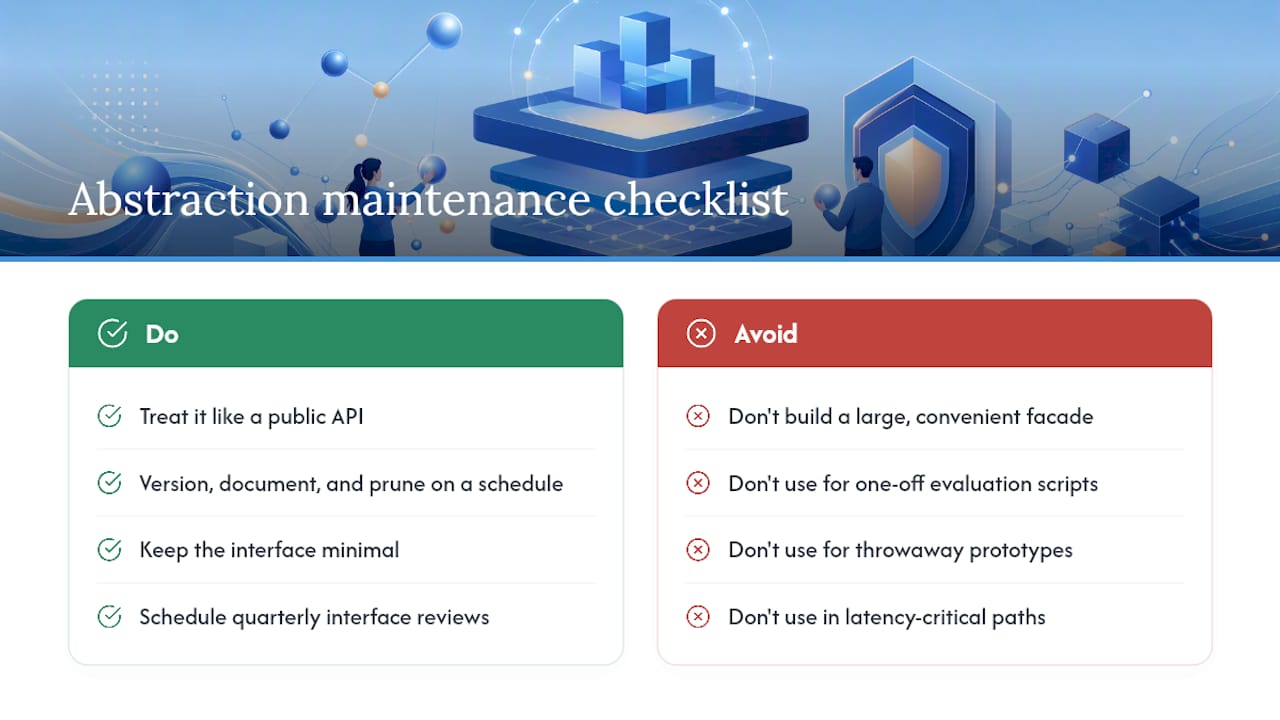
The teams that get the most value from an AI SDK abstraction layer are the ones that treat it like a public API: versioned, documented, and pruned on a schedule. The ones that struggle built a large, convenient facade that absorbed every provider quirk and now can't be changed without breaking callers.
Keep the interface minimal. Every method you add is a contract you must honor across every adapter, every provider, and every future version. Schedule a quarterly interface review: remove methods that no callers use, deprecate adapters for providers you've retired, and bump the major version when a breaking change is unavoidable. A deprecation policy written down before you need it is worth more than any amount of clever routing logic.
The honest tradeoff: there are moments when calling a provider SDK directly is the right call. A one-off evaluation script, a prototype that will be thrown away, a latency-critical path where every millisecond counts — these are not the places for an abstraction layer. Accept that, and your abstraction stays clean for the cases where it genuinely earns its keep.
Sources
The following references back the claims in this article and are worth bookmarking for your implementation work:
- Understanding abstraction layers in platform engineering
- What Are Abstraction Layers? | Coursera
- AI SDK by Vercel
- Chapter: Computer levels of abstraction