AI Agent Evaluations: A Developer's Practical Guide

Agent evaluations are the difference between an AI system you trust in production and one that surprises you at the worst moment. Most teams reaching for agent concepts assume that strong model benchmark scores translate directly into reliable agent behavior. They don't. A model that aces standard benchmarks can still hallucinate tool arguments, loop endlessly, or abandon a multi-step task midway. Effective agent evaluations require a fundamentally different approach, one that examines entire execution trajectories, tool decisions, and reasoning quality, not just final outputs.
Table of Contents
- Key Takeaways
- Agent evaluations: what they actually measure
- Core metrics for measuring agent performance
- Building a practical evaluation pipeline
- Best practices that teams consistently overlook
- My honest take on agent evaluation in practice
- How MLflow supports your agent evaluation workflow
- FAQ
Key Takeaways
| Point | Details |
|---|---|
| Agent evals differ from model evals | Focus on full execution trajectories and tool use, not only whether a final answer is correct. |
| Multi-dimensional metrics matter | Track Task Success Rate, Tool Call Accuracy, Latency, and cost alongside output quality for a full picture. |
| Separate capability from regression | Run distinct eval suites to improve difficult tasks while preventing backsliding on existing functionality. |
| Automate with human calibration | Automated LLM judges need continuous recalibration against human-labeled sets to stay reliable. |
| Integrate evals into CI/CD | Regression gates that block deployments on metric failures prevent silent degradations from reaching production. |
Agent evaluations: what they actually measure
Automated agent evaluations feed inputs to AI agents, run the full execution, and grade the results. That sounds similar to standard model testing, but the scope is categorically different. When you evaluate a language model, you check whether a response is accurate, relevant, or safe. When you evaluate an agent, you check whether it correctly selected the right tool, constructed the right arguments, executed steps in the right order, recovered from intermediate failures, and reached the correct final state.
This distinction matters because high model benchmark scores do not guarantee reliable agent behavior. An agent operating in a dynamic environment faces failure modes that benchmarks simply cannot surface:
- Tool call errors: The model selects a valid tool but passes malformed arguments, causing silent failures downstream.
- Step inefficiency: The agent completes the task but takes three times more steps than necessary, inflating cost and latency.
- Non-deterministic divergence: The same input produces meaningfully different execution paths across runs, making stability hard to verify.
- Reasoning drift: Intermediate reasoning looks plausible in isolation but accumulates errors across a multi-step workflow.
- State loss: Long-running agents lose context between sessions and produce responses that contradict earlier decisions.
Each of these failure modes requires you to evaluate trajectory, not just output. That is the core principle separating agent performance assessment from traditional model evaluation.
Core metrics for measuring agent performance
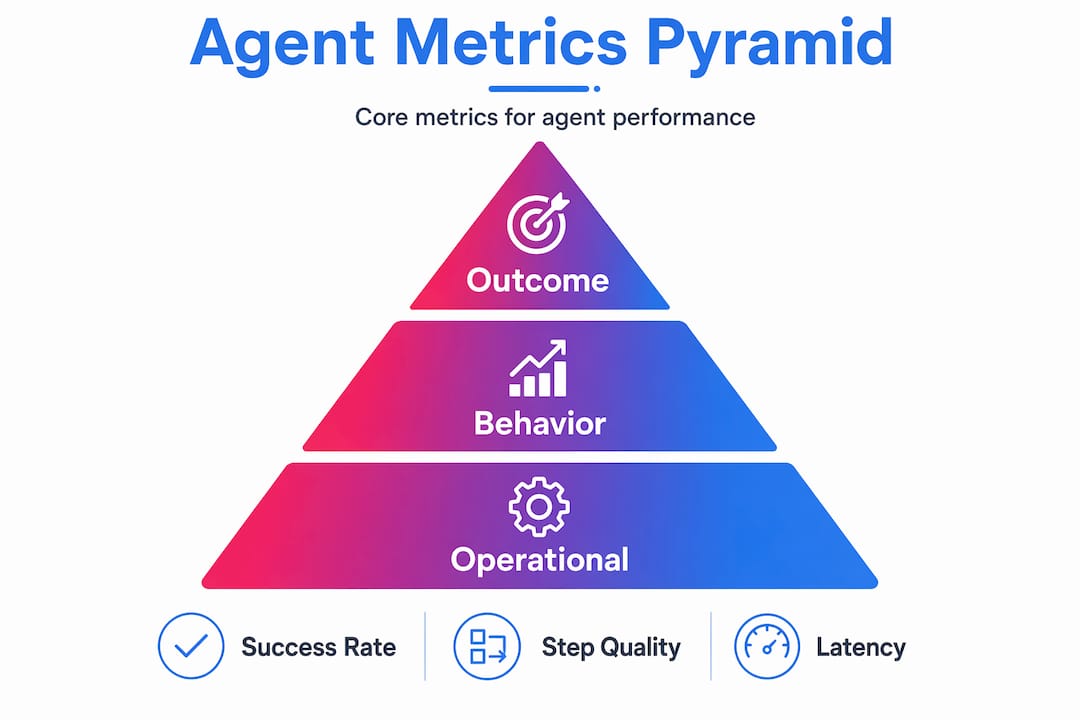
Building a solid metrics framework starts with understanding what each layer of the agent's behavior tells you. We organize these into three tiers.
Tier 1: outcome metrics
Task Success Rate (TSR) is your primary signal. It measures whether the agent completed the intended task end-to-end. A TSR below 80% on a capability eval suite signals fundamental gaps. A TSR below 95% on a regression suite signals backsliding. Those thresholds are different by design.
Tier 2: trajectory metrics
These metrics examine how the agent reached its outcome. Comprehensive metrics track correctness, groundedness, safety, trajectory, and performance across every run. The most informative trajectory metrics are:
- Tool Call Accuracy: Percentage of tool invocations where both the selected tool and its arguments were correct.
- Plan Adherence: How closely the agent followed its intended execution plan versus improvising steps.
- Step Efficiency: Ratio of optimal steps to actual steps taken, penalizing unnecessary loops or redundant calls.
- PII and Safety Flags: Whether the agent leaked sensitive data or produced outputs violating safety constraints.
Tier 3: operational metrics
Operational metrics connect agent behavior to engineering economics. Latency per task, token cost per run, and infrastructure spend per 1,000 executions belong here. An agent that is highly accurate but costs 10x more per run than your budget allows is still a production problem.
| Metric category | Examples | Grading method |
|---|---|---|
| Outcome | Task Success Rate, Goal Completion | Deterministic or LLM-as-judge |
| Trajectory | Tool Call Accuracy, Plan Adherence | Deterministic (rule-based) |
| Reasoning quality | Response relevance, Groundedness | LLM-as-judge |
| Operational | Latency, Token Cost, Safety flags | Deterministic |
A well-designed evaluation framework also separates capability evals from regression evals. Capability evals start with low passing rates and target the hardest tasks you want the agent to eventually solve. Regression evals run near 100% pass rates and exist solely to prevent you from breaking what already works. Conflating these two suites is one of the most common agent appraisal method mistakes we see in practice.
Building a practical evaluation pipeline
Theory becomes useful only when it runs in your CI/CD pipeline and surfaces real signal. Here is how to move from metrics to working infrastructure.

Start with automated evals during development. Every time you change a prompt, swap a model version, or add a tool, your eval suite should run automatically. Regression gates in CI/CD block deployments that fail per-metric thresholds, preventing stealth degradations from reaching production. Define thresholds per metric, not just for TSR. A deployment that maintains TSR while doubling latency still deserves a gate.
Layer in production monitoring. Development evals cover the scenarios you thought to write. Production monitoring covers everything else. Automated evaluation can review 100% of interactions using transcript analysis and natural language grading criteria, giving you aggregated dashboards that surface emerging failure patterns at scale.
Handle long-running agents explicitly. This is where most evaluation pipelines have gaps. Long-running agents require durable state and evaluations that simulate idle-time delays. A test that injects a 48-hour pause between agent steps can catch hallucinations on resume that no context window check will find. Pre-seed session state in your test harness and verify the agent resumes correctly.
- Set up an open-source evaluation harness that captures latency, token use, and cost per run alongside correctness scores.
- Run multiple metric types per test including reliability, safety, similarity, and LLM-judged criteria so each run produces a complete diagnostic snapshot.
- Use transcript logging to make every intermediate step reviewable. Tracing infrastructure that scores intermediate decision steps is non-negotiable for debugging failures in multi-step workflows.
- Calibrate your LLM judges continuously. Judge-human agreement targets of around 75% are the threshold at which recalibration becomes necessary, and verbosity bias and position bias are the most common culprits when scores drift.
Pro Tip: When you discover a production failure, immediately convert it into a test case. This turns reactive debugging into an expanding eval suite that grows more protective over time.
MLflow's agent tracing tools make it straightforward to capture this runtime metadata and integrate it with your broader evaluation pipeline.
Best practices that teams consistently overlook
Collecting metrics is the easy part. Keeping them trustworthy over months of active development requires discipline.
Calibrate your judges, not just your models
LLM-as-judge metrics are powerful, but LLM-as-judge agreement figures can be misleading without a ground-truth reference. Maintain a small human-labeled calibration set of 50 to 200 examples and re-run agreement checks every time you update your judge model or rubric. Skipping this step means you may be gating on noise rather than signal.
Avoid eval saturation
Eval saturation occurs when a team optimizes so hard against a fixed eval suite that the agent learns to pass tests without generalizing. Rotate difficult capability eval examples regularly. Pull new cases from production transcripts. Keep your eval suite slightly ahead of your agent's current ability.
Pro Tip: Track capability evals and regression evals in separate dashboards with separate alerts. A sudden capability score drop deserves investigation; a sudden regression score drop demands immediate rollback.
A few additional practices that separate mature evaluation programs from immature ones:
- Log full agent transcripts for every eval run, not just pass/fail scores. You cannot debug what you cannot read.
- When your agent handles diverse task types, use multiple grader types: deterministic for tool calls, LLM-based for reasoning quality, and rule-based for safety constraints.
- Account for non-determinism by running each eval case multiple times and reporting mean and variance, not just point estimates. An agent with high variance is a production risk even at acceptable average TSR.
- Align your agent evaluation criteria with business goals, not just technical metrics. If your agent's job is to reduce support ticket resolution time, include that measurement directly in your eval pipeline.
My honest take on agent evaluation in practice
I've watched teams spend months fine-tuning model performance and then ship agents that fail embarrassingly in production on tasks the model theoretically handles well. The pattern is almost always the same: they evaluated the model but not the system.
What changed my perspective was seeing what happens when you treat proactive evaluation design as a first-class engineering activity. Instead of reactive debugging sessions, you get a growing library of test cases that encode every failure the agent has ever encountered. New engineers onboard faster. Regressions surface in minutes instead of days.
That said, I want to be honest about automated LLM judges. Teams often over-rely on them because they produce numbers that feel precise. In my experience, those numbers drift without you noticing unless you are actively maintaining a human calibration set. I have seen evaluation dashboards that looked excellent for weeks while the agent quietly degraded on a task category the judge was systematically underscoring.
The future of agent evaluations is moving toward tighter integration between tracing infrastructure, evaluation frameworks, and production monitoring. The teams winning right now are the ones treating their eval suite as a living product, not a one-time setup. That shift in mindset is worth more than any individual tool choice.
— Kevin
How MLflow supports your agent evaluation workflow
MLflow was built specifically to address the complexity that makes agent evaluation hard: multi-step reasoning, dynamic tool use, and the gap between development testing and production reality. The MLflow GenAI platform gives you deep tracing of agentic reasoning out of the box, so every tool call, token, and decision step is captured and reviewable.
MLflow's LLM-as-a-Judge evaluation framework lets you define custom rubrics and run automated grading at scale, with the calibration controls needed to keep judge reliability high over time. For production readiness, AI observability tools connect development eval results to live monitoring, giving you a continuous signal rather than a snapshot. Whether you are prototyping and evaluating agents rapidly or managing a mature agentic system, MLflow gives you the infrastructure to move from experimental to production-grade with confidence.
FAQ
What is agent evaluation and why does it differ from model evaluation?
Agent evaluation measures end-to-end task execution across multi-step workflows, including tool call accuracy, plan adherence, and step efficiency. Model evaluation only checks whether individual responses are accurate or relevant.
What metrics should I prioritize in agent performance assessment?
Start with Task Success Rate as your primary outcome metric, then layer in Tool Call Accuracy, Step Efficiency, Latency, and Token Cost to get a full diagnostic picture of agent behavior.
How do I prevent regressions when updating my AI agent?
Use CI/CD regression gates that block deployments failing per-metric thresholds. Maintain a separate regression eval suite with near-100% pass rates to catch silent degradations before they reach production.
How reliable are LLM-as-judge metrics for evaluating agent effectiveness?
LLM judges are useful but require continuous calibration. Maintain a human-labeled validation set and target roughly 75% judge-human agreement as your reliability benchmark before trusting automated scores for gating decisions.
How should I evaluate agents that run for extended periods?
Long-running agents need evaluation that simulates idle-time delays and verifies durable state recovery. Pre-seeded session state tests that inject multi-hour pauses can surface hallucinations on resume that standard evals will miss entirely.