Managing State in AI Agents: A Practical Framework

For most multi-turn and production agent workloads, run a stateless model inside a stateful runtime. This hybrid pattern gives your agents continuity across turns without forcing the language model itself to own memory, which is the architecture we recommend defaulting to unless you have a specific reason not to.
State belongs to the runtime, not the model. The LLM call is stateless by nature; what makes an agent feel continuous is the layer around it.
- Choose pure stateless for atomic, high-throughput tasks like classification, extraction, or single-shot compliance checks where zero retention is a feature, not a bug.
- Choose stateful or hybrid for long-horizon assistants, coding agents, or any workflow that needs an audit trail.
- Immediate operational implications: your storage choice, caching strategy, and tracing setup all follow directly from this first decision.
Pro Tip: Decide your state paradigm before you write a single prompt template. Retrofitting session memory into a stateless design usually means rebuilding your orchestration layer from scratch.
Key Takeaways
Most production agents should run a stateless language model inside a stateful runtime, with storage, caching, and tracing choices flowing from that single decision.
| Point | Details |
|---|---|
| Default to hybrid | Wrap a stateless LLM in a stateful runtime for most multi-turn agents; reserve pure stateless for atomic, high-throughput tasks. |
| Tier your state | Separate run, session, user, and long-term memory into distinct stores with their own lifecycle and eviction rules. |
| Fix localized amnesia | Use Redis or pinned sessions so state survives load-balancer routing across instances. |
| Trace every mutation | Correlate LLM calls, tool calls, and state changes with persistent trace IDs for debugging and audits. |
| Instrument with MLflow | Use MLflow's tracing and LLM-as-judge evaluation to observe and score stateful agent behavior in production. |
Table of Contents
- What Are Stateless, Stateful, and Hybrid Agents?
- Where Should Different Types of Agent State Live?
- Why Do Stateful Agents Fail at Scale?
- How Do You Implement Eviction and Summarization?
- How Do You Trace and Govern Agent State Changes?
- How Do You Choose Between Stateless, Stateful, and Hybrid?
- How Does MLflow Support Agent State in Production?
- What Conventional Advice Gets Wrong About Agent State
- Get Your Agent State Under Control With MLflow
- Sources
What Are Stateless, Stateful, and Hybrid Agents?
Every LLM call is stateless on its own. The model has no memory of your last request; whatever context it "remembers" was re-sent to it in the prompt. The three paradigms describe what happens around that call.
- Stateless agents treat each request as complete in isolation. No session data persists between calls, which makes them easy to scale horizontally and simple to reason about for zero-retention compliance workloads. Extraction, classification, and single-turn Q&A fit here.
- Stateful agents persist context in a durable store and reconstruct it on every subsequent call. Multi-turn customer support bots and coding assistants that track a repository's context over hours need this.
- Hybrid agents are the practical default: a stateless LLM wrapped by a stateful runtime that manages session, memory, and tool state on the model's behalf. Most production systems land here, since it separates the reasoning step from the state it depends on, and the 2026 architecture consensus treats hybrid as the conservative starting point.
The practical difference shows up in calls-per-resolved-task: stateless designs often need more round trips because context has to be rebuilt or re-sent each time, while a well-managed stateful runtime resolves the same task with fewer, better-informed calls.
Where Should Different Types of Agent State Live?
Not all state is the same, and treating it as one blob is where most teams get into trouble. Split it into tiers, each with its own lifecycle and store.
- Run/session state lives for the duration of a single task or conversation and typically dies when the session ends. Key it by a session ID, often scoped to a channel or thread (
session:{channel_id}:{user_id}). - Conversation state spans multiple turns within one interaction, holding the message history and intermediate reasoning the agent needs to stay coherent.
- User state persists across sessions: preferences, past decisions, account context.
- Long-term memory is the durable knowledge an agent accumulates over time, often embedding-based and queried by similarity rather than key.
State payloads need to stay small and serializable. The Cloudflare Agents documentation on embedded SQL-backed state stores is a good concrete reference here: it recommends keeping persisted state compact, using an explicit initialState, and separating transient UI props from what actually gets synced and saved. For store selection, in-memory works fine for local testing, Redis handles low-latency shared session caching, and durable databases or vector stores handle anything meant to outlive a single run.
Why Do Stateful Agents Fail at Scale?
The most common production failure mode is what practitioners call localized amnesia: session history gets stranded on the specific instance that handled earlier turns, so when a load balancer routes the next request elsewhere, the agent "forgets" everything. This is a routing problem disguised as a memory problem, and centralized caching with Redis or pinned sessions fixes it by making state available to whichever instance picks up the request.

Prefix caching is the other lever worth understanding. When a stable prompt prefix (system instructions, tool definitions, early conversation turns) gets reused across calls, recognizing and caching that prefix cuts time-to-first-token and per-call token cost meaningfully. Stateless designs that resend full context on every call lose this advantage entirely, trading infrastructure simplicity for higher token spend.
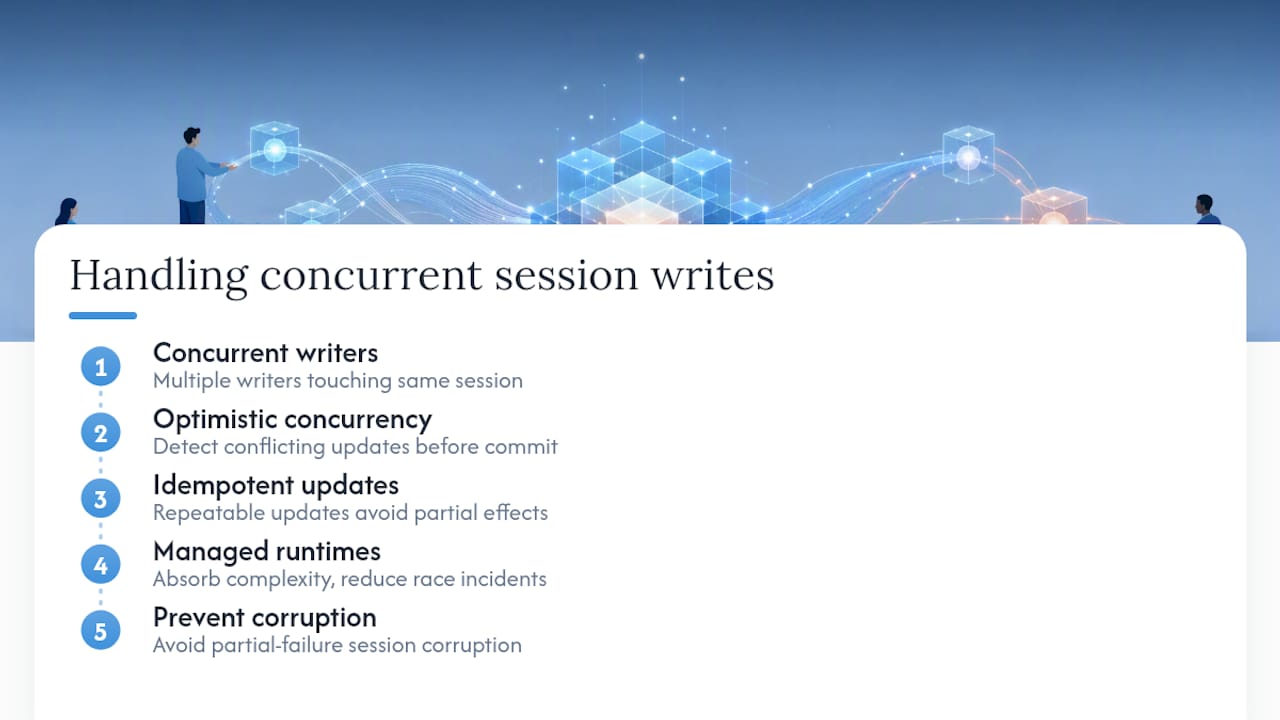
Concurrency is where things get genuinely hard. When multiple writers touch the same session, optimistic concurrency and idempotent update patterns prevent partial-failure corruption. Managed runtimes absorb a lot of this complexity for you, which changes the cost equation: the extra infrastructure spend on a managed layer often pays for itself in fewer 3 AM incidents caused by race conditions.
Pro Tip: If you're debugging a "the agent forgot what we just discussed" bug in production, check instance affinity before you touch your prompt engineering. It's usually a routing issue, not a context window problem.
How Do You Implement Eviction and Summarization?
Raw conversation history grows without bound, and every stateful agent eventually has to decide what to keep. Two decisions matter most.
- Summarize, don't just truncate. Once a conversation crosses a length threshold, compress older turns into a summary and keep only the most recent raw turns verbatim. This preserves the gist of the interaction without paying full token cost on every call.
- Version your memory schema. Agent state schemas change as products evolve. Bake in an explicit version field from day one, because migrating live session data without one is painful.
- Checkpoint at run boundaries. Durable checkpoints at the start and end of each run give you replayability, which matters enormously for debugging and for auditing regulated workflows.
The retrieval and update loop itself is simple to sketch:
state = store.load(session_id)
prompt = build_prompt(state.summary, state.recent_turns, user_input)
response = llm.call(prompt)  # stateless call
state.recent_turns.append((user_input, response))
if len(state.recent_turns) > THRESHOLD:
    state.summary = summarize(state.recent_turns[:-N])
    state.recent_turns = state.recent_turns[-N:]
store.save(session_id, state)
Treat state as multiple tiers, not one blob, and pick storage and governance policy per tier. Migrations demand explicit schema versioning and replay tests, or you will eventually break sessions you didn't know still existed.
That last point is easy to underestimate until a schema change silently corrupts every session created before the deploy.
How Do You Trace and Govern Agent State Changes?
Observability for agentic systems means correlating three things that usually live in separate logs: the LLM call, the tool call it triggers, and the state mutation that results. OpenTelemetry-style tracing conventions are becoming the practical standard for this, and persisting trace IDs alongside state changes turns "why did the agent do that" from a guessing game into a query.
Governance follows the same logic:
- Attach lineage to every memory write so you can answer "where did this fact come from" months later.
- Build retention and expiry directly into your schema, not as an afterthought, especially for anything touching regulated data.
- Support right-to-forget by making user-scoped state deletable without cascading breakage elsewhere.
- Use run-level checkpoints paired with deterministic evaluation harnesses so you can replay a failed run and reproduce the bug instead of hoping it happens again.
How Do You Choose Between Stateless, Stateful, and Hybrid?
Run through six questions before writing your architecture doc: task horizon (single call or multi-turn?), persistence requirement (does anything need to survive the session?), latency budget, compliance obligations, expected concurrency, and your team's operational capacity to run stateful infrastructure.
- Short horizon, no compliance need: stateless. Ship it and move on.
- Multi-turn but bounded: hybrid with session-scoped Redis caching.
- Long-horizon, audited, or multi-agent: stateful, with durable checkpoints and full trace correlation.
Whatever you land on, budget your first 90 days for a working prototype, a managed runtime evaluation, and full tracing instrumentation before you touch production traffic. Guardrails that matter from day one: schema versioning, an eviction policy, monitoring on state store latency, and backups you've actually tested restoring from.
How Does MLflow Support Agent State in Production?
Choosing an architecture is half the problem. Operating it reliably in production is the other half, and that's where most teams underinvest.
- Deep tracing of agentic reasoning lets you correlate the LLM call, tool invocations, and the state mutation that followed, which is exactly the trace correlation the observability section above calls for.
- LLM-as-judge evaluation gives you a repeatable way to score multi-turn agent quality instead of eyeballing transcripts, using the evaluation framework built for exactly this.
- A centralized AI Gateway handles prompt versioning and cross-provider governance, so schema changes to your prompts don't silently break sessions built on an older version.
Pro Tip: Start by instrumenting tracing and monitoring on an existing agent before you touch its architecture. You'll often find the bug is a state issue, not a prompt issue, and you'll want the trace data before you start refactoring.
What Conventional Advice Gets Wrong About Agent State
Most guidance on this topic treats stateless versus stateful as a binary architecture decision made once at project kickoff. That framing undersells how much the choice depends on operational maturity, not just workload shape. A team with no experience running Redis in production will make a stateful architecture fail for reasons that have nothing to do with the architecture itself: bad eviction policies, no schema versioning, and zero trace correlation when something breaks at 2 AM.
The bigger blind spot is treating observability as an afterthought you bolt on once the agent works. In practice, you cannot debug a multi-turn agent without tracing the state mutation alongside the LLM call that caused it. Teams that build tracing in from the first prototype spend measurably less time firefighting than teams that add it after a production incident forces the issue.
If there's one piece of overrated advice in this space, it's "keep it simple, go stateless" as a universal default. Stateless is right for atomic tasks. It's the wrong answer the moment your agent needs to remember what the user said three turns ago, and pretending otherwise just moves the complexity into increasingly desperate prompt engineering.
— Kevin
Get Your Agent State Under Control With MLflow
Once you've picked your architecture, the harder problem is proving it works and keeping it working as your agent evolves. MLflow gives engineering teams the observability and evaluation layer that stateful and hybrid agents need without building tracing infrastructure from scratch: deep traces that connect LLM calls, tool calls, and state mutations into one debuggable timeline, LLM-as-judge evaluation for scoring multi-turn conversations, and a centralized AI Gateway for managing prompt versions across providers.
If you're moving an agent from prototype to production, start by exploring MLflow's agent engineering platform to see how tracing and evaluation plug into your existing stack, or check the AI platform overview if you're still deciding what your operational stack should look like. Either page gives you a concrete next step instead of another architecture debate.
Sources
- Machinelearningmastery
- Stateful vs. Stateless Agents: The 2026 Architecture Decision — Genαi
- Store and sync state · Cloudflare Agents docs