What Is AI Cost Governance: A Guide for Finance Leaders

AI cost governance is the structured practice of tracking, attributing, controlling, and optimizing the financial resources consumed by AI systems across an organization. Unlike traditional IT cost management, which handles fixed infrastructure allocations, AI spending is variable and usage-driven. Every model call, token processed, and API request generates a cost that compounds quickly without active oversight. Finance leaders who treat AI spend like a static software license will find their budgets overwhelmed before the quarter closes.
What is AI cost governance and why does it differ from IT cost management?
AI cost governance is the framework that connects AI usage to ownership and outcomes rather than relying on fixed cost allocations. Traditional IT budgets cover servers, licenses, and headcount. AI budgets must account for per-interaction costs that spike unpredictably when a new feature launches or an agentic loop runs longer than expected. The difference is not just technical. It changes how finance teams forecast, how IT teams enforce limits, and how procurement teams write contracts.
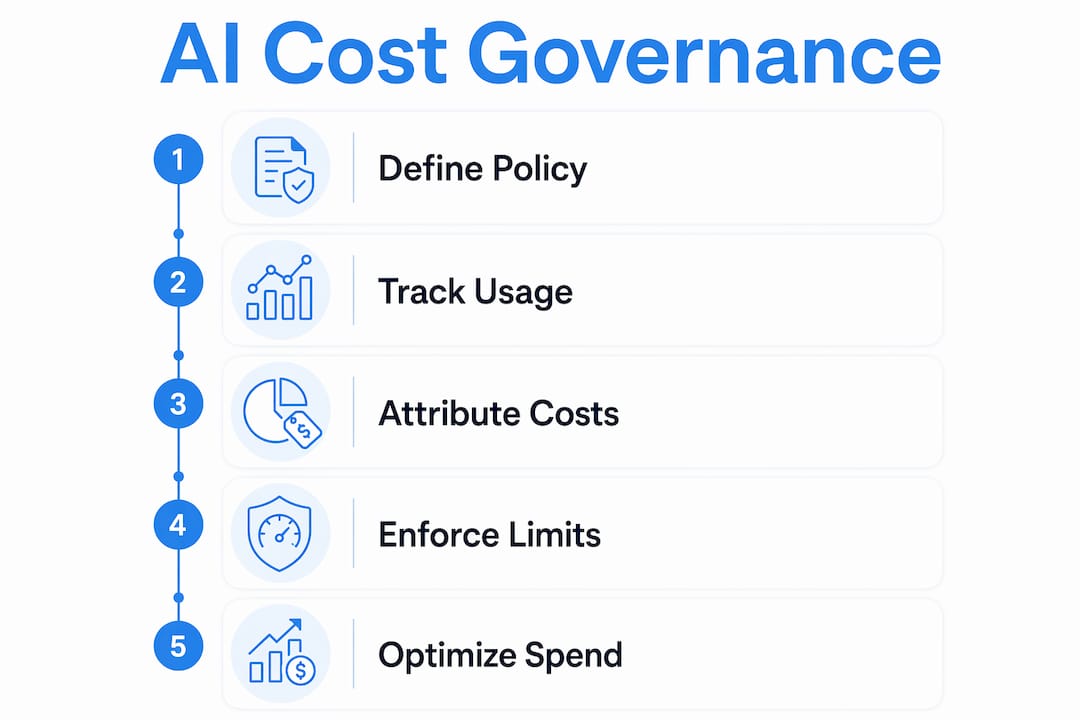
The core functions of AI cost governance are real-time visibility, policy enforcement, cost attribution, and spend optimization. Each function addresses a different failure mode. Visibility catches problems early. Policy enforcement stops overspending before it happens. Attribution assigns accountability. Optimization reduces waste without cutting capability. Together, these four functions form a governance layer that sits above the AI systems themselves.

Enterprise AI governance starts earlier than optimization. It creates structure before uncontrolled use occurs by defining who can use which AI workloads, at what cost thresholds, and with what proof of business value. Organizations that skip this step often discover the problem only when a cloud invoice arrives.
How does AI cost governance work in practice for enterprise finance and IT teams?
Finance and IT share responsibility in a well-run governance program, but their roles are distinct. Finance owns budgeting, forecasting, and approval workflows. IT owns the technical controls that enforce those budgets at runtime. Procurement handles vendor terms and contract discipline. When these three functions operate in silos, costs slip through the gaps.
Finance and IT collaboration prevents pilot creep by setting approval gates tied to spend thresholds. A small proof-of-concept might require only team-lead approval. A production deployment crossing a defined cost threshold triggers a finance review. This escalation model keeps governance proportional to financial risk.
The operational controls that make governance real include:
- Budget caps set at the team, project, or environment level
- Rate limits that throttle API calls before a budget ceiling is reached
- Anomaly detection that flags unusual spending patterns in real time
- Kill switches that shut down runaway workloads automatically
- Approval gates that require sign-off before high-cost models enter production
Real-time enforcement through rate limits and automated shutdowns prevents overspending before the billing cycle closes. This is the critical difference between governance and after-the-fact reporting. Reporting tells you what happened. Governance stops the problem while it is still happening.
Pro Tip: Set your anomaly detection thresholds at 80% of your budget cap, not 100%. This gives your team time to investigate and respond before the limit is actually hit.
What are the key components and technologies involved in AI cost governance?
A complete AI cost governance program requires five technical components working together. Each one addresses a specific gap that, left unfilled, creates financial or compliance risk.
- Usage tagging assigns every AI request to a team, feature, model version, and environment. Without tags, you cannot tell which business unit is driving costs or which feature is burning budget.
- Cross-provider cost normalization consolidates billing data from multiple cloud providers and API vendors into a single cost view. Cross-provider governance reads usage and billing data from each provider and converts it using published unit costs, enabling a unified month-to-date total and forecast.
- Real-time alerting notifies budget owners when spending approaches defined thresholds. Alerts must fire before the limit is breached, not after.
- Policy engines translate budget rules into automated technical controls. When a threshold is crossed, the policy engine throttles access or blocks requests without requiring human intervention.
- Audit logging records every approval, exception, alert, and remediation action. This log is the evidence trail that satisfies auditors and regulators.
The table below shows how each component maps to a governance outcome:
| Component | Primary governance outcome |
|---|---|
| Usage tagging | Cost attribution and chargeback accuracy |
| Cross-provider normalization | Unified visibility across vendors |
| Real-time alerting | Proactive budget protection |
| Policy engine | Automated enforcement at runtime |
| Audit logging | Compliance and audit defensibility |
Pro Tip: Tag at design time, not after deployment. Retrofitting tags onto production workloads is expensive and error-prone. Build tagging into your CI/CD pipeline as a release requirement.
Why is attribution important in AI cost governance and how is it achieved?
Attribution is the mechanism that makes accountability real. Without it, AI costs accumulate in a shared pool that no one owns and no one has incentive to reduce. With it, every dollar of AI spend maps to a business unit, a product feature, or a specific project.
High tagging coverage of approximately 90% is required before a chargeback model can be applied fairly. Below that threshold, untagged costs create disputes and erode trust in the governance program. Organizations typically start with a showback model, which provides visibility without financial enforcement, and graduate to chargeback once tagging coverage is sufficient.
The two models serve different organizational maturity levels:
- Showback gives teams visibility into what they are spending without moving money between budgets. It builds awareness and changes behavior through transparency.
- Chargeback transfers actual costs to the consuming business unit. It creates direct financial accountability and aligns incentives with efficient AI use.
Cost attribution in token-priced AI requires combining centralized governance with business-unit budget ownership. A central team sets the rules and maintains the tagging taxonomy. Individual teams own their budgets and are accountable for their consumption. This split avoids the two failure modes: a central team that cannot enforce accountability at scale, and distributed teams that optimize locally without seeing the full picture.
What challenges and best practices exist in implementing AI cost governance?
The most common failure in AI cost governance is siloing. Finance teams track spend in spreadsheets. IT teams manage rate limits in infrastructure dashboards. Neither team has the full picture, and the gap between them is where budget overruns hide.
Integrating finance and governance risk monitoring as a single measurable system improves both accuracy and forecasting. AI FinOps programs that treat cost monitoring and risk monitoring as separate disciplines miss the operational costs that governance itself generates, including infrastructure for monitoring, bias detection, and explainability tracking.
The best practices that separate mature programs from struggling ones are:
- Enforce close to execution. Rate limits and kill switches applied at the API gateway level are more reliable than controls applied at the billing layer. Embedding limits close to the execution path with hard ceilings and automated kill switches ensures budgets control runtime costs, not just reported costs.
- Maintain continuous evidence trails. Audit-grade defensibility requires records linking approvals, exceptions, anomalies, and remediation actions. Executives, auditors, and regulators need to see how AI usage was supervised.
- Set per-feature cost budgets at design time. Enforcing cost budgets at release gates avoids silent budget overruns. If a feature exceeds its per-request cost budget, it fails the build before it reaches production.
- Balance control with capability. Governance that blocks every high-cost request kills the business value of AI. The goal is predictable spending, not zero spending.
Pro Tip: Run a quarterly governance review that includes both finance and engineering leads. Cost patterns shift as AI usage matures, and your controls need to shift with them.
How does AI cost governance integrate with broader financial and operational strategies?
AI cost governance does not stand alone. It connects to enterprise FinOps, procurement strategy, vendor management, and risk controls. Cross-functional collaboration among finance, engineering, and security teams is the only way to distinguish intentional AI spend from waste and make decisions that stick.
Procurement plays a specific role that is often underestimated. AI procurement governance covers the contractual terms that define how vendors charge, what usage rights organizations hold, and what audit rights apply. Negotiating rate caps, volume discounts, and exit clauses before signing reduces financial risk over the contract lifecycle.
The table below maps governance functions to the enterprise teams that own them:
| Governance function | Primary owner | Supporting teams |
|---|---|---|
| Budget setting and forecasting | Finance | Engineering, Product |
| Technical controls and rate limits | IT/Engineering | Security |
| Vendor contracts and terms | Procurement | Finance, Legal |
| Risk and compliance monitoring | Risk/Compliance | IT, Finance |
| Cost attribution and chargeback | FinOps | Finance, Engineering |
Mature AI FinOps programs move from token visibility to real-time monitoring tied to business metrics. The shift from "how much did we spend?" to "what did we get for it?" is where AI financial governance matures into a strategic function. When AI spend links to measurable ROI, the governance program earns executive confidence and sustained investment.
The ROI case for AI governance is straightforward. Organizations that govern AI spend proactively avoid the emergency budget reallocations, vendor disputes, and compliance findings that plague programs built on reactive reporting.
Key Takeaways
Effective AI cost governance requires real-time enforcement, cross-functional ownership, and attribution coverage above 90% to deliver budget control that holds under audit.
| Point | Details |
|---|---|
| Governance differs from optimization | AI cost governance controls spending proactively; optimization reduces it after the fact. |
| Finance and IT must share ownership | Finance sets budgets; IT enforces them technically; neither function works without the other. |
| Attribution requires 90% tag coverage | Chargeback models fail without near-complete tagging; start with showback to build coverage. |
| Enforcement belongs close to execution | Rate limits and kill switches at the API gateway level stop overruns before billing closes. |
| Evidence trails are non-negotiable | Audit-grade records of approvals, exceptions, and remediations protect organizations from regulatory and executive scrutiny. |
The governance gap that most finance teams still haven't closed
I've worked with finance and engineering teams across a range of AI deployments, and the pattern I see most often is this: the governance conversation starts six months too late. A team runs a successful pilot, gets approval to scale, and only then discovers that no one tagged the workloads, no one set rate limits, and the first production invoice is three times the estimate.
The uncomfortable truth is that most organizations treat AI cost governance as a FinOps problem when it is actually a governance design problem. The controls need to be in place before the first production request fires, not after the first surprise invoice lands. Real-time visibility and enforcement are not nice-to-have features. They are the difference between a budget that holds and one that doesn't.
What I've found actually works is treating the governance framework as a first-class engineering requirement, not a finance afterthought. When cost budgets are set at design time and enforced at release gates, the entire dynamic changes. Engineers start thinking about cost efficiency the same way they think about latency. Finance teams get forecasts they can defend. And when an auditor asks how AI usage was supervised, the evidence trail is already there.
The organizations that get this right are the ones that integrate FinOps and risk monitoring into a single system, assign clear ownership at every layer, and review their controls quarterly as usage patterns evolve. The ones that struggle are still waiting for the invoice to tell them what happened.
— Kevin
How Mlflow supports AI cost governance in production
Mlflow gives engineering and finance teams the production-grade controls needed to govern AI spend from the first deployment. The Mlflow AI Gateway enforces budget limits and rate controls directly at the request layer, stopping overruns before they reach the billing cycle. Real-time AI monitoring surfaces anomalies and usage patterns across models and environments, giving finance teams the visibility they need to forecast accurately. Fine-grained tracing and tagging support attribution down to the feature and team level, making chargeback models practical rather than theoretical. For teams managing LLMs and AI agents at scale, the Mlflow GenAI platform connects governance controls directly to the development and deployment workflow.
FAQ
What is AI cost governance in simple terms?
AI cost governance is the practice of tracking, controlling, and attributing the money an organization spends on AI systems. It combines real-time monitoring, policy enforcement, and cost attribution to keep AI spending within budget and aligned with business outcomes.
How does AI cost governance differ from traditional IT cost management?
Traditional IT costs are mostly fixed, covering servers and licenses. AI costs are variable and usage-driven, changing with every model call and token processed. Governance frameworks must account for this variability with real-time controls rather than static allocations.
What is cross-provider AI cost governance?
Cross-provider AI cost governance normalizes usage and billing data from multiple cloud providers and API vendors into a single unified cost view. It converts each provider's billing units into comparable figures, enabling consolidated forecasting and budget enforcement across all AI sources.
Why does cost attribution matter in AI financial governance?
Attribution assigns AI costs to specific teams, features, and projects, creating the accountability needed to reduce waste. Without attribution, no one owns the spend and no one has incentive to reduce it.
What role does Mlflow play in AI cost governance?
Mlflow provides the technical infrastructure for AI cost governance, including gateway-level budget enforcement, real-time anomaly detection, and fine-grained usage tagging. These capabilities connect governance policy to runtime enforcement across LLM and agentic AI workloads.