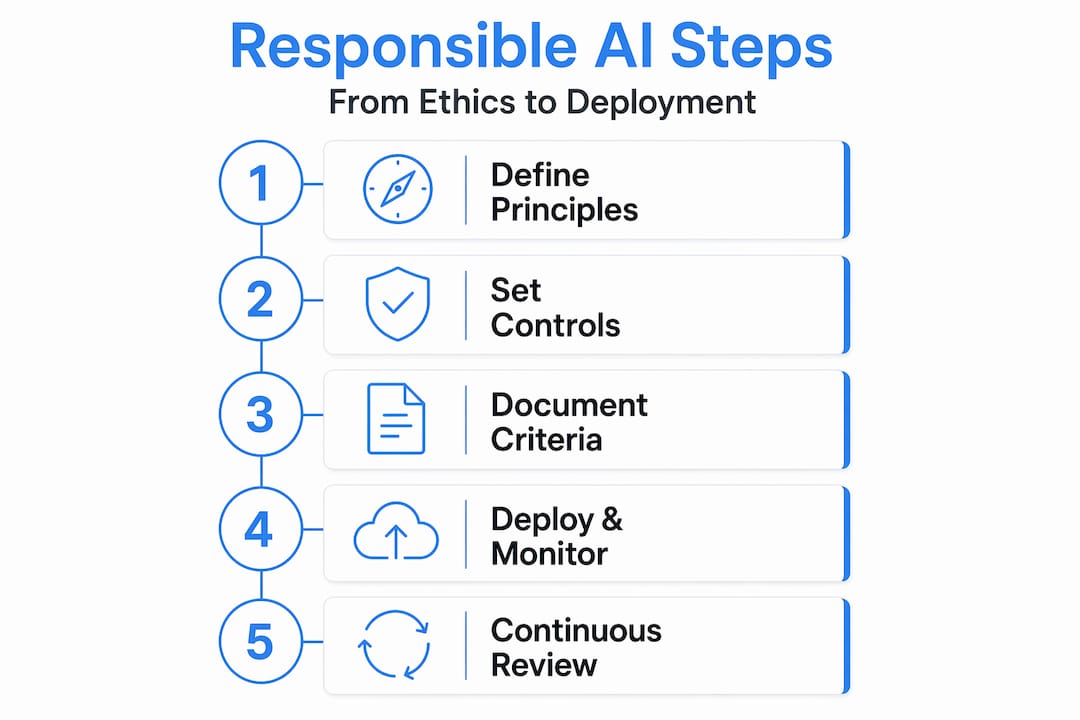
Enterprise AI Compliance Documentation: A Practical Guide

Enterprise AI compliance documentation is a single, auditable package: policy, risk register, control catalogue, evidence registry, model cards and evaluation reports, retention rules, and vendor due-diligence records that together prove your AI systems operate safely, lawfully, and explainably. Skip any one of these and an audit or regulator inquiry turns into a fire drill.
Each document earns its place for a specific reason. The policy sets scope and accountability. The risk register and control catalogue map obligations from frameworks like the NIST AI Risk Management Framework to actual controls. Model cards and evaluation reports give auditors the metadata they need without chasing engineers for answers. Retention and logging policies satisfy eDiscovery requests when a regulator or plaintiff asks what your system did on a specific date.
- Corporate AI policy and governance charter
- Risk taxonomy and control catalogue mapped to a named framework
- Evidence register with searchable metadata
- Model cards and evaluation reports per model version
- Retention, logging, and vendor due-diligence documentation
- Inventory every AI system in production or pilot.
- Assign document owners before you draft a single template.
- Build the evidence register last, once you know what evidence actually exists.
Pro Tip: Store your evidence register in one indexed repository, not scattered across shared drives. A tool like Mlflow or Microsoft Purview can act as that single source of truth, letting auditors self-serve instead of emailing you for screenshots.
Enterprises that consolidate controls into one library, rather than a separate mini-program per regulation, cut duplicated audit prep and speed up external audit cycles.
Key Takeaways
Enterprise AI compliance documentation succeeds when policy, control catalogue, and evidence register are built together and refreshed continuously, not treated as separate one-time deliverables.
| Point | Details |
|---|---|
| Start with four documents | Policy, control catalogue, one model card, and the evidence register come first. |
| Automate evidence collection | Continuous logging beats quarterly manual evidence gathering for audit speed. |
| Standardize naming | Machine-searchable evidence files cut audit response time significantly. |
| Assign single owners | Every control needs one accountable owner, not a shared committee. |
| Mlflow accelerates reporting | Experiment tracking and observability generate model provenance and evaluation evidence automatically. |
Table of Contents
- What Documents Should Enterprise AI Compliance Programs Prioritize?
- How Do You Template Model Cards and Control Entries?
- What Metadata Do Model Reports Need to Include?
- How Do You Enforce Controls and Collect Evidence Continuously?
- Who Owns AI Governance Inside an Enterprise?
- How Does MLflow Map to Compliance Documentation Requirements?
- What's the 90-Day Roadmap for AI Compliance Documentation?
- What Enterprise Compliance Teams Get Wrong About AI Documentation
- Accelerate Your Compliance Evidence With MLflow
- Frequently Asked Questions
- Sources
What Documents Should Enterprise AI Compliance Programs Prioritize?
Compliance teams rarely have unlimited runway, so sequencing matters more than completeness on day one. Start with the documents auditors ask for first, then build outward.
- Corporate AI policy — scope, prohibited uses, approval gates. Owned by legal and compliance jointly.
- AI risk taxonomy and register — categorizes systems by risk tier (a KPMG-style risk-tiering approach works well here). Owned by compliance.
- Control catalogue mapped to a named framework, such as NIST AI RMF or ISO 42001. Owned by compliance, tested by internal audit.
- Evidence register with consistent file naming. Owned by platform engineering, reviewed by compliance.
- Model cards per model and version. Owned by data science.
- Evaluation reports covering bias, safety, and performance thresholds. Owned by data science, reviewed by compliance.
- Data lineage records tracing training data provenance. Owned by data engineering.
- Retention and logging policy. Owned by legal, enforced by platform engineering.
- Vendor due-diligence package for third-party models and APIs. Owned by procurement and legal.
- PIA-style privacy assessments for any system processing personal data. Owned by privacy counsel.
- Incident runbooks for model failures or misuse. Owned by security and compliance jointly.
- Training and awareness materials for staff who build or operate AI systems. Owned by compliance and HR.
| Document | Minimum Content | Typical Owner |
|---|---|---|
| AI policy | Scope, approvals, prohibited uses | Legal & compliance |
| Control catalogue | Control statement, test frequency, evidence link | Compliance |
| Model card | Purpose, data lineage, metrics | Data science |
| Vendor DDA | Data handling, subprocessors, audit rights | Procurement/legal |
Pro Tip: With 90 days, build the policy, the control catalogue, and one complete model card for your highest-risk system. Everything else can follow once that pattern proves out.
Request a simple template pack internally: one policy skeleton, one control-entry template, one model-card template, and one vendor-DDA template. Standardizing these four saves weeks of rework later.
How Do You Template Model Cards and Control Entries?
Standardized fields turn a document from a one-off artifact into something machine-searchable and audit-ready. A model card missing training data lineage is functionally useless in an audit, no matter how polished it looks.
Model card fields:
- Purpose and intended use
- Owner and review date
- Input schema and output format
- Training data lineage and source
- Evaluation metrics and thresholds
- Bias and safety check results
- Permitted uses and prohibited uses
- Human oversight checkpoints
Control catalogue entry fields:
- Control statement (what must be true)
- Owner and test frequency
- Test pattern (manual attestation vs. automated check)
- Evidence pointer (link to the evidence register)
Evidence record fields:
- File path and unique identifier
- Ingestion timestamp
- Verifier name or system
- Retention rule applied
- Draft the field list before the template layout.
- Pilot the template on one real model.
- Lock naming conventions before scaling to a second team.
| Field | Example Value |
|---|---|
| Model name | fraud-scoring-v3 |
| Evaluation metric | Precision, threshold met |
| Bias check | Demographic parity tested, passed |
| Point | Details |
|---|---|
| Consistent naming | Machine-searchable evidence cuts audit response time from days to hours. |
| Field-level templates | Standardized model cards and control entries prevent audit gaps across teams. |
Pro Tip: Use an underscore-separated naming convention (model_name_version_date) across every artifact. It sounds trivial until an auditor needs 40 files pulled by Friday.
What Metadata Do Model Reports Need to Include?
Auditors and regulators expect specific fields, not free-form narrative. A model report missing evaluation thresholds or lineage data forces a follow-up request, which is exactly what a good evidence package avoids.
| Field | Why It Matters |
|---|---|
| Model name and version | Ties every artifact to a specific deployed instance |
| Training dataset ID | Supports data lineage and provenance claims |
| Evaluation metrics with thresholds | Shows pass/fail criteria, not just raw scores |
| Deployment configuration | Documents guardrails and content filters at time of release |
| Last review timestamp | Proves ongoing monitoring, not a one-time check |
| Export Format | Use Case |
|---|---|
| PDF summary | Human-readable report for regulators and auditors |
| SPDX | Machine-readable component and dependency manifest |
Microsoft's Foundry AI reports and Purview Compliance Manager can generate these exports automatically, producing PDF and SPDX outputs tied to model versions rather than requiring manual assembly each time.
- Immutable artifact storage per version
- Version tags that never get overwritten
- Human-in-the-loop checkpoints logged with timestamps
- Automate report generation at deployment time, not quarterly.
- Store every export alongside its source model version.
- Tag reports with retention rules matching your policy.
Pro Tip: Automate report export the day you deploy a model, not the week before an audit. eDiscovery requests rarely give you a comfortable runway.
How Do You Enforce Controls and Collect Evidence Continuously?
Documentation alone doesn't survive an audit. What survives is evidence that controls actually ran, on a schedule, with logs to prove it. This is where most enterprise AI programs quietly fail.
- CI/CD gates that block model promotion without a passing evaluation report
- Automated bias and performance tests run pre-deployment
- Prompt and interaction logging captured continuously, not sampled
- Data lineage capture triggered at every retraining event
- Role-based access controls on model registries and evidence stores
- Content-safety filters logged with their configuration version
- Automated remediation runbooks triggered by threshold breaches
- Place bias and safety tests pretrain to catch data problems early.
- Place evaluation gates predeploy to block unsafe releases.
- Place logging and monitoring postdeploy for continuous evidence.
Continuous control monitoring closes the gap that spreadsheets and manual quarterly reviews leave open, giving compliance teams real-time visibility across business units instead of a scramble every audit season. Enterprises reusing a single control library across frameworks report cutting external audit time by roughly 30 to 40 percent.
Pro Tip: Automation handles volume, but keep a human attestation step for any control tied to a high-stakes decision, like credit approval or hiring. A signature still matters when the outcome affects someone's life.

Who Owns AI Governance Inside an Enterprise?
Documents decay without an operating model behind them. The RACI matrix is what keeps a control catalogue from turning into shelfware within two quarters.
- Legal: policy language, regulatory interpretation, incident escalation
- Compliance: control catalogue, evidence register, audit liaison
- Platform engineering: CI/CD gates, logging infrastructure, access controls
- Data science: model cards, evaluation reports, retraining triggers
- Privacy counsel: PIAs, data subject requests, cross-border transfer reviews
- Assign one accountable owner per control, never a committee.
- Set review cadence by risk tier, not a flat calendar.
- Report a small set of metrics to executive sponsors quarterly.
| Cadence | Item | Trigger |
|---|---|---|
| Quarterly | Policy review | Regulatory change or incident |
| Monthly | High-risk model re-evaluation | New training data or drift signal |
| Continuous | Evidence refresh | Every deployment event |
| Governance Element | Manual Approach | CoE-Backed Approach |
|---|---|---|
| Control ownership | Ad hoc, per project | Centralized, RACI-defined |
| Evidence collection | End-of-quarter scramble | Continuous ingestion |
A compliance-first culture, backed by executive sponsorship and a dedicated Cloud Compliance Center of Excellence, turns AI governance into an engineering-first discipline instead of an audit-season fire drill.
Pro Tip: Report three metrics to your board, not thirty: percentage of models with current model cards, mean time to produce audit evidence, and open high-risk findings.
How Does MLflow Map to Compliance Documentation Requirements?
MLflow's tracking and observability features generate much of the metadata compliance teams otherwise assemble by hand. The mapping below shows what each feature produces as documentation.
- Quick win: inventory your models, then instrument your single highest-risk model with tracking.
- Mid-term: automate model report generation and wire evaluation gates into CI/CD.
- Long-term: build an organization-wide control library with continuous monitoring across every model.
| MLflow Capability | Documentation or Evidence Produced |
|---|---|
| Experiment tracking | Model provenance and version history |
| AI observability and tracing | Interaction logs and reasoning traces |
| LLM-as-a-Judge evaluation | Evaluation metrics for model cards |
| Prompt and version management | Change history for prompt governance |
Pro Tip: MLflow reduces the manual burden of tracking versions and metrics, but legal and compliance still need to sign off on control language and regulatory mapping. Automation produces evidence; it doesn't produce judgment.
Do compliance officers need engineering skills to use these tools? No. Reviewing exported model reports and evidence logs requires GRC fluency, not code.
How often should evaluation reports be regenerated? At every retraining event and at minimum quarterly for models in active production.
What's the 90-Day Roadmap for AI Compliance Documentation?
Prioritize by risk tier and regulatory exposure, not by which team asks loudest.
- Days 1 to 30: inventory AI systems, tier by risk, draft the policy.
- Days 31 to 60: build the control catalogue and first model cards for high-risk systems.
- Days 61 to 90: stand up the evidence register and automate one CI/CD gate.
- Months 4 to 6: extend controls org-wide, automate report generation, run first internal audit dry-run.
- Track models documented per month
- Track mean time to produce audit-ready evidence
- Track number of controls with automated (versus manual) testing
Pro Tip: Run this in two-week sprints with a visible backlog. Compliance work stalls when it has no cadence.
| Point | Details |
|---|---|
| Sequence matters | Policy and one model card come before scaling to the full catalogue. |
| Risk tiering drives priority | High-risk, high-exposure systems get documentation first. |
What Enterprise Compliance Teams Get Wrong About AI Documentation
Most programs over-invest in policy language and under-invest in evidence plumbing. A beautifully written AI policy means nothing if nobody can produce the log showing a specific model's output on a specific date six months ago.
The bigger miss is treating documentation as a one-time deliverable instead of a living system. Frameworks like NIST AI RMF and ISO 42001 assume continuous re-evaluation, not a binder finished once and shelved. Teams that automate evidence collection from day one spend far less time in audit-season panic than teams that write comprehensive policies and then manually chase screenshots every quarter.
If you're serious about defensible AI governance, prioritize the plumbing over the prose.
Accelerate Your Compliance Evidence With MLflow
Mlflow gives compliance teams what manual spreadsheets never can: continuous, automated evidence generation tied directly to model versions. Instead of chasing data scientists for screenshots before an audit, your team can pull interaction logs, evaluation metrics, and tracing data straight from the platform where models actually run.
Mlflow's LLM-as-a-Judge evaluation and experiment tracking generate the model provenance and evaluation evidence that feed directly into model cards and control catalogues, cutting the manual documentation burden without replacing the legal judgment your team still applies. If you're building or refreshing your AI compliance program this quarter, start by mapping one high-risk model's lifecycle in Mlflow's GenAI and agent engineering environment and see what evidence it generates automatically before you build another manual template.
Frequently Asked Questions
What is the minimum documentation required for enterprise AI compliance? A policy, risk register, control catalogue, evidence register, model cards, and retention rules form the baseline audit-ready package.
Which frameworks should enterprise AI compliance documentation reference? Most enterprises map controls to the NIST AI RMF, ISO 42001, and the EU AI Act, then layer in sector-specific rules as needed.
How often should model cards be updated? Update model cards at every retraining event and review them at minimum quarterly for models in active production use.
Can compliance automation tools replace legal review? No. Automation produces evidence and metadata; legal and compliance still interpret regulatory obligations and sign off on control language.
Sources
- Security for AI — Govern (Microsoft Learn)
- Deploying trustworthy AI: An Illustrative Risk and Controls Guide (KPMG)
- Enterprise compliance: Frameworks, challenges and best practices (Sprinto)
- Enterprise Compliance Management: One Program, Many Rules | Neutral Partners