AI Gateway Architecture: A Guide for Technical Teams

An AI gateway is a centralized middleware control plane that routes, authenticates, and governs AI service traffic across multiple models, providers, and agents from a single enforcement point. The term "AI gateway" has become the dominant shorthand for what architects more formally call an LLM gateway or AI API gateway. Whether you are managing a single OpenAI integration or orchestrating dozens of agents across AWS Bedrock, Google Gemini, and Azure OpenAI, the architectural problem is the same: you need one place to enforce policy, track cost, and observe behavior. This article covers how these systems work, how to deploy them, and what to evaluate when choosing one.
What is an AI gateway and how does it work?
An AI gateway functions as a centralized proxy and control plane that intercepts all LLM traffic before it reaches any model provider. Every internal service sends requests through this single layer, which handles authentication, routing, caching, and usage logging. This design eliminates the "secret sprawl" problem where dozens of application pods each hold their own provider API keys.
The gateway sits between your application layer and the model providers. Requests arrive, get authenticated against internal policies, pass through rate limiting and token budget checks, and then get routed to the appropriate model. Responses flow back through the same path, where the gateway logs token counts, latency, and caller identity before returning the result to the application.

Envoy AI Gateway formalizes this with a two-tier pattern. Tier One handles centralized authentication and routing across providers including OpenAI, Azure OpenAI, Google Gemini, and AWS Bedrock. Tier Two controls fine-grained access to self-hosted models. This separation gives platform teams coarse control at the perimeter while preserving granular policy enforcement closer to the inference layer.
Semantic caching is one of the less obvious but high-value features. When two callers submit semantically equivalent prompts, the gateway can return a cached response rather than making a redundant API call. For applications with repetitive query patterns, this directly reduces token spend without any change to application code.
Pro Tip: Configure your gateway's cache TTL based on the volatility of your data domain. A customer support bot answering product FAQs can tolerate a 24-hour cache. A financial analysis agent querying live market data should use zero caching or a TTL measured in seconds.
How to deploy an AI gateway in Kubernetes and cloud environments
Kubernetes is the dominant runtime for production AI workloads, and the deployment pattern for an artificial intelligence gateway in that environment is well established. The gateway runs as a dedicated Deployment with a Service fronting it. Application pods reference the gateway's internal cluster DNS name rather than any external model provider URL. ConfigMaps store routing rules and model endpoint configurations. Secrets hold provider API keys, accessible only to the gateway pod.
The most widely used open-source options for this pattern are:
- LiteLLM Proxy — Provides an OpenAI-compatible API surface that proxies to over 100 model providers. Supports per-key rate limiting, spend tracking, and model fallback. Deployable as a Helm chart with a PostgreSQL backend for persistent usage data.
- Envoy AI Gateway — Built on the Envoy proxy, this option suits teams already running Envoy as their service mesh. The two-tier architecture maps cleanly to Kubernetes namespace boundaries.
- Mozilla's open-source gateway — Implements an OpenAI-compatible API surface with virtual API key management, budget enforcement, and health endpoints at "/v1/keys
,/v1/users, and/v1/budgets`. Well suited for teams that need lightweight budget tracking without a full enterprise platform.
For cloud-native deployments, Azure API Management's AI gateway capabilities offer a managed alternative. Azure API Management provides multi-endpoint load balancing, policy enforcement, logging, and developer self-service portals. Integration with Microsoft Foundry enables centralized governance for agents and tools registered across multi-cloud and on-premises environments.
| Deployment Option | Best For | Key Limitation |
|---|---|---|
| LiteLLM Proxy | Multi-provider routing with spend tracking | Requires external DB for persistence |
| Envoy AI Gateway | Teams using Envoy service mesh | Higher operational complexity |
| Mozilla Gateway | Lightweight budget enforcement | Limited enterprise governance features |
| Azure API Management | Microsoft-stack enterprises | Vendor lock-in to Azure ecosystem |
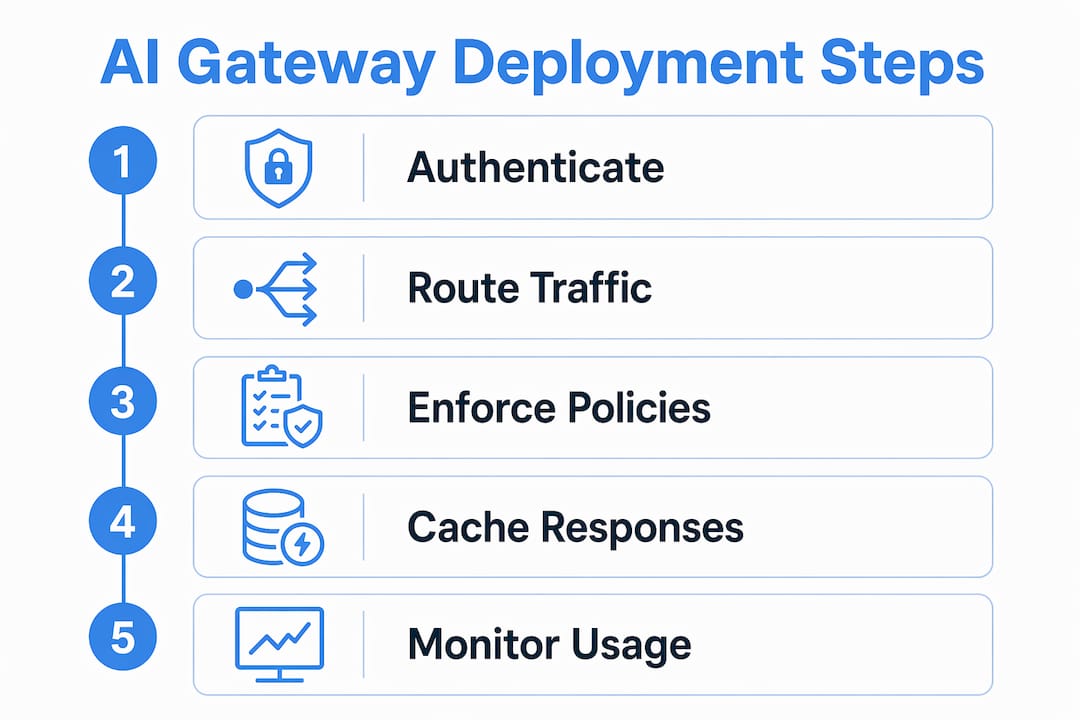
OAuth and JWT validation belong at the gateway layer, not inside individual application services. Centralizing authentication here means you audit one place, rotate one set of credentials, and enforce one policy. Bolting authentication onto each MCP server individually is a common gap in multi-agent deployments that creates inconsistent governance and complicates incident response.
What governance and security features do AI gateways provide?
Governance is where AI gateways earn their place in enterprise architecture. The core controls fall into three categories: identity and access, quota enforcement, and policy execution.
On the identity side, the gateway authenticates every caller before any token is spent. This means application teams get virtual API keys scoped to their namespace or service account. The gateway maps those virtual keys to real provider credentials internally, so no application pod ever holds a live OpenAI or Anthropic key. Holding provider API keys exclusively in the gateway and not distributing them to application pods reduces secret sprawl and enables precise auditing of which service made which call.
Quota enforcement operates at multiple granularities. Token budget policies can be set per namespace, per application, or per team on hourly, daily, or monthly windows. When a caller hits its limit, the gateway returns a 429 before the request reaches the provider. This prevents runaway agent loops from generating unexpected bills. You can also configure soft limits that trigger alerts without hard blocking, giving teams visibility before they hit a wall.
Policy execution covers content safety filters, prompt injection detection, and response validation. Some gateways integrate with external moderation APIs to screen both inbound prompts and outbound responses. Circuit breaker configurations protect downstream models from cascading failures. When a model endpoint becomes unhealthy, the gateway routes traffic to a fallback provider automatically, maintaining availability without application-level changes.
Pro Tip: Set token budget alerts at 70% of your monthly limit, not 90%. By the time you receive a 90% alert, a single high-volume agent can breach the limit before your team responds. The 70% threshold gives you a meaningful intervention window.
Centralizing authentication and policy enforcement in the gateway also reduces configuration complexity across application services. Teams stop duplicating retry logic, timeout handling, and error normalization in every service. The gateway owns that logic once, and every caller benefits.
How do AI gateways improve observability and cost control?
Observability is the operational payoff of running an AI gateway. Without a gateway, token usage data is scattered across provider dashboards, application logs, and billing statements. With one, every request generates a structured log entry that captures caller identity, model name, prompt tokens, completion tokens, latency, and cost estimate in a single record.
Prometheus and Grafana are the standard stack for surfacing these metrics. Gateways expose a /metrics endpoint that Prometheus scrapes on a configurable interval. Grafana dashboards then visualize token usage by caller, latency percentiles by model, and error rates by provider. This gives platform teams a real-time view of AI workload health without touching provider-specific tooling.
For distributed tracing, the OpenTelemetry agent-to-gateway pattern separates lightweight telemetry collectors running in each pod from a centralized gateway that performs tail-based sampling and filtering. This architecture keeps per-pod overhead minimal while concentrating the expensive sampling decisions in one place. The critical deployment constraint is that all spans from a single trace must route to the same gateway instance. If spans from one trace land on different gateway replicas, tail-based sampling breaks because no single instance has the complete trace context.
| Metric | What It Tells You | Recommended Alert Threshold |
|---|---|---|
| Token usage per caller | Which service or agent is driving cost | 80% of monthly budget |
| P99 latency by model | Identifies slow providers or overloaded endpoints | Greater than 5 seconds |
| Error rate by provider | Signals provider instability or misconfiguration | Greater than 1% over 5 minutes |
| Cache hit rate | Measures semantic caching effectiveness | Below 20% warrants review |
Dynamic endpoint picking based on runtime metrics like KV-cache utilization and active LoRA adapter counts takes routing beyond simple round-robin. The Endpoint Picker service reads real-time inference pod metrics and directs each request to the pod best positioned to handle it. Under variable load, this reduces tail latency significantly compared to static load balancing. For teams running self-hosted models on GPU infrastructure, this feature alone can justify the gateway overhead.
MLflow's AI observability platform integrates directly with these tracing patterns, giving teams deep visibility into agentic reasoning chains alongside the gateway-level metrics described above.
Key takeaways
An AI gateway is the single most effective architectural decision for teams managing multiple AI models, agents, or providers at scale because it centralizes authentication, cost control, and observability in one enforceable layer.
| Point | Details |
|---|---|
| Centralized control plane | Route all LLM traffic through one gateway to enforce policy and eliminate secret sprawl. |
| Two-tier architecture | Use Tier One for perimeter auth and routing, Tier Two for fine-grained self-hosted model access. |
| Token budget enforcement | Set per-team or per-app quotas with alerts at 70% to prevent runaway agent costs. |
| Tail-based sampling constraint | Route all spans from one trace to the same gateway instance or tail sampling breaks. |
| Governance beyond routing | Evaluate gateways on quota control, multi-agent support, and audit trail depth, not just routing speed. |
Why most teams underestimate what an AI gateway actually needs to do
I have seen teams deploy a gateway as a thin reverse proxy, configure it to forward requests to OpenAI, and call it done. That works for a proof of concept. It fails in production within weeks. The first agent that enters a retry loop, the first team that accidentally shares an API key, the first month-end bill that surprises finance — these are the moments that reveal whether your gateway is a real control plane or just a URL forwarder.
The governance layer is where most implementations fall short. Decision-makers should evaluate AI gateway solutions based on quota control, multi-agent integration support, and audit trail depth, not just routing capability. A gateway that cannot tell you which agent made which call at what cost is not a governance tool. It is a proxy with extra steps.
The tail-based sampling problem in distributed tracing is genuinely underappreciated. Accurate tail sampling requires all spans from a trace to land on the same collector instance. When you scale your gateway horizontally with a standard round-robin load balancer, you break this guarantee. The fix is consistent hashing on trace ID at the load balancer layer, but most teams discover this only after their trace data becomes unreliable under load.
My practical recommendation: start with the security model, not the routing model. Lock down API key management at the gateway on day one. Add quota enforcement in week one. Build out observability dashboards in month one. Routing sophistication, semantic caching, and dynamic endpoint picking are valuable, but they deliver no value if your security posture is weak underneath them.
— Kevin
How MLflow's AI gateway supports production-grade AI orchestration
MLflow's AI Gateway platform is built specifically for teams that need more than a proxy. It provides centralized, secure management of LLM and agent workflows with production-grade observability baked in. The gateway handles cross-provider routing, prompt management, and token budget enforcement while MLflow's tracing infrastructure captures the full reasoning chain of every agent interaction. For teams building on Kubernetes, MLflow deploys cleanly into existing cluster configurations and integrates with Prometheus and OpenTelemetry without custom instrumentation. If you are evaluating AI integration solutions for enterprise agent deployments, the MLflow GenAI platform gives you governance, observability, and multi-agent orchestration in one open-source platform.
FAQ
What is an AI gateway in simple terms?
An AI gateway is a middleware layer that sits between your applications and AI model providers, handling authentication, routing, rate limiting, and usage logging from a single control point. It prevents every application from needing its own provider credentials and policy logic.
How does an AI gateway differ from a standard API gateway?
A standard API gateway manages HTTP traffic for general services. An AI gateway adds LLM-specific capabilities including token budget enforcement, semantic caching, model fallback routing, and prompt-level observability that general API gateways do not provide natively.
Which open-source AI gateway tools are most widely used?
LiteLLM Proxy, Envoy AI Gateway, and Mozilla's open-source gateway are the most widely deployed open-source options. Each supports OpenAI-compatible API surfaces and multi-provider routing, with different trade-offs in operational complexity and feature depth.
How do AI gateways control costs for AI workloads?
Gateways enforce token budgets per team, application, or namespace on configurable time windows. Combined with semantic caching to eliminate redundant API calls and real-time spend dashboards via Prometheus and Grafana, they give teams precise control over AI expenditure before bills arrive.
What is the biggest security risk in AI gateway deployments?
The most common gap is distributing provider API keys directly to application pods instead of holding them exclusively in the gateway. This creates secret sprawl across your cluster and makes auditing nearly impossible. Centralizing all provider credentials in the gateway and issuing virtual keys to applications eliminates this risk.