Multi-Provider AI Strategy Explained for Enterprise Teams

A multi-provider AI strategy is defined as the practice of routing AI workloads across multiple model providers through a unified architecture, rather than depending on a single vendor's API. This approach treats AI models as external dependencies, complete with abstraction layers, failover circuits, and policy engines. Enterprise teams adopting this model gain measurable advantages in availability, cost control, and capability refresh. Initiatives like the EY and Microsoft $1B global program and platforms like Eden AI demonstrate that multi-provider AI strategy explained at scale is an architectural discipline, not just a vendor diversification tactic.
What is a multi-provider AI strategy and why does it matter?
A multi-provider AI strategy is portfolio management for AI models, selecting providers by task type, latency requirement, and risk tier rather than using every model simultaneously. The core insight is that no single provider excels at every workload. Code generation, long-context reasoning, multimodal tasks, and real-time chat each have different cost and performance profiles across providers like OpenAI, Anthropic, Google Gemini, and open-source models hosted on private infrastructure.
The business case is direct. Vendor lock-in through single-provider APIs causes agility loss when pricing changes or a provider deprecates a model. A unified API layer, as offered by platforms like Eden AI, lets teams benchmark, switch, and onboard new models without rewriting application logic. That flexibility compounds over time as the model market evolves rapidly.
What are the key architectural components?
A production-grade multi-provider architecture has five distinct layers, each with a specific function.
-
Provider abstraction layer. This layer shields application code from the differences in SDKs, request and response formats, and error codes across providers. Your application calls one internal interface; the abstraction layer translates that call to the correct provider format.
-
Routing and fallback logic. The router selects a provider based on defined SLAs, current latency, and cost thresholds. If the primary provider exceeds a latency ceiling or returns errors, the router fails over to the next candidate automatically.
-
Circuit breakers and health monitoring. Circuit breakers use sliding failure windows to detect degraded providers and enter a half-open state that probes for recovery before restoring full traffic. Without this mechanism, a slow provider causes hanging requests and latency cascades across the entire application.
-
Policy engine. This component enforces governance rules. Policy-driven routing factors in data sensitivity, user roles, geography, and regulatory constraints to select the correct provider for each request.
-
Observability and monitoring layer. This layer tracks token usage, cost per provider, error rates, and latency percentiles. Teams use this data to tune routing rules and catch provider degradation before it affects users.
Pro Tip: Define latency SLAs per UI feature before you write a single line of routing logic. Streaming chat requires p95 TTFT below 1500ms; batch jobs tolerate far longer. Mixing these in one routing policy produces unpredictable results.
| Layer | Primary function | Failure mode without it |
|---|---|---|
| Provider abstraction | Unified API across providers | Tight coupling to one SDK |
| Routing and fallback | Dynamic provider selection | No automatic recovery |
| Circuit breakers | Fail-fast on degraded providers | Latency cascades and hangs |
| Policy engine | Governance and compliance routing | Data locality violations |
| Observability | Usage and performance tracking | Blind spots in cost and errors |

What are the main benefits and risks?
The benefits of multi-provider AI are concrete and measurable when the architecture is implemented correctly.
- Availability. Firms targeting 99.97%+ uptime use threshold-based routing to filter slow providers in real time. A single-provider setup has no equivalent fallback path.
- Cost control. Pricing variance across providers for equivalent tasks is significant. Routing cost-insensitive batch jobs to cheaper providers while reserving premium models for latency-sensitive features reduces total inference spend.
- Capability refresh. New models ship constantly. A multi-vendor AI solution with a proper abstraction layer lets teams onboard a new model in days, not months.
- Vendor lock-in avoidance. When a provider changes pricing or deprecates a model, teams with abstraction layers switch without rewriting application logic.
The risks are real but manageable. Added architectural complexity is the primary concern. Without automated failover and circuit breakers, degraded providers cause latency cascades and hanging requests that undermine the availability gains the strategy is meant to deliver. The solution is automation, not simplification. EY's deployment of Microsoft Copilot across 150,000 users produced 15% productivity gains reinvested in learning and client delivery. That result required integrated governance and standardized workflows, not just multiple API keys.
How do organizations implement multi-provider AI strategies in practice?
AI strategy implementation follows a clear sequence. Skipping steps, especially benchmarking and SLA definition, is the most common reason pilots fail to scale.
-
Benchmark providers by task type. Measure cost, latency, and accuracy for each workload category: chat, classification, code generation, and long-context summarization. Use a unified API layer like Eden AI to run these benchmarks without writing provider-specific code.
-
Implement the abstraction layer first. Build or adopt a provider abstraction layer before writing routing logic. This decouples your application from provider specifics and makes every subsequent step easier.
-
Define SLAs per feature. Set explicit latency and availability targets for each UI feature and background process. These SLAs drive routing rules and circuit breaker thresholds.
-
Apply policy-driven routing. Configure the policy engine to route sensitive data to private cloud inference and general workloads to public foundation models. Hybrid AI deployments under unified policy control are the standard pattern for regulated industries.
-
Establish continuous monitoring and governance workflows. Track provider performance against SLAs weekly. Adjust routing weights as provider performance shifts. Treat this as an ongoing operational discipline, not a one-time configuration.
-
Scale from pilot to enterprise-wide rollout. The EY-Microsoft 2026 initiative emphasizes agentic AI capabilities tied to measurable business outcomes as the bridge between isolated pilots and enterprise-wide value. Tie each deployment to a KPI before expanding scope.
Pro Tip: Engage forward-deployed engineers or consulting partners during the abstraction layer design phase. The decisions made at that stage, especially around error normalization and retry logic, determine how much operational debt you carry for years.
How does governance fit into multi-provider AI strategies?
Governance is not a post-deployment concern. It is a first-class architectural component in any multi-vendor AI solution operating at enterprise scale.
- Centralized access control. Every provider call passes through a central policy engine that enforces role-based access, data classification rules, and usage quotas. Teams can review AI model access control patterns to understand how to structure these controls.
- Data locality and privacy. Regulatory requirements in sectors like finance and healthcare mandate that certain data never leaves a specific geography. Policy engines route those requests to private cloud inference endpoints automatically.
- Unified auditing. A single audit log covering all provider interactions is the foundation for compliance reporting. Without it, teams cannot demonstrate which model processed which data under which policy.
- Responsible AI deployment. Safety guardrails, output filtering, and bias monitoring must apply consistently across all providers. A responsible AI deployment framework standardizes these controls regardless of which provider handles the request.
- Model usage rules. Some providers impose contractual restrictions on output use cases. The policy engine must encode these restrictions and enforce them at routing time.
How do you evaluate and select providers within a multi-provider ecosystem?
Provider selection is a continuous process, not a one-time decision. The evaluation framework has four dimensions.
| Dimension | What to measure | Why it matters |
|---|---|---|
| Cost | Price per token by task type | Drives routing for batch vs. real-time workloads |
| Latency | p50 and p95 TTFT per workload | Determines SLA feasibility per feature |
| Accuracy | Task-specific benchmark scores | Prevents routing high-stakes tasks to weaker models |
| Vendor roadmap | Model update cadence and deprecation policy | Affects long-term abstraction layer maintenance |
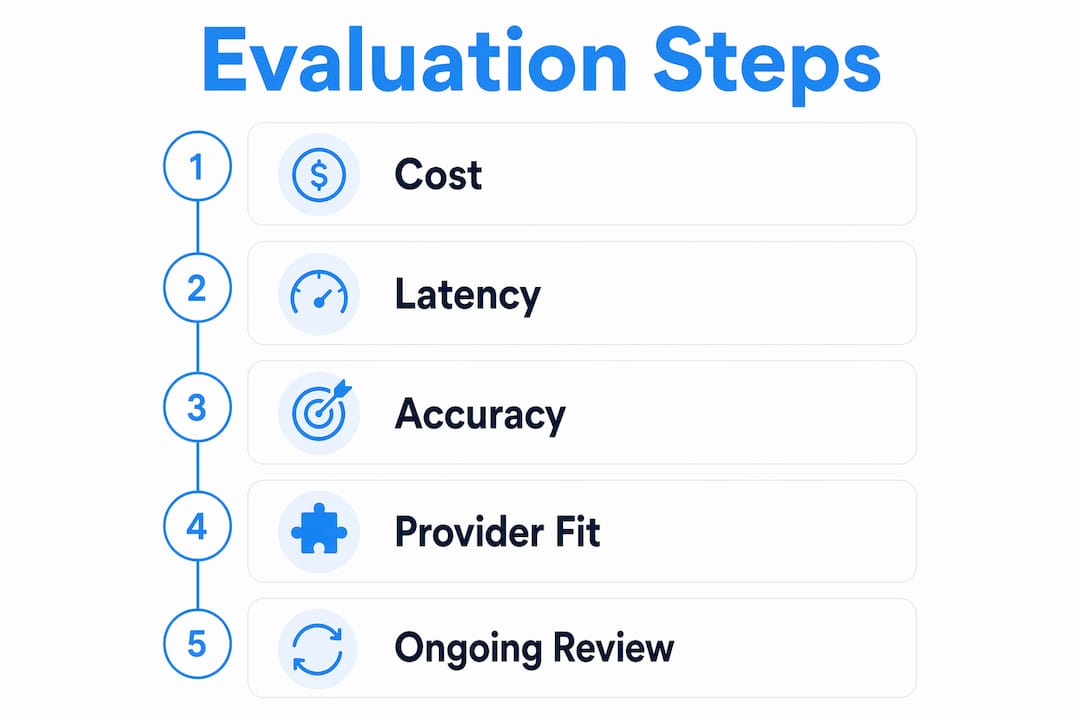
Multi-provider AI strategy is portfolio management by task and risk tier. A common misconception is that teams should use every available model simultaneously. The correct approach assigns providers to workload categories based on measured performance, then routes dynamically within those assignments.
Task specialization is the practical expression of this principle. Use a provider with strong code generation benchmarks for developer tooling. Use a long-context provider for document analysis. Use a fast, cost-efficient provider for classification tasks that run at high volume. Continuous benchmarking against these assignments catches provider drift before it affects production quality.
Pro Tip: Build a provider scorecard that updates monthly with fresh latency and cost data. Routing decisions made on six-month-old benchmarks are often wrong. The model market moves faster than most teams realize.
Key Takeaways
A multi-provider AI strategy requires a unified abstraction layer, automated circuit breakers, and policy-driven routing to deliver reliable, governed AI at enterprise scale.
| Point | Details |
|---|---|
| Abstraction layer is foundational | Build provider abstraction before routing logic to decouple application code from vendor specifics. |
| Circuit breakers prevent cascades | Sliding window failure detection and half-open recovery probes are required for true production reliability. |
| SLAs must be defined per feature | Streaming chat and batch jobs have different latency tolerances; mixing them in one policy creates unpredictable behavior. |
| Governance is architectural, not optional | Policy engines enforcing data locality, access control, and audit logging must be built in from the start. |
| Provider selection is ongoing | Monthly benchmarking on cost, latency, and accuracy keeps routing decisions aligned with current provider performance. |
Why the complexity argument against multi-provider AI is mostly wrong
The most common objection I hear is that multi-provider architectures add too much complexity for the reliability gains they deliver. That argument collapses when you examine what "simplicity" actually looks like in a single-provider setup. You get a single point of failure, no pricing leverage, and a hard dependency on one vendor's roadmap. That is not simple. That is fragile.
The real complexity risk is not the architecture itself. It is implementing the architecture without automation. Teams that add multiple providers without circuit breakers and health monitoring do create problems. But that is an implementation failure, not a strategy failure. Outcome-based AI integration tied to measurable KPIs is what separates successful multi-provider deployments from expensive experiments. The teams I have seen struggle are the ones that treat provider diversity as a goal rather than a means to specific performance and cost targets.
The governance layer is where I see the most underinvestment. Teams spend weeks on routing logic and days on policy engines. That ratio should be reversed. A routing layer without a policy engine is a liability in any regulated environment. Build the governance infrastructure first, then layer routing sophistication on top of it. The future of AI strategy collaboration between enterprises and providers will increasingly be defined by who owns the governance layer, not who picks the best model.
— Kevin
Mlflow supports multi-provider AI deployment end to end
Mlflow is built for teams that need production-grade observability and governance across complex AI deployments.
Mlflow's AI Gateway provides a centralized entry point for routing requests across multiple providers, with built-in support for API abstraction, prompt management, and cross-provider policy enforcement. The LLM tracing layer gives teams end-to-end visibility into every model call, including latency, token usage, and provider-specific error patterns. For teams evaluating model quality across providers, Mlflow's LLM-as-a-Judge evaluation framework automates output scoring at scale. The GenAI engineering platform ties these capabilities together for teams moving from prototype to production across multi-provider agent architectures.
FAQ
What is a multi-provider AI strategy?
A multi-provider AI strategy is the practice of routing AI workloads across multiple model providers through a unified abstraction layer, with automated failover, policy-driven routing, and centralized observability. It treats AI providers as interchangeable infrastructure components rather than fixed dependencies.
What are the main benefits of multi-provider AI?
The primary benefits are higher availability through automated failover, cost control through task-based routing, and freedom from vendor lock-in. Teams targeting 99.97%+ uptime use threshold-based routing to filter degraded providers in real time.
What are the biggest challenges of multi-provider AI?
The main challenge is architectural complexity, specifically the risk of latency cascades if circuit breakers and health monitoring are not implemented. Without automated fail-fast behavior, degraded providers cause hanging requests that undermine the availability gains the strategy is designed to deliver.
How do you select providers in a multi-provider AI ecosystem?
Select providers by benchmarking cost, latency, and accuracy per workload type, then assign providers to task categories rather than routing all traffic to every model. Update benchmarks monthly because provider performance and pricing shift frequently.
How does governance work in a multi-provider AI strategy?
Governance is enforced through a centralized policy engine that routes requests based on data sensitivity, user roles, geography, and regulatory requirements. A unified audit log covering all provider interactions is the foundation for compliance reporting across the entire multi-provider deployment.