Managing AI Vendor Risk for Enterprise AI Teams

The fastest way to control AI vendor risk in enterprise LLM and GenAI deployments is a proportionate TPRM overlay that combines AI-specific vendor assessments, contractual safeguards (AIBOM, material behavioral change clauses), and continuous behavioral monitoring. The NIST AI Risk Management Framework and the MAS proportionality principle are the two governing standards to anchor your program. Mlflow operationalizes the observability and automated evaluation layer that makes continuous monitoring practical at scale.
Start here — your immediate next steps:
- Tier every active AI vendor by impact, data sensitivity, and operational reliance (low / medium / high).
- Add three contract clauses to every new LLM vendor agreement: AIBOM delivery, material behavioral change notification, and explicit training-data opt-out for production keys.
- Run at least one synthetic behavioral test suite against each high-tier vendor API in your CI pipeline today.
Pro Tip: Verify the opt-out setting on every production API key before your next deployment. Default terms on most commercial LLM APIs permit training on your inputs unless you explicitly disable it.
Table of Contents
- How to classify AI vendor engagements by risk and apply proportional governance
- Vendor vetting checklist that goes beyond standard TPRM questionnaires
- Contractual controls, SLAs, and negotiation priorities that reduce AI vendor risk
- Run-time controls: observability, continuous evaluation, and operational gating
- Governance for subvendors, model suppliers, and open-source components
- Practical test suites, red-team playbooks, and audit evidence
- Phased rollout plan with RACI, timeline, and cost buckets
- KPIs, cadence, and who to brief on AI vendor risk
- Key Takeaways
- Why the governance gap matters more than the compliance gap
- Mlflow gives your team a production-grade vendor governance layer
- Useful sources and further reading
How to classify AI vendor engagements by risk and apply proportional governance
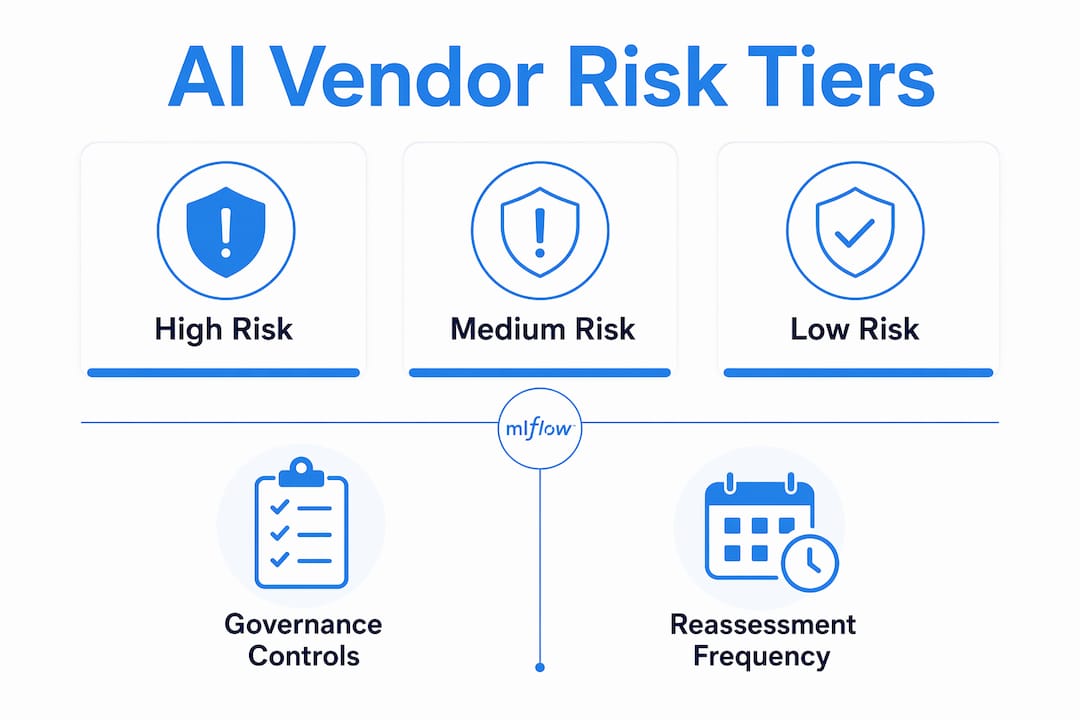
MAS guidance frames AI governance as proportionate to model impact, complexity, and operational reliance. That framing maps directly to NIST AI RMF's MAP function, which asks teams to define context before applying controls. The practical output is a risk tier that determines onboarding depth, reassessment frequency, and minimum control requirements.
Four materiality criteria drive tier assignment: (1) impact on regulated data or customer outcomes, (2) model complexity and opacity, (3) degree of operational reliance, and (4) whether the model generates customer-facing or legally consequential outputs.
| Tier | Example use case | Onboarding depth | Reassessment cadence | Minimum controls |
|---|---|---|---|---|
| Low | Internal concierge chat plugin | Lightweight questionnaire | Annual | Logging, opt-out verification |
| Medium | Internal code generation assistant | Standard TPRM + AI addendum | Semi-annual | AIBOM, bias review, behavioral tests |
| High | LLM generating customer-facing legal text | Full AI due diligence | Quarterly | Full TEVV, audit rights, incident SLA, subprocessor map |
A concierge chat plugin that only accesses internal FAQs sits at low tier. An LLM that drafts loan disclosures or medical summaries is high tier by definition, regardless of vendor reputation.
Vendor vetting checklist that goes beyond standard TPRM questionnaires
Standard TPRM questionnaires miss AI-specific risks like data lineage, bias mitigation, and model-training transparency. Your AI vendor assessment must add these items explicitly.
Core assessment items to request:
- Model provenance and AIBOM: Which base model, version, and fine-tuning layers are in scope?
- Training-data provenance: What datasets were used, and are they licensed for commercial use?
- Bias-mitigation documentation: What evaluation datasets and fairness metrics were applied?
- Data lineage and retention: Where does your input data go, and for how long?
- Explainability artifacts: Are model cards, datasheets, or TEVV logs available?
- Fine-tuning and continuous-training policy: Will the model be updated, and how will you be notified?
- Subprocessor disclosure: Which fourth parties process your data?
- Default data-use settings: Does the vendor opt out of training by default on production keys?
| Evidence request | Format to ask for |
|---|---|
| AIBOM | Machine-readable SPDX or CycloneDX file |
| Bias evaluation | Model card with fairness metrics and test datasets |
| TEVV logs | Test run artifacts, pass/fail thresholds, regression history |
| Subprocessor list | Named list with data-access scope |
Red flags: no AIBOM available, ambiguous data-reuse language, no process for notifying you of model updates, or inability to reproduce prior test cases.
Contractual controls, SLAs, and negotiation priorities that reduce AI vendor risk
The NIST Generative AI Profile recommends explicit disclosure clauses, recordkeeping obligations, and incident response planning as baseline contractual requirements for GenAI vendors. Practitioners add that you must define "material behavioral change" in objective terms, not just as a narrative concept.
Essential clauses to include or strengthen:
- AIBOM delivery at signing and on each model update
- Notification of material behavioral change within a defined window (a short notification window is a reasonable starting position)
- Explicit prohibition on using your data for model training or fine-tuning
- Named subprocessor list with change-notification obligations
- Audit rights: right to request TEVV logs, model cards, and incident records
- Incident response SLA: detection-to-notification timeline and remediation commitments
- Exit and data-destruction provisions: how model artifacts and your data are returned or destroyed
- Change-control approval: your right to approve or reject model version upgrades in production
On SLA metrics, target latency and availability thresholds appropriate to your use case, a model-behavior stability threshold tied to your synthetic test suite pass rate, and a maximum response time for model-change notification. Define "material" quantitatively: a regression of more than X% on your benchmark suite, or a shift in output distribution beyond a defined threshold.
Pro Tip: Require the vendor to retain historical model artifacts for a sufficient period to allow reproduction of prior outputs to investigate complaints or regulatory inquiries. Without them, you cannot reproduce a prior output to investigate a complaint or regulatory inquiry.

Run-time controls: observability, continuous evaluation, and operational gating
Continuous behavioral monitoring catches silent model drift and vendor-pushed updates that point-in-time audits miss entirely. The operational control layer has three components: instrumentation, gating, and continuous evaluation.
Observability checklist:
- Log every input, output, prompt version, and model version identifier
- Map prompt templates to artifact versions for full lineage
- Alert on distributional shifts in output length, sentiment, or refusal rate
- Gate deployments on pre-production TEVV pass rates
- Enable rollback to a prior model version within a defined SLA
For deployment gating, run pre-production TEVV (unit tests, integration tests, adversarial prompts) before any model version reaches production. After deployment, run synthetic behavioral tests continuously against the live vendor API. Mlflow's automated evaluation and deep tracing capabilities make this pipeline practical: you can instrument agentic reasoning traces, version prompts alongside model artifacts, and trigger alerts when evaluation scores drop below threshold.
Pro Tip: Add at least two synthetic adversarial prompts to your CI pipeline for every high-tier vendor integration. They cost almost nothing to run and are the fastest signal you have that a silent model update has changed behavior.
Governance for subvendors, model suppliers, and open-source components
The NIST GAI Profile explicitly recommends supplier vetting, SBOM/AIBOM requirements, and dynamic monitoring for third-party GenAI risks, including fourth-party components your primary vendor relies on.
Supply-chain controls to implement:
- Map every vendor's subprocessors and the data each can access
- Require AIBOM and SBOM for any model that uses open-source weights or third-party datasets
- Document fallback options for every critical AI service (what happens if the vendor API goes down or is deprecated?)
- For open-source models: vet licensing (Apache 2.0, MIT, or commercial-use-restricted?), pin versions explicitly, and prefer private cloud or on-premises hosting for high-tier workloads
Pro Tip: For your highest-risk workloads, private hosting of open-source model weights eliminates the subprocessor risk entirely. The operational overhead is real, but so is the data-custody advantage.
Practical test suites, red-team playbooks, and audit evidence
Repeatable testing is the operational backbone of AI vendor governance. A test suite for a third-party LLM integration should cover four layers:
- Unit tests: deterministic input/output checks for known-good and known-bad cases
- Integration tests: end-to-end workflow validation including upstream and downstream system behavior
- Adversarial prompts: injection attempts, jailbreak patterns, and out-of-distribution inputs
- LLM-as-a-Judge evaluation: automated scoring of output quality, safety, and policy compliance using a secondary model as evaluator
For red-teaming, define scope (which endpoints, which data categories), establish safe-handling rules for sensitive test inputs, use a severity taxonomy (critical / high / medium / low), and track remediation to closure. Mlflow's LLM-as-a-Judge framework supports automated evaluation artifact generation, which doubles as audit evidence.
Audit evidence to maintain: historical model outputs with version identifiers, TEVV run logs with pass/fail records, drift alerts with timestamps, model-change notifications from the vendor, and signed attestations of AIBOM delivery. Without this paper trail, you cannot demonstrate due diligence to a regulator or board.
Phased rollout plan with RACI, timeline, and cost buckets
| Phase | Timeline | Key activities | Trigger to advance |
|---|---|---|---|
| Pilot | Weeks 1–— | Tier 2–3 vendors, draft AI contract addendum, deploy synthetic test suite | TEVV pass rate stable; contract signed |
| Hardened onboarding | Weeks 7–— | Full TPRM AI overlay, AIBOM collection, observability instrumentation | All high-tier vendors assessed |
| Scale and continuous monitoring | Ongoing | Automated evaluation in CI, quarterly reassessments, executive reporting | KPIs within threshold for several weeks |
RACI summary:
- Vendor assessment: Procurement owns, Security reviews, ML Engineering consults
- Contract negotiation: Legal owns, Risk Management approves, ML Engineering provides technical requirements
- Runtime observability: ML Engineering owns, Security monitors, Risk Management reviews
- Incident response: Security owns, Legal notifies, ML Engineering remediates
- Offboarding: Procurement owns, Legal verifies data destruction, ML Engineering confirms artifact removal
Cost buckets to plan for: initial assessment labor (questionnaires, evidence review), tooling and monitoring infrastructure, legal negotiation time on AI-specific clauses, and ongoing audit and continuous evaluation compute.
Pro Tip: Pre-vetting a small set of approved providers dramatically reduces duplicate assessment work. Publish an internal approved-vendor list with pre-negotiated AI addenda and teams can onboard in days instead of weeks.
KPIs, cadence, and who to brief on AI vendor risk
Core KPIs to track:
- Model-behavior stability score (synthetic test suite pass rate, week over week)
- TEVV pass rate at each deployment gate
- Data provenance coverage (percentage of active vendor integrations with confirmed AIBOM)
- Incident mean-time-to-detect (MTTD) and mean-time-to-recover (MTTR)
- Third-party compliance score (percentage of vendors meeting minimum control requirements)
Reporting cadence: daily operational alerts for anomaly detection, weekly engineering reviews of behavioral stability trends, monthly risk-owner dashboards covering compliance scores and open findings, and quarterly executive heat maps showing tier distribution and incident trends.
For executive audiences, translate technical signals into business risk language: a drop in TEVV pass rate becomes "vendor model behavior has shifted outside approved parameters, affecting X workflows." Engineers need the root-cause detail; boards need the exposure and remediation timeline. Mlflow's enterprise AI monitoring capabilities support both layers by surfacing trace-level detail for engineers and aggregated evaluation scores for dashboards.
Key Takeaways
A proportionate, vendor-specific governance program combining AI-specific assessments, contractual safeguards, and continuous behavioral monitoring is the most effective way to manage AI vendor risk in enterprise GenAI deployments.
| Point | Details |
|---|---|
| Tier vendors by materiality | Assign low, medium, or high tier based on data sensitivity, model complexity, and operational reliance before applying controls. |
| Contractual rights are non-negotiable | Require AIBOM delivery, material behavioral change notification, and explicit training-data opt-out in every high-tier vendor agreement. |
| Continuous monitoring beats audits | Synthetic test suites running in CI catch silent model drift that point-in-time questionnaires miss entirely. |
| Supply-chain visibility requires AIBOM | Map subprocessors and require SBOM/AIBOM for every vendor using open-source weights or third-party datasets. |
| Mlflow operationalizes the monitoring layer | Mlflow's automated evaluation, LLM-as-a-Judge scoring, and deep tracing give teams the observability infrastructure to run continuous vendor governance at scale. |
Why the governance gap matters more than the compliance gap
The conventional framing of AI vendor risk as a compliance problem misses the operational reality. Regulatory checklists tell you what to document. They do not tell you that a vendor pushed a silent model update at 2 AM that shifted your customer-facing output distribution by enough to trigger a complaint pattern you won't see for three weeks. That is the actual risk.
The teams that manage this well are not the ones with the most elaborate governance documents. They are the ones who instrumented their vendor integrations early, defined behavioral thresholds before they needed them, and negotiated notification rights when the vendor still wanted the contract. The NIST AI RMF and MAS proportionality guidance are useful precisely because they push you toward measurable controls, not just policy statements.
The alignment between those frameworks and a well-instrumented MLflow deployment is not coincidental. GOVERN → MAP → MEASURE → MANAGE maps almost directly onto tier assignment, assessment, TEVV, and continuous monitoring. The teams that close the governance gap fastest are the ones who treat observability as a first-class engineering requirement, not an audit afterthought.
Mlflow gives your team a production-grade vendor governance layer
The hardest part of AI vendor governance is not writing the policy. It is instrumenting your production environment to detect behavioral drift, version your prompts alongside model artifacts, and generate audit-ready evaluation records automatically. That is exactly what Mlflow is built for.
Mlflow's GenAI and agent engineering platform gives enterprise AI teams automated LLM-as-a-Judge evaluation, deep tracing of agentic reasoning chains, prompt and artifact versioning, and a centralized AI Gateway for cross-provider governance. To pilot: configure an evaluation pipeline against your highest-tier vendor integration, add two synthetic behavioral tests to CI, and connect Mlflow tracing to your existing alerting stack. Your risk and security teams get the audit trail; your engineers get the root-cause signal. Start your evaluation at mlflow.org/genai.
Useful sources and further reading
The guidance in this article draws on the following authoritative documents and practitioner resources:
- NIST AI Risk Management Framework (AI RMF 1.0): Core governance structure (GOVERN, MAP, MEASURE, MANAGE), TEVV requirements, and monitoring recommendations. Directly supports sections on risk tiering, operational controls, and KPIs.
- NIST Generative AI Profile (AI 600-1): GAI-specific vendor disclosure, SBOM/AIBOM requirements, and dynamic monitoring guidance. Supports vendor assessment checklist and supply-chain sections.
- MAS AI Risk Management Executive Handbook: Proportionality principle, AI-specific KRIs, and procurement uplift guidance. Supports risk-tiering and contract sections.
- OECD Due Diligence Guidance for Responsible AI: Due diligence framework for AI systems across business relationships; supports vendor assessment and supply-chain governance.
- PwC: Responsible AI and Third-Party Risk Management: Practical guidance on integrating AI controls into TPRM and pre-vetting provider lists. Supports procurement and implementation sections.
- BeyondScale: Third-Party AI Vendor Risk Assessment: Practitioner playbook on behavioral monitoring, AIBOM contract language, and continuous test harnesses. Supports operational controls, contract, and testing sections.
- AI Governance Playbook: Managing Third-Party AI Risk: Guidance on training-data opt-out verification and production key management. Supports vendor assessment and contract sections.
- Mlflow implementation resources: AI observability, AI model governance, and AI risk management tag pages provide implementation depth mapped to the operational controls and monitoring sections of this guide.