Canary Deployment for AI Models: A 2026 Guide

What is canary deployment in AI, and why does it matter?
Canary deployment in AI is a progressive rollout strategy where a new model version receives a small slice of live production traffic while the stable version continues serving the rest. You monitor both versions concurrently, and if the new version degrades, an automated rollback reroutes traffic immediately without redeploying infrastructure.

The name comes from the coal-mining practice of carrying canaries underground. Toxic gas would kill the canary before reaching lethal concentrations for miners, giving workers an early warning. A canary release works the same way: a small user group absorbs the risk of a bad deployment before it reaches everyone.
For traditional software, "bad" usually means elevated error rates or latency spikes. AI changes that calculus. A new model version can be technically flawless, with zero errors and lower latency, yet produce subtly worse reasoning, shift tone, or hallucinate more frequently. Canary deployment in AI therefore monitors a broader signal set:
- Error rate and HTTP 5xx counts
- P99 latency and GPU out-of-memory events
- Automated quality scores (hallucination rate, coherence, toxicity)
- LLM-as-a-Judge evaluation results
- Business-level signals like task completion rate and user satisfaction
That combination of infrastructure and quality signals is what separates an AI canary from a standard software rollout.
Table of Contents
- Key benefits of canary deployment for AI models
- How canary deployments work technically
- Challenges unique to canary deployments in AI
- How to implement an AI canary deployment step by step
- AI-specific monitoring challenges you need to plan for
- Rollback and governance controls in canary deployments
- Tools and platforms that support canary deployment for AI/ML
- Metrics and KPIs for AI model performance during canary rollouts
- Mlflow gives your canary deployments production-grade observability
- Key Takeaways
Key benefits of canary deployment for AI models
Shipping a new model version to 100% of traffic in one step is a bet that your staging environment caught everything. It rarely does. Canary deployment gives you a controlled way to find out what staging missed.
- Risk containment. A faulty model version reaches only the canary slice. Automated rollback triggers update routing rules immediately, so the blast radius stays small.
- Detection of subtle quality regressions. Staging datasets are static. Production traffic is not. A canary observation window catches tone shifts, reasoning degradation, and edge-case failures that never appear in offline evaluation.
- Real user feedback loops. Quality signals from live users are richer than any benchmark. You learn how the model behaves on the actual distribution of prompts your users send, not a curated test set.
- Governance and compliance support. Canary deployment frames quality control as regression detection rather than subjective preference, making it achievable for most teams without the statistical overhead of full A/B testing.
- Capacity validation. Running both versions simultaneously under real load reveals GPU memory pressure, throughput limits, and scaling behavior before full rollout.
Pro Tip: Track qualitative metrics alongside infrastructure KPIs from the very first canary stage. A model that looks healthy on error rate and latency dashboards can still be producing logically inferior outputs. Catching that at 1% traffic costs almost nothing; catching it at 100% costs a lot.
How canary deployments work technically
The core mechanism is traffic weight splitting. Your load balancer or service mesh routes a configured percentage of requests to the canary version while the remainder go to the stable baseline. Both versions run concurrently, and you compare their metrics against each other rather than against a historical baseline, which controls for traffic pattern changes throughout the day.
Traffic splitting and progression
A typical rollout progression moves through stages starting with a small percentage of traffic for a short period, gradually increasing through several increments until full rollout. At each stage, automated checks evaluate whether the canary version has crossed any rollback threshold. If it passes, traffic weight increases. If it fails, routing reverts to the stable version without a redeployment.
Consistent user routing
For conversational AI and agents, consistent routing by hashing the user ID or session ID is critical. Without it, a user mid-conversation could hit the stable model on one turn and the canary on the next, producing incoherent dialogue context. Deterministic hashing keeps each user pinned to one version for the duration of the rollout.
Canary vs. blue-green vs. linear deployment
| Dimension | Canary | Blue-Green | Linear |
|---|---|---|---|
| Traffic shift | Gradual, percentage-based | Instant, all-at-once | Incremental, fixed steps |
| Rollback speed | Fast (reroute only) | Fast (reroute only) | Moderate |
| Infrastructure cost | Moderate (both versions live) | High (full duplicate env) | Low to moderate |
| Risk exposure | Low (small initial slice) | Higher (full cutover) | Moderate |
| AI quality monitoring | Continuous across stages | Limited observation window | Staged but less granular |
| Best for AI models | Yes, preferred | Less suitable | Acceptable for low-risk updates |
Blue-green deployments swap all traffic at once, which limits your ability to catch subtle quality regressions before they hit every user. Canary is preferred for AI model updates precisely because it preserves an observation window long enough to accumulate meaningful quality signals. You can read a deeper breakdown of blue-green deployment mechanics if you want to compare the infrastructure tradeoffs directly.
Challenges unique to canary deployments in AI
AI canaries are harder to run than software canaries, and the difficulty is mostly about measurement, not infrastructure.
- Non-deterministic outputs. The same prompt can produce different responses across runs. That variability makes it harder to distinguish a genuine quality regression from natural output variance, so you need more samples before drawing conclusions.
- Expensive quality metrics. Measuring hallucination rate or coherence requires running an LLM-as-a-Judge evaluation on each response. That adds latency and cost to every canary request, which affects how long you can afford to run a canary stage.
- Longer soak times. Because quality signals are noisy, you need more traffic at each stage to reach statistical confidence. A software canary might complete in minutes; an AI canary often needs hours at each stage.
- Consistent user experience. Mixed model exposure within a single user session creates incoherent experiences, especially for agents that maintain state across turns. Hashing must be applied at the session level, not the request level.
- Subjective quality tradeoffs. A new model might score better on factual accuracy but worse on tone. Deciding which dimension gates the rollout requires explicit policy decisions before the canary starts, not during it.
- Human rater coverage. Automated judges miss some failure modes. Including a sample of human-rated responses in your rollback logic catches the cases that LLM-as-a-Judge scores miss.
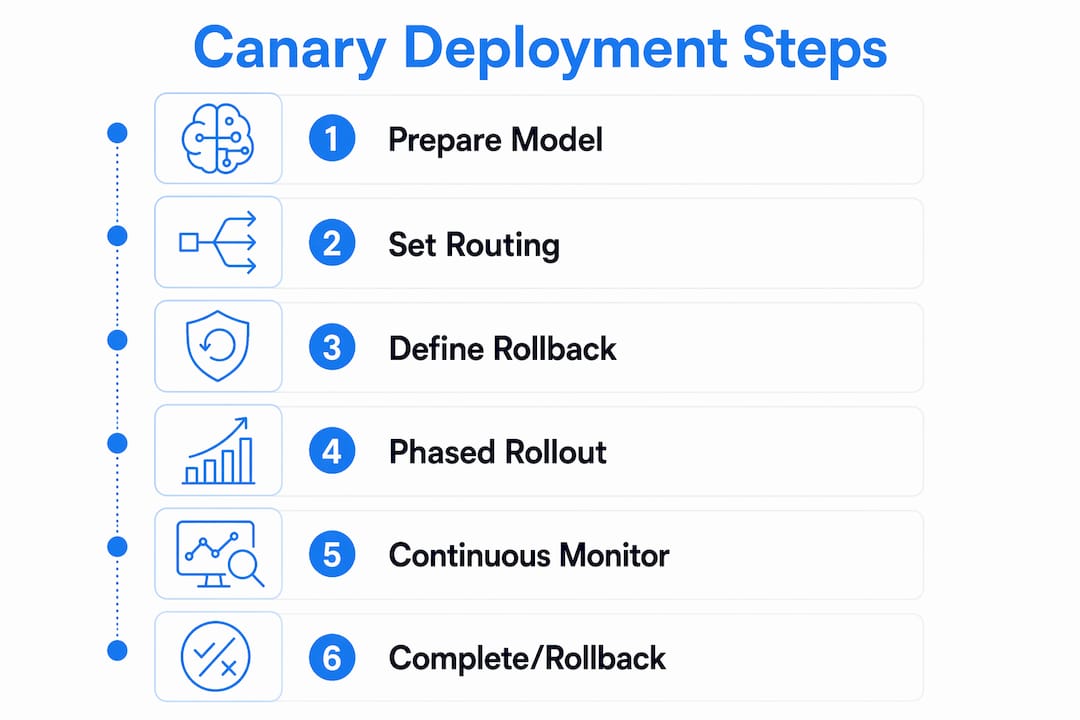
How to implement an AI canary deployment step by step
1. Prepare the new model version
Tag the new model version in your registry with a unique identifier and document the changes: architecture differences, fine-tuning dataset, prompt template updates, or inference parameter changes. This metadata becomes your audit trail if a rollback is needed.
2. Set up traffic routing infrastructure
Configure your load balancer or service mesh to support weighted routing between the stable and canary versions. Implement deterministic user-ID or session-ID hashing so each user stays on one version throughout the rollout.
3. Define rollback thresholds before you start
Rollback triggers should be set against the concurrent baseline, not historical averages. Thresholds include error rate increases, latency increases, GPU out-of-memory events, decreases in automated evaluation scores, increases in toxicity, and drops in coherence scores. Agree on these thresholds with your team before traffic shifts begin.
4. Execute phased rollout stages
| Stage | Traffic to canary | Minimum soak time | Key checks |
|---|---|---|---|
| Initial | 1% | ≥10 min | Basic infrastructure metrics |
| Early | 5% | Longer duration | Additional automated quality metrics |
| Mid | 25%-50% | Extended duration | In-depth quality checks including coherence and toxicity |
| Late | 100% | Ongoing | Includes human rater samples and comprehensive monitoring |
5. Monitor continuously and automate decisions
Wire your monitoring stack to evaluate metrics at each stage boundary. Automated checks should either advance the rollout or trigger rollback without requiring manual intervention. Manual review remains valuable at the 50% stage before full cutover.

6. Complete or roll back
If all stages pass, promote the canary version to stable and decommission the old version. If any stage fails, reroute all traffic back to the stable version and open a post-mortem on which metric triggered the rollback.
Pro Tip: Integrate Mlflow's LLM-as-a-Judge evaluation into your canary monitoring pipeline. Mlflow's automated evaluation framework scores model outputs against quality rubrics in real time, giving you a structured quality signal at each rollout stage rather than relying solely on infrastructure metrics.
AI-specific monitoring challenges you need to plan for
The hardest part of running a canary for an AI model is not the traffic routing. It is deciding what "worse" means and then measuring it reliably under production conditions.
Traditional software canaries gate on binary signals: the request either succeeds or it fails. AI outputs exist on a quality spectrum. A response can be grammatically correct, factually wrong, and still return HTTP 200. That gap between infrastructure health and output quality is where most AI canary failures hide.
Monitoring only technical signals is the most common mistake teams make when canarying AI models. A model can be faster with zero errors yet produce logically inferior outputs. LLM-as-a-Judge evaluation and human rater samples must be part of the rollback logic, not an afterthought reviewed after the rollout completes.
Because quality metrics like hallucination rate and coherence scores are computationally expensive and inherently noisy, AI-specific canaries require prolonged monitoring and longer soak times compared to classical software canaries. A stage that would take 10 minutes for a web service might need 2 hours for an LLM-based agent to accumulate enough rated samples for a statistically meaningful comparison.
LLM-as-a-Judge frameworks address part of this problem by automating quality scoring at scale. But they introduce their own noise: the judge model has its own biases and failure modes. Calibrating your judge against human rater agreement scores before the canary starts is worth the upfront investment. You can also use an AI search visibility test to benchmark how model changes affect discoverability and output quality in AI-driven contexts, which is increasingly relevant for production LLM applications.
Rollback and governance controls in canary deployments
Rollback in a canary deployment is a routing change, not a redeployment. When a threshold breach triggers rollback, the load balancer shifts 100% of traffic back to the stable version. The canary version stays deployed but receives no traffic, which preserves it for debugging without affecting users.
Governance controls should be defined in a written rollout policy before any canary starts. That policy should specify: who has authority to override an automated rollback decision, what the escalation path is when metrics are ambiguous, how long a canary must run before manual promotion is allowed, and which quality dimensions are hard gates versus advisory signals.
For regulated industries or high-stakes AI applications, every canary stage should produce a signed audit record: which model version was deployed, what traffic percentage it received, which metrics were evaluated, and what decision was made. Mlflow's tracing and experiment tracking capabilities make this audit trail straightforward to generate and store alongside your model registry entries. Connecting canary deployment to your broader AI model governance framework turns each rollout into documented evidence of due diligence.
Tools and platforms that support canary deployment for AI/ML
Several infrastructure layers are involved in a production AI canary, and different tools handle different parts of the stack.
Traffic routing is typically handled by a service mesh (Istio, Linkerd), a cloud load balancer (AWS ALB with weighted target groups, Google Cloud Load Balancing), or a managed deployment platform. Amazon ECS supports canary deployments natively, routing a configured percentage to a new task set and monitoring CloudWatch alarms before completing the shift. Google Cloud Deploy supports automated canary progressions with configurable percentage stages and deploy analysis.
Model registry and versioning is where Mlflow excels. Mlflow's model registry tracks every version, its lineage, and its evaluation results, giving you a single source of truth for which version is stable and which is canary. The registry integrates with serving infrastructure so that promoting or rolling back a version is a metadata operation rather than a manual redeployment.
Evaluation and observability during the canary window requires tooling that can score live outputs in real time. Mlflow's AI observability platform provides deep tracing of agentic reasoning chains, automated LLM-as-a-Judge scoring, and dashboards that compare canary versus baseline quality metrics side by side. That combination covers the monitoring gap that pure infrastructure tools leave open.
Exploring the full range of AI deployment methods available in the ecosystem helps teams choose the right combination of routing, evaluation, and observability tooling for their specific model architecture and traffic patterns.
Metrics and KPIs for AI model performance during canary rollouts
Infrastructure metrics are table stakes. The metrics that actually differentiate AI canary monitoring from traditional software monitoring are the quality signals.
Infrastructure metrics (compare canary vs. baseline concurrently):
- Error rate (HTTP 5xx, model inference failures)
- P99 and P95 latency
- GPU out-of-memory rate
- Throughput (requests per second)
- Token generation rate (for LLM-based models)
AI quality metrics (require automated or human evaluation):
- Hallucination rate: proportion of responses containing factual errors
- Coherence score: logical consistency across multi-turn conversations
- Toxicity score: rate of harmful or policy-violating outputs
- Task completion rate: proportion of user intents successfully resolved
- LLM-as-a-Judge score: automated rubric-based quality rating
Business metrics (often overlooked but critical):
- User session length and return rate
- Task abandonment rate
- Escalation rate to human agents (for support applications)
- Conversion rate (for recommendation or sales applications)
All metrics should be measured against the concurrent baseline version, not against historical averages. Traffic patterns change throughout the day, and comparing a canary running at 2 PM against a baseline measured at 9 AM introduces confounding variables that make rollback decisions unreliable. The rollback thresholds established in Section 5 apply here: error rate increase greater than 1 percentage point, P99 latency increase greater than 20%, automated evaluation score decrease greater than 5%, coherence score drop greater than 0.1, and any toxicity increase trigger immediate rollback.
Mlflow gives your canary deployments production-grade observability
Running a canary deployment for an AI model without the right observability stack means flying blind at the moment you can least afford to. Mlflow is built specifically for this problem.
Mlflow's GenAI and agent engineering platform combines model registry, LLM-as-a-Judge automated evaluation, and deep agentic tracing in a single open-source platform. During a canary rollout, you get real-time quality scoring on live outputs, side-by-side metric comparison between canary and baseline versions, and a complete audit trail of every evaluation decision. The centralized AI Gateway handles prompt versioning and cross-provider governance, so your canary infrastructure stays consistent whether you are routing to OpenAI, Anthropic, or a self-hosted model.
For MLOps teams moving from experimental prototypes to production agents, Mlflow removes the gap between offline evaluation and live monitoring. Start with Mlflow's platform at mlflow.org/genai to see how it fits your canary deployment workflow.
Key Takeaways
Canary deployment in AI is the most practical framework for catching quality regressions in production, because staging environments cannot replicate the full distribution of real user prompts.
| Point | Details |
|---|---|
| AI canaries monitor quality, not just uptime | Track hallucination rate, coherence, and toxicity alongside error rate and latency from the first stage. |
| Rollback is a routing change | Automated rollback reroutes traffic to the stable version instantly, without redeploying infrastructure. |
| Phased rollout with defined thresholds | Progress through 1%, 5%, 25%, 50%, and 100% traffic stages, with explicit metric gates at each step. |
| Consistent user routing is required | Hash by user or session ID to prevent mixed model exposure, especially for conversational agents. |
| Mlflow supports the full canary lifecycle | Mlflow provides model registry, LLM-as-a-Judge evaluation, and AI observability for production canary monitoring. |