3 Moves Today for Enterprise Azure OpenAI Governance: Trace Agents, CI

Azure OpenAI governance, in the sense that matters for production AI systems, means cross-provider lifecycle controls covering access, observability, and prompt management for LLMs and agents. Verify three things today: centralized prompt and version control with enforced access policies, production-grade tracing of every agent reasoning step, and CI-driven evaluation gates before anything ships. Start by inventorying your models, prompts, and telemetry endpoints, then centralize prompt storage and tracing around that inventory.
TL;DR:
- Effective governance requires centralized prompt and model version control, detailed tracing of agent decision steps, and strict CI evaluation gates before deployment.
- Maintaining a comprehensive model registry with metadata, enforcing least-privilege access, and applying concrete policy enforcement ensure early detection of governance gaps.
- Implementing distributed tracing with correlation IDs and masking sensitive data in logs support thorough audits and compliance over extended periods.
- Managing prompts as versioned artifacts, validated through automated tests and routed via a policy-enforcing gateway, reduces regressions and policy violations.
- Using tools like MLflow, with its observability, evaluation, and centralized prompt management, simplifies cross-provider governance and aligns with existing cloud security practices.
Table of Contents
- What Belongs in an Azure OpenAI Governance Checklist?
- How Do You Capture Agentic Reasoning for Audits?
- Should Prompts Be Managed Like Code?
- What Deployment Safeguards Prevent Production Incidents?
- How Do You Continuously Validate LLM and Agent Outputs?
- Where MLflow Fits: Practical Integration Points
- What Data Privacy Considerations Apply to Azure OpenAI Deployments?
- How Do You Stay Compliant With Regional and Industry Rules?
- What Risk Management Strategies Reduce AI Governance Exposure?
- How Does This Fit With Azure Native Security Tools?
- How Do You Control Costs Across Azure OpenAI Deployments?
- Operator Perspective: The First Three Things To Do This Quarter
- Get Started With MLflow's Governance Tools
- Further Reading on MLflow Governance Patterns
- FAQ
What Belongs in an Azure OpenAI Governance Checklist?
Governance fails quietly. A prompt gets edited in a shared doc, an API key leaks into a notebook, and nobody notices until an audit or an incident forces the question. A working governance checklist closes those gaps before they open, and it needs owners, not just policies.
Start with the model registry. Every model or fine-tuned variant your teams use in production should live in a registry with immutable artifacts, an approved list, and metadata tracking who trained it, on what data, and when it was promoted. Provenance without that metadata is just a folder of files.
Access control comes next, and it's where most teams cut corners under deadline pressure:
- Enforce least-privilege access to model endpoints, training data, and prompt stores.
- Separate roles so the person approving a prompt change isn't the same person deploying it.
- Scope API keys to specific services and rotate them on a schedule, not just after an incident.
- Log every access event with enough context to reconstruct who touched what and why.
Policy enforcement needs concrete checkpoints, not a document nobody reads. Define your safety policies (disallowed outputs, content filtering rules, escalation triggers) and wire them into actual enforcement hooks in your serving layer.
Change management ties it together. Require pull requests and review gates for any change to a model, prompt, or policy, with named approvers for each category. Finally, decide upfront what audit documentation you're required to keep, how long you retain it, and where the evidence lives, because reconstructing this after a regulator asks is far harder than logging it from day one.
How Do You Capture Agentic Reasoning for Audits?
An agent that calls three tools, reasons across two model providers, and produces a final answer is opaque unless you trace every hop. The trace needs to capture the prompt ID and version used, each intermediate reasoning step, every tool call with its inputs and outputs, and metadata from the final model response including latency and token counts.
Correlation IDs make this workable at scale. Tag each user request with a single ID that threads through every provider call and internal service, so a distributed tracing approach (the kind OpenTelemetry popularized for microservices) lets you reconstruct the full decision path across systems that were never designed to talk to each other.
Retention is a genuine trade-off. You need enough historical context to support an audit or root-cause analysis months later, but raw traces often contain personally identifiable information or fragments of secrets that shouldn't sit in plaintext logs indefinitely. Encrypt trace stores, define a retention window tied to your compliance obligations, and strip or mask sensitive fields at the instrumentation layer, not after the fact.
Structure each event as JSON, use spans for individual sub-decisions inside an agent's reasoning chain, and tag safety-relevant moments (a refused output, a tool call that hit a rate limit) so they're searchable later. MLflow's observability tooling describes this kind of deep tracing for agentic workflows, turning what would otherwise be a black box into a reviewable record that feeds directly into evaluation and compliance reporting.
Pro Tip: Tag every trace with a safety-flag field even when nothing goes wrong. A clean audit trail with visible "no issues found" tags is far more persuasive to a compliance reviewer than a log that only mentions problems.
Should Prompts Be Managed Like Code?
Yes, and teams that skip this step end up with five slightly different versions of the same prompt scattered across notebooks, Slack threads, and hardcoded strings. Treating prompts and policies as versioned artifacts is one of the highest-leverage habits an MLOps team can adopt.
- Store every prompt and policy in a versioned repository with metadata describing its purpose, example inputs and outputs, and its safety profile.
- Require pull request review, automated behavioral tests, and regression checks before any prompt gets promoted to production.
- Manage secrets through a vault system with ephemeral, short-lived credentials. Never hardcode a provider API key into a prompt template or config file.
- Tag prompt variants by use case and safety tier, and map each tier explicitly to the model families or endpoints it's allowed to call.
- Route all prompt traffic through a centralized gateway that can apply policy transforms or block disallowed outputs before they reach the user.
This isn't bureaucracy for its own sake. Version-controlled prompts with automated tests catch regressions the same way unit tests catch a broken function, and a centralized AI Gateway gives you one enforcement point instead of policy logic duplicated across a dozen services.
What Deployment Safeguards Prevent Production Incidents?
Deployment is where governance either holds or collapses under real traffic. Pre-deploy CI checks should validate output schemas, run prompt regression tests against known cases, and execute a safety test suite covering your worst-case scenarios, not just the happy path.
Staged rollouts limit blast radius. Push a new model or prompt version to a small percentage of traffic first, watch quality and safety metrics against defined thresholds, and automate the rollback if those metrics degrade. Canary deployments with metric gates are standard practice across model pipelines precisely because manual rollback decisions are too slow once an issue is live.
Runtime safeguards matter just as much as pre-deploy checks:
- Rate limits and quota enforcement to contain runaway agent loops or cost spikes.
- Input sanitization to block prompt injection attempts before they reach the model.
- Circuit breakers that halt a failing integration instead of retrying into a cascading outage.
- Version pinning so a provider-side model update doesn't silently change your production behavior overnight.
Pair all of this with a documented incident response playbook specifically for model or agent misbehavior. Guidance on these operational patterns is available in MLflow's deployment best-practice articles, and having the playbook written before an incident happens is the difference between a contained issue and a scramble.
How Do You Continuously Validate LLM and Agent Outputs?
Manual spot-checking doesn't scale past a handful of prompts, which is why automated evaluation belongs directly in your CI pipeline, not as a quarterly review. Unit tests catch obvious regressions, behavioral tests check for tone and policy compliance, and regression suites run against every prompt or model change before it ships.

LLM-as-a-Judge patterns extend this by using a separate model to score outputs against a rubric, generating pass/fail signals at a volume no human review team could match. Fold red-teaming into a regular cadence, not a one-time exercise, and treat adversarial findings as acceptance criteria for the next release rather than a report that sits in a drawer.
Track these operational metrics continuously:
- Safety incident rate and severity.
- Hallucination indicators flagged by your judge model or user reports.
- Latency and error rates by provider and model version.
- User-reported failures, categorized by root cause.
Map every evaluation outcome to a concrete governance action. A model that passes should be promoted; one that regresses gets rolled back or restricted to a narrower use case automatically, not after a meeting.
Where MLflow Fits: Practical Integration Points
Every control above maps to a concrete implementation choice, and MLflow was built around exactly this lifecycle. Its observability tooling provides the deep tracing for agentic reasoning described above, capturing structured telemetry across tool calls and reasoning steps rather than a flat request log.
The AI Gateway gives you the centralized prompt management and cross-provider access control the checklist calls for, so policy enforcement happens at one layer instead of being duplicated per integration. MLflow's evaluation frameworks support automated scoring and LLM-as-a-Judge workflows directly, which means the CI gates described in the evaluation section aren't a separate system you have to bolt on.
In practice, teams connect MLflow traces to their existing telemetry backend, plug MLflow's evaluation checks into their CI pipeline as a promotion gate, and use the AI Gateway to enforce policy at call time rather than after the fact.
What Data Privacy Considerations Apply to Azure OpenAI Deployments?
Data flowing through any hosted LLM endpoint, including Azure-hosted deployments, carries privacy exposure at multiple points: the prompt itself, any retrieved context injected into it, and the model's response. Enterprise governance has to treat all three as sensitive, not just the obvious ones.
Prompts frequently contain customer names, account details, or internal business data that gets typed in without a second thought. Before that prompt reaches any model endpoint, you need a masking or redaction layer that strips personally identifiable information, particularly in customer-facing agent applications where user input is unpredictable by design.
Data residency matters for regulated industries. Know where your prompt and response data is processed and stored, and confirm that matches your organization's data residency commitments to customers or regulators. This isn't a one-time check. Provider infrastructure changes, and your governance process needs a recurring review, not a checkbox ticked at initial deployment.
Retention policy deserves the same rigor. Decide explicitly how long prompt and response logs persist, who can access them, and under what conditions they get purged. A trace store built for audit purposes (see the observability section above) needs the same encryption and access controls as any other system holding customer data, because functionally, that's exactly what it is.
Finally, build a data flow diagram that shows every hop a piece of user input takes, from the initial request through any retrieval step, the model call, and back to the response. If you can't draw that diagram cleanly, you don't yet have the visibility privacy governance requires.
How Do You Stay Compliant With Regional and Industry Rules?
Compliance requirements vary sharply by industry and region, and no single control satisfies all of them. A healthcare deployment handling patient data faces different constraints than a financial services agent processing transaction requests, even if both run on the same underlying model.
The starting point is mapping which regulatory frameworks actually apply to your use case. Financial services teams typically need to satisfy model risk management expectations, healthcare teams need to address patient data handling, and any organization serving European users needs to consider data protection obligations that govern automated decision-making. Treat this mapping as a living document, reviewed whenever you add a new use case or expand to a new region, not a one-time legal sign-off.
Documentation is where compliance and engineering overlap most directly. Regulators and internal audit teams generally want to see what data trained or informed a model, what testing was performed before deployment, and what human oversight exists for high-stakes decisions. MLflow's governance-tagged articles cover practical patterns for building this kind of documentation into your existing workflow rather than treating it as a separate compliance exercise bolted on afterward.
Industry-specific rules often require human review for certain decision categories. If your agent makes or influences decisions about credit, employment, or medical triage, confirm whether a human review step is legally required before the decision takes effect, and build that checkpoint into your deployment architecture rather than your policy document. A policy that isn't enforced in code is a policy that will eventually be violated by accident.
What Risk Management Strategies Reduce AI Governance Exposure?
Risk in production LLM and agent systems shows up in three flavors: technical failure, policy violation, and reputational exposure, and each needs a distinct mitigation approach rather than one generic "AI risk" bucket.
Technical risk, model drift, hallucination, latency spikes, gets addressed through the evaluation and monitoring practices covered earlier, tied to concrete rollback triggers. Policy risk, an agent producing disallowed content or violating a safety rule, gets addressed at the gateway layer through enforced policy transforms rather than relying on the model to police itself.
Reputational risk is the one teams underestimate most. A single widely shared example of an agent giving a harmful or embarrassing answer can undo months of careful deployment work, regardless of how rare the failure actually was in aggregate. Build a rapid response process for exactly this scenario: a way to pull a model or prompt version from production within minutes, not hours, and a communication plan that doesn't require executive sign-off to execute the technical rollback.
Risk scoring helps prioritize where governance effort actually goes. Not every use case carries the same stakes. An internal drafting assistant and a customer-facing financial advisory agent need very different levels of scrutiny, and treating them identically wastes review capacity on low-risk cases while under-resourcing the high-risk ones. A practical enterprise risk management framework scores each deployment by potential harm and assigns review depth accordingly, rather than applying one uniform gate to everything.
How Does This Fit With Azure Native Security Tools?
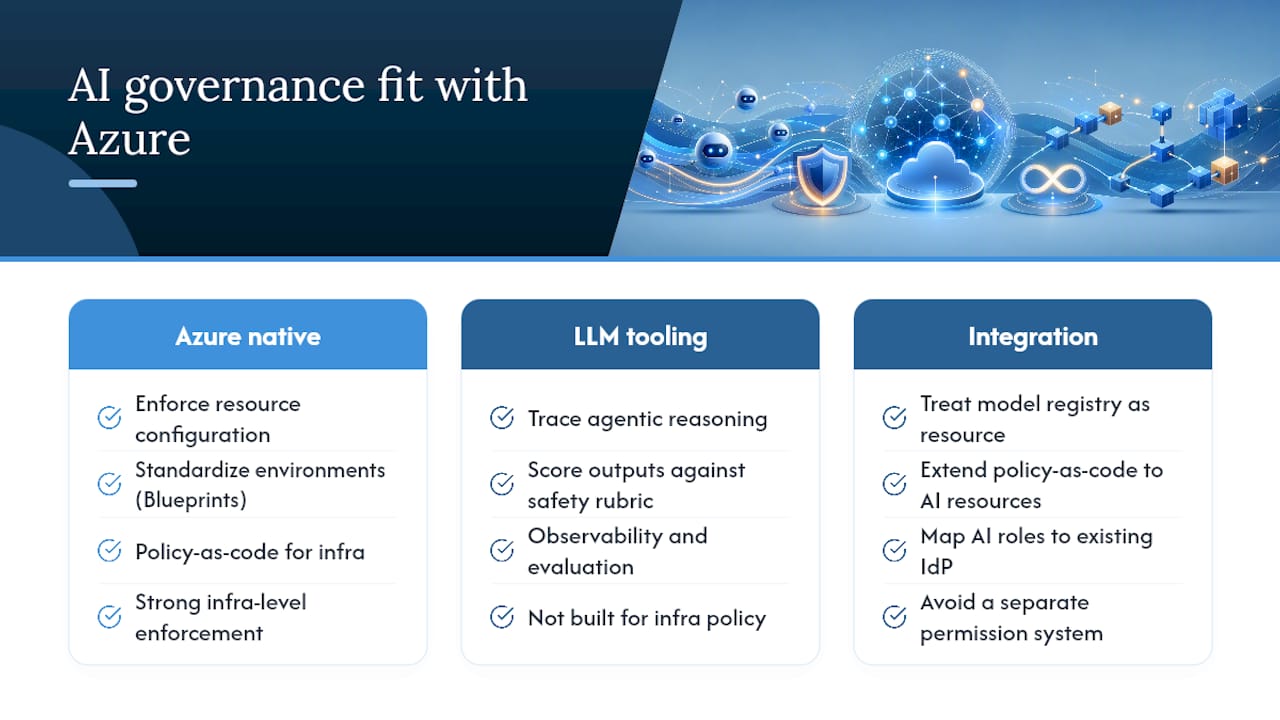
Enterprise teams running on Azure infrastructure typically already have native governance tooling in place for cloud resources broadly, and AI workloads shouldn't sit in a separate silo from that existing control plane. Azure Policy can enforce organizational rules around resource configuration, and Azure Blueprints can standardize compliant environment setup across teams. The governance controls described throughout this article, model registries, access policies, audit logging, sit alongside those native tools rather than replacing them.
The practical integration point is treating your model registry, prompt store, and gateway configuration as resources subject to the same policy-as-code discipline you'd apply to any other cloud infrastructure. If your organization already uses policy-as-code to enforce network configurations or storage encryption, extend that same discipline to AI-specific resources: who can register a new model, who can modify a gateway policy, what tags are required on any production AI endpoint.
Identity and access management is the clearest overlap. Role separation for AI governance (the distinction between who approves a prompt change and who deploys it, covered in the checklist section) should map onto your existing enterprise identity provider and role definitions rather than creating a parallel access system specific to AI tooling. A second, disconnected permission system is itself a governance risk, because it's one more place credentials can drift out of sync with actual organizational roles.
Native cloud governance tools are strong at infrastructure-level policy enforcement. They're not built to trace agentic reasoning or score model outputs against a safety rubric. That gap is exactly where dedicated LLM and agent observability and evaluation tooling needs to plug in alongside your existing cloud governance stack, not instead of it.
How Do You Control Costs Across Azure OpenAI Deployments?
Cost overruns in LLM deployments rarely come from a single obvious source. They accumulate from unbounded agent loops, verbose prompts that burn tokens unnecessarily, and a lack of visibility into which team or use case is actually driving spend.
Start with granular tagging. Every model call should carry metadata identifying which application, team, and use case triggered it, so a monthly cost report can actually attribute spend rather than showing one undifferentiated total. Without this, cost conversations become guesswork, and the loudest team in the room tends to win budget arguments regardless of actual usage.
Quota enforcement at the gateway layer, the same layer handling policy enforcement described earlier, prevents a single misbehaving agent or a runaway retry loop from generating an unexpected bill. Set hard caps per team or application, and alert well before those caps are reached rather than after the invoice arrives.
Token efficiency deserves ongoing attention. Longer prompts, verbose system instructions, and unnecessarily large context windows all drive cost linearly with volume. Regularly review your highest-traffic prompts for unnecessary verbosity, and consider whether a smaller, cheaper model handles a given task adequately before defaulting to the most capable option available.
Finally, treat cost as a monitored metric with the same rigor as latency or error rate. A sudden cost spike is often the earliest signal of a technical problem, an agent stuck in a retry loop, a prompt injection causing excessive tool calls, before it shows up in any other monitoring dashboard.
Operator Perspective: The First Three Things To Do This Quarter
Governance work competes with feature deadlines, so prioritize ruthlessly. This week, inventory every model, prompt, and telemetry endpoint currently in production. Next, enable minimal tracing on agent decisions and centralize that metadata rather than letting it scatter across services. Finally, add one automated behavior test and one safety check to your CI pipeline before any promotion to production. Everything else in this checklist builds on those three moves.
— Kevin
Get Started With MLflow's Governance Tools
MLflow is the open-source route to the entire checklist covered here, not a single point solution bolted onto your existing stack. Every governance control this article describes, such as model registry provenance, agent tracing, prompt versioning, and automated evaluation gates, maps to capabilities offered by an open-source AI platform, with no enterprise features held back behind a paywall.
That matters because governance tooling that's incomplete in its free tier tends to get skipped under deadline pressure, and skipped governance is how incidents happen. An observability layer captures agentic reasoning traces needed for compliance, an AI Gateway centralizes prompt and policy enforcement, and an evaluation framework supports LLM-as-a-Judge checks that belong in your CI pipeline. Because the project uses Linux Foundation governance with broad framework compatibility through OpenTelemetry, it fits into infrastructure commonly used rather than requiring rebuilding around a proprietary stack.
Start by visiting MLflow's GenAI and agent engineering page to see how tracing, evaluation, and the gateway connect for agent-based workflows, then explore the main MLflow platform to plan your integration path.
Further Reading on MLflow Governance Patterns
FAQ
What Does Azure OpenAI Governance Mean for Production Systems?
In practice, it means cross-provider lifecycle controls for LLMs and agents: access management, observability through agentic tracing, and centralized prompt and policy governance. It covers the full pipeline from model registration through deployment, monitoring, and audit documentation.
What Should an Agentic Tracing System Capture?
A trace needs the prompt ID and version, every intermediate reasoning step, all tool calls with inputs and outputs, and model response metadata like latency. MLflow's observability tooling structures this telemetry specifically for agent workflows rather than flat request logs.
How Often Should Red-Teaming Happen?
Red-teaming works best as a recurring cadence tied to your release cycle, not a one-time exercise before launch. Fold every finding into your model acceptance criteria so adversarial results directly influence whether a version gets promoted or rolled back.
Does MLflow Support Cross-Provider Prompt Management?
Yes. MLflow's AI Gateway provides centralized prompt management and access control across model providers, giving teams one enforcement point instead of duplicated policy logic per integration.
What Does MLflow Cost for Enterprise Governance Use?
MLflow is available as open source with no published price for its core platform. Enterprise support and managed service options are discussed directly on the MLflow site.