Continuous Training in ML: A Practical MLOps Guide

Continuous training (CT) is the automated retraining loop that keeps production models current by triggering a new training run whenever measurable signals indicate the data distribution or model performance has shifted. You do not retrain manually on a schedule you set once and forget. Instead, the pipeline responds to real conditions in production.
TL;DR for ML engineers:
- Common triggers: scheduled cron jobs, new-data volume thresholds, monitored accuracy/ROC degradation, data distribution shift, schema or code changes. AWS Prescriptive Guidance covers all four trigger classes with implementation notes.
- Required platform pieces: model registry, metadata store, feature store, monitoring and observability layer, and pipeline orchestration.
- Where to start: scheduled retraining with manual validation gates first. Automate reactive retraining only after those gates pass consistently.
- Recommended lifecycle platform: Mlflow provides model registry, experiment tracking, and observability hooks that make CT artifacts reproducible and auditable from day one.
Table of Contents
- What is continuous training in ML, and how does it differ from related terms?
- Why does your model degrade without continuous training?
- What triggers a continuous training run?
- How does a continuous training pipeline work, step by step?
- Which training pattern fits your workload?
- What does a production-ready CT system require?
- What are the most common CT failure modes, and how do you fix them?
- Key Takeaways
- The part of continuous training most teams get wrong
- Mlflow makes CT pipelines traceable from the first run
- Useful sources and further reading
What is continuous training in ML, and how does it differ from related terms?
CT is an operational, pipeline-level concept. It describes the automated process of retraining a deployed model in production when a defined trigger fires, then evaluating and promoting the new model through a gated workflow. The term lives at the MLOps layer, not the algorithm layer.
That distinction matters when you are reading the literature. Continuous training in MLOps refers to the pipeline automation decision. Online learning and incremental learning, by contrast, are algorithmic approaches where the model updates its weights on individual records or mini-batches as data arrives, without a full retrain cycle. Lifelong learning is an academic framing for systems that accumulate knowledge across tasks over time without forgetting prior ones.
A practical naming convention: use "CT" when you are talking about pipeline automation and retraining cadence. Use "online learning" or "incremental learning" when you are describing the algorithm's update mechanism. Conflating them leads to architecture mismatches, because a system designed for online learning has very different infrastructure requirements than a batch-retrain CT pipeline.
Why does your model degrade without continuous training?
Two failure modes drive most production accuracy decay: data drift and concept drift.
Data drift is a change in the statistical distribution of input features. A fraud detection model trained on 2023 transaction patterns will see a different feature distribution by 2025 as payment methods, merchant categories, and user behaviors shift. The model's learned boundaries no longer match reality.
Concept drift is subtler. The relationship between inputs and the target label changes even when the input distribution stays stable. A credit-risk model may face concept drift after a macroeconomic shock: the same applicant features now predict different default probabilities.
The practical trade-off is real. Automation reduces staleness but raises operational risk. A CT pipeline that fires without validation gates can promote a model trained on poisoned or mis-specified data, causing cascading failures. That is why monitoring and gating are not optional add-ons; they are structural requirements of any CT system.
What triggers a continuous training run?
AWS Prescriptive Guidance on continuous training organizes triggers into four practical classes. Here is how to instrument each one:
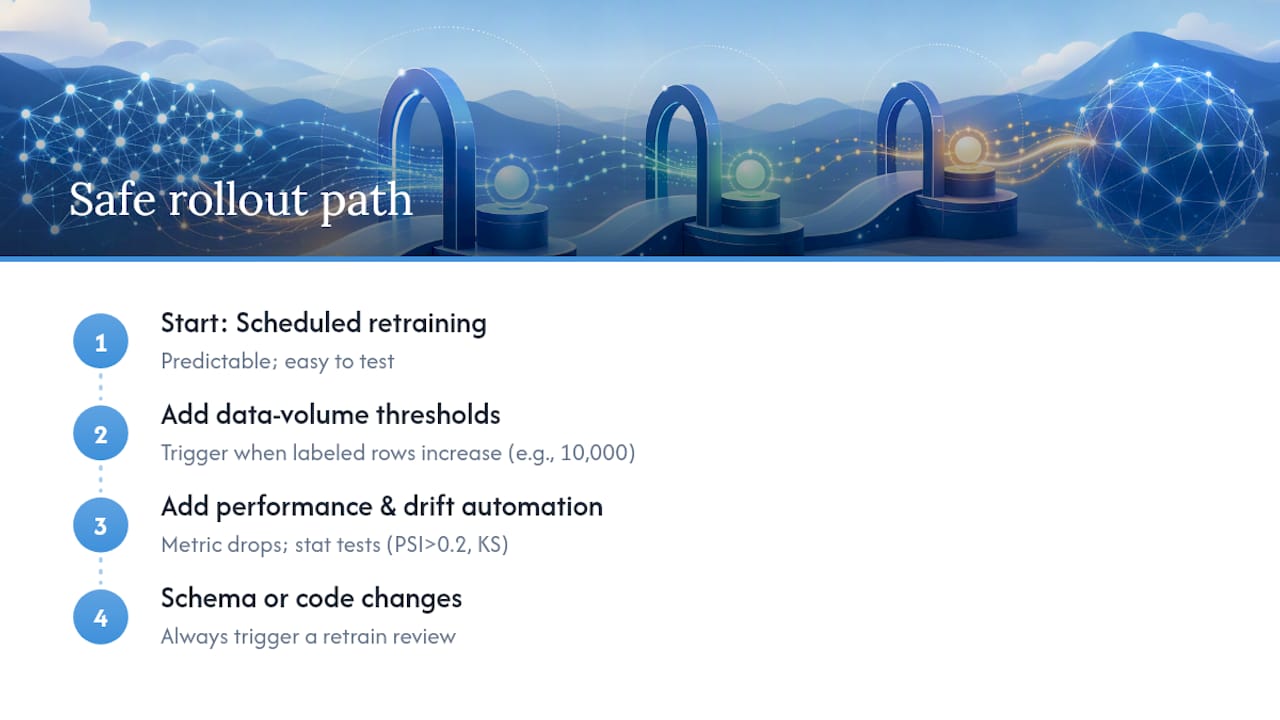
Scheduled retraining fires on a cron schedule regardless of observed drift. It is the safest starting point because it is predictable and easy to test. The downside is that it can retrain unnecessarily when data is stable, or miss a sudden drift event between scheduled runs.
New-data volume thresholds fire when the labeled dataset grows by a defined amount, for example when 10,000 new labeled records accumulate since the last training run. Track the row count of your labeled training partition and emit a trigger event when the delta crosses the threshold.
Model performance degradation fires when a monitored metric drops below a threshold. Track accuracy, F1, AUC-ROC, or a business-aligned metric like conversion rate on a held-out validation set or via shadow scoring. A relative drop from the baseline registered at deployment is a common starting threshold, though the right value depends on your SLA.
Data distribution shift fires when a statistical test detects that the input feature distribution has diverged from the training distribution. Population Stability Index (PSI) and Kolmogorov-Smirnov tests are standard choices. PSI above 0.2 on a key feature is a widely used alert threshold.
Schema or code changes should always trigger a retrain review. A new feature column, a changed encoding, or an upstream data pipeline change can silently invalidate a model even when performance metrics look stable.
Safe rollout path: start with scheduled retraining and manual review. Add data-volume thresholds next. Introduce performance-triggered and drift-triggered automation only after your validation gates have passed consistently across several cycles.
How does a continuous training pipeline work, step by step?
A well-structured CT pipeline has eight ordered stages. Every stage produces a versioned artifact.
- Model training — Execute the training job with versioned hyperparameters and a pinned dataset snapshot. Log all parameters, metrics, and the dataset hash to your experiment tracker.
- Model registration. Push the passing candidate to the model registry with full metadata: training dataset version, feature schema version, hyperparameters, evaluation metrics, and the trigger that initiated the run. Mlflow's model registry stores all of this as first-class metadata.
Pro Tip: Treat every pipeline stage as an independently testable unit. If your evaluation step cannot be run in isolation against a fixed dataset and a fixed model artifact, you cannot debug failures in production. Pipelines-as-code with tools like CML make each step a versioned, testable component.
For teams building out automating machine learning pipelines, the key discipline is that no artifact moves forward without a logged, versioned record of what produced it.
Which training pattern fits your workload?
Choosing the wrong retraining pattern wastes compute or degrades accuracy. The table below maps each pattern to its typical use case and key trade-offs.
| Pattern | How it works | Best fit | Key trade-off |
|---|---|---|---|
| Full batch retrain | Retrain from scratch on the full historical dataset | Stable data, infrequent retrains, high accuracy requirement | High compute cost; slow cadence |
| Incremental / continued training | Resume training from the last checkpoint on new data only | Frequent data arrival, moderate compute budget | Risk of catastrophic forgetting without replay |
| Online learning | Update model weights on individual records or mini-batches in real time | High-velocity streams, low-latency adaptation required | Noisy updates; harder to validate before serving |
| Replay buffer / experience replay | Interleave new data with a sampled buffer of historical data during incremental training | Preventing forgetting while adapting to new patterns | Buffer management overhead; storage cost |
| Hybrid | Full retrain on a slow schedule; incremental updates between cycles | Most production systems with mixed data cadence | Requires two coordinated pipelines |
Academic research on lifelong and continuous learning identifies catastrophic forgetting as the central risk of incremental updates: the model overwrites previously learned patterns when trained only on new data. Experience replay and regularization-based approaches (Elastic Weight Consolidation, for example) are the standard mitigations.
When label delay is significant, such as in fraud detection where confirmed fraud labels arrive days after the transaction, full batch retraining on a delayed window is usually safer than online updates. Datacamp's continuous learning overview recommends delayed-batch windows and pseudo-labeling as practical strategies for this case.
Prefer incremental updates over full retrains when your compute budget is constrained, your concept is relatively stable, and you have a replay buffer in place. Default to full retrains when you need maximum reproducibility or when a significant concept shift has occurred.
What does a production-ready CT system require?
Omdena's guide to continuous training in production is direct on this point: rushing into automated retraining without the right infrastructure causes production instability. Here is the minimum viable stack and what each component guarantees.
- Model registry: version control for model artifacts, with promotion states (staging, production, archived) and metadata linking each version to its training run.
- Metadata store / experiment tracker: records every training run's parameters, metrics, dataset hash, and environment. Without this, you cannot reproduce a model or audit why it was promoted.
- Feature store: guarantees training-serving parity by serving the same feature computation logic at training time and inference time. This is the single most effective defense against training-serving skew.
- Monitoring and observability: tracks input distributions, prediction distributions, and business metrics in production. Feeds drift and performance signals back to the trigger layer.
- Orchestration / pipelines-as-code: defines the CT pipeline as a versioned, deployable artifact. Apache Airflow, Kubeflow Pipelines, and Prefect are common choices in US production environments.
- Artifact storage: durable, versioned storage for datasets, model binaries, and evaluation reports. Amazon S3 with versioning enabled is a standard choice.
- CI/CD integration: automated testing of pipeline code changes before they reach production. CML provides a CLI for running training and evaluation jobs inside GitHub Actions or GitLab CI.
- Secret management: credentials for data stores, registries, and serving endpoints must never be hardcoded in pipeline code. AWS Secrets Manager or HashiCorp Vault are standard options.
Deployment checklist:
- Define validation gates with explicit pass/fail thresholds before enabling any automated promotion.
- Set circuit-breakers: if three consecutive pipeline runs fail evaluation, halt automation and page the on-call engineer.
- Use canary or shadow deployment for every promotion; never flip 100% of traffic to a new model in a single step.
- Define rollback criteria and test the rollback procedure before you need it.
- Set SLA objectives for retrain latency (how quickly a triggered pipeline must complete) and monitor against them.
Pro Tip: Instrument your metadata store and observability layer first. Practical CT adoption guidance consistently shows that teams who skip this step and jump straight to automated retraining spend months debugging failures they cannot reproduce. Build the audit trail before you build the automation.
What are the most common CT failure modes, and how do you fix them?
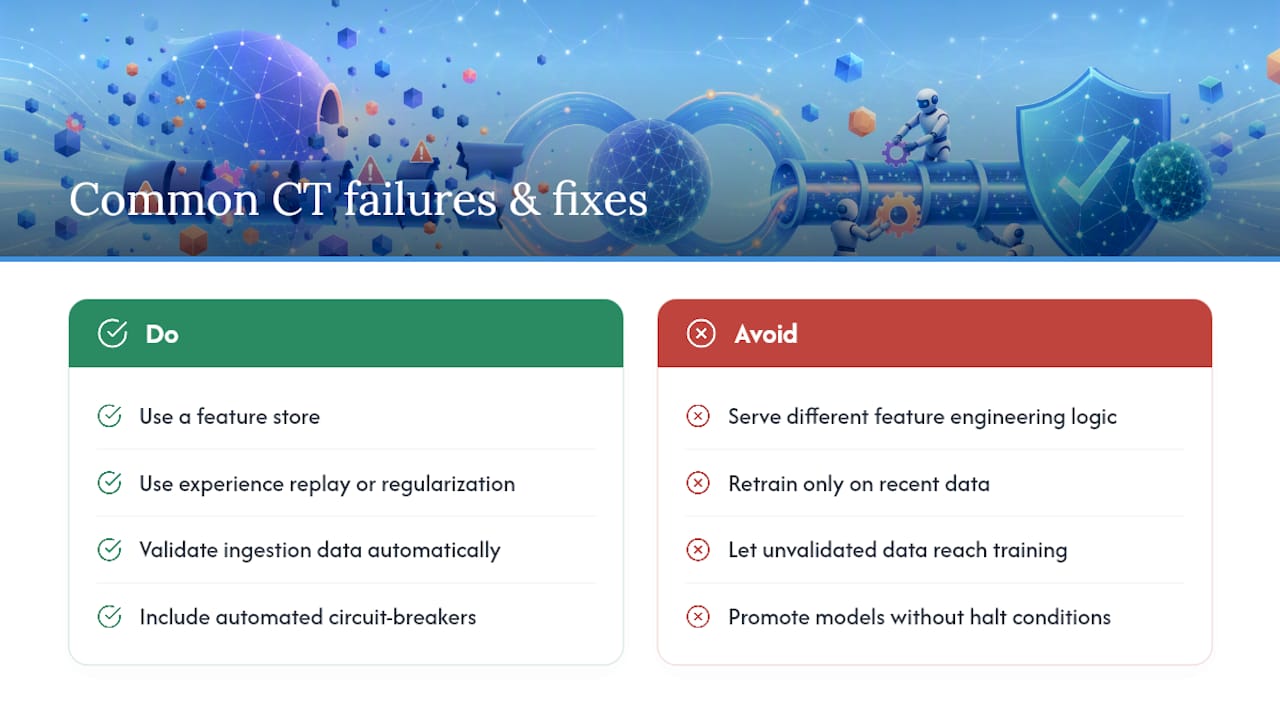
Training-serving skew occurs when the feature engineering logic differs between training and serving. The fix is a feature store that serves the same transformation code in both contexts. This is the highest-leverage infrastructure investment in a CT system.
Catastrophic forgetting happens when incremental retraining on new data overwrites learned patterns from older data. Use experience replay (mixing new data with a random sample of historical data) or regularization techniques like Elastic Weight Consolidation. Datacamp's analysis covers both approaches with practical implementation notes.
Poisoned or low-quality data entering the pipeline will produce a model that passes automated metrics but fails in production. Automated data validation at the ingestion step, with schema checks, outlier detection, and distribution comparison against a known-good baseline, is the mitigation. Never let unvalidated data reach the training step.
Label delay is common in domains where ground truth arrives long after the prediction. Strategies include delayed-batch retraining windows (wait for labels to accumulate before triggering), pseudo-labeling for interim updates, and keeping retraining cadence flexible enough to incorporate labels when they arrive.
Feedback loops occur when a model's predictions influence the data it will be trained on in the next cycle. A recommendation model that only shows popular items will generate training data that reinforces that bias. Causal monitoring, per-segment performance tracking, and periodic audits of the training data distribution are the standard mitigations.
Automated circuit-breakers are non-negotiable. AWS Prescriptive Guidance recommends that any automated CT pipeline include explicit halt conditions: if evaluation metrics fall below a floor, if data validation fails, or if the new model is statistically indistinguishable from the champion, the pipeline should stop and alert rather than promote.
Key Takeaways
Continuous training keeps production models accurate by automating retraining in response to measurable triggers, but it requires validation gates, a model registry, and observability before any reactive automation is safe to enable.
| Point | Details |
|---|---|
| Start with scheduled retrains | Begin with cron-triggered retraining and manual review before adding reactive, automated triggers. |
| Gates before automation | Validation gates and circuit-breakers must pass consistently before you automate promotion. |
| Feature store prevents skew | A feature store is the single most effective defense against training-serving skew in CT pipelines. |
| Metadata enables reproducibility | Every training run needs a logged artifact trail; without it, you cannot audit or reproduce a promoted model. |
| Mlflow for lifecycle management | Mlflow's model registry and experiment tracking provide the artifact versioning and observability CT pipelines require. |
The part of continuous training most teams get wrong
Most teams treat CT as a tooling problem. They spend weeks evaluating orchestration frameworks and model registries before they have answered the more fundamental question: who owns the decision to promote a model to production?
Tooling is the easy part. The hard part is governance. In practice, automated CT pipelines tend to fail not because the infrastructure is wrong but because no one has defined the promotion criteria, no one owns the monitoring alerts, and no one has a clear mandate to roll back a bad model under time pressure. The pipeline fires, a model gets promoted, something breaks in production, and the post-mortem reveals that three different teams each assumed someone else was watching.
The fix is organizational before it is technical. Before you write a single pipeline step, write a one-page runbook: what are the promotion criteria, who approves exceptions, who owns the rollback decision, and what is the escalation path when a circuit-breaker fires at 2 AM. That document is worth more than any orchestration framework.
On the technical side, the most underrated investment is the metadata store. Teams that instrument MLOps implementation strategies with rigorous experiment tracking from the start can debug production failures in minutes. Teams that skip it spend days reconstructing what data, what hyperparameters, and what code version produced the model that is now misbehaving.
Mlflow's model registry and experiment tracking are genuinely useful here, not because they are the only options, but because they make the metadata-first discipline easy to enforce across a team. When every training run is logged with its dataset hash, feature schema version, and evaluation metrics, reproducibility stops being a goal and starts being a default.
Mlflow makes CT pipelines traceable from the first run
The production checklist in this article maps directly to what Mlflow for ML models provides out of the box: a model registry with promotion states, experiment tracking that logs every run's parameters and metrics, and observability hooks that feed drift and performance signals back into your trigger layer.
For teams running GenAI or agentic workflows, Mlflow's AI observability layer extends the same traceability to LLM inference traces, making it practical to use performance signals from agentic reasoning as CT triggers. Whether you are managing classical ML models or LLM-based agents, Mlflow gives you the artifact trail and the observability layer that CT pipelines depend on. Start with the model registry and experiment tracking, instrument your first scheduled retrain pipeline, and let the validation gates tell you when you are ready to automate further.
Useful sources and further reading
- 8. Continuous training - AWS Prescriptive Guidance
- Continuous Training of ML Models in Production
- What is Continuous Training (CT) in MLOps?
- Continuous learning / lifelong learning (academic overview)
- What is continuous learning? (Datacamp blog)
- SAI #21: What is Continuous Training (CT) in Machine Learning Systems?
- CML (Continuous Machine Learning) GitHub repository
- MLflow