The Role of Embeddings in AI Apps: 2026 Guide

Embeddings are defined as dense numerical vectors that transform raw inputs, including text, images, and audio, into a mathematical format that AI systems can process for meaning. The role of embeddings in AI apps is foundational: without them, large language models cannot perform semantic search, retrieval-augmented generation (RAG), or recommendation at scale. Embeddings are classified as one of the three foundational layers of the modern AI stack, alongside foundation models and vector databases. That positioning is not marketing language. It reflects how deeply embedding infrastructure shapes what AI applications can actually do.
What are embeddings and how do they encode semantic meaning?
Embeddings convert real-world objects into dense numerical vectors, typically ranging from 768 to 3,072 floating-point numbers per input. Each number in that vector encodes a dimension of meaning learned during model training. The result is a coordinate in a high-dimensional space where semantically similar inputs cluster together.
The geometry of that space is what makes embeddings powerful. Techniques like cosine similarity and dot product measure the angle or alignment between two vectors. Two sentences with the same intent but different words will land near each other in vector space. Two sentences that share keywords but mean different things will land far apart. That distinction is what separates embedding-based retrieval from legacy keyword search.

Vector space consistency is non-negotiable in production. Mixing embedding models between indexing and query time destroys semantic retrieval because the vectors live in incompatible spaces. A document indexed with one model and queried with another will return meaningless similarity scores. This is one of the most common and costly mistakes teams make when building embedding pipelines.
Key technical properties to understand:
- Dimensionality: Standard production models output 768 to 3,072 dimensions. Higher dimensions capture more semantic nuance.
- Similarity metrics: Cosine similarity is the default for text; dot product works when vectors are normalized.
- Storage footprint: A 3,072-dimension vector stored as 32-bit floats consumes roughly 12KB per document. At millions of documents, that adds up fast.
- Latency trade-offs: High-dimensional embeddings increase both storage and query latency. Dimension reduction techniques like PCA or Matryoshka Representation Learning help balance the trade-off.
Pro Tip: When prototyping, start with a 768-dimension model. Only move to 1,536 or 3,072 dimensions if retrieval quality benchmarks show a measurable gain. The latency and storage cost is real.
How do embeddings power semantic search, recommendations, and RAG?
Embeddings enable a fundamentally different class of AI application. The shift from keyword matching to meaning matching changes what users can ask and what systems can return. Here are the four core workflows where vector embeddings do the heavy lifting:
-
Semantic search. A user query is embedded at runtime. The system retrieves documents whose vectors are closest to the query vector using approximate nearest neighbor (ANN) search. ANN search retrieves top-k results in under 100ms in optimized production systems. That speed makes real-time semantic search viable at scale.
-
Recommendation engines. Users and items are embedded into a shared vector space. A user's embedding reflects their behavior and preferences. Items with vectors close to the user's vector are surfaced as recommendations. This approach powers product discovery in e-commerce and content feeds in media platforms.
-
Retrieval-augmented generation (RAG). Documents are embedded and stored in a vector database. At query time, the user's question is embedded and matched against stored document vectors. The top-k retrieved chunks are injected into the LLM's context window as grounding knowledge. Embedding-based memories also extend AI agent recall beyond what context windows alone allow, enabling long-term conversational memory across sessions.
-
Cross-modal retrieval. Multimodal embedding models place text and image vectors in the same space. A text query can retrieve images, and an image can retrieve related text. This capability drives visual search in retail and content tagging in media.
"Embedding infrastructure often impacts application performance more than complex prompt engineering. Teams that invest in retrieval quality before prompt tuning consistently ship better AI products."
That insight reframes where engineering effort belongs. Most teams over-invest in prompt design and under-invest in the quality of their embedding pipeline. Getting retrieval right first produces larger gains.
For developers building AI-powered features, the RAG pipeline is usually the first place embeddings appear in production. The pattern is well-established, but the operational details around model selection and vector consistency are where most teams encounter problems.
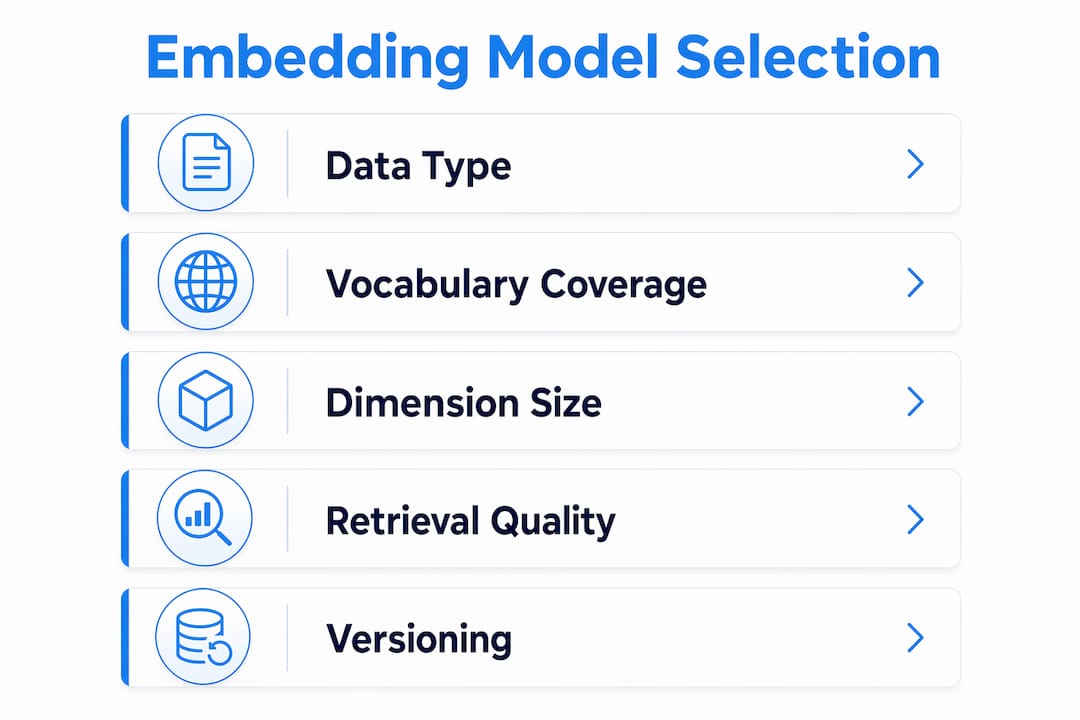
What should you consider when selecting embedding models for production?
Choosing an embedding model is not a one-time decision. The model you select shapes your retrieval quality, your storage costs, and your operational overhead for the life of the application.
Vocabulary coverage matters more than most teams expect. BERT's vocabulary of approximately 30,000 words causes it to fragment technical terms into subword tokens. In domain-specific applications, such as legal, medical, or scientific search, that fragmentation degrades semantic accuracy. Domain-adapted models or models trained on in-domain corpora produce meaningfully better results for specialized tasks.
Embedding drift is an operational risk. When you upgrade an embedding model, every document in your vector store must be re-embedded. Embedding drift requires re-embedding the entire corpus on model upgrades, which is a significant operational challenge for systems with large document stores. Teams that do not plan for this end up with mixed-model vector stores that silently degrade retrieval quality.
Hybrid search outperforms pure vector search in most production scenarios. Hybrid search combining vector similarity with BM25 keyword search consistently improves retrieval results using Reciprocal Rank Fusion. Vector search captures semantic intent; BM25 captures exact matches for product codes, names, and technical identifiers. Neither method alone handles both cases well.
| Consideration | What to evaluate | Impact |
|---|---|---|
| Vocabulary size | Domain term coverage | Retrieval accuracy on specialized content |
| Embedding dimension | 768 vs. 1,536 vs. 3,072 | Latency, storage, and semantic nuance |
| Model upgrade policy | Re-embedding cost and frequency | Operational complexity and downtime risk |
| Search strategy | Vector only vs. hybrid BM25 + vector | Recall and precision across query types |
Pro Tip: Version your embedding models explicitly in your AI data management pipeline. Treat a model upgrade like a database migration: plan the re-embedding job, validate retrieval quality before cutover, and never mix model versions in the same vector index.
How do multimodal embeddings expand what AI apps can do?
Multimodal embeddings unify different data types into a single vector space. Text and images, which are fundamentally different data formats, become directly comparable when embedded by the same multimodal model. That comparability is what enables cross-modal retrieval.
CLIP embeds images and text into the same vector space, enabling a text query to retrieve semantically matching images and vice versa. This capability drives visual search in e-commerce, where a user uploads a photo and retrieves similar products, and content moderation systems that match image content against text policy descriptions. Merging image and text embeddings into a unified space is also accelerating advances in semantic SEO and cross-modal AI applications.
The architectural pattern for multimodal systems uses specialized encoders per modality. A text encoder and an image encoder are trained jointly so their outputs land in the same vector space. At inference time, you can embed a query in any modality and retrieve results in any other modality.
Emerging embedding types are extending this pattern further:
- Audio embeddings capture speaker identity, emotion, and phonetic content for voice search and audio classification.
- Video embeddings encode temporal sequences, enabling scene retrieval and action recognition.
- Sensor and time-series embeddings power anomaly detection in industrial and IoT applications.
- Graph embeddings represent relationships between entities, enabling knowledge graph retrieval and link prediction.
The common thread across all of these is the same: convert complex, high-dimensional data into a vector space where geometric proximity means semantic similarity. The AI gateway architecture that governs model routing and access control becomes especially important when multiple embedding modalities feed into a single AI system.
Key Takeaways
Embeddings are the foundational retrieval layer in modern AI applications, and their quality, consistency, and model selection determine whether semantic search, RAG, and recommendation systems actually work in production.
| Point | Details |
|---|---|
| Embeddings encode meaning geometrically | Cosine similarity between vectors captures semantic intent, not keyword overlap. |
| Model consistency is non-negotiable | Use the same embedding model for indexing and querying or retrieval breaks entirely. |
| Hybrid search beats pure vector search | Combining BM25 with vector similarity improves recall and precision across real query types. |
| Embedding drift requires active management | Upgrading embedding models means re-embedding your entire document corpus. |
| Multimodal embeddings expand AI capabilities | Models like CLIP enable cross-modal retrieval across text, images, and beyond. |
Why embeddings deserve more engineering attention than they get
Most teams treat embeddings as a commodity: pick a model, generate vectors, move on. That approach works until it doesn't. The retrieval failures I've seen in production almost always trace back to embedding decisions made early and never revisited.
The geometric intuition matters more than most engineers realize. When a RAG pipeline returns irrelevant chunks, the instinct is to fix the prompt. The actual problem is usually cosine similarity returning vectors that are close in the embedding space but semantically wrong for the query. Understanding vector space geometry is the skill that separates engineers who can debug retrieval from those who can only guess at it.
The trend toward embedding-centric AI architectures is accelerating. Memory systems, agent reasoning, and cross-modal retrieval all depend on the same underlying infrastructure. Teams that build a rigorous embedding pipeline now, with versioned models, hybrid search, and re-embedding workflows, will have a structural advantage as AI applications grow more complex. The teams that treat embeddings as an afterthought will keep fighting retrieval quality problems that compound over time.
— Kevin
How Mlflow supports embedding-powered AI development
Building production AI applications on embeddings requires more than a vector database. You need observability into what your retrieval pipeline is actually doing, evaluation frameworks to measure whether retrieved chunks improve LLM outputs, and tracing to debug failures when they occur.

Mlflow provides LLM tracing that captures the full execution path of embedding-powered workflows, from query embedding through retrieval to generation. The LLM-as-a-Judge evaluation framework lets you measure retrieval quality and generation accuracy with automated, configurable judges. For teams moving from prototype to production, Mlflow's AI observability layer gives you the metrics and traces needed to catch embedding drift, retrieval degradation, and latency regressions before they reach users.
FAQ
What are embeddings in machine learning?
Embeddings are dense numerical vectors that represent data objects, such as words, sentences, or images, in a continuous vector space where geometric proximity encodes semantic similarity. They are the core representation format enabling modern AI systems to process meaning rather than raw symbols.
Why does using the same embedding model for indexing and querying matter?
Different embedding models produce vectors in incompatible vector spaces, so mixing models makes similarity scores meaningless. Every document and every query must be embedded with the identical model version for retrieval to work correctly.
What is hybrid search and why does it outperform vector-only search?
Hybrid search combines vector similarity with BM25 keyword matching, using Reciprocal Rank Fusion to merge results. This approach captures both semantic intent and exact term matches, which neither method handles well on its own.
How do multimodal embeddings work?
Multimodal models like CLIP train separate encoders for text and images jointly, so their outputs land in the same vector space. This enables cross-modal retrieval where a text query returns matching images and an image query returns matching text.
What is embedding drift and how do you manage it?
Embedding drift occurs when you upgrade your embedding model, making existing indexed vectors incompatible with new query vectors. Managing it requires re-embedding your entire document corpus after any model upgrade and validating retrieval quality before switching production traffic to the new model.