2 posts tagged with "best LLM evaluation platforms"

View All Tags

Best LLM Evaluation Platforms in 2026: 6 Platforms Compared

· 14 min read

Last reviewed: October 12, 2026. This is Part 1 of a two-part series. Part 2 compares the best open-source LLM evaluation tools you can self-host.

An LLM evaluation platform tells you whether your LLM app or agent gives correct, safe, and useful answers, before and after you ship. The best LLM evaluation platforms in 2026 do more than score outputs. They find failures in production traces, turn those failures into test cases, and help you fix the prompt or the judge that caused them.

This guide compares six platforms on the features that matter for evaluation: judges, datasets, human review, production monitoring, and what happens after a failure is found.

How we ranked them: by how much of the evaluation loop each platform covers in one tool, from finding failures to measuring and fixing them. This guide is published by the MLflow team, and every competitor description links to that platform's own documentation.

Quick answer: what are the best LLM evaluation platforms in 2026?​

The best LLM evaluation platforms in 2026 are:

  1. MLflow: best open-source, end-to-end evaluation platform, with automatic issue detection and built-in prompt and judge optimizers.
  2. LangSmith: best for teams that want to build within the LangChain ecosystem.
  3. Braintrust: best for a hosted experiment workflow with a polished UI.
  4. Confident AI (DeepEval): best for pytest-style evaluation with a large metric library.
  5. Galileo: best for low-latency guardrails that use small evaluation models.
  6. W&B Weave: best for teams that already use Weights & Biases.

Table of contents​

What to look for in an LLM evaluation platform​

An LLM evaluation platform should cover the full loop: find a failure, measure it, fix it, and confirm the fix. Use these criteria to compare platforms.

  • LLM-as-a-judge and code scorers. You need both. LLM judges score open-ended quality. Code scorers check exact rules, such as format or tool arguments.
  • Judge alignment. An LLM judge is only useful if it agrees with your domain experts. Look for a way to tune judges with human feedback.
  • Datasets from production traces. The best test cases come from real failures. The platform should turn a trace into a dataset row in one step.
  • Human review. Domain experts must label traces and correct judges without writing code.
  • Production monitoring. The same scorers should run on live traffic, not only in offline tests.
  • Issue discovery. At scale, nobody can read every trace. The platform should find and group failure patterns for you.
  • Optimization. After you find a failure, the platform should help you fix it, for example by optimizing the prompt against your evaluation data.
  • Open source and self-hosting. If your traces contain sensitive data, check whether you can run the platform on your own infrastructure.

LLM evaluation platforms comparison table​

PlatformStandout evaluation featureBest for
MLflowAutomatic Issue Detection, prompt and judge optimizersOpen-source, end-to-end evals
LangSmithOffline and online evaluations with annotation queuesLangChain and LangGraph teams
BraintrustSide-by-side experiments and the Loop assistantHosted experiment workflow
Confident AI (DeepEval)Large metric library, including G-EvalPytest-style test suites
GalileoLuna evaluation models for low-latency scoring and guardrailsRuntime guardrails
W&B WeaveEvaluations and leaderboards inside Weights & BiasesExisting W&B users

Each platform has a different focus. MLflow covers the full loop, from finding failures to fixing them, and it is free and open source.

1. MLflow​

MLflow is an open-source, end-to-end platform for evaluating, tracing, and improving LLM apps and agents. It is free under the Apache 2.0 license, hosted by the Linux Foundation, and it brings issue detection, evaluation, and prompt and judge optimization together in one tool.

  • Best for: teams that want one open-source tool for the full evaluation loop: trace, evaluate, find issues, and optimize.
  • Key fact: 30M+ monthly downloads, 28K+ GitHub stars, and 900+ contributors.

Automatic Issue Detection​

Automatic Issue Detection finds quality problems in the traces you already collect. It uses an LLM to analyze traces, groups related failures into issues, and tracks each issue over time. You start it from the MLflow UI in three clicks. You do not need to write scorers first, so it works even when you do not yet know what to measure.

This changes the order of work. A typical evaluation workflow starts by defining metrics. MLflow can show you the failure patterns first, so you know which judges to build.

Built-in optimizers for prompts and judges​

MLflow connects evaluation to optimization:

  • Prompt optimization. mlflow.genai.optimize_prompts() improves a prompt against your evaluation data. It gives you a structured way to iterate: every candidate prompt is scored with the same evaluation dataset and judges, and every optimized prompt is saved as a new version in the MLflow Prompt Registry. Each step is measured, not guessed, so you can hill-climb on quality with full confidence that a new version is better than the last one, and roll back if it is not. GEPA and DSPy optimizers sit behind one API, so you can switch algorithms without rewriting your code.
  • Judge alignment. MemAlign and SIMBA tune an LLM judge with human feedback, so the judge agrees with your domain experts. MemAlign shows improvement with a handful of labeled examples.

Key evaluation features​

  • LLM judges and code scorers. Use predefined judges for correctness, relevance, safety, and groundedness, write custom judges in plain language, or write code scorers in Python.
  • Trace-based judges. Judges can read the full trace, including tool calls and retrieval steps, not only the final answer.
  • Multi-turn evaluation. Evaluate whole conversations, and use conversation simulation to test agents before you have real users.
  • Third-party scorers. Run DeepEval and other scorer libraries inside MLflow, next to your own judges.
  • Human review. Review queues let domain experts label traces in the UI.
  • Production monitoring. Automatic evaluations run the same scorers on live traffic.
  • OpenTelemetry tracing. MLflow Tracing is OpenTelemetry-compatible and integrates with major agent frameworks and LLM providers.

Open source, free, and community-driven​

MLflow has no feature gating. Every feature in this section is in the open-source release, and you can self-host it for free. If you need a feature, open a feature request or a suggestion on GitHub. The maintainers review suggestions and feature requests from the community.

2. LangSmith​

LangSmith is the evaluation and observability platform from LangChain, and it is a great choice for teams who want to complete agent evaluation within the LangChain ecosystem. It runs offline evaluations on datasets and online evaluations on production traces, and it understands LangChain runs with no extra setup. Source: LangSmith evaluation docs.

  • Best for: teams whose agents run on LangChain or LangGraph.
  • Key fact: supports both offline evaluations on datasets and online evaluations on production traces.

Key evaluation features​

  • Offline and online evaluations. Run evaluators on datasets before release, and on live traces after release.
  • LLM-as-a-judge evaluators. Score outputs with a rubric, and improve the judge with few-shot corrections from human reviewers.
  • Annotation queues. Send runs or pairwise comparisons to human reviewers and track their status.
  • OpenTelemetry ingestion. Send OpenTelemetry traces to LangSmith and evaluate them.

3. Braintrust​

Braintrust is a hosted evaluation platform that connects datasets, experiments, scorers, and a prompt playground in one workflow for engineers and product managers. Its experiment view compares prompt and model variants row by row, and the same scorers can run on production traffic. Source: Braintrust evaluation docs.

  • Best for: teams that want a hosted experiment workflow with UI-driven evaluations, including product managers who review results.
  • Key fact: Loop, a built-in AI assistant, generates scorers and datasets from plain-language descriptions.

Key evaluation features​

  • Experiments. Compare prompt, model, and configuration variants side by side on the same dataset, and gate CI on regressions.
  • Scorers. Use code scorers, heuristic scorers, and LLM-as-a-judge scorers. The open-source autoevals library provides scoring functions you can run locally.
  • Online scoring. Score production traffic with the same scorers you use in experiments.
  • Playground. Replay traces, swap models, and preview score changes in the UI.

4. Confident AI (DeepEval)​

Confident AI is the hosted platform behind DeepEval, a popular open-source evaluation library. DeepEval lets you write LLM tests that look like pytest unit tests and run them in CI, and Confident AI stores the results, reports, and history for your team. Source: DeepEval docs.

  • Best for: engineers who want evaluation as code, inside their existing test suites and CI.
  • Key fact: DeepEval ships a large metric library, including G-Eval, a general LLM-as-a-judge metric for custom criteria.

Key evaluation features​

  • Metric library. Ready-made metrics for RAG, agents, and conversations, such as faithfulness, answer relevancy, task completion, and tool correctness.
  • G-Eval. Define custom criteria as steps, and get repeatable judge scores.
  • Test runs and regression testing. Run test suites in CI and compare results across prompt or model changes.
  • Red teaming. DeepTeam, a separate open-source project, simulates attacks such as jailbreaks and prompt injection.

5. Galileo​

Galileo is an enterprise platform for AI evaluation and agent reliability. It uses Luna, a family of small evaluation models, to score outputs with low latency and at low cost, so teams can evaluate production traffic and enforce guardrails before answers reach users. Source: Galileo docs.

  • Best for: enterprises that need guardrails in the request path, which block bad outputs before users see them.
  • Key fact: Luna-2 evaluation models are built for fast, low-cost scoring, so you can evaluate a large share of production traffic.

Key evaluation features​

  • Luna evaluation models. Small models tuned to detect issues such as hallucinations, and fine-tunable on your data.
  • Runtime guardrails. Block or transform outputs before they reach users.
  • Agent metrics. Metrics such as tool selection quality and action completion.
  • Insights Engine. Surfaces failure patterns across logs and traces.

6. W&B Weave​

W&B Weave is the LLM evaluation and tracing toolkit from Weights & Biases. It pairs datasets with scorers, versions every evaluation run, and compares results on leaderboards, so it fits well for teams that already track model training in W&B. Source: Weave evaluation docs.

  • Best for: teams that already use Weights & Biases for classic ML experiments.
  • Key fact: the Weave SDK is open source under Apache 2.0.

Key evaluation features​

  • Evaluations. Pair datasets with scorers, version the results, and drill into single examples.
  • Scorers. Built-in scorers plus custom scorer functions.
  • Tracing. Automatic tracing for common LLM and agent SDKs.
  • Leaderboards. Compare evaluation runs and models in shared views.

How to choose an LLM evaluation platform​

Start from your stack and your constraints, not from the feature list.

If your team...Choose
Wants one free, open-source tool to trace, evaluate, find issues, and optimizeMLflow
Wants to self-host evaluation for freeMLflow
Builds agents on LangChain or LangGraphLangSmith
Wants a hosted experiment UI for engineers and product managersBraintrust
Wants evaluation as pytest-style tests in CIConfident AI (DeepEval)
Needs low-latency guardrails in the request pathGalileo
Already tracks training runs in Weights & BiasesW&B Weave

Before you commit, run a short pilot on one real agent workflow. Collect traces, find at least three real failures, and check how each platform helps you measure and fix them. The platform that shortens that loop is the right one.

FAQ​

What is the best LLM evaluation platform in 2026?​

MLflow is the best LLM evaluation platform for most teams in 2026, because it is free, open source, and covers the full loop: tracing, LLM judges, automatic issue detection, human review, and prompt and judge optimization. LangSmith is a strong choice for LangChain teams, and Braintrust is a strong choice for a hosted experiment workflow.

What is the difference between an LLM evaluation platform and an LLM evaluation framework?​

An LLM evaluation framework is a library of metrics that you run in code, such as DeepEval. An LLM evaluation platform adds storage, a UI, datasets, human review, and production monitoring around those metrics. MLflow is a platform that can also run framework metrics as scorers.

Is there a free, open-source LLM evaluation platform?​

Yes. MLflow is free and open source under the Apache 2.0 license, with no feature gating. You can self-host every evaluation feature, including Automatic Issue Detection, review queues, and prompt optimization.

How do I find issues in production LLM traces?​

Use a platform that analyzes traces for you. MLflow's Automatic Issue Detection analyzes your traces, groups related failures into issues, and tracks them over time, so you do not need to read every trace by hand.

How do I make an LLM judge agree with human experts?​

Collect a small set of human labels, then align the judge to them. In MLflow, MemAlign and SIMBA tune a judge with human feedback. MemAlign shows improvement with a handful of labeled examples.

What platform should I use for automated LLM evaluation in production?​

Use a platform that runs the same scorers on live traffic that you use in offline tests. MLflow runs automatic evaluations on production traces with LLM judges and code scorers, and Automatic Issue Detection groups the failures it finds. It is free and open source.

Can I request a feature for MLflow?​

Yes. Open a feature request on GitHub. MLflow is community-driven, and the maintainers review suggestions and feature requests from users.

Get started with MLflow evaluation​

Install MLflow with pip install mlflow, then follow the evaluation quickstart to run your first LLM judge in a few minutes.

Part 2: open-source LLM evaluation tools​

Part 2 of this series compares six open-source LLM evaluation tools you can self-host: MLflow, Langfuse, Arize Phoenix, Opik, Promptfoo, and Ragas.

Top 5 Best LLM Evaluation Platforms Alternatives 2026

· 17 min read

Woman working on LLM evaluation at tech desk

Finding an LLM evaluation platform that supports open standards, cross-framework workflows, and enterprise security requirements is often difficult. Most competing tools restrict integration choices, lack built-in lifecycle observability, or tie advanced compliance features to enterprise pricing, so AI teams can select an LLM evaluation platform matched to their operational and compliance needs.

Table of Contents​

MLflow​

https://mlflow.org

At a Glance​

The vendor reports 30 million downloads monthly. MLflow runs under the Apache 2.0 license and targets the full machine learning lifecycle for agents, LLMs, and models. It emphasizes open standards and extensibility to avoid vendor lock in.

Core Features​

MLflow centralizes experiment tracking, model registry, and model deployment in a single workflow, while adding model evaluation and version control for prompts. The platform includes observability with OpenTelemetry support and prompt registry and optimization tools for LLM and agent management.

Key Differentiator​

MLflow combines broad framework compatibility with production observability and automated evaluation for agent workflows. It links tracing of agentic reasoning to evaluation pipelines and encourages open standards to reduce vendor dependencies. That combination suits teams that must audit model decisions and run repeatable LLM evaluations across frameworks.

Pros​

MLflow is open source and free to use, so teams avoid vendor lock in and can inspect core components. It supports PyTorch, TensorFlow, scikit learn, HuggingFace, OpenAI, and LangChain, which lets you reuse existing training and inference code. The platform bundles lifecycle tools from experimentation to deployment and gives engineers observability hooks for tracing agent behavior. An active community contributes integrations and fixes, which shortens time to resolve infra issues.

Cons​

  • Complex setup for large scale or enterprise deployments; expect nontrivial configuration and infrastructure management.

Notable Integrations​

  • OpenTelemetry for distributed tracing and observability.
  • PyTorch and TensorFlow for training and inference pipelines.
  • scikit learn for classical model workflows.
  • HuggingFace and OpenAI for LLM model hosting and API access.
  • LangChain for agent orchestration and prompt workflows.

Who It's For​

Data scientists, MLOps engineers, and AI teams building and maintaining production machine learning and LLM systems will get the most from MLflow. Teams that need cross framework workflows and audit trails for agentic decision making will find its toolset aligned with operational needs. Small experimental projects can use the same tooling as larger teams.

Unique Value Proposition​

Centralized AI Gateway for secure prompt management and cross provider governance. That gateway plus tracing and evaluation pipelines shifts prompt and model governance into a single control plane. For engineering teams, this reduces ad hoc prompt copies, centralizes access controls, and creates a single source for prompt versioning and governance across providers.

Real World Use Case​

A large enterprise tracks experiments and model versions across multiple research teams using MLflow. The company traces agent decisions in production through OpenTelemetry and runs automated LLM as a Judge evaluations before deployment. That workflow enforces consistent quality gates and makes rollbacks auditable across teams.

Website: https://mlflow.org

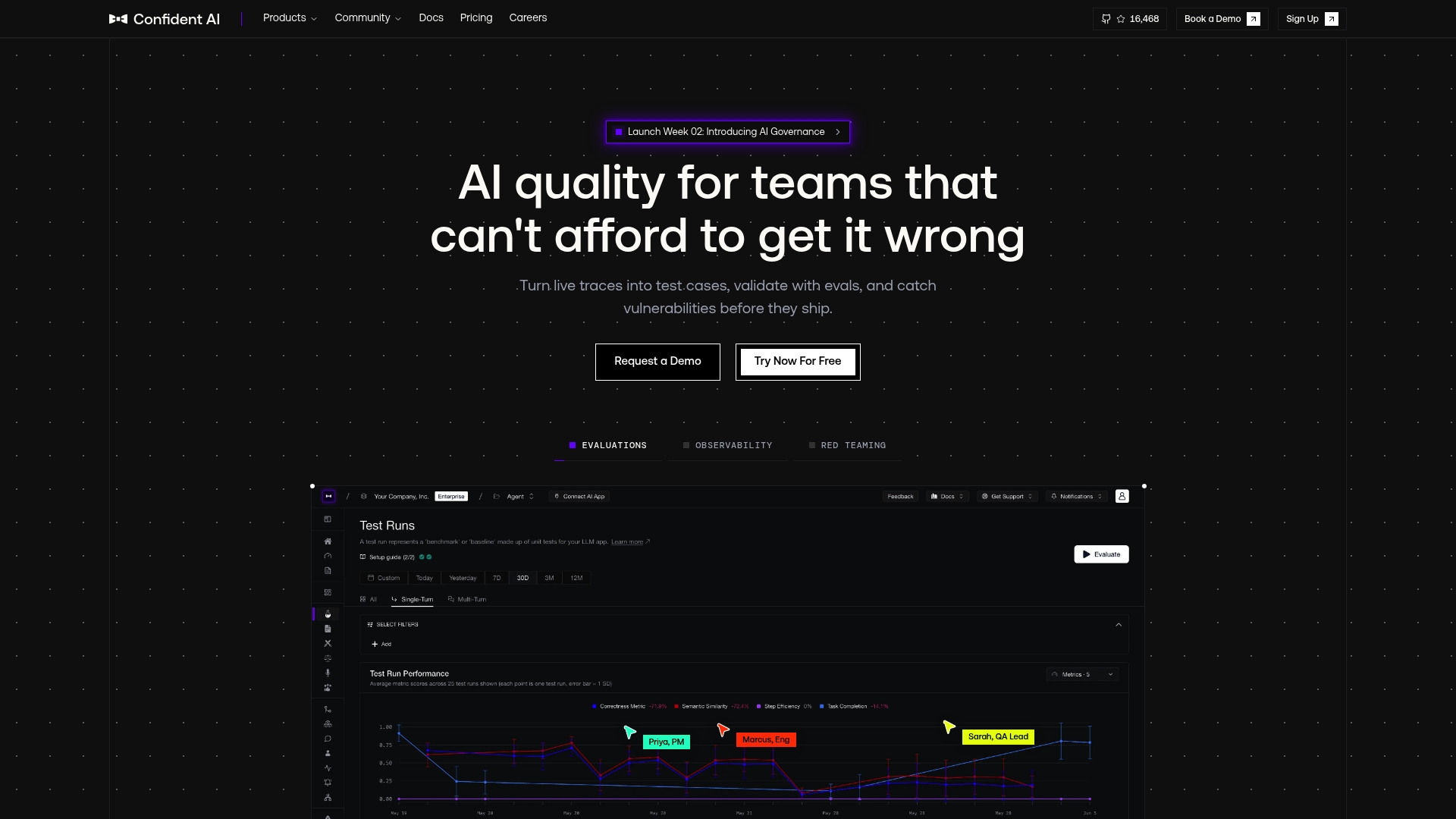
Confident AI​

https://confident-ai.com

At a Glance​

The vendor advertises SOC 2 and HIPAA support along with on-prem deployment options for regulated environments. Confident AI also captures real-time LLM traces and curates datasets from production traffic. That mix targets teams that must combine predeployment testing with live observability and governance.

Core Features​

Confident AI packages an evaluation and testing suite called DeepEval together with real-time tracing and observability that capture tokens and call-level metadata. The platform includes custom evaluation metrics, dataset management, and prompt versioning tied to Git workflows. Red teaming and AI risk assessment tools integrate with dataset curation and trace-based alerting.

Key Differentiator​

Confident AI brings evaluation, observability, red teaming, and governance into a single workflow built for enterprise controls. The platform centers compliance and security workflows alongside test automation and monitoring. Compared with Mlflow, Confident AI focuses more narrowly on regulatory validation and safety for enterprise deployments.

Pros​

Confident AI speeds collaborative testing by combining dataset curation, prompt versioning, and trace replay in the same environment. The vendor advertises enterprise security features such as SOC 2 and HIPAA support and offers on-prem deployment for locked-down infrastructure. Its tracing and alerting make debugging production LLM failures and regressions straightforward for product, engineering, and QA teams.

Cons​

  • Trust Pilot reviews mention an initial learning curve, with some users finding the UI complex at first.

  • Costs can grow steep for large-scale deployments, and pricing may become significant for high-volume projects.

  • Teams unfamiliar with AI governance workflows may require time to adopt the platform effectively.

When It May Not Fit​

Confident AI is weighted toward enterprise and regulated-industry needs, so small teams with simple validation needs may find it over-featured. Startups with tight budgets could find the price model constraining at scale. Teams focused primarily on agent orchestration rather than governance may prefer a different tool.

Notable Integrations​

The product integrates with OpenAI and LangChain to support model and pipeline connections. It also lists SDK and observability ties such as Vercel SDK, Pydantic, and OpenTelemetry. Those integrations let teams pull traces from running services and push curated datasets back into evaluation workflows.

Who It's For​

This product fits enterprise AI teams that require formal validation, continuous monitoring, and documented governance workflows. It suits healthcare, finance, and other regulated sectors that must enforce compliance and auditability. Teams that need on-prem deployment and strict data controls will find the platform aligned with those requirements.

Real World Use Case​

A healthcare provider runs clinical decision support models through DeepEval before clinical rollouts. The team collects production traces with OpenTelemetry and uses prompt versioning to track changes. That workflow reduces unexpected model behavior while keeping an audit trail for regulators.

Pricing​

Confident AI offers a free tier and paid plans starting from $9.99 per user per month. The vendor also provides custom enterprise plans for larger organizations and on-prem installations. Costs scale with seats, usage, and deployment options.

Website: https://confident-ai.com

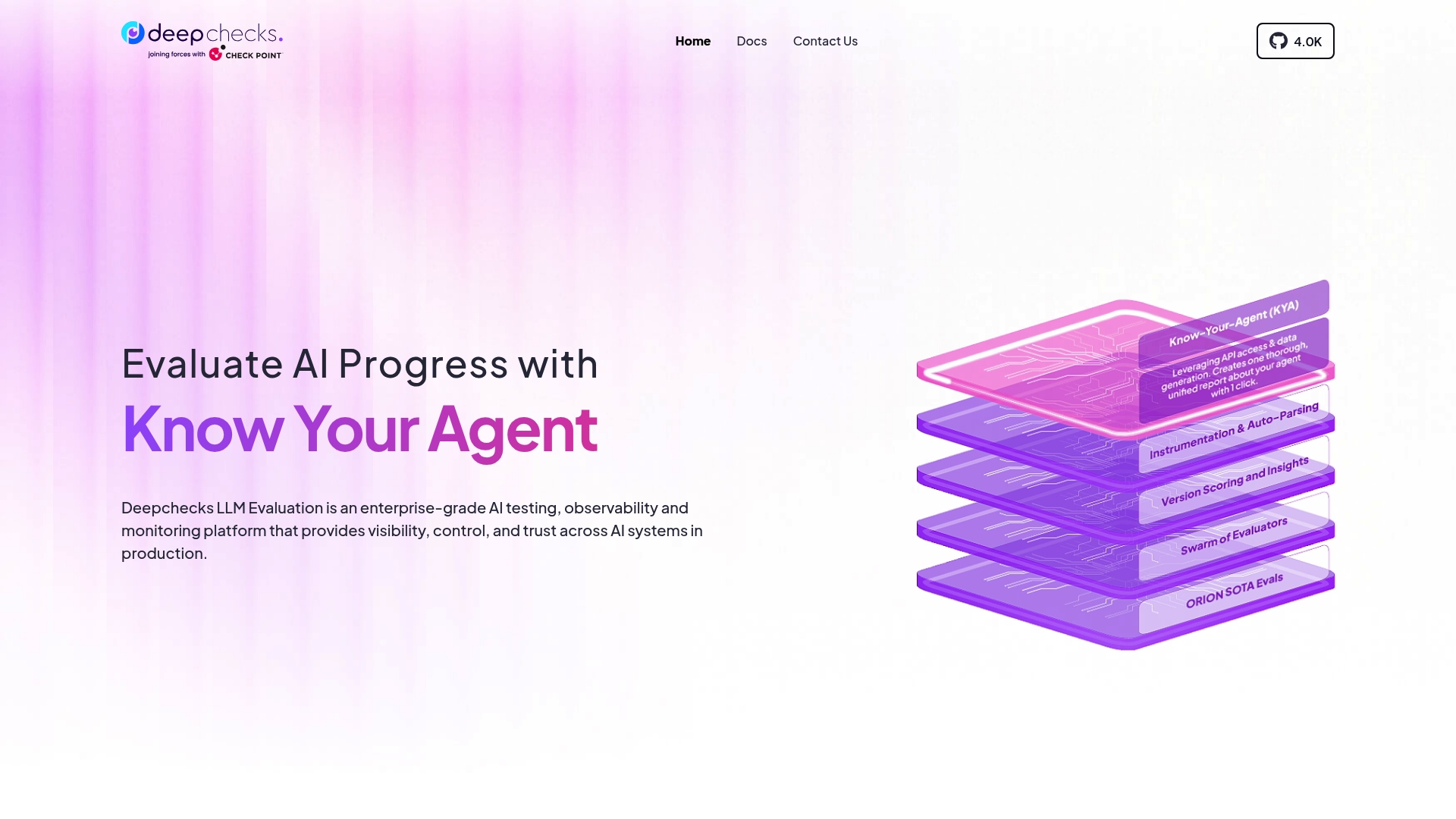
Deepchecks LLM Evaluation​

https://deepchecks.com

At a Glance​

The vendor advertises enterprise security certifications including SOC2, GDPR, and HIPAA. That claim signals orientation toward regulated industries and compliance-driven deployments. The product also supports SaaS, private cloud, bare metal, and AWS-managed deployment options, which suits teams that must match infrastructure policies.

Core Features​

Deepchecks LLM Evaluation combines model evaluation, observability, and monitoring into a single workflow and supports generation of datasets and creation of LLM judges. The platform offers auto-scoring for annotations and data slicing and provides version comparison for prompts, models, and agents. It integrates with CI/CD systems to run evaluation pipelines and supports deployment across multiple infrastructure types.

Key Differentiator​

Deepchecks positions itself as an enterprise-oriented evaluation stack that keeps testing and monitoring inside production operations rather than in separate tooling. That focus lets teams run continuous validation alongside deployment pipelines and observe model behavior in real time. The product targets companies that need security controls and observability built into evaluation workflows.

Pros​

The platform unifies model validation and runtime observability, removing the need to stitch separate tools together. It supports multiple deployment targets and claims enterprise-grade security, which helps teams with strict compliance requirements. The product automates dataset generation and evaluation pipelines, and it integrates with CI/CD so testing can run as part of release workflows.

Cons​

  • Public user feedback is limited, so independent reliability data is sparse and trust rests largely on the vendor's security claims.
  • The platform can be complex for small teams without dedicated MLOps resources, increasing onboarding time and operational overhead.
  • Pricing is not publicly listed and appears tailored to enterprises, which complicates budgeting for smaller projects.

When It May Not Fit​

Teams without an MLOps engineer or a DevOps pipeline will find setup and integration effort material. Organizations seeking transparent, self-serve pricing may find procurement slower because pricing details are enterprise-specific. Small research teams that need a lightweight evaluation toolkit will likely prefer simpler, low-setup alternatives.

Notable Integrations​

  • AWS SageMaker
  • Google Cloud AI
  • OpenAI
  • Nvidia GPUs
  • DataDog
  • LangChain

Who It's For​

ML Ops teams, data scientists, and enterprise AI departments that deploy LLMs into production and require ongoing validation will get the most value. The product fits groups that must meet regulatory controls and that operate CI/CD pipelines for model updates. Teams that plan to run evaluations on private infrastructure or managed cloud will find the deployment options useful.

Real World Use Case​

A financial institution uses Deepchecks to run continuous tests on credit risk models and on LLM-based decision assistants. The system flags shifts in model outputs and triggers auto-scoring pipelines to validate new prompt and model versions. That workflow helps maintain performance stability across updates and during changing data conditions.

Pricing​

Pricing is not openly listed and appears to be enterprise-customized. Procurement typically involves contacting sales for tailored quotes and deployment options. Smaller teams should expect a consultative pricing process rather than a listed starter tier.

Website: https://deepchecks.com

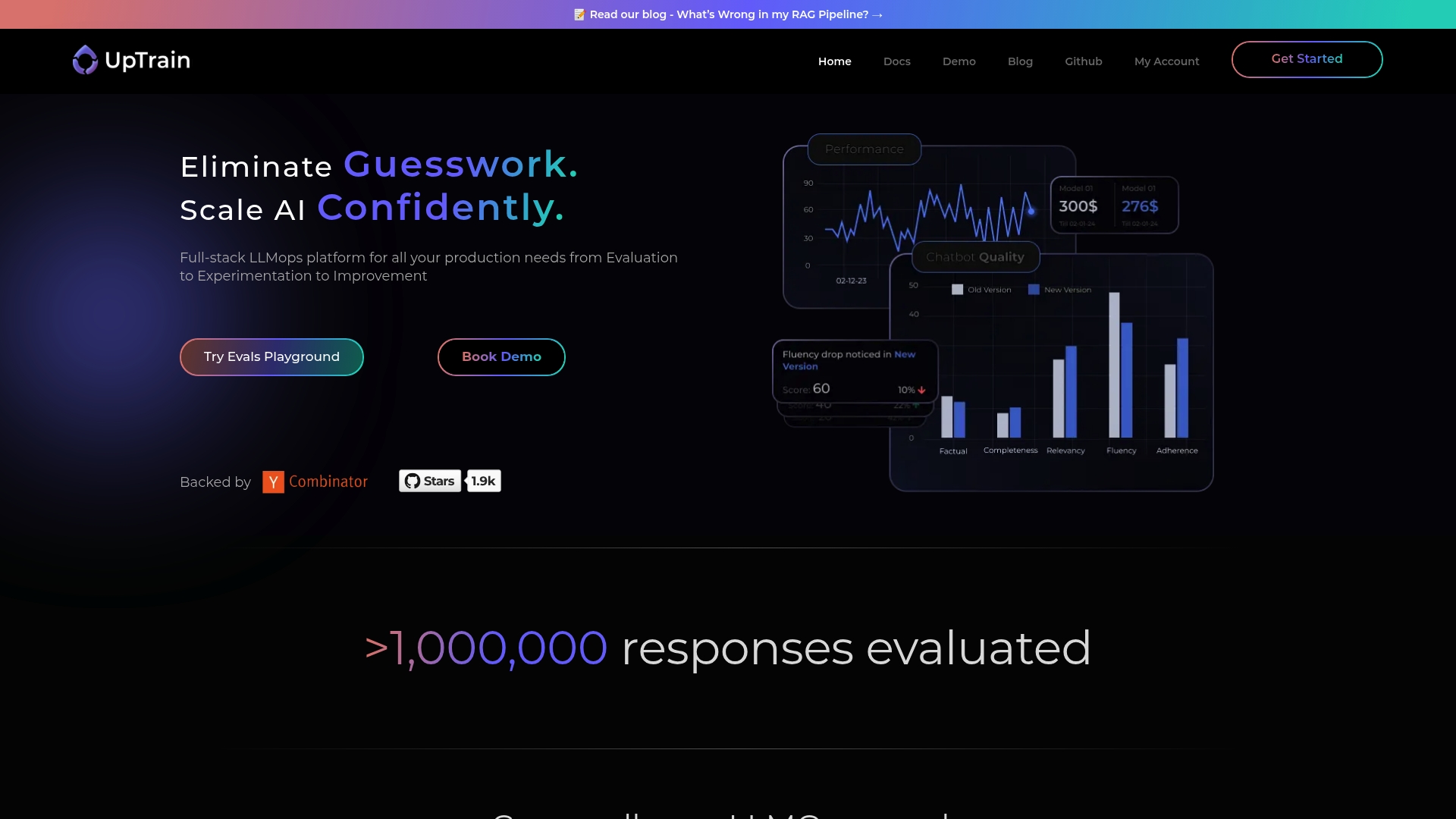
UpTrain​

https://uptrain.ai

At a Glance​

Backed by YCombinator, UpTrain centers an open source core evaluation framework for LLM evaluation platforms. The product pairs automated regression testing with root cause analysis and dataset enrichment to test models against real production signals. We found the onboarding flow emphasizes a fast API connection to start evaluations and collect telemetry.

Core Features​

Full stack LLMOps for evaluation, experimentation, and iterative improvement combines diverse metrics with dataset enrichment and regression tests. The platform runs automated regression testing for prompt, code, and config changes and surfaces error patterns via root cause analysis. Teams can route production logs into enriched test sets to exercise edge cases and measure model regressions over time.

Key Differentiator​

UpTrain pairs an open source evaluation core with enterprise grade testing and analysis tooling, and it is backed by YCombinator. That tight focus on evaluation and testing makes the product narrower than platforms that prioritize deployment orchestration or end user interfaces.

Pros​

The open source core makes the evaluation logic inspectable and modifiable, which helps research teams reproduce and extend tests. The architecture targets large datasets and responses, so the system scales for heavy production workloads. The vendor advertises a single API call for quick integration, which reduces friction for teams that want fast feedback loops.

Cons​

  • Limited detailed third party reviews exist, so many claims are presented by the vendor.
  • The full platform has operational complexity that may exceed the needs of small projects.
  • The product requires technical expertise to configure, tune, and operate effectively.

When It May Not Fit​

Organizations seeking a plug and play deployment layer or an end user testing interface will find the scope narrower than alternatives. Small teams or solo developers will likely face overhead from the platform's full stack feature set. If you need a hosted service with minimal configuration, this evaluation first approach may feel heavy.

Who It's For​

AI and ML developers, data scientists, and product teams running LLMs in production gain the most from UpTrain. It suits teams that already manage model serving and need a rigorous evaluation and regression testing workflow. Research groups that want an inspectable evaluation core will also find the open source approach useful.

Real World Use Case​

An AI engineering team connects multiple model endpoints to UpTrain and runs systematic regression tests after every prompt or config update. They use the root cause analysis output to isolate error patterns and iterate on prompts and model choices. The result is fewer regressions in a customer service chatbot production stack.

Pricing​

The vendor lists pricing as not applicable and the product is presented for informational use. UpTrain is open source, so total cost depends on hosting, compute, and any commercial support choices. Evaluate hosting and operational costs before committing to a production rollout.

Website: https://uptrain.ai

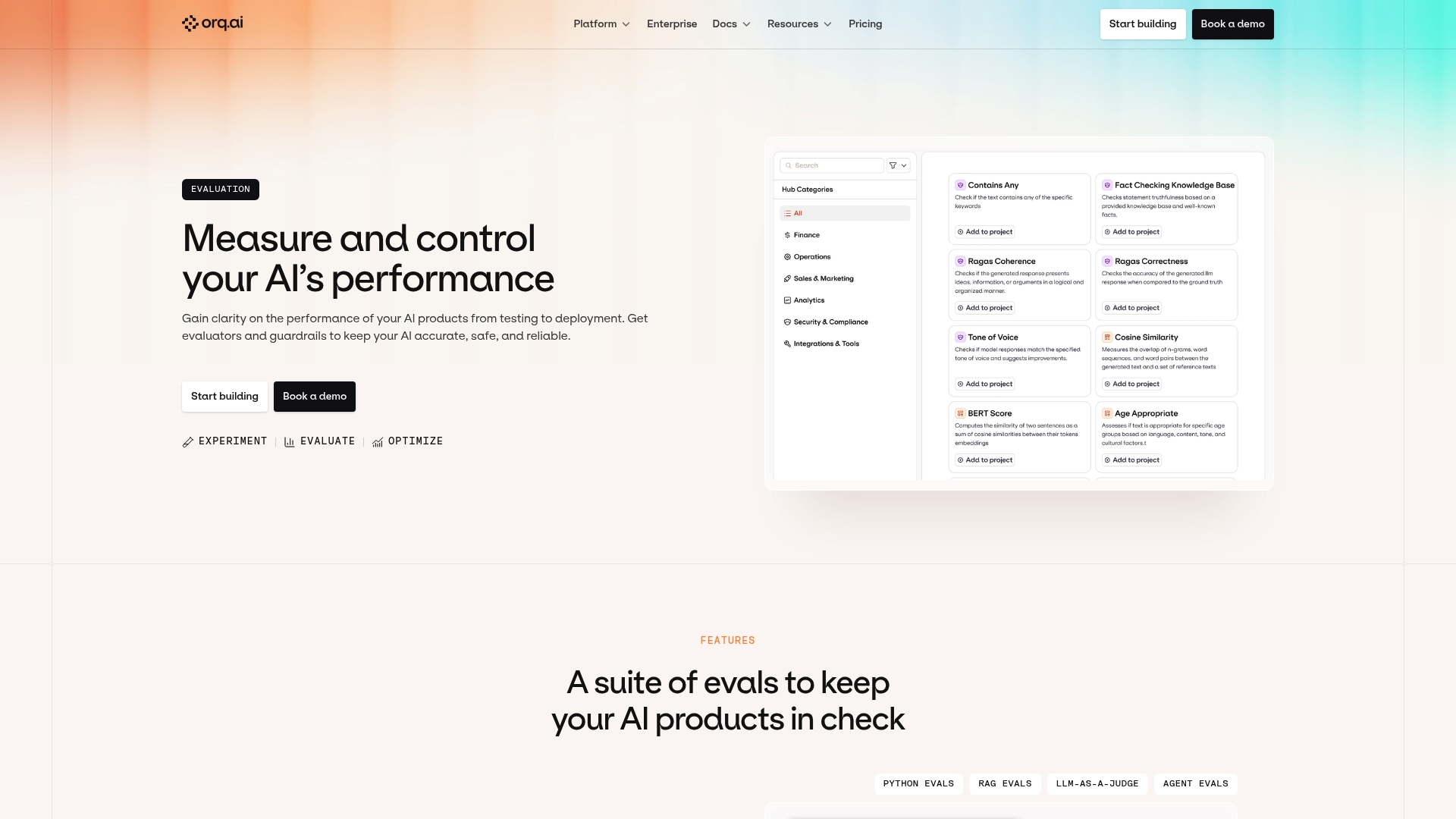
Orq.ai​

https://orq.ai/platform/evaluation

At a Glance​

Orq.ai supports cloud, VPC, and on premise deployment options alongside evaluation and governance tooling. The platform groups evaluation frameworks, observability, and deployment controls into one product. That architecture targets enterprise teams that must run evaluated agents inside strict network and compliance boundaries.

Core Features​

Orq.ai bundles flexible evaluation frameworks such as RAG Evans, LLM as a Judge, agent evals, regression tests, and prompt experiments into a single workflow. It records agent reasoning and multi step behavior while offering scalable human review and dataset versioning with lineage and PII detection. The product also exposes automated safety controls and policy enforcement for production guardrails.

Key Differentiator​

The vendor advertises an all in one approach that integrates evaluation, monitoring, governance, and deployment with enterprise security features including SOC 2 and GDPR alignment. That integration reduces toolchain handoffs for teams that must validate agents, run audits, and operate agents under regulatory constraints. Orq.ai positions evaluation as a native part of the production lifecycle rather than an afterthought.

Pros​

Orq.ai combines evaluation and runtime controls so teams can run experiments and then promote the same artifacts to production. The platform supports multi cloud and hybrid deployment patterns, which helps teams keep sensitive workloads inside corporate networks. Extensive connectors and out of the box evaluators speed early testing, and dashboards make trace review and human feedback workflows easier to manage. Those compliance and security features also help governance officers and MLOps engineers meet audit requirements.

Cons​

  • Complexity and steep learning curve. New teams report a high setup and configuration effort to map policies and evaluation pipelines.
  • Pricing not publicly specified. That lack of transparency can complicate budget planning for procurement cycles.
  • Advanced customization requires senior engineering skills. Expect integration work to wire custom observability and guardrails.

When It May Not Fit​

Small teams without dedicated MLOps or security engineers will struggle to justify the onboarding time and integration effort. Organizations that need fixed per seat pricing or transparent public tiers may find procurement discussions slow. If your project is a one off prototype rather than a long running production agent, the platforms enterprise focus may add unnecessary overhead.

Notable Integrations​

  • OpenAI
  • Azure OpenAI
  • Google Vertex AI
  • LangChain
  • Vercel AI SDK
  • OpenTelemetry

Who It's For​

Orq.ai fits enterprise AI teams and MLOps groups that manage production agents and strict compliance controls. It suits AI governance officers needing traceable decision logs and policy enforcement across models. Solutions architects running multi model, multi cloud deployments will get the most value.

Real World Use Case​

A financial services firm deploys multiple agents for client risk assessment and keeps them inside a VPC while running continuous evaluation. The firm uses automated guardrails and human review queues to prevent unsafe outputs and to capture audit trails. That setup helps the team meet regulatory reporting needs while iterating on model behavior.

Pricing​

Not publicly disclosed. Orq.ai lists enterprise and custom pricing options available on request and through procurement channels. For exact licensing, contact the vendor for a tailored quote.

Website: https://orq.ai/platform/evaluation

Comparison of alternatives​

MLflow excels in providing a flexible and community-backed open-source platform for LLM evaluation and observability. However, it is pertinent to examine other options tailored for specific use cases within this domain.

Open-source accessibility and integration​

MLflow's open-source nature allows it to support numerous machine learning frameworks like PyTorch and TensorFlow while also offering observability via OpenTelemetry. This ensures usability across diverse systems. On the other hand, tools like UpTrain, with its open-source core, also emphasize extensive compatibility but focus narrowly on evaluation and regression workflows, which could benefit highly-specialized teams.

Compliance and governance capabilities​

For enterprise customers in regulated industries, Confident AI and Orq.ai provide notable advantages—Confident AI with SOC 2 and HIPAA compliance, and Orq.ai with GDPR alignment and support for policy-driven LLM deployments. These features make them standout choices for compliance-oriented companies, compared to MLflow which prioritizes extensibility over strict governance features.

Best fit​

  • For AI teams needing open-source solutions to manage experiments, evaluations, and deployments, MLflow's integrated features and extensive framework compatibility are.
  • Organizations requiring governance features such as SOC 2 and HIPAA compliance will find Confident AI's offerings distinctly aligned with their regulatory needs.
  • Companies demanding flexible customization of LLM evaluation workflows alongside hybrid and multi-cloud deployment options should explore Orq.ai as a matching solution.

Our pick​

MLflow represents the leading choice for teams that value open standards, framework extensibility, and centralized lifecycle management within an evaluation platform. Nonetheless, users with strict compliance requirements might better evaluate Confident AI or Orq.ai for their tailored offerings that prioritize governance and security.

MLflow suits teams that demand framework flexibility and robust observation tools for production rollout.

PlatformKey DifferentiatorBest ForNotable LimitationPricing
MLflowOpen standards across frameworksAI teams managing auditsComplex setup for large deploymentsFree
Confident AISOC 2, HIPAA complianceEnterprise governance workflowsPrice escalates for large projectsStarting at $9.99/user/month
Deepchecks LLM EvaluationContinuous validation with CI/CD pipelinesEnterprise LLM operationsSetup effort for small teamsPrice not published
UpTrainOpen-source regression toolchainResearch and testing improvementsRequires technical configuration expertiseFree, with hosting fees
Orq.aiIntegrated governance and complianceEnterprise AI with strict controlsHigh setup complexityPrice not published

Choosing the Right LLM Evaluation Platform for Production Success​

Managing LLM lifecycle and agent evaluation can feel complex for AI teams needing auditability and cross-framework control. Mlflow addresses these challenges by unifying model tracking, deployment, and tracing into one open-source platform designed for AI engineers, data scientists, and MLOps teams. Its centralized AI Gateway secures prompt management while supporting evaluation workflows using LLM-as-a-Judge methods.

https://mlflow.org

See how Mlflow reduces the risk of fragmented tooling and improves governance across providers. Visit Mlflow to learn how your team can start using detailed observability and consistent evaluation pipelines that drive transparent, auditable LLM deployments.

FAQ​

What are the key features that make Mlflow a great choice for LLM evaluation?​

Mlflow offers centralized experiment tracking and model deployment in a single workflow. It includes observability with OpenTelemetry support and tools for prompt optimization, making it suitable for teams that require comprehensive management of the ML lifecycle.

How does Confident AI compare to Mlflow in terms of regulatory compliance?​

Confident AI excels in enterprise security, offering SOC 2 and HIPAA support, which is particularly useful for regulated industries. Mlflow, while versatile, focuses more on general framework compatibility and may not provide the same level of specialized compliance tools as Confident AI.

Which platform offers better integration with widely used machine learning frameworks?​

Mlflow supports a broad range of frameworks, including PyTorch, TensorFlow, and LangChain, making it a better fit for teams that want to leverage existing training and inference code across diverse environments. This flexibility facilitates experimentation and deployment.

Can I use Mlflow for small-scale projects?​

Yes, Mlflow is suitable for small experimental projects as it provides the same tools for smaller teams as larger organizations. This scalability allows for consistent workflows in both environments, making it an approachable option for various use cases.

What unique feature does UpTrain offer for evaluating models in production?​

UpTrain focuses on automated regression testing and root cause analysis, which helps teams exercise edge cases in real production conditions. While this is beneficial, teams seeking comprehensive ML lifecycle management may find Mlflow to be a more complete solution.