Why Standardize AI Workflows for Enterprise MLops

Standardizing AI workflows converts experimental GenAI into reliable, auditable production systems. Without a shared foundation, every team reinvents context delivery, evaluation criteria, and tracing schemas, and the result is exception sprawl that compounds with every new pilot. The minimal set of standards that deliver immediate value: identity and access posture, a context and metadata layer, model and prompt registries, evaluation and acceptance criteria, and a unified observability schema.
Pro Tip: Freeze a small set of platform-level building blocks before you scale pilots. Adding standards retroactively costs three to five times more in engineering effort than defining them upfront.
Table of Contents
- Why standardize AI workflows before scaling pilots
- What does standardizing AI workflows actually deliver?
- How do you implement AI workflow standards without slowing teams down?
- What technical architecture enforces AI workflow standards?
- How does governance align with ISO/IEC 42001 and audit requirements?
- What pitfalls should you watch for when introducing AI standards?
- How does Mlflow map to these standards in practice?
- Key Takeaways
- The political reality of platform standards
- Mlflow gives your team a production-ready standards foundation
- Useful sources and further reading
Why standardize AI workflows before scaling pilots
CAISI field notes frame the core principle clearly: treat AI as a platform capability before you scale it as a business capability. That posture means centralizing what must be common and allowing controlled variation everywhere else.
The items that must be standardized fall into eight categories:
- Identity and access posture — which principals can invoke which models, tools, and data sources; prevents unauthorized model calls and credential leakage
- Context and semantic layer — a shared business glossary and canonical data sources that agents query; prevents twelve business units from maintaining twelve inconsistent context stores
- Model registry — versioned model artifacts with provenance metadata; enables reproducible runs and rollback
- Prompt registry — versioned prompt templates with owner, purpose, and linked evaluation results; separates content from acceptance criteria
- Evaluation and acceptance criteria — explicit pass/fail thresholds for output quality, latency, and safety; a prompt is not a standard until acceptance gates are defined
- Observability and tracing schema — unified span attributes across all agents and pipelines; without this, debugging becomes what practitioners call "AI archaeology"
- Deployment and CI/CD environment rules — environment-aware configuration, secrets management, and promotion gates
- Evidence and audit records — immutable logs of who acted, on what input, with which model version, and what policy verdict was returned
| Item | Purpose | Minimum fields |
|---|---|---|
| Identity and access | Prevent unauthorized invocations | Principal, scope, credential TTL |
| Context endpoint | Consistent semantic grounding | Source ID, version, freshness timestamp |
| Model registry | Reproducibility and rollback | Model ID, version, artifact hash, lineage |
| Prompt registry | Prompt governance and versioning | Prompt ID, version, owner, eval link |
| Evaluation criteria | Trusted output gates | Metric name, threshold, pass/fail, evaluator |
| Tracing schema | Unified observability | Trace ID, span type, latency, token count |
| Audit record | Regulatory evidence | Actor, input hash, model version, output, verdict |
Standardizing tracing, evaluation, and guardrails delivers the highest near-term value as the number of AI systems grows.

What does standardizing AI workflows actually deliver?
The business case maps directly to operational metrics your platform sponsors already track.
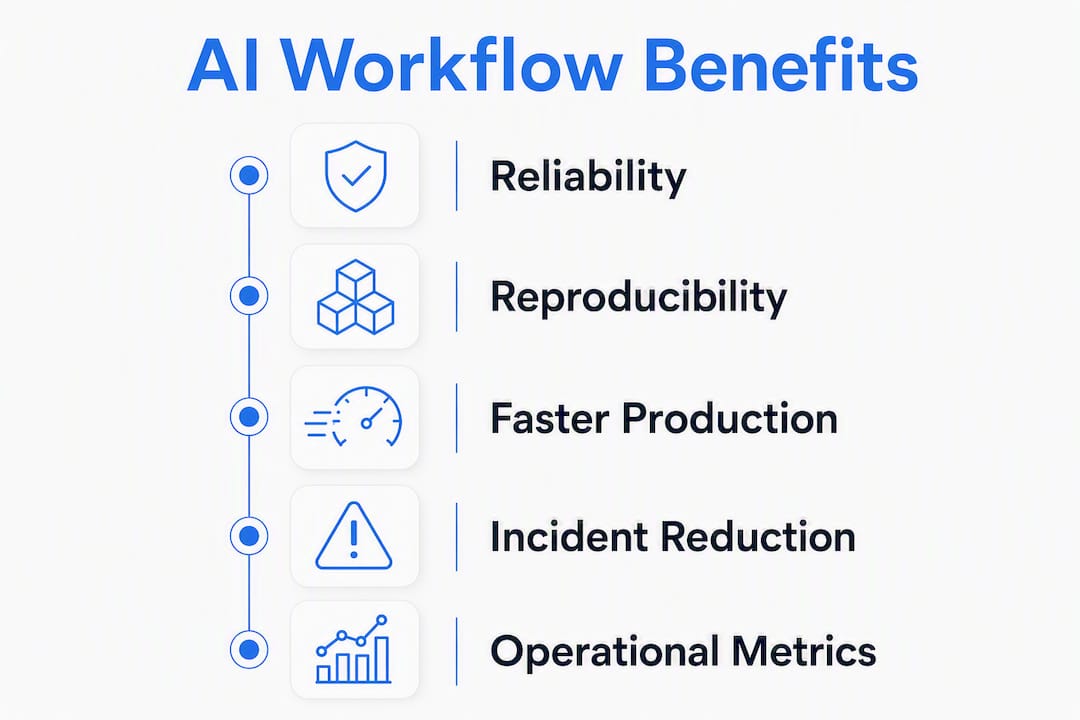
Reliability and incident reduction. Unified tracing means every agent run produces a queryable span tree. When a production incident occurs, you locate the failing component in minutes, not days. Non-deterministic AI systems have hidden state: prompts, model versions, sampled outputs. Standardized tracing reduces the cost of surfacing that state dramatically.
Reproducibility. Declaring model and prompt versions in configuration, as engineering discipline requires, means any run can be replayed with identical inputs. That is the difference between a demo and a production system.
Faster time-to-production. Teams that share a context endpoint, a model registry, and a CI/CD promotion gate stop rebuilding the same scaffolding for every new use case. Onboarding a new agent drops from weeks to days.
Regulatory readiness. Audit records that capture actor, input, model version, output, and policy verdict satisfy the evidence requirements that regulators and internal risk teams request. ISO/IEC 42001 provides a recognized governance framework that auditors accept.
Lower exception volume. Rising exception counts are a leading indicator that standards are missing or ambiguous. Measuring exception volume as a KPI gives platform teams an early warning signal before incidents escalate.
"Standards provide a common basis that helps balance rapid innovation with governance and makes decision processes more transparent, building accountability and public trust." — ANSI commentary on ISO/IEC AI standards
Track these metrics per phase: mean time to resolution (MTTR) for AI incidents, regression-fail rate across model updates, time-to-deploy for new agents, and exception count per sprint.
How do you implement AI workflow standards without slowing teams down?
A four-phase roadmap keeps standards minimal and iterative.
- Assess (Days 1–30): Inventory all active AI pilots. Count exception volume per use case. Identify which teams share no context, tracing, or evaluation infrastructure. Assign a platform owner and a security reviewer to each pilot.
- Define (Days 30–60): Draft minimal data contracts for the eight items above. Define two to three acceptance criteria per use case. Document the context endpoint schema and the tracing span attributes. Keep standards to one page per domain.
- Pilot (Days 60–90): Apply standards to one or two high-value use cases. Measure exception volume before and after. Validate that the model registry, prompt registry, and tracing pipeline produce the expected artifacts. Collect feedback from the BU pilot lead.
- Scale (Days 90–180): Adopt a federated governance model. Central platform teams own the shared context endpoint, model registry, and tracing schema. Business units own delivery and can vary their tooling within those guardrails.
| Phase | Owner | Deliverable | Checkpoint |
|---|---|---|---|
| Assess | Platform owner | Exception inventory, pilot map | Day 30 |
| Define | Security reviewer + platform owner | Data contracts, tracing schema | Day 60 |
| Pilot | BU pilot lead | Instrumented use case, eval results | Day 90 |
| Scale | Platform owner + BU leads | Federated governance model | Day 180 |
Pro Tip: Measure exception volume weekly during the pilot phase. A flat or declining count confirms your standards are specific enough. A rising count means a standard is still too vague or missing entirely.
What technical architecture enforces AI workflow standards?
Five components form the reference architecture. Each maps to a specific failure mode the standards above are designed to prevent.
- Context endpoint (MCP-style server): A single service that agents query for business glossary terms, canonical data sources, and metadata. Shared infrastructure for context lets business units adopt different agent frameworks while preserving consistency and auditability.
- Model and prompt registry: Versioned stores for model artifacts and prompt templates. During a CI/CD promotion, the pipeline reads the registered model ID and prompt version, runs acceptance criteria, and blocks promotion on failure.
- AI gateway: A cross-provider control plane that enforces prompt policies, rate limits, credential rotation, and cost attribution before requests reach any model provider. This is where centralized AI model access control is applied at runtime.
- Observability and tracing pipeline: Every agent span, tool call, and LLM invocation emits a structured trace with a canonical schema. Telemetry flows to a queryable store so platform teams can correlate latency, token usage, and output quality across runs.
- Model inventory and lifecycle manager: Tracks model risk classification, approval status, re-validation dates, and deprecation schedules. Connects to the CI/CD pipeline to gate deployments on approval state.
Integration notes: connect your secrets store to the AI gateway for credential injection; wire the tracing pipeline to your existing observability platform via OpenTelemetry; trigger evaluation runs from CI/CD on every model or prompt version bump.
How does governance align with ISO/IEC 42001 and audit requirements?
ISO/IEC 42001 establishes an AI management system standard that auditors and regulators increasingly reference. Aligning your platform standards to it reduces regulatory friction because the evidence artifacts you already produce map directly to its requirements.
Governance artifacts to require on every production AI system:
- Evidence record per inference run: actor identity, input hash, model version, output, policy verdict, timestamp
- Model risk classification: low/medium/high based on data sensitivity and decision impact
- Approval workflow: sign-off from security reviewer and risk owner before production promotion
- Periodic re-validation gate: scheduled re-evaluation against acceptance criteria after model updates or data drift events
- Audit log retention: immutable, tamper-evident storage for the period your compliance team specifies
AI standards bridge regulatory gaps and create transparent decision-making paths that build accountability. A platform that produces these artifacts automatically, rather than requiring engineers to assemble them manually, is the practical payoff of standardization.
Pro Tip: Map each governance artifact to a specific ISO/IEC 42001 clause during your define phase. That mapping becomes your audit response package and saves days of evidence collection when a review arrives.
For systematic evidence capture, treat audit records as first-class pipeline outputs, not afterthoughts.
What pitfalls should you watch for when introducing AI standards?
Standardizing tools instead of context. Mandating a single LLM provider or agent framework kills adoption. Standardize the interfaces and data contracts; let teams pick their implementation.
Starting too late. Standards applied after ten pilots are in production require retroactive instrumentation. The political cost is high and the coverage is always incomplete. Start during the first pilot.
Over-broad standards that block innovation. A standard that specifies more than the minimum necessary fields becomes a bottleneck. Keep each standard to the smallest contract that prevents the failure mode it targets, then extend iteratively.
Missing observability and acceptance criteria. Shipping an agent without a tracing schema and explicit pass/fail thresholds means you cannot tell whether it is working. This is the most common gap in early-stage enterprise GenAI programs.
Negotiating with product teams: Frame standards as shared infrastructure that reduces their toil, not as compliance overhead. Show the before/after exception count from your pilot. Offer to own the platform components so product teams only consume them.
- Identify the failure mode each standard prevents.
- Write the minimal data contract that addresses it.
- Pilot with one team, measure exception volume, and publish results.
- Use those results as the business case for broader adoption.
How does Mlflow map to these standards in practice?
Mlflow's capabilities correspond directly to the eight standardization items above.
- Observability and tracing: Mlflow's AI observability provides deep agentic reasoning traces, capturing every span, tool call, and token count with a structured schema that feeds directly into the unified tracing pipeline described above.
- Prompt registry: The prompt registry versions prompt templates with owner metadata and links each version to its evaluation results, separating content from acceptance criteria.
- Model registry: Mlflow's model registry stores versioned artifacts with lineage, approval state, and deployment history, giving the lifecycle manager its source of truth.
- AI gateway: The centralized AI Gateway enforces cross-provider controls, credential rotation, and prompt policies at runtime, covering the access posture and policy enforcement requirements.
- Evaluation: LLM-as-a-Judge evaluation runs automatically on model and prompt version bumps, producing the acceptance-criteria verdicts that gate CI/CD promotions.
For platform engineers: wire Mlflow's tracing SDK into your existing OpenTelemetry pipeline, register your context endpoint as a custom dependency, and configure the AI Gateway as the single egress point for all model provider calls.
Pro Tip: Start with Mlflow tracing on your highest-traffic agent. The span data you collect in the first two weeks will reveal which model versions, prompt versions, and tool calls account for the majority of latency and errors, giving you a prioritized list of what to standardize next.
Key Takeaways
Standardizing AI workflows is the fastest path from experimental GenAI to reliable, auditable production systems that satisfy governance requirements and scale without exception sprawl.
| Point | Details |
|---|---|
| Freeze standards early | Define minimal data contracts before scaling pilots to avoid costly retroactive instrumentation. |
| Measure exception volume | Rising exception counts signal missing or vague standards; track this weekly as a leading KPI. |
| Federated governance scales | Central teams own shared interfaces; business units own delivery within those guardrails. |
| ISO/IEC 42001 alignment | Producing evidence records, risk classifications, and audit logs maps directly to recognized governance frameworks. |
| Mlflow covers the stack | Mlflow's tracing, prompt registry, model registry, AI Gateway, and LLM-as-a-Judge evaluation address all eight standardization domains. |
The political reality of platform standards
The hardest part of introducing AI workflow standards is not the architecture. It is convincing twelve product teams that a shared context endpoint is worth the coordination cost. My rule: never propose a standard without showing the failure mode it prevents and the exception count it reduces. Data from a two-week pilot is more persuasive than any governance framework document.
The platform-first posture works because it separates what must be common from what can vary. Centralize the context layer, the tracing schema, and the evaluation gates. Let teams choose their agent frameworks, their LLM providers, and their prompt styles within those guardrails. That controlled variation is not a weakness in the standard; it is what makes adoption politically viable. The teams that resist standards the hardest are usually the ones rebuilding the same context store for the third time. Show them the shared endpoint and they tend to come around quickly.
Mlflow gives your team a production-ready standards foundation
The gap between a working GenAI demo and a production system that satisfies your security team, your compliance team, and your on-call engineers is exactly the gap that Mlflow is built to close. Mlflow's open-source platform covers observability with deep agentic tracing, a versioned prompt registry with evaluation links, a centralized AI Gateway for cross-provider governance, and a model registry with full lifecycle management. Teams that adopt Mlflow as their platform foundation skip months of custom instrumentation and get audit-ready artifacts from day one.
Evaluate Mlflow's GenAI and agent engineering platform to see how its capabilities map to the standards your team needs to enforce before the next pilot goes to production.
Useful sources and further reading
Governance and standards
- ISO/IEC AI standards overview — ISO's AI management system standards, including ISO/IEC 42001
- ANSI: Why organizations should adhere to AI standards — Connects standards adoption to governance, accountability, and public trust
- NIST: A Possible Approach for Evaluating AI Standards Development — Framework for measuring the impact of AI standards on innovation and trust
- The Role of Standards in Enabling the AI Stack — Columbia Science and Technology Law Review analysis of standards as enabling infrastructure
Architecture and implementation playbooks
- CAISI: What Platform Teams Must Standardize Before AI Can Scale — Field notes on identity, evidence, validation, and exception volume as platform KPIs
- Atlan: How to Standardize AI Tooling Across Business Units — MCP server pattern and federated governance for context standardization
- The Underestimated Challenge of Production AI: Standardized Components — Practitioner analysis prioritizing tracing, evaluation, and guardrails
- Generative AI workflows need engineering discipline to scale beyond the demo — Case write-ups on reproducible pipeline execution and CI/CD integration
- Your AI Workflow Is Not Slow. It Is Missing a Standard. — Explains why acceptance criteria, not prompts, define a standard
- Crafting an AI Compass: The Influence of Global AI Standards on Firms — SSRN research on how AI standardization drives investment and firm value