Why Monitor Model Drift in Production: A Practical Guide

Unmonitored model drift is one of the most expensive silent failures in production ML. Environ 91 % des modèles d'apprentissage automatique connaissent une dégradation de leurs performances au fil du temps, mais cette détérioration ne déclenche que rarement une alerte système. Infrastructure metrics stay green. Latency looks normal. Meanwhile, your model's predictions quietly diverge from reality. Monitoring model drift in production means continuously tracking statistical changes in your model's inputs, outputs, and behavior so you can catch that divergence before it costs you. The core elements of effective monitoring include input data distribution checks, prediction distribution analysis, business KPI surveillance, and automated alerting tied to retraining workflows.
- Input data checks: Compare live feature distributions against your training baseline using statistical tests.
- Prediction distribution analysis: Track output shifts as an early proxy when ground truth labels are delayed.
- Business KPI surveillance: Tie model health to downstream metrics like conversion rate, fraud catch rate, or clinical accuracy.
- Automated alerting: Set threshold-based triggers that fire retraining jobs rather than just sending emails.
The FDA and CMS both advocate for postmarket surveillance of AI prediction models, recognizing that a model's real-world impact can degrade even when accuracy metrics appear stable. That regulatory pressure is sharpest in healthcare, but the underlying logic applies to any high-stakes production system.
Table of Contents
- What types of model drift should you watch for?
- How do you detect and monitor model drift effectively?
- How does drift monitoring fit into your MLOps workflow?
- How Mlflow helps you manage model drift at scale
- Mlflow gives your production models the observability they need
- Key Takeaways
What types of model drift should you watch for?
Model drift is not a single phenomenon. Three distinct types affect production systems, and each demands a different detection strategy.
Data drift (covariate shift) occurs when the statistical distribution of input features changes after deployment, even if the underlying relationship between inputs and outputs stays the same. A fraud detection model trained on 2023 transaction patterns will see data drift as consumer spending behavior shifts. The model's learned decision boundary no longer maps cleanly to the new input space.
Concept drift is more fundamental: the relationship between inputs and outputs changes. A credit risk model trained before an economic downturn may find that the same applicant profile now carries a very different default probability. The inputs look similar, but the world has changed around them.
Prediction drift describes shifts in the model's output distribution, regardless of course. It often surfaces before you can confirm concept drift, making it a useful early warning signal. If your classifier's positive prediction rate jumps from 12% to 28% over two weeks, something has changed upstream, even if you cannot yet label it.
Two additional failure modes deserve attention:
- Training-serving skew: Feature engineering applied differently at training time versus inference time produces systematic prediction errors that mimic drift but require pipeline fixes, not retraining.
- Upstream schema drift: A column rename, a unit change, or a new null pattern in a data pipeline can cause apparent model degradation that looks like concept drift but resolves with a pipeline patch.
Root cause triage matters here. Retraining a model to fix a schema bug wastes compute and delays the real fix.
How do you detect and monitor model drift effectively?
Statistical rigor is what separates genuine drift detection from noise. Three metrics form the practical foundation for most production monitoring setups.

Population Stability Index (PSI) compares a feature's current distribution to its training baseline. A PSI below 0.1 signals stability; between 0.1 and 0.25 indicates moderate drift worth investigating; above 0.25 signals significant drift requiring fast action. PSI is particularly common in financial services because it was originally developed for credit scorecard monitoring.
Kolmogorov-Smirnov (KS) test measures the maximum distance between two cumulative distribution functions. It works well for continuous features and is sensitive to shifts in the tails of a distribution, where fraud signals and anomalies often live.
Pearson's Chi-Squared test handles categorical features. If your model ingests encoded categorical variables like product category or geographic region, Chi-Squared lets you test whether the category frequency distribution has shifted meaningfully.
| Metric | Feature type | What it measures | Alert threshold |
|---|---|---|---|
| PSI | Continuous or ordinal | Distribution shift vs. baseline | PSI > 0.25 |
| KS test | Continuous | Max CDF distance between distributions | p-value below typical significance threshold |
| Chi-Squared | Categorical | Frequency distribution shift | p-value below typical significance threshold |
| Jensen-Shannon Distance | Any | Symmetric divergence between distributions | Domain-specific |
| Prediction drift rate | Model output | Output distribution shift over time | Baseline ± threshold |
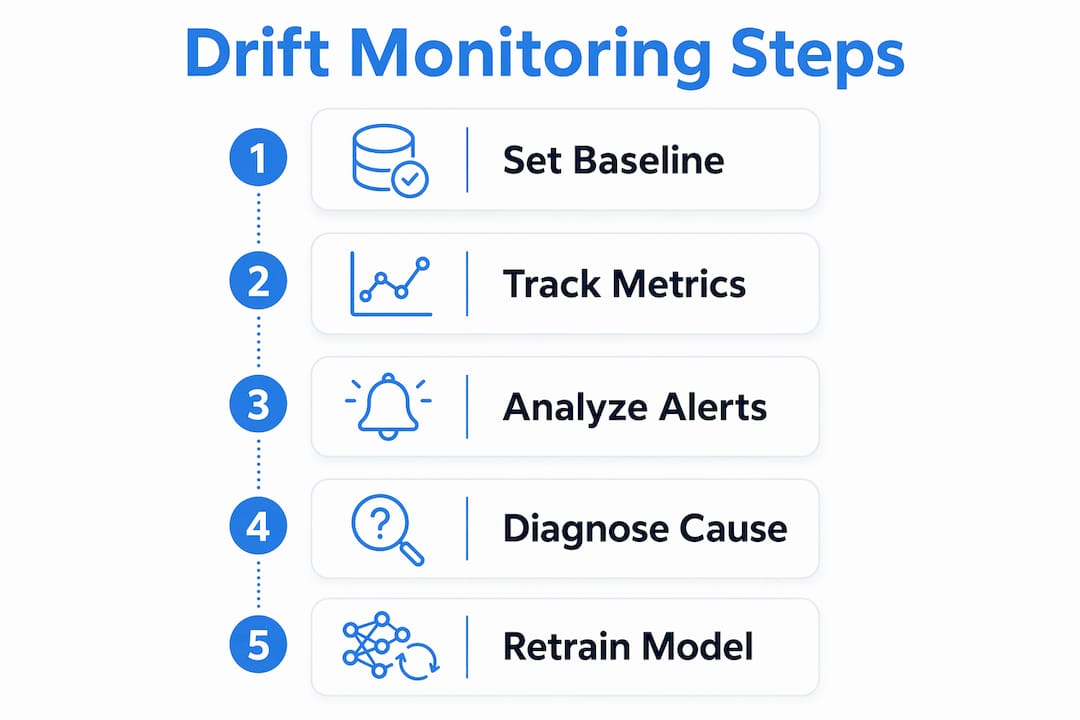
A layered monitoring approach covers more ground than any single metric. Start with data quality checks (null rates, type mismatches, out-of-range values), then add input distribution monitoring, then prediction drift tracking. When ground truth labels are delayed or unavailable, prediction distribution shifts serve as the most reliable early proxy for concept drift. Only add model performance signals (accuracy, F1, AUC) once you have access to labeled actuals.
Pro Tip: Establish your monitoring baseline at deployment time, not retroactively. Capture the training data distribution, the validation prediction distribution, and key feature statistics as artifacts alongside the model version. Trying to reconstruct a baseline six months later is error-prone and often impossible.
Alert calibration is as important as metric selection. Thresholds must be set with domain knowledge to avoid alert fatigue. A PSI of 0.15 on a stable demographic feature may be noise; the same PSI on a real-time behavioral feature may warrant immediate investigation. Work with your data scientists to set feature-level thresholds, not just global ones.
How does drift monitoring fit into your MLOps workflow?
Drift monitoring works best when it is wired directly into your MLOps pipeline rather than bolted on as an afterthought. The key architectural shift is moving from fixed-schedule retraining to trigger-based retraining tied to drift threshold alerts. Fixed schedules retrain whether or not the model needs it. Trigger-based workflows retrain when evidence demands it, reducing unnecessary compute and cutting the window of exposure to degraded predictions.
A production-grade drift monitoring pipeline typically includes these stages:
- Continuous data ingestion: Collect inference inputs and outputs at every prediction, or at batch intervals for high-volume systems.
- Statistical computation: Run PSI, KS, or Chi-Squared comparisons against the baseline on a schedule that matches your use case, from every few minutes for real-time systems to daily for batch pipelines.
- Threshold evaluation: Compare computed metrics against configured thresholds and emit structured events when limits are exceeded.
- Automated response: Trigger retraining jobs, open incident tickets, or page on-call engineers depending on severity.
- Feedback loop: Feed newly labeled data back into the training pipeline so retraining uses current ground truth, not stale historical data.
Teams that treat models as living systems rather than static artifacts maintain better operational maturity. That means assigning clear ownership for each production model, defining drift thresholds collaboratively across data science, engineering, and business stakeholders, and documenting remediation protocols before drift occurs. Waiting until a model fails to decide who owns the fix is a governance gap that shows up repeatedly in post-mortems.
Monitoring should function as a continuous feedback loop integrated with retraining workflows, not a one-time alert system. When a drift event fires, the pipeline should already know what data to collect, what retraining job to run, and what validation gates the new model must pass before promotion.

How Mlflow helps you manage model drift at scale
Mlflow is built for exactly the kind of production observability that drift management requires. Its lifecycle management capabilities cover the full arc from experiment tracking through deployment and continuous monitoring, giving teams a single platform to govern model health rather than stitching together separate tools.
For drift monitoring specifically, Mlflow's metrics tracking lets you log distribution statistics, PSI values, and prediction drift rates as time-series metrics against a registered model version. You can set up alerting rules tied to those metrics and connect them to automated retraining workflows. The Model Registry provides version control and stage transitions (Staging, Production, Archived) so that when a retrained model passes validation, promotion is a governed, auditable step rather than a manual deployment.
Where Mlflow goes further than basic monitoring is in its production observability for GenAI and LLM-based systems. Deep tracing of agentic reasoning lets you see not just what a model predicted, but why, which is critical when drift in a multi-step agent workflow is harder to localize than drift in a single classifier. The LLM-as-a-Judge evaluation framework automates quality assessment across model versions, so you can compare a retrained model against its predecessor on real production traces before promoting it.
Mlflow's AI observability tools also address the organizational side of drift management. Centralized governance through the AI Gateway means that prompt templates, model versions, and evaluation criteria are all versioned and auditable. Cross-functional teams get a shared view of model health rather than siloed dashboards that tell different stories.
Key Mlflow capabilities for drift management:
- Metrics logging: Track PSI, KS statistics, and prediction drift rates as first-class metrics against model versions.
- Model Registry: Govern model lifecycle with stage transitions tied to drift-triggered retraining outcomes.
- Deep tracing: Instrument agentic workflows to localize drift to specific reasoning steps or tool calls.
- LLM-as-a-Judge: Automate evaluation of retrained models against production traces before promotion.
- Centralized AI Gateway: Version and audit prompts and model configurations across providers.
The practical result is that drift monitoring stops being a reactive fire drill and becomes a continuous quality assurance process embedded in your deployment pipeline.
Mlflow gives your production models the observability they need
Production model drift is a solved problem when you have the right instrumentation in place. Mlflow's open-source platform gives ML engineers and AI operations teams production-grade observability that covers the full lifecycle: from tracking training baselines and logging drift metrics to orchestrating automated retraining and governing model promotions.
Unlike point solutions that monitor one signal in isolation, Mlflow connects drift detection to the broader model lifecycle. When a PSI threshold fires, the retraining workflow already knows which model version to update, which evaluation criteria to apply, and which team to notify. For GenAI and LLM-based systems, deep tracing and LLM-as-a-Judge evaluation give you the same level of production confidence that tabular model teams have relied on for years. Start with Mlflow's production observability cookbook to wire drift monitoring directly into your existing MLOps pipeline.
Key Takeaways
Monitoring model drift in production is the difference between a model that stays accurate over time and one that silently erodes business value while your dashboards show no errors.
| Point | Details |
|---|---|
| Drift is silent by default | Environ 91 % des modèles de ML se dégradent au fil du temps, mais la dérive déclenche rarement une alerte système. |
| Three drift types need different responses | Data drift, concept drift, and prediction drift each require distinct detection metrics and remediation paths. |
| PSI thresholds guide action | A PSI above 0.25 signals significant drift; between 0.1 and 0.25 warrants investigation before acting. |
| Trigger-based retraining beats fixed schedules | Threshold-triggered retraining responds to real degradation, reducing exposure and unnecessary compute cycles. |
| Mlflow centralizes drift governance | Mlflow connects metrics logging, model versioning, and automated retraining into a single auditable production workflow. |