Top 4 braintrust.dev Alternatives for Agent Deployment 2026
Achieving full observability and reliable evaluation for production AI agents is difficult when key metrics and traces are fragmented across tools or hidden behind proprietary dashboards. Many options either require heavy engineering investment for setup, lock essential data away from your organization, or do not support deep traceability across agent decisions and prompts. This comparison looks at feature coverage, integration flexibility, and deployment posture so you can find an agent observability and evaluation platform that fits your team’s compliance, scale, and operational needs better than Braintrust.
Table of Contents
MLflow
At a Glance
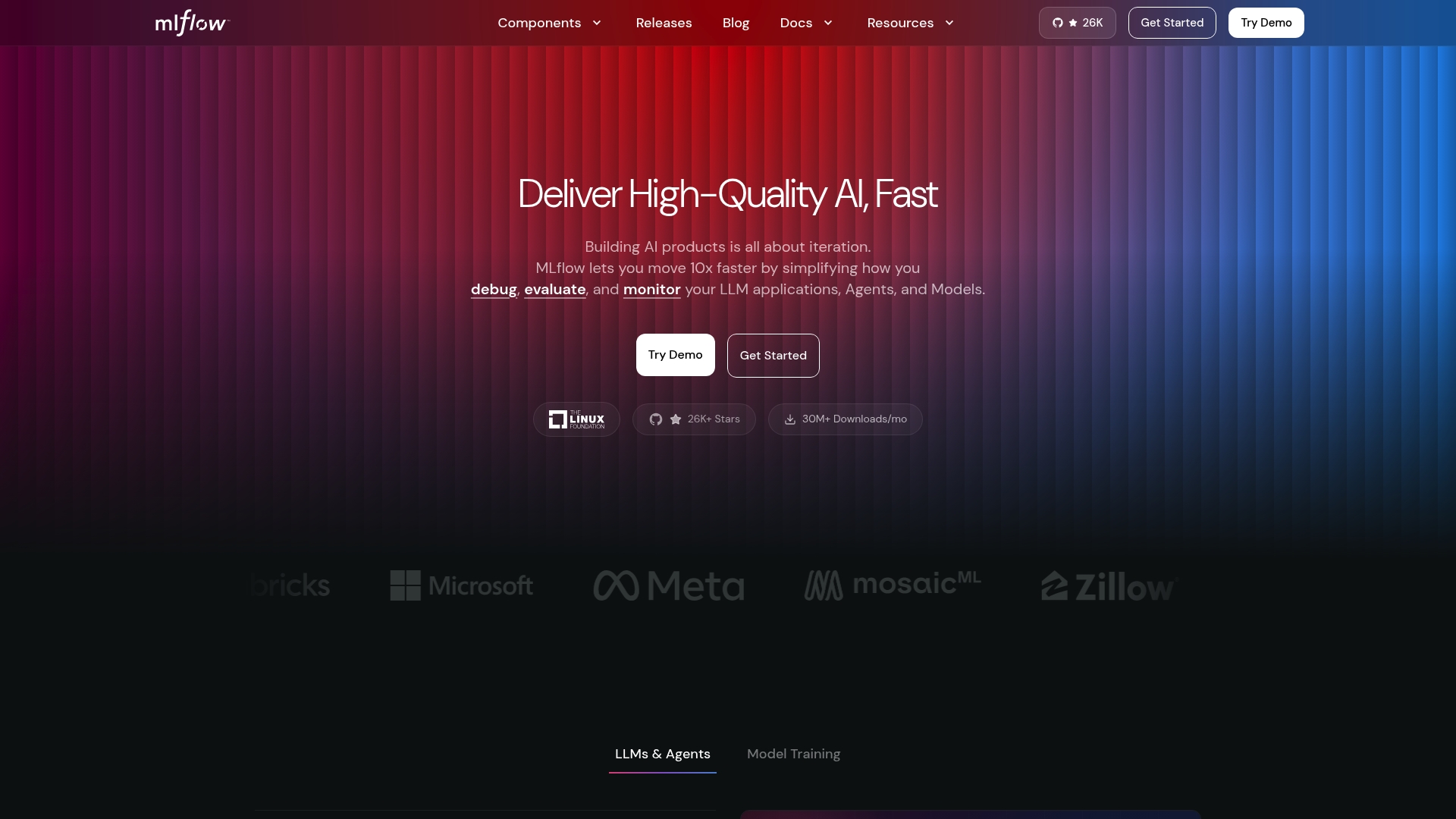
Production-grade observability with deep tracing of agent reasoning and a centralized AI Gateway for prompt governance are part of the core feature set rather than optional add-ons. MLflow's marketing materials state it is backed by many major organizations and aims to standardize evaluation and serving of complex GenAI workflows so teams can move prototypes into production.
Core Features
- Experiment tracking for models and LLMs with searchable run metadata and artifact storage.
- Model evaluation and registry that ties evaluation results to deployable model versions.
- Full lifecycle management for classical ML and deep learning projects across training to serving.
- Observability and traceability for agentic workflows, enabling end to end tracing of decisions and actions.
- Prompt registry and optimization to manage, version, and audit prompts used by LLMs and agents.
Key Differentiator
A unified open source stack that manages both traditional ML pipelines and LLM plus agent workflows. That single focus reduces the friction of connecting experiment tracking, model gating, and agent observability across different teams and orchestration frameworks.
Pros
- Open source and free to use, which removes per-seat licensing and lets teams inspect or fork behaviour when compliance demands transparency.
- Framework-agnostic support for PyTorch, TensorFlow, XGBoost, and HuggingFace makes it practical to consolidate projects already spread across toolchains.
- Integrated LLM and agent tooling turns ad hoc prompt scripts into auditable artifacts, accelerating governance reviews.
- Scalable architecture. The vendor advertises enterprise usage and scalability; that claim explains why large teams choose it when they outgrow single-provider tooling.
- Bridges experiment tracking and deployment so evaluation metrics travel with model artifacts instead of living in separate spreadsheets.
Cons
- Requires nontrivial setup and infrastructure for enterprise scale; larger teams should budget for deployment, storage, and observability configuration.
Notable Integrations
- OpenTelemetry
- LangChain
- OpenAI
- PyTorch
- TensorFlow
- XGBoost
- HuggingFace
Who It's For
Data scientists, ML engineers, and platform teams managing both model training and agentic LLM applications who need vendor neutrality and auditability. Good fit when multiple frameworks and cloud providers must interoperate under a single governance model.
Unique Value Proposition
Automated evaluation using LLM-as-a-Judge frameworks gives you repeatable, machine-enforced validation gates that slot into CI pipelines. Pairing those gates with a centralized AI Gateway for secure prompt management converts informal checks into auditable policy controls across providers.
Real World Use Case
A multinational firm uses MLflow to centralize experiment records, push validated models to a registry, and monitor deployed agents across clouds. Teams iterate faster because evaluation artifacts, prompts, and traces are all linked to the same model version.
Website: https://mlflow.org
LangChain
At a Glance
According to the vendor, Klarna’s AI assistant cut case resolution time by 80% using LangSmith for agent observability and management. That specific deployment is the clearest example the vendor uses to illustrate LangChain’s production capabilities.
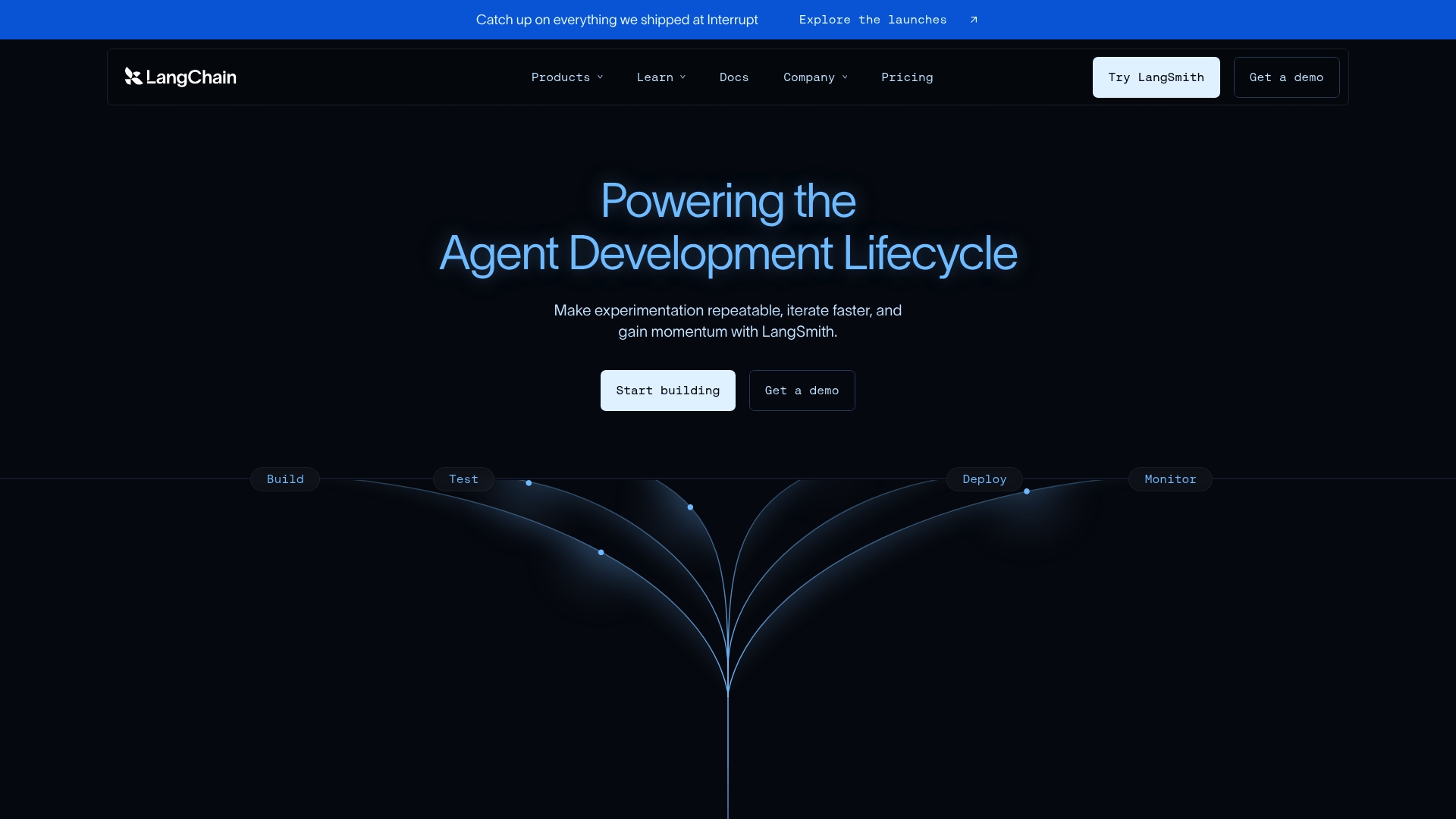
LangChain pairs a framework approach with tools for observability, evaluation, and deployment so teams can move prototypes toward production faster.
Core Features
-
Framework agnostic agent engineering platform that lets you plug in different model runtimes and libraries.
-
Built in tooling for observing and evaluating agent behavior across long running tasks and multi agent flows.
-
Deployment utilities for running agents in enterprise environments and connecting human in the loop workflows.
-
Debugging and monitoring features that surface decision traces and token level reasoning for postmortems.
-
Support for multi agent coordination and long horizon task orchestration in production contexts.
Key Differentiator
The vendor advertises LangChain as a framework agnostic stack that combines open source agent frameworks with deep observability and evaluation tools. That combination appeals to teams that want flexible runtime choices plus the ability to instrument agent reasoning from development through production.
Pros
-
Widely adopted approach for LLM integration makes it easier to find examples, templates, and community support when you prototype a new agent.
-
The ecosystem accelerates experimentation because many connectors and patterns are available as community maintained modules.
-
Built in agent observability and evaluation tooling helps you track decision traces, which speeds debugging for long horizon tasks.
-
Supports human in the loop patterns and multi agent coordination, so you can design complex workflows without rebuilding orchestration primitives.
-
Works with multiple open source frameworks and runtimes which reduces vendor lock in during architectural decisions.
Cons
-
The abstraction level is high which creates a steep learning curve for engineers new to agent architectures.
-
When scaled to many agents, topologies can become hard to maintain and the codebase may require significant engineering investment.
-
The platform does not include built in proprietary guardrails or out of the box compliance controls for regulated data handling.
-
High level abstractions can obscure underlying calls and make low level troubleshooting slower for unfamiliar teams.
When It May Not Fit
If your team needs a managed product that enforces compliance out of the box, LangChain’s community driven stack may add undue operational burden. Small teams that require turnkey, low configuration deployment and strict regulatory controls will likely spend more time building missing pieces than they save.
Who It's For
Software developers and AI teams building agentic applications who need flexible frameworks and deep observability. This is a fit when you have engineering capacity to manage abstractions and want to choose or swap runtimes and libraries over time.
Real World Use Case
The vendor cites the Klarna deployment and the 80% reduction figure above as an example of agent observability driving measurable operational improvement. For a customer service team that needs shorter resolution loops, LangChain plus LangSmith provides traceability that helps iterate agent prompts and policies rapidly.
Website: https://langchain.com
Arize AI
At a Glance
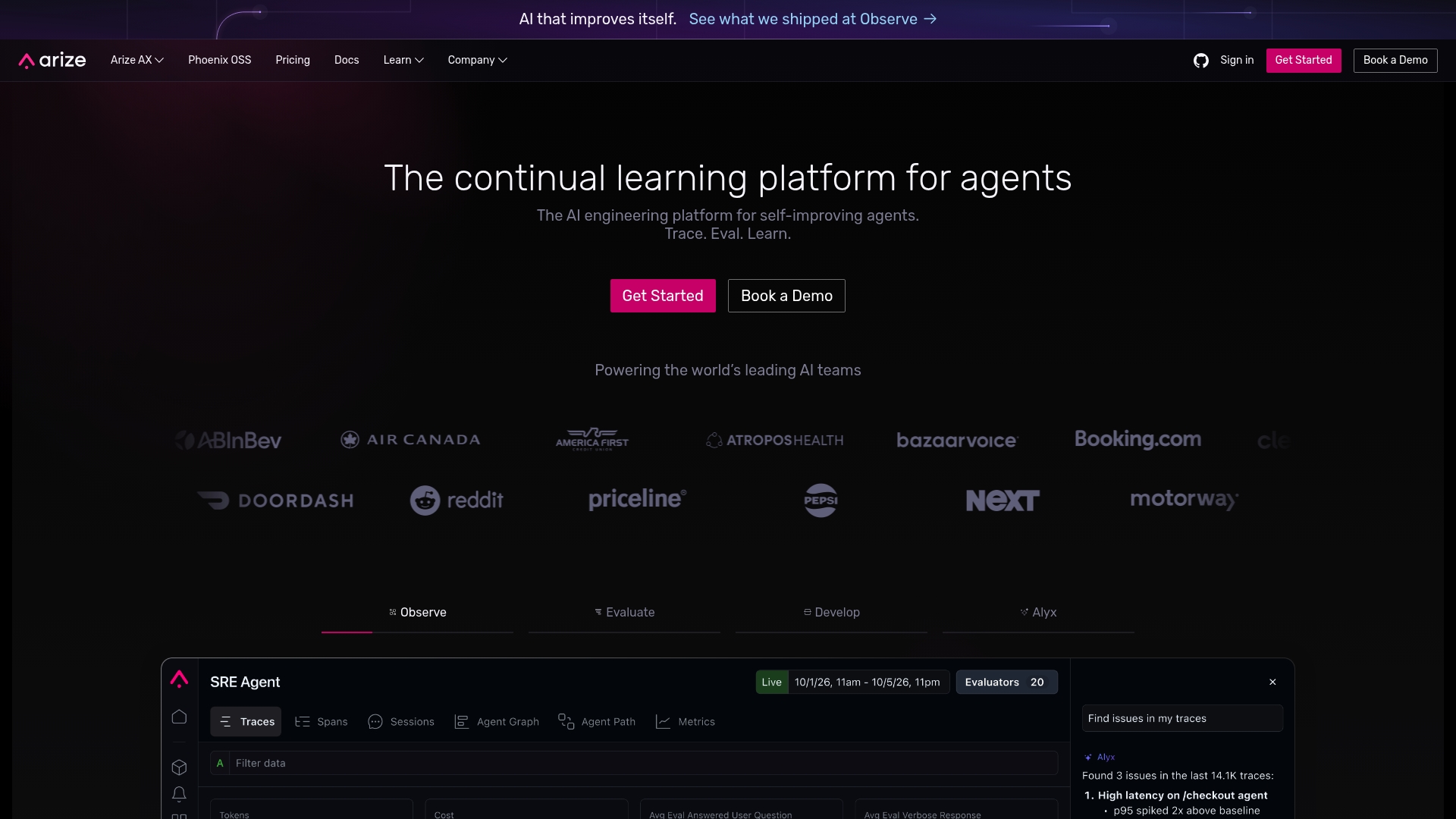
Arize's marketing materials advertise integrations with over 40 models and frameworks, including OpenAI, Anthropic, Google, and AWS. That integration claim underpins a production-first toolkit for monitoring, debugging, and continuous improvement of large models and agentic systems.
Arize targets teams running models at scale and emphasizes transparency through open standards and open-source components.
Core Features
- AI monitoring and observability for production models and agents, with session and trace level telemetry that helps you follow model behavior end to end.
- Evaluation workflows that support span, trace, and session evals so you can formalize A B tests and regression checks across versions.
- Debugging tools with end to end workflows that link incidents to model inputs and outputs for faster root cause analysis.
- Open standards support including Phoenix and OpenInference to work alongside existing open-source tooling.
Key Differentiator
Arize is built around open standards and deep support for open-source evaluation pipelines. That architecture lets teams plug Arize into existing observability stacks and retain control of model artifacts and metrics rather than locking data into a proprietary format.
Pros
- Highly responsive customer support reported by users, which shortens the time from incident to resolution for production teams.
- Model monitoring provides detailed drift and performance signals across sessions so you can spot regressions before they cascade.
- Strong evaluation tooling simplifies large scale comparisons and continual learning loops, useful when you run many model variants in parallel.
- Built in support for open standards means you can reuse traces and eval artifacts outside the platform which helps long term portability.
- Scalable architecture suits automated feedback workflows for agents that require frequent retraining or model selection.
Cons
- Onboarding is perceived as complex for teams without existing monitoring infrastructure, with a steep initial setup curve.
- Versioning and catalog features can feel limited or unintuitive when multiple teams share models and artifacts.
- The interface and workflows skew technical and require AI engineering expertise, which raises the bar for product managers and analysts.
When It May Not Fit
If your team is a small research group without dedicated MLOps capacity the setup overhead will likely outweigh the benefits. If you need polished nontechnical dashboards for executive stakeholders this product may feel too technical. Teams needing a turnkey, nonengineering monitoring solution should look elsewhere.
Who It's For
AI and ML teams operating production models at scale including ML engineers, data scientists, and AI operations staff who run frequent eval loops and need detailed observability and debugging tied to model sessions.
Real World Use Case
An enterprise running LLM based agents connects model telemetry and session traces into Arize to monitor live performance. Engineers use session evals to detect prompt drift, then push a controlled model swap after automated A B comparisons validate the candidate.
Pricing
Pricing is not published in the product data. The vendor lists the offering as informational only so contact Arize for commercial tiers and deployment options. Expect enterprise oriented contracts for large scale production deployments.
Website: https://arize.com
Langfuse
At a Glance
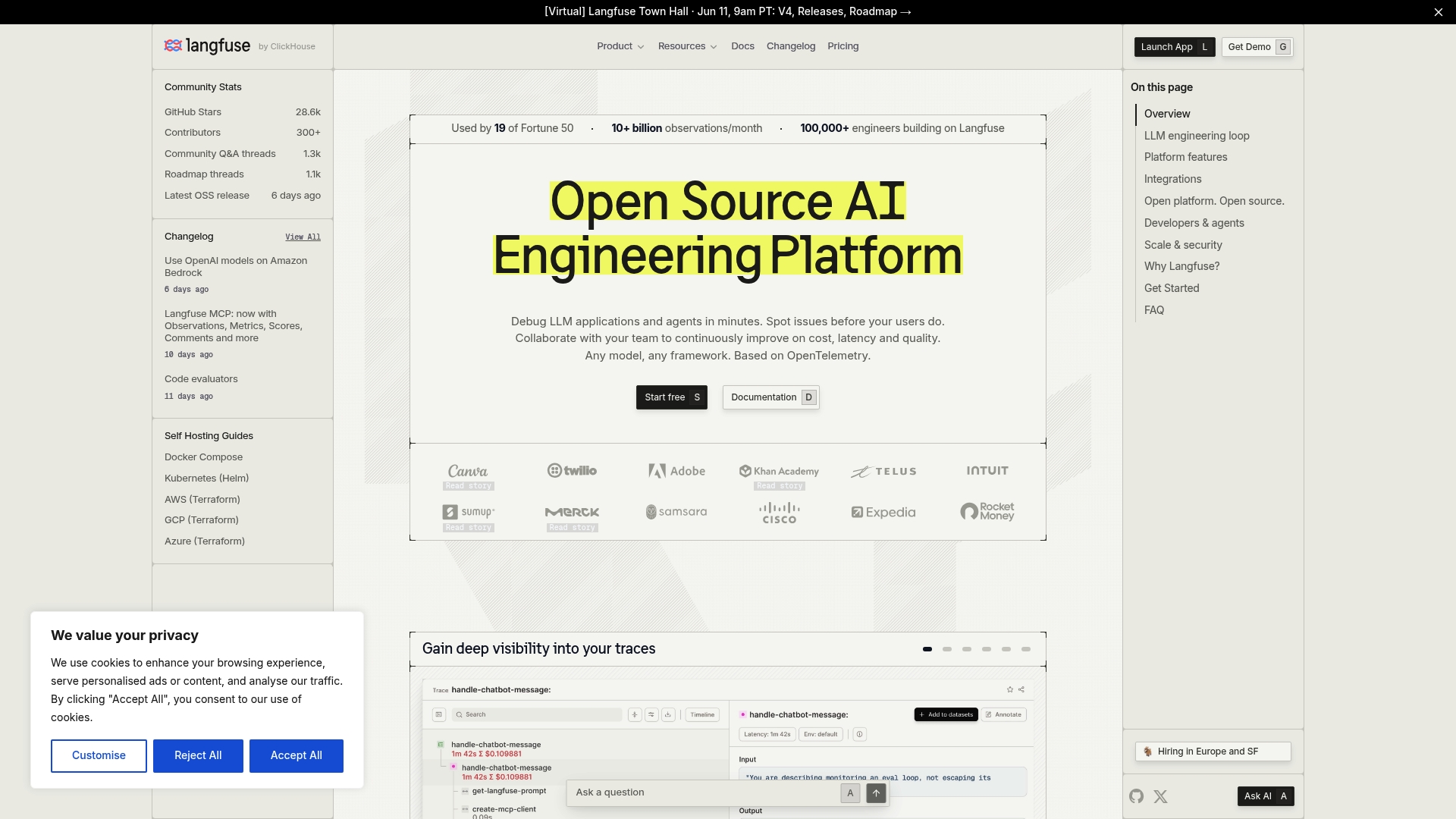
Langfuse's marketing materials report usage by over 2,300 companies and claim it can scale to billions of observations per month while supporting SOC 2 and ISO 27001. That scalability and compliance posture is the headline claim here. If you prioritize traceable, auditable LLM telemetry, this is worth a close look.
Core Features
- Open-source platform under an MIT license that you can self-host and extend.
- Tracing plus prompt management, evaluation tooling, and analytics in a single stack.
- Built on OpenTelemetry for standardization and compatibility with existing observability tooling.
Takeaway: the feature set is focused on deep observability for LLM workflows rather than end-to-end model training or experiment tracking.
Key Differentiator
Langfuse combines open-source licensing with native OpenTelemetry support and an explicit enterprise scale story. The result is a tool aimed at teams that want full control over tracing and prompt history while plugging into existing observability pipelines. Compared with Mlflow, Langfuse narrows the scope to live LLM observability and prompt governance instead of lifecycle orchestration.
Pros
- Deep traceability and analytics that map model calls, prompt versions, and downstream signals to concrete observations. This makes debugging multi-step agent flows easier in production.
- Open-source and flexible so you can self-host, adapt SDKs, and avoid vendor lock in when that matters for compliance.
- Wide framework and provider support including SDKs across languages and frameworks, which reduces integration friction for polyglot stacks.
- Enterprise posture with security and compliance claims that appeal to regulated teams and sensitive data environments.
- Developer-friendly interfaces with CLI, SDKs, and APIs that let engineers automate collection and interrogation of telemetry.
Each pro above ties directly to product claims and to the architecture choices Langfuse publishes.
Cons
- Evaluation and model scoring features are still evolving which means you may need to augment with separate eval tooling for rigorous model comparison.
- Full independence requires self-hosting which adds infrastructure and operational overhead compared with a fully managed alternative.
- The product is feature rich on observability but not a substitute for experiment tracking or model governance platforms focused on training pipelines.
When It May Not Fit
If your team lacks SRE capacity to run a self-hosted stack then Langfuse may impose too much operational work. If you need out of the box experiment tracking, model versioning, and training orchestration then tools focused on lifecycle management will suit you better. Also plan for extra work where eval maturity matters.
Notable Integrations
- Language and runtime SDKs including OpenTelemetry SDKs for Python, TypeScript, Go, Java, .NET, Ruby, PHP, and Swift.
- Framework and builder support such as LangChain, Vercel SDK, Pydantic AI, AutoGen, LangChain DeepAgents, Dify, Langflow, and n8n.
- Model and gateway coverage including OpenAI, Anthropic, Amazon Bedrock, Google Gemini and Vertex AI, Hugging Face, Mistral, Helicone, Litellm, and Vercel AI Gateway.
- Analytics connectors like PostHog, Mixpanel, and Coval for downstream metric joins.
These integrations make Langfuse practical for heterogeneous stacks that already use observability standards.
Who It's For
Engineering teams building production LLM applications that require transparent traces, prompt version control, and integrations with existing observability systems. Best for teams that can operate a self-hosted service and need strong compliance posture while keeping telemetry within their control.
Real World Use Case
A large enterprise uses Langfuse to trace and debug a proprietary AI assistant by capturing prompts, model responses, cost, latency, and accuracy in real time. Teams correlate those traces with user journeys to find prompt regressions and to prioritize model swaps across providers.
Website: https://langfuse.com
Comparing Agent Observability and Evaluation Platforms
When selecting an agent observability and evaluation platform, readers must consider their operational needs, team size, engineering resources, and compliance requirements. Here's how MLflow, LangChain, Arize AI, and Langfuse compare across key dimensions.
Scalability and Deployment Options
MLflow supports a wide variety of deployment scenarios, including multi-cloud and hybrid cloud setups, making it a choice for organizations requiring flexible scalability. Langfuse shines in its capability to provide SOC 2 and ISO 27001 compliance in addition to integration with existing telemetry pipelines. However, LangChain and Arize AI require significant operational effort for scalability in comparison.
Observability and Compliance
While Langfuse leverages OpenTelemetry standards to deliver deep transparency and traceability for LLMs, MLflow integrates observability with evaluation features for enhanced governance. Arize AI, through its session-focused methodology, also contributes to detailed tracking but lacks the extensive compliance certifications of Langfuse. LangChain's challenges in maintaining clarity during complex implementations might not serve highly regulated industries as effectively.
Best Fit Scenarios
- Choose MLflow for extensive lifecycle management and governance features when handling both traditional ML and agentic workflows.
- Choose Langfuse for transparent auditing of prompts and compatibility with regulatory environments.
- Opt for Arize AI if session evaluations are your focus and you're managing various model comparisons efficiently.
Our Pick
For engineering teams needing extensive tools to streamline both model development and monitoring, MLflow provides a united platform that reduces overhead while fostering collaboration. That said, Langfuse might better serve specialized setups requiring stringent compliance handling.
In conclusion, an informed decision should reflect your team's exact needs and operational scope for maximum effectiveness.
Comparison of Agent Observability and Evaluation Tools
When selecting an agent observability and evaluation platform, it is essential to consider the scope of features, integration capabilities, scalability, and user-specific requirements. The following table compares four notable platforms in this domain based on these factors:
| Platform | Core Features | Key Differentiator | Target Users | Price | Notable Limitation |
|---|---|---|---|---|---|
| MLflow | Lifecycle management, experiment tracking, and agent observability | Unified lifecycle for ML and LLM workflows, open-source | Data scientists and ML engineers managing models and agents | Free | Advanced setup required for enterprise scalability |
| LangChain | Agent orchestration, debugging tools, observability | Framework agnostic, deep debugging for multi-agent flows | Developers of agentic applications needing flexibility | Not disclosed | Steep learning curve for new teams |
| Arize AI | Model monitoring, debugging workflows, continuous improvement | Open standard support for observability and evaluation tooling | Large-scale AI/ML production teams | Not disclosed | Complex onboarding without existing infrastructure |
| Langfuse | Open-source LLM observability, prompt management | OpenTelemetry support, enterprise compliance capabilities | Teams needing full control over LLM telemetry | Not disclosed | Self-hosting with increased operational overhead |
This table provides an overview to facilitate the selection of the most suitable platform for streamlined and efficient agent management and evaluation workflows.
Discover a Powerful Braintrust Alternative for Agent Deployment
Managing complex agent workflows with transparent evaluation and secure prompt governance can feel challenging. Mlflow offers a unified open-source solution designed to standardize lifecycle management for GenAI and LLM applications. With production-grade observability through deep tracing of agentic reasoning and an AI Gateway centralizing prompt management, Mlflow simplifies moving from prototype to scalable production.
Key benefits:
- Automated LLM-based evaluation gates for reliable deployment decisions
- Cross-provider governance eliminating fragmented oversight
- Framework-agnostic orchestration integrating diverse AI pipelines
Explore Mlflow to see how it compares as a leading Braintrust alternative.
Take control of your AI agent deployments now and link evaluation metrics, prompt versions, and traces directly to your model registry for seamless production delivery.
Frequently Asked Questions
How does Mlflow support agent observability and evaluation for large teams?
Mlflow offers full lifecycle management for classical ML and deep learning projects, enabling comprehensive tracking and observability. The centralized AI Gateway allows teams to monitor models and manage prompts, enhancing governance reviews. Consider using Mlflow to streamline your deployment processes under a unified governance model.
What is the difference between LangChain and Mlflow regarding agent evaluation?
LangChain excels in providing built-in tooling for observing and evaluating agent behavior across long-running tasks. Conversely, Mlflow's strength lies in its integrated model evaluation and registry features that connect evaluation results to deployable model versions. If your focus is on governance across multiple frameworks, Mlflow may serve your needs better.
Can Arize AI manage model monitoring effectively compared to Mlflow?
Arize AI is designed for AI monitoring and observability with extensive session-level telemetry to track model behavior end-to-end. While Mlflow also offers detailed experiment tracking and integrates evaluation metrics with model artifacts, Arize's strength is its deep integration with existing observability stacks. Utilize Arize for dedicated monitoring, but consider Mlflow for a more streamlined model development process.
How does Langfuse facilitate compliance compared to Mlflow?
Langfuse emphasizes auditability and compliance with features supporting SOC 2 and ISO 27001 certifications. While Mlflow provides a solid governance framework for evaluating LLMs, Langfuse focuses specifically on LLM observability and prompt governance. For teams prioritizing strict compliance, Langfuse might be the more compliant choice, but Mlflow offers a practical starting point for broader ML lifecycle management.
What unique benefits does Mlflow offer for centralized experiment records?
Mlflow centralizes experiment records, allowing teams to link validated models to a registry for easy monitoring and iteration. Its model evaluation and artifact tracking capabilities streamline the entire process from training to deployment. For effective model management, consider leveraging these features to enhance your team's workflow.