REST API for AI Models Explained: 2026 Guide

A REST API for AI models is an HTTP-based interface that lets developers access, control, and deploy AI capabilities through standardized resource operations. If you are building applications on top of large language models (LLMs), deploying inference endpoints, or wiring up AI agents to external tools, understanding REST APIs is the foundation everything else sits on. This guide covers how REST APIs work in AI contexts, how they compare to newer protocols like Model Context Protocol (MCP), and the specific engineering decisions that separate a well-built AI integration from one that breaks under agent load.
REST API for AI models explained: core mechanics
A REST API is defined by six architectural constraints: stateless communication, a uniform interface, client-server separation, cacheability, a layered system, and optional code on demand. In practice, AI model integration uses the first three almost exclusively. Every call to an LLM inference endpoint is stateless. The server holds no memory of the previous request. Each HTTP call carries all the context it needs.
The four standard HTTP verbs map cleanly to AI model operations:
- POST sends a new inference request, such as submitting a prompt to an LLM.
- GET retrieves model metadata, available endpoints, or prior run results.
- PUT updates a resource in full, such as replacing a stored prompt template.
- DELETE removes a resource, such as clearing a stored session artifact.
Most AI REST APIs use JSON as the payload format. A typical inference call sends a JSON body containing the model name, a messages array, and optional parameters like temperature and max tokens. The server returns a JSON response with the generated output, token usage counts, and a status code. A 200 OK means success. A 429 Too Many Requests means you have hit a rate limit. A 503 Service Unavailable signals the model backend is overloaded.
Most AI REST APIs operate at Level 2 of the Richardson Maturity Model. This means they use proper HTTP verbs and status codes but stop short of full HATEOAS hypermedia navigation. That is the right call for AI workloads. Hypermedia adds overhead without meaningful benefit when your client already knows the endpoint structure.

Pro Tip: When calling an LLM inference endpoint, always log the raw HTTP response including status codes and headers. Debugging agent failures is far easier when you can see exactly what the model backend returned, not just what your SDK parsed.
REST vs. MCP: what is the right protocol for AI agents?
REST was designed for human-driven applications. A browser or mobile app makes a request, waits for a response, and moves on. AI agents operate differently. They run autonomously, make thousands of calls per minute, and need to discover what tools and resources are available at runtime without a developer hardcoding every endpoint.
MCP adds AI-native features like runtime discovery and stateful sessions that REST does not natively provide. This is the core distinction. REST handles static resource access well. MCP handles dynamic, agent-driven interaction well.
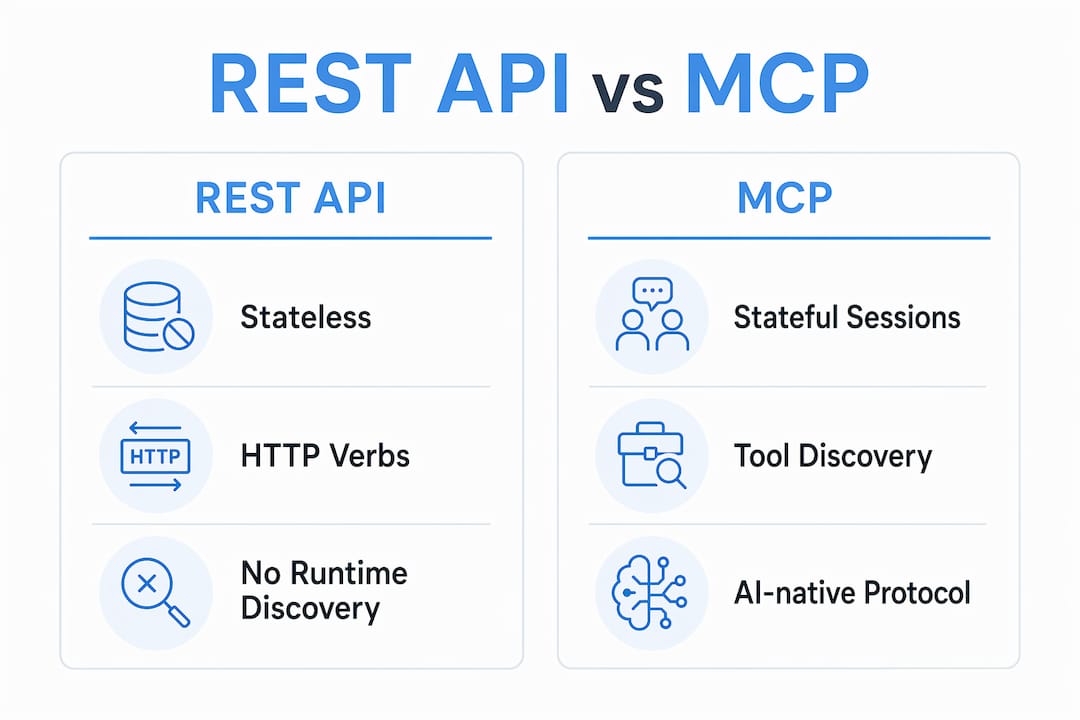
Here is a direct comparison:
| Characteristic | REST API | Model Context Protocol (MCP) |
|---|---|---|
| State management | Stateless per request | Stateful sessions supported |
| Interface discovery | No runtime self-description | Runtime tool and resource discovery |
| Designed for | Human-driven clients | Autonomous AI agents |
| Payload format | JSON, XML, others | JSON-RPC with tool schemas |
| Streaming support | Varies by implementation | First-class streaming support |
| Adoption maturity | Decades of production use | Emerging, 2024 onward |
MCP does not replace REST. It acts as an AI-native adapter layer that wraps existing REST endpoints and exposes them with tool abstractions and natural language descriptions that AI agents can understand. Think of it as a translation layer. Your REST API stays exactly as it is. An MCP server sits in front of it and tells the AI agent what the API can do, what parameters it accepts, and how to call it correctly.
MCP has reached significant adoption with over 97 million SDK downloads and more than 13,000 MCP servers on GitHub as of 2026. Gartner forecasts that 75% of API gateways will support MCP by end of 2026. That trajectory means any AI platform you build today should account for MCP compatibility, even if you start with pure REST.
Typical REST APIs lack runtime self-description, which is the critical gap for autonomous agents. An agent cannot interrogate a REST API to learn what it does. It needs a developer to hardcode that knowledge. MCP closes this gap by exposing a discoverable interface the agent can query at runtime.
Pro Tip: If you are exposing an existing REST API to AI agents, you do not need to rewrite it. Build a thin MCP server that wraps your endpoints, adds tool schemas, and provides natural language descriptions. The underlying REST API remains unchanged. See tool use in AI agents for a detailed breakdown of how agents consume these schemas.
What are the best practices for building REST apis for AI?
Building REST APIs for human clients and building them for AI agents are different engineering problems. Agents are faster, less forgiving of ambiguous responses, and far more likely to retry aggressively on failure. The following practices address those specific pressures.
-
Implement idempotency on POST and PATCH endpoints. Idempotency is critical for endpoints accessed by AI agents because agents retry aggressively on network failures. Without idempotency, a single failed call can trigger duplicate database writes, duplicate charges, or duplicate model invocations. Use idempotency keys in request headers and store them server-side with a short TTL.
-
Use agent-aware rate limiting. AI agents can generate thousands of API calls per minute, making standard per-user rate limits ineffective. Standard limits designed for human users will either block legitimate agent workflows or fail to prevent runaway loops. Implement separate rate limit tiers for agent clients, identified by a dedicated API key or client type header.
-
Design endpoints that return only what the model needs. Over-fetching data increases token usage and latency in AI REST APIs. Every extra field in a JSON response costs tokens when that response gets passed back into an LLM context window. Build tailored endpoints that return only the fields the model will actually use.
-
Secure with OAuth 2.1 and scoped access. AI agents should operate with the minimum permissions required for their task. Use OAuth 2.1 with fine-grained scopes so a compromised agent cannot access endpoints outside its designated function. Rotate credentials automatically and audit scope usage regularly.
-
Add middleware for logging, retries, and response normalization. Fragmentation across vendor SDKs and response formats is a real operational problem. A middleware layer that normalizes responses, handles retries with exponential backoff, and logs every request and response gives you a single place to debug failures across multiple AI providers. Review API gateway strategies for architecture patterns that handle this at scale.
How do you integrate REST apis with AI models in practice?
The practical path from a REST API to a working AI model integration depends on your infrastructure, your model provider, and whether you are building for direct inference or agent orchestration.
Cloud platforms like Azure provide REST API endpoints for calling foundational AI model inference directly from your application. Azure AI Model Inference REST API exposes a uniform interface across multiple model families. You send a POST request with your prompt payload, and the endpoint returns the model output in a consistent JSON format regardless of which underlying model you are using.
The decision between using an SDK and calling REST directly depends on your project requirements:
- Use an SDK when you want built-in retry logic, streaming support, and type-safe request construction. OpenAI's Python SDK and Azure's AI SDK handle the HTTP layer for you and expose clean Python objects.
- Call REST directly when you need precise control over headers, timeouts, and request shaping. Direct HTTP calls are also the right choice when integrating with a model provider that does not have an SDK in your language.
- Use MCP-compliant adapters when you are building AI agents that need to discover and call REST APIs dynamically. An MCP server wraps your REST endpoints and exposes them as named tools with JSON schemas. The agent calls the MCP server, which translates the tool call into the appropriate REST request.
For teams managing multiple model providers, a centralized AI gateway is the most practical integration pattern. The gateway normalizes request and response formats across providers, handles authentication, and gives you a single observability surface. Mlflow's AI Gateway for LLMs implements this pattern with support for cross-provider governance and prompt management. Review why integrating AI into applications matters for a broader view of where REST API integration fits in the full application lifecycle.
Pro Tip: When testing a new REST API integration, use a tool like Postman or curl to make raw HTTP calls before writing any application code. Seeing the exact request and response at the HTTP level prevents a whole class of bugs that only appear when an SDK abstracts away the details.
Key takeaways
REST APIs remain the primary interface for AI model integration, and MCP extends them for autonomous agents rather than replacing them.
| Point | Details |
|---|---|
| REST is stateless by design | Every AI model call must carry full context; no server-side session state is assumed. |
| MCP wraps REST for agents | MCP adds runtime discovery and tool schemas on top of existing REST endpoints without rewriting them. |
| Idempotency prevents duplicates | POST and PATCH endpoints need idempotency keys to handle aggressive agent retries safely. |
| Agent rate limits differ | AI agents require separate throttling tiers because they generate far more calls than human users. |
| Over-fetching costs tokens | Tailored endpoints that return only necessary fields reduce latency and LLM token consumption. |
Where REST apis are heading for AI: a developer's honest assessment
I have watched the REST API conversation in AI circles shift significantly over the past two years, and I want to share what I think is actually happening versus what the hype suggests.
REST is not going away. The engineers declaring it obsolete because of MCP are missing the point. MCP is built on top of REST. Every MCP server you deploy is wrapping REST endpoints underneath. The real shift is that we are finally acknowledging REST was designed for humans, and AI agents need something more. MCP is that something more, but it is an addition, not a replacement.
The fragmentation problem is more serious than most teams admit. You are not integrating one AI model. You are integrating OpenAI, Anthropic, Google Gemini, and whatever your enterprise vendor is shipping this quarter. Each has its own SDK, its own response format, and its own quirks. Without a normalization layer, you end up with brittle glue code scattered across your codebase. I have seen this pattern fail at scale repeatedly. The teams that get this right build abstraction early, not after the third provider integration breaks production.
The security angle for AI agents is genuinely underappreciated. An AI agent with broad API access and no scope restrictions is a significant attack surface. OAuth 2.1 with scoped credentials is not optional for production systems. It is the minimum viable security posture. Treat every AI agent like an untrusted third-party client until you have a reason to do otherwise.
My prediction: within 18 months, the standard production architecture will be REST APIs at the data and service layer, MCP adapters at the agent interface layer, and a centralized gateway handling auth, logging, and normalization in between. Teams that build that architecture now will spend far less time firefighting later.
— Kevin
How Mlflow supports REST API integration for AI models
Mlflow is built for exactly the kind of multi-provider, agent-driven AI architecture described in this article.
Mlflow's Agent and LLM engineering platform gives you the tools to manage the full lifecycle of AI model integrations, from prompt engineering to production observability. The centralized AI Gateway normalizes REST API calls across providers, handles authentication, and gives you a single surface for governance and monitoring. For teams building AI agents that call REST APIs, Mlflow provides deep tracing of agentic reasoning so you can see exactly which API calls an agent made, what it received, and where it went wrong. Explore Mlflow's open-source platform to see how it fits your current integration stack.
FAQ
What is a REST API in the context of AI models?
A REST API for AI models is an HTTP-based interface that exposes model capabilities, such as inference, embedding generation, and fine-tuning, as addressable resources. Developers call these endpoints using standard HTTP methods like POST and GET with JSON payloads.
How does MCP differ from a standard REST API?
MCP is an AI-native protocol that wraps REST APIs to add runtime tool discovery, stateful sessions, and structured tool schemas for autonomous agents. REST handles static resource access; MCP handles dynamic agent interaction.
Why does idempotency matter for AI agent API calls?
AI agents retry failed requests aggressively, so a non-idempotent POST endpoint can trigger duplicate operations on each retry. Implementing idempotency keys on POST and PATCH endpoints prevents duplicate side effects from network failures.
What is the richardson maturity model for REST apis?
The Richardson Maturity Model defines four levels of REST API design, from Level 0 (plain HTTP) to Level 3 (full HATEOAS). Most AI REST APIs operate at Level 2, using proper HTTP verbs and status codes without hypermedia navigation.
How do i choose between an SDK and direct REST calls for AI integration?
Use an SDK when you want built-in retry logic, streaming support, and type safety. Call REST directly when you need precise control over request shaping or when no SDK exists for your language or model provider.