Building Production-Ready AI Agents in 2026

Getting an AI agent to work in a notebook is a fundamentally different problem from getting one to work reliably at scale. Building production-ready AI agents, formally called agentic AI systems in the research community, requires you to think beyond prompt quality and into the territory of distributed systems engineering, runtime governance, and rigorous evaluation. Most teams discover this gap the hard way, after a prototype that dazzled stakeholders starts silently degrading in production. This guide walks through the architecture, governance, observability, and security decisions that separate experimental demos from systems you can actually trust.
Table of Contents
- Key Takeaways
- Building Production-Ready AI Agents: foundational requirements
- Implementing production-grade agent architecture
- Integrating evaluation and observability
- Common deployment challenges and how to address them
- Comparing frameworks for production agent development
- My perspective on engineering AI agents for production
- How MLflow simplifies production agent development
- FAQ
Key Takeaways
| Point | Details |
|---|---|
| Architecture over prompts | Modular multi-agent architectures with routing layers outperform monolithic agents in reliability and maintainability. |
| Runtime governance is non-negotiable | Deterministic policy enforcement beneath the model layer prevents undesired actions before they reach the wire. |
| Evaluation belongs in the workflow | Embed evaluation probes inside agentic workflows for real-time auditability, not just offline batch analysis. |
| Security lives at the skill boundary | Most agent runtime risks cluster at the plugin and skill execution layer, not the LLM layer itself. |
| Observability drives continuous improvement | Monitoring faithfulness, drift, and hallucination rates creates the feedback loops that keep agents reliable over time. |
Building Production-Ready AI Agents: foundational requirements
Before writing a single line of agent code, you need your environment and architectural foundations locked in. Decisions made here compound in ways that are expensive to undo later.
Development environment and platform selection shape everything downstream. Choose platforms that natively support multi-agent orchestration, structured logging, and model versioning. You want reproducibility at every layer: model weights, prompt versions, tool definitions, and runtime configuration.
Architectural pattern is perhaps the most consequential early choice. Monolithic agent designs, where a single LLM handles all reasoning, routing, and execution, are deceptively easy to prototype but brittle in production. A microservices-inspired approach treats each agent capability as a discrete, independently deployable unit. This is not just a performance preference. Multi-agent architectures enable agile updates, allowing individual sub-agents to be replaced or upgraded as models evolve, which matters enormously as the underlying models you depend on are replaced every few months.
Open protocol standards prevent vendor lock-in and enable interoperability. Two worth knowing: the Model Context Protocol (MCP) standardizes how agents exchange context with tools and external systems, while the Agent-to-Agent (A2A) protocol governs communication between agents in multi-agent pipelines. Adopting these early is far less painful than retrofitting them after you've built custom communication layers.
Security and compliance baseline must be established before deployment. The OWASP Agentic Skills Top 10 provides a cross-platform framework addressing the ten most critical risk categories in agent behavior layers, covering skill authorization, supply-chain integrity, and runtime isolation. This is your security checklist, not optional reading.
For teams operating under regulatory scrutiny, EU AI Act Article 14 mandates human oversight mechanisms for high-risk AI systems, requiring human-machine interfaces and verified confirmation steps for certain decision classes. Know where your agent falls on the risk spectrum before you build.
Here is a baseline readiness checklist:
- Modular, microservices-inspired agent architecture with a defined routing layer
- Open protocol adoption (MCP and A2A) for tool and inter-agent communication
- Structured logging and model version pinning from day one
- OWASP AST10 security review completed for every skill and plugin
- Human oversight hooks implemented where regulatory risk applies
| Requirement | Why it matters |
|---|---|
| Multi-agent architecture | Isolates failures, enables independent upgrades, and reduces blast radius |
| MCP/A2A protocol support | Prevents lock-in and enables interoperable tool and agent communication |
| OWASP AST10 compliance | Addresses known runtime security vulnerabilities at the skill execution layer |
| Human oversight interface | Satisfies regulatory requirements and reduces unrecoverable autonomous errors |
| Structured audit logging | Provides the evidence trail required for debugging, compliance, and evaluation |
Implementing production-grade agent architecture
With foundations in place, we can move to architecture implementation. This is where prototype thinking has to give way to engineering discipline.

Step 1: Decompose into tightly scoped sub-agents. Each sub-agent should own one well-defined responsibility: retrieval, classification, summarization, code execution, and so on. A supervisor or routing layer coordinates these sub-agents, directing queries to the appropriate specialist based on intent. Google's Agent Bake-Off teams reduced processing times from one hour to ten minutes by adopting exactly this pattern. The modularity also means you can swap out underperforming sub-agents without touching the rest of the system.
Step 2: Apply runtime governance with privilege rings and kill switches. The Microsoft Agent Governance Toolkit takes an explicit position here: governance decisions are enforced deterministically before actions reach the wire, making blocked actions structurally impossible rather than just unlikely. Version 3.6.0 adds privilege rings, kill switches, and audit sink enhancements. This approach positions policy enforcement as infrastructure, not as a soft guardrail layered on top of model outputs.
Step 3: Sandbox execution environments. Any agent with access to external APIs, file systems, or databases needs a sandboxed execution context. The build-vs-buy decision here is real. Building your own sandboxing is expensive and error-prone. Adopting a toolkit like Microsoft's AGT or a container-based execution environment (with strict network egress controls) is almost always the better tradeoff for most teams.
Step 4: Integrate SRE practices. Treat your agent system as a production service. That means defining SLOs for latency and error rates, setting up health checks for each sub-agent, and implementing circuit breakers that degrade gracefully rather than fail catastrophically. Audit logs are not just for compliance. They are your primary debugging tool when an agent makes an unexpected decision.
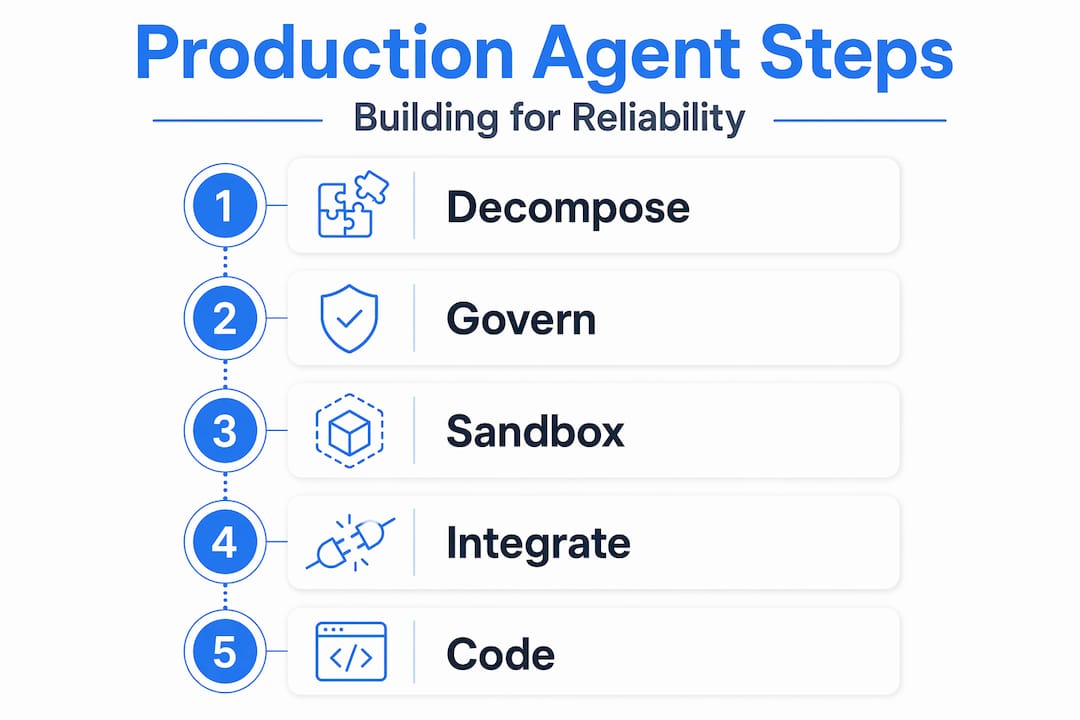
Step 5: Use deterministic code for critical operations. LLMs excel at reasoning and intent classification, but deterministic execution should handle transactions, financial calculations, and any operation where correctness is binary. This hybrid approach reduces validation errors and makes the system easier to test.
Pro Tip: Reserve LLM reasoning for ambiguity and intent resolution. Route anything with a deterministic correct answer, like arithmetic, status lookups, or rule-based decisions, to conventional code. This keeps your LLM inference costs predictable and your error rates low.
Integrating evaluation and observability
Evaluation is not something you do before launch and then forget. For production AI systems, it needs to live inside the workflow itself.
NIST's approach makes this concrete. Evaluation probes embedded in active agentic workflows enable adversarial verification with results stored in machine-readable audit trails. Each probe assesses factual grounding, produces a structured evaluation verdict, and records the rationale behind that verdict. This gives you both real-time quality signals and a defensible audit trail for compliance purposes.
The metrics that matter most in production differ from the ones you track during development. You want to monitor:
- Faithfulness: Does the agent's response accurately reflect the source material it retrieved?
- Completeness: Did the agent address all components of the task or query?
- Sufficiency: Is the response appropriately scoped, neither hallucinating extra claims nor omitting critical information?
- Drift: Are response quality distributions shifting over time as models or data change?
For drift detection specifically, you need a baseline. Capture response quality distributions at launch and set statistical thresholds that trigger alerts when distributions shift beyond acceptable bounds. This is where agent observability tools earn their place: they automate the monitoring of these distributions and surface anomalies before they become user-facing failures.
Evaluation should be built into the agentic workflow, providing immediate feedback and auditability, not just as offline analysis run periodically after the fact.
Feedback loops close the cycle. When evaluation probes flag a low-quality response, that signal should flow back into your agent evaluation pipeline to update test cases, refine prompts via the prompt engineering cookbook, or trigger a sub-agent replacement review. Without this loop, your agent degrades silently until a user escalation forces a postmortem.
Common deployment challenges and how to address them
Even well-architected agents hit friction in production. Here are the failure modes we see most often, and how to address them.
-
Skill and plugin security vulnerabilities. Runtime security risks concentrate at skill and plugin boundaries, not the LLM layer. Enforce signed skill manifests, review plugin supply chains, and sandbox every skill execution context. Treat unverified plugins the way you'd treat unreviewed third-party code in a production API.
-
Monolithic agent fragility. Teams that build a single agent handling all tasks find that debugging becomes exponentially harder as complexity grows. A failure in one capability breaks the entire system. Decompose early. The short-term investment in modular architecture pays back in reduced incident response time.
-
Over-reliance on LLM reasoning for deterministic tasks. When agents use LLM outputs to compute values that should be exact, like currency conversions or database queries, errors compound. Keep LLMs focused on intent classification and natural language understanding. Route execution to typed, testable code.
-
Harness impermanence. The orchestration frameworks and model versions your agent depends on change frequently. Build your harness with upgrade paths in mind: abstract model calls behind versioned interfaces, pin dependency versions in CI, and test against upcoming model releases before they go live.
-
Scalability and cost management. Token costs scale with request volume in ways that surprise teams who prototype with low-traffic assumptions. Cache intermediate reasoning where possible, set context window budgets per sub-agent, and monitor token consumption per workflow step as a first-class metric.
Pro Tip: Set up a shadow deployment for major agent updates. Route a small percentage of production traffic to the new version and compare quality metrics between versions before full rollout. This catches regressions before they affect all users.
Comparing frameworks for production agent development
Choosing the right toolkit affects your governance capabilities, integration surface, and long-term maintainability. Here is a practical comparison of the major options available in 2026:
| Framework | Governance | Sandboxing | Evaluation | Composability | Best for |
|---|---|---|---|---|---|
| Microsoft AGT | Native policy engine, privilege rings | Container-based | Audit sink integration | High (enterprise integrations) | Regulated enterprise deployments |
| Google ADK | Supervisor layer patterns | Limited native | Bake-Off evaluation patterns | High (multi-agent) | Performance-critical, multi-agent pipelines |
| LangGraph | Manual policy wiring | None native | External integrations | Very high (graph-based) | Custom, complex workflow graphs |
| MLflow Agent Platform | Policy middleware, AI Gateway | External | LLM-as-a-Judge, tracing | High (open ecosystem) | Teams needing evaluation plus observability in one platform |
The tradeoff between custom internal tooling and standard platforms is primarily a function of team size and regulatory requirements. Small teams move faster on standard platforms. Enterprises with strict compliance needs often need the customization surface of frameworks like LangGraph combined with governance tooling from AGT or MLflow. Neither is universally correct.
My perspective on engineering AI agents for production
I've watched teams spend months tuning prompts for reliability problems that were actually architecture problems. The winning insight from the most successful production agent deployments is consistent: reliability comes from modular design, rigorous state management, and deterministic guardrails, not from better prompts alone.
What I've learned is that the most dangerous moment in an agent project is when a prototype impresses stakeholders. The pressure to ship before the architecture is solid creates technical debt that compounds fast. Observability in particular gets deferred. Teams deploy without meaningful metrics and then can't explain why quality degrades three weeks later.
My take on the impermanence problem: design for it explicitly. Your harness will need to swap models, replace sub-agents, and adopt new protocols. Teams that build with rigid dependencies on specific model behaviors spend enormous energy on each upgrade cycle. Modularity is not just a performance choice. It's a survival strategy for a field where the underlying components change every quarter.
The teams I've seen succeed treat their agent as a software system first and an AI product second. That means version control, automated testing, deployment pipelines, and SRE practices applied to every layer of the stack.
— Kevin
How MLflow simplifies production agent development
MLflow is purpose-built for exactly the challenges outlined in this article. Its agent engineering platform supports modular, multi-agent architectures with deep tracing of agentic reasoning at every step of a workflow. The LLM-as-a-Judge evaluation framework automates quality assessment at scale, surfacing faithfulness and completeness issues without requiring manual review of every agent response. The AI Gateway provides centralized prompt governance and cross-provider cost controls, so you maintain visibility even as your agent fleet grows. MLflow's observability tooling gives you drift detection, hallucination monitoring, and structured audit trails out of the box, turning the feedback loop from a manual process into an automated one. For teams moving from prototype to production, MLflow provides the infrastructure that makes that transition systematic rather than chaotic.
FAQ
What makes an AI agent "production-ready"?
A production-ready AI agent operates reliably under real user load, with structured logging, runtime governance, drift monitoring, and defined escalation paths. It handles failure modes gracefully rather than silently degrading.
How do I choose between a monolithic and multi-agent architecture?
Multi-agent architectures are almost always preferable for production systems. Google's Bake-Off data shows that decomposed architectures deliver significantly better performance and make individual components easier to upgrade and debug.
Where should I focus security hardening for my AI agent?
Focus hardening at the skill and plugin execution layer. The OWASP AST10 framework identifies this boundary as the highest-risk surface, covering skill authorization, supply-chain integrity, and sandboxed execution controls.
How do evaluation probes differ from traditional software tests?
Evaluation probes embedded in agentic workflows assess semantic quality: factual grounding, completeness, and sufficiency in real requests. They run during live inference, not just in pre-deployment test suites, and produce machine-readable verdicts with rationale for audit purposes per NIST's guidance.
What role does human oversight play in production AI agents?
For high-risk systems, EU AI Act Article 14 mandates human oversight interfaces with verified confirmation steps. Even outside regulated domains, human-in-the-loop checkpoints for high-stakes decisions are standard practice in reliable agent deployments.