
2 posts tagged with "cache llm responses"

View All Tags

Enforce, Validate, Observe: 3 LLM Structured Output Patterns with MLflow

· 18 min read

Engineer reviewing structured LLM responses

Structured outputs are machine-readable, schema-constrained responses from an LLM, almost always JSON, that a program can parse without guesswork. For production systems, we recommend schema-constrained generation or function/tool calling as the default over prompted JSON, paired with runtime validation and a fallback path for the cases that still slip through.


TL;DR:

  • Schema-constrained generation guarantees syntactic validity and reduces parsing errors better than prompted JSON, but does not ensure value correctness.
  • Using only schema-enforced outputs for critical application logic is recommended, while prompt-based JSON is suitable for rapid prototyping with validation logs.
  • Keep schemas minimal with required fields, strict types, and enums to prevent ambiguous outputs and simplify validation at scale.
  • Regularly log raw and parsed outputs, set validation failure metrics, and incorporate retrials or fallbacks to catch and manage schema violations early.
  • Implement observability tools like MLflow to trace, evaluate, and monitor structured outputs over time, preventing silent regressions and enabling timely debugging.

Table of Contents

What Are Structured Outputs in LLM Applications?

A structured output is any LLM response that conforms to a predefined shape, typically JSON, so downstream code can consume it directly without a human reading it first. Compare a free-text answer like "The invoice total is $432.10, due March 15" against {"total": 432.10, "due_date": "2026-03-15"}. The second version is what your billing system actually needs.

This distinction matters because free-text generation fails in ways that are expensive to debug. A model might phrase a number as "four hundred thirty two dollars," wrap JSON in markdown fences your parser chokes on, or drop a field entirely because the prompt didn't emphasize it enough. Grammar-based outputs, enforced through constrained decoding, go a step further than plain JSON generation: they guarantee the output is syntactically valid before a single token is wasted on something a parser will reject.

Three failure modes show up constantly once you put LLMs into a real pipeline:

  • Malformed parse: the model returns valid-looking text that isn't valid JSON, often from stray commentary before or after the object
  • Missing fields: the model omits a required key because it judged the field "obvious" or ran out of context budget
  • Ambiguous types: a phone number returned as an integer, dropping a leading zero, or a date returned as a string in three different formats across calls

Structured outputs matter most anywhere a machine reads the result: extracting fields into a database, classifying a support ticket for routing, or generating typed arguments for an agent's next action. Anywhere a human reads the output directly, the constraint matters far less.

Which Method Should You Use to Get Structured Output From an LLM?

Three approaches dominate current practice, and each solves a different part of the problem.

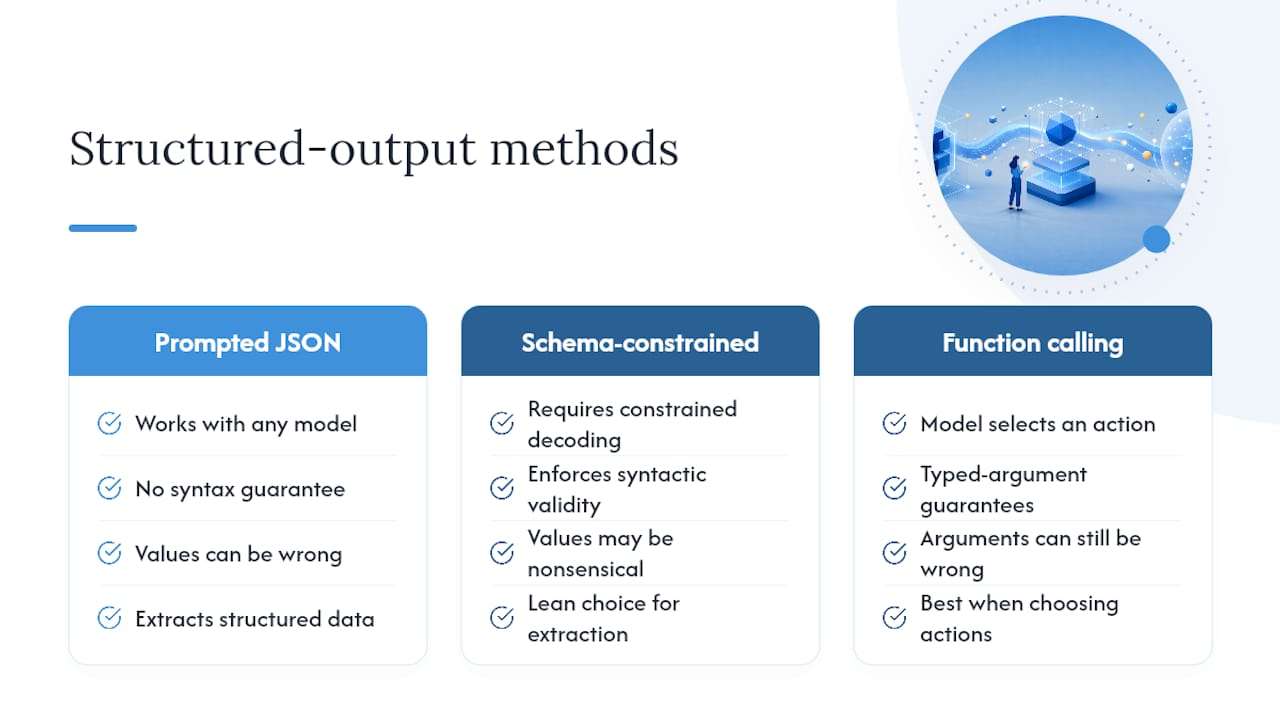
Prompted JSON means asking the model, in plain language, to "respond only in JSON matching this shape." It's the fastest way to prototype and works with any model, but it carries no guarantee. The model can still wrap the object in explanatory text, invent a field you never asked for, or produce JSON that's almost right. Use it for early prototyping, always paired with client-side validation and logging so you can see exactly how often it breaks.

Schema-constrained generation, also called constrained decoding, restricts which tokens the model can emit at each step, so the output can never leave valid syntax. The LLM Inference Handbook from Modular describes this as enforcing syntactic validity during token sampling itself, by masking logits for any token that would break the schema. That's a stronger guarantee than "please output JSON." It doesn't mean the values inside the schema are correct. A phone_number field constrained to a string type will always be a string; it might still be nonsense. Use this approach whenever the output feeds directly into application logic without a human checkpoint.

Function or tool calling asks the model to select an action and supply typed arguments for it, rather than just returning data. This is the right tool when the model needs to decide something, not just extract something, such as choosing whether to escalate a ticket, call a refund API, or query a database with specific parameters. It combines decision-making with the same typed-argument guarantees you get from schema-constrained generation.

A simple decision guide: if the model is only pulling structured data out of unstructured input, schema-constrained generation is the leaner choice. If the model needs to choose among several possible actions and produce arguments for whichever one it picks, function calling is the better fit. Many production systems, as one 2026 developer guide on structured outputs notes, use both: schema-constrained generation for deterministic extraction paths, and function calling for the agentic decision points in between.
Comparison of three structured output methods

How Do You Design a Schema That Doesn't Break in Production?

Schema design decisions made in week one tend to determine how many 2 AM pages you get by month three. A few rules hold up consistently.

  1. Keep required fields minimal. Every field marked required is a field that can cause a validation failure. If a field is genuinely optional, mark it that way and handle its absence in your application code instead of forcing the model to invent a value.
  2. Use explicit types everywhere. A price field should be a number, not a string that sometimes contains a currency symbol. Loose typing pushes the parsing problem downstream instead of solving it.
  3. Prefer enums for closed choices. If a status field can only be pending, approved, or rejected, say so in the schema. This removes an entire category of ambiguity, including typos and casing mismatches.
  4. Avoid wide-open string fields when a narrower type exists. A free-text notes field is fine. A category field left as open text invites twelve spellings of the same three categories.

The two validator libraries you'll actually use depend on your stack. Python teams reach for Pydantic, which lets you define the schema as a class and get parsing, coercion, and validation errors in one step. TypeScript and Node teams reach for Zod, which does the same job with a fluent schema-builder syntax that TypeScript's type system can infer from directly. Both integrate cleanly with JSON Schema, the underlying standard for describing JSON shapes that most provider APIs and validator libraries speak natively.

Runtime validation follows a consistent sequence regardless of stack: parse the raw response, validate it against your schema, and on failure either retry with a tightened prompt or route to human review, logging the raw output every time so you have something to debug against.

Pro Tip: Even when a provider guarantees schema enforcement at the API level, keep client-side validation in place. Multi-provider fallback chains and version changes on the provider's end can bypass that guarantee in ways you won't notice until a malformed record turns up in your database.

What Happens When a Structured Output Call Fails?

A validation failure is not an edge case to handle eventually. It's a certainty you should design for from the first call. The workable retry pattern is a single retry with a tightened prompt or stricter schema enforcement, followed by a fallback to a safe default value or a human review queue. Retrying indefinitely just burns tokens on a call that's already shown you it can't comply.

Caching is where structured-output systems either save real money or introduce quiet correctness bugs. Semantic caching stores an embedding of each request and returns a cached response when a new request's embedding crosses a similarity threshold, which can meaningfully cut both latency and LLM cost. The catch is tuning that threshold. Set it too high and you serve a cached answer to a request that meant something subtly different; set it too low and you barely cache anything. Azure's guidance on semantic cache lookup suggests starting low, around 0.05, and raising the threshold gradually as you confirm cached responses stay accurate. Agentic traffic, where each step depends on evolving context, is generally a poor candidate for semantic caching. Reuse there risks handing an agent a stale decision it never actually made for this exact state.

Beyond semantic similarity, plain request-response caching and prompt caching are worth layering in separately. AWS's guidance on LLM caching recommends combining multiple caching layers rather than relying on one, since each layer catches a different kind of repeat traffic.

Observability closes the loop on all of this. Log both the raw model output and the parsed, validated result, not just one or the other. For agent pipelines, instrument every intermediate structured decision, not just the final output, so you can trace exactly where a multistep chain went wrong. Feeding these logs into an evaluation pipeline, using an LLM-as-a-Judge approach to score outputs against a rubric, is how teams catch schema regressions before they become customer-facing incidents rather than after.

  • Retry once with a tightened prompt or stricter schema, then fall back to a default or human queue
  • Tune semantic cache similarity thresholds gradually upward from a conservative starting point
  • Exclude agentic and highly variable traffic from semantic caching by default
  • Log raw and parsed outputs together, and score them through an evaluation pipeline

What Tools and Libraries Support Structured Output Generation?

Provider APIs have converged on a similar pattern for enforcing structure. OpenAI's Structured Outputs feature enforces a JSON Schema at the API level and ships SDK helpers that parse the result directly into Pydantic models in Python or Zod schemas in JavaScript, removing a manual parsing step most teams used to write by hand. When you're evaluating any provider's structured-output support, look specifically for a response_format parameter and a strict-schema flag. Those two features tell you whether the provider is enforcing the schema during generation or just hoping the model complies.

For self-hosted or open-weight models, constrained decoding happens at the sampling layer, since you control the inference stack directly rather than calling a hosted API. Techniques like compressed finite-state machines, documented in LMSYS's research on constrained decoding, enforce a grammar during token sampling without the overhead of naively checking every possible token at every step. This is the practical path if you're running Llama, Mistral, or another open-weight model on your own infrastructure and want the same syntactic guarantees a hosted API gives you out of the box.

On the validation side, the landscape splits cleanly by language:

  • Pydantic for Python stacks, handling parsing, coercion, and detailed validation error messages
  • Zod for TypeScript and Node stacks, with schema definitions that double as inferred types
  • Provider SDK helpers that wire the two together automatically when you're using a hosted API
  • Tools like BabyLoveGrowth's structured data audit for checking how well your schema-defined outputs align with how AI systems parse and cite structured content

Whichever combination you land on, the integration pattern stays the same: the provider or decoding layer guarantees syntax, and your validator guarantees semantics fit your application's expectations.

How Do You Build a Validated Structured Output Pipeline?

Here's a concrete walkthrough, from a bare schema to a production-ready call.

  1. Define the minimal schema first. For a support-ticket classifier, that might be just three fields: category (enum, required), priority (enum, required), and summary (string, required, max length capped). Every field earns its place because downstream routing logic actually reads it. Resist adding a fourth "just in case" field.
  2. Request schema-constrained output from the provider, passing your JSON Schema through whatever response_format or strict-mode parameter it exposes. If you're on a provider without native enforcement, emulate it with a tightly worded prompt that includes the schema verbatim, plus a retry loop that reissues the same prompt with an added instruction on failure.
  3. Parse the response with your validator. In Python, that's handing the raw string to a Pydantic model and catching the validation error if it doesn't fit. In TypeScript, it's the equivalent Zod .parse() call.
  4. On success, log the parsed object and move on. On failure, log the raw output in full, not a truncated version, since that's your only evidence for debugging why the model drifted from the schema.
  5. Route validation failures to a queue, not directly to an error page or a silently dropped record. A human review queue, even a lightweight one, catches the small percentage of cases automated retries can't fix, and gives you a feedback loop for improving the schema or prompt.

Pro Tip: Version your schema from day one, even when it feels premature. Add a schema_version field to logged records so that when you tighten a field's type six months from now, you can tell which historical records used which schema without guessing.

The pattern generalizes past a single ticket classifier. Multi-step agents chain several of these calls together, and the same schema plus validate plus log discipline applies at each step, not just at the final output.

What Are the Most Common Mistakes Teams Make With Structured Outputs?

The failures that show up repeatedly in production are rarely exotic. They're small design decisions that compound.

  • Oversized schemas. A twenty-field schema with half the fields optional and vaguely defined invites the model to guess, and guessing is exactly what you built the schema to prevent.
  • Ambiguous field names and types. A field called date with no format specified will come back in at least three formats across enough calls.
  • Skipping raw-output logging. Logging only the parsed result means you have nothing to inspect when parsing starts failing at a higher rate next week.
  • No validation-failure metrics. If you're not tracking how often outputs fail validation, a silent regression in a model update can run for weeks before anyone notices.
  • Overeager caching. Applying a semantic cache to agentic or highly personalized traffic risks returning a response that was correct for a different user's context, not this one.

Where Does MLflow Fit Into a Structured-Output Pipeline?

Once you've settled on schema-constrained generation or function calling, the harder problem becomes watching that system over time. MLflow's observability tooling traces agentic reasoning step by step, including the structured intermediate outputs a multi-step agent produces between the first prompt and the final answer, so a schema drift three calls deep doesn't stay invisible.

On the evaluation side, MLflow's LLM-as-a-Judge workflows let you score structured outputs against a rubric automatically, catching the kind of slow semantic regression that passes syntactic validation but starts drifting from what the field actually means. Centralized prompt and version governance through MLflow's AI Gateway means the schema and prompt that produced a given output are traceable after the fact, not lost in a chat log somewhere.

A reasonable starting integration looks like three pieces: structured-output logging through tracing, a validation-failure metric feeding into that same trace data, and an evaluation pipeline running periodically against a sample of production outputs.

Balancing Enforcement and Iteration Speed

Teams that over-engineer structured outputs on day one usually pay for it in iteration speed later, and teams that skip enforcement entirely pay for it in production incidents. The workable middle ground is staged: prototype with prompted JSON and client-side validation to learn what your schema actually needs to look like, then move to schema-constrained generation or function calling once that output feeds real business logic.

The mistake we see most often isn't picking the wrong approach. It's skipping observability until after the first incident. Wiring in tracing and evaluation, through MLflow or an equivalent, while you're still on prompted JSON gives you a baseline for what "normal" looks like before you tighten enforcement. That baseline is what tells you, months later, whether a new model version quietly changed your failure rate.

— Kevin

Try MLflow for Structured-Output Observability

The platform gives teams shipping structured-output features a way to see exactly what a schema-constrained call or function-calling agent actually did, not just what it was supposed to do.
Mlflow

Every approach covered here, prompted JSON, schema-constrained generation, function calling, still benefits from the same visibility layer once it's running in front of real traffic. MLflow's tracing captures the raw and parsed structured outputs from every call, including the intermediate arguments an agent passes between tool calls, so a schema regression shows up in a trace instead of a support ticket. Its LLM-as-a-Judge evaluation workflows score those outputs automatically against a rubric you define, and because MLflow is fully open source under Linux Foundation governance, none of that observability or evaluation tooling sits behind an enterprise paywall. If you're already validating outputs on the client side, adding MLflow's agent and LLM engineering tools is the next step for catching regressions before your validation-failure metric does. Start by pointing your existing structured-output pipeline at MLflow's evaluation tooling and see what your current failure rate actually looks like.

Sources

For deeper reference, start with the JSON Schema specification for schema syntax, OpenAI's Structured Outputs guide for provider-level enforcement, and Redis's semantic caching overview for caching architecture and threshold tuning.

  • JSON Schema

FAQ

Which LLM Is Best for Structured Outputs?

No single model wins universally. The more reliable factor is whether the provider offers native schema enforcement, like OpenAI's Structured Outputs feature, rather than relying on prompted JSON alone.

Does Grok Support Structured Output?

Structured-output support varies by provider and changes frequently as APIs evolve, so check the provider's current API documentation directly rather than relying on a general answer. Whatever the provider, client-side validation with Pydantic or Zod stays necessary regardless of what the API claims to enforce.

What Is a Structured Output in the Claude Model?

Structured output support works similarly across major providers: the model is constrained to return data matching a defined shape, typically JSON, instead of free-form text. Always confirm the exact enforcement mechanism in the provider's own current documentation.

What Is the Output of an LLM?

By default, an LLM's output is free-form text, generated one token at a time with no guaranteed format. Structured outputs are a constraint layered on top, through schema enforcement, constrained decoding, or function calling, that forces that text into a machine-readable shape.

How Do You Evaluate the Quality of Structured Outputs?

Evaluation combines syntactic checks (did the output validate against the schema) with semantic checks (are the field values actually correct), often scored through an automated LLM-as-a-Judge pipeline like the one MLflow provides alongside a tracked validation-failure rate over time.


Engineer First LLM Cache Strategies: Routing Aware Prefixes, SphereLFU, MLflow

· 22 min read

Distributed inference servers handling cached requests

Use a layered caching approach: exact-match request caching, prefix/KV caching, and selective semantic caching, stacked in that order of precedence. Turn on exact-match and prefix caching at your gateway first, since both are low-risk and near-universal wins. Only enable semantic caching after you've collected real traffic and run offline replay tests. In the meantime, coalesce in-flight identical requests and instrument hit/miss metrics before you touch anything else.


TL;DR:

  • Exact-match caching offers the highest hit rate for repetitive queries, especially in FAQ systems, with minimal latency and no accuracy risk.
  • Prefix caching depends on strict prompt structuring and consistent routing, as even minor formatting differences break byte-for-byte matches, reducing effectiveness.
  • Semantic caching provides significant savings on paraphrased queries but introduces higher complexity and accuracy risk, requiring careful threshold tuning and verification.
  • Proper cache management involves measuring hit and miss rates per layer, implementing request coalescing, and controlling cache invalidation through versioning and TTLs.
  • Using tools like MLflow for tracing cache operations and evaluating false-positive rates helps ensure caching systems deliver correct answers without silent errors.

Table of Contents

What Are the Three Layers of LLM Cache Strategies?

Every serious LLM cache strategy resolves to the same three-layer model, and knowing which layer handles which job is the difference between a cache that saves money and one that quietly serves wrong answers.

Prefix (KV) caching lives at the inference engine level. It reuses the attention key-value states computed for a prompt's shared prefix, so the model doesn't recompute tokens it has already processed. Exact-match request caching sits one layer up, usually at the gateway or application layer. It hashes the full request (model, prompt, parameters) and returns a stored response byte-for-byte when the hash matches. Semantic caching sits highest in the stack. It embeds the incoming query, searches a vector store for a similar past query, and returns a cached response when similarity clears a threshold, typically somewhere between 0.80 and 0.95 depending on risk tolerance.

The recommended lookup order runs from cheapest and safest to most expensive and riskiest:

  • Check exact-match cache first. It's a hash lookup, costs almost nothing, and carries zero accuracy risk.
  • Fall through to prefix/KV caching for anything that reaches the model, since it's handled automatically by the inference engine when prompts share a structure.
  • Only fall through to semantic cache lookup for endpoints where near-duplicate queries are common and wrong answers are tolerable.

Rough trade-offs: exact-match caching adds negligible latency and carries essentially no accuracy risk, but its hit rate depends entirely on how much traffic repeats verbatim. Prefix caching cuts time-to-first-token substantially on long system prompts with no accuracy risk at all, since it's byte-identical reuse, but it requires careful prompt structuring. Semantic caching offers the largest potential hit-rate lift on paraphrased traffic, at the cost of real implementation complexity and a nonzero risk of serving a subtly wrong answer.

Building Exact-Match Request Caching at the Gateway

Exact-match caching for LLM responses is the easiest layer to ship and often the first place teams see a real dent in the inference bill. It works exactly like an HTTP cache: hash the request, store the response, serve it again when the same hash shows up.

The hash key needs more than just the raw prompt text. Build it from the model identifier, a hash of the prompt template (not just the filled-in values), sampling parameters like temperature and top_p, and, critically, a version tag for any retrieval artifacts the prompt depends on. If your RAG pipeline pulls from a document corpus, tie the cache key to that corpus's version number; otherwise, you'll keep serving answers built from a document set that no longer exists.

Here's a practical build sequence:

  1. Normalize the request (strip whitespace, sort JSON keys) before hashing to avoid cache misses caused by formatting noise.
  2. Compute a single hash from model ID + template hash + parameters + corpus version.
  3. Check an in-memory or Redis-backed store for that hash before calling the model.
  4. On a miss, invoke the model, store the response with a TTL, and return it.
  5. Wrap the whole lookup-then-invoke sequence in request coalescing so two identical requests arriving milliseconds apart don't both trigger a model call.

TTLs should match how fast your underlying data changes. A support FAQ bot pulling from a static knowledge base can cache for hours or days. A RAG system over a frequently updated document set needs content-triggered invalidation, where a corpus update bumps the version tag and implicitly invalidates every cache entry tied to the old version.

Hit rates vary sharply by endpoint type. FAQ-style endpoints with a narrow set of common questions often see high exact-match hit rates because users tend to phrase the same question the same way repeatedly. Open-ended chat endpoints see far lower exact-match hit rates, since conversational phrasing rarely repeats verbatim, which is exactly why prefix and semantic caching exist as complementary layers rather than substitutes.

Pro Tip: Request coalescing (also called in-flight deduplication) catches a failure mode exact-match caching alone misses: a traffic spike where 50 identical requests land before the first one finishes. Without coalescing, you pay for 50 model calls instead of one.

How Do You Get Prefix Caching to Actually Hit?

Prefix caching reuses key-value states from the attention mechanism, but only when the prefix is byte-for-byte identical to something already processed. One extra space, a reordered JSON field, or a timestamp injected into your system prompt breaks the match and silently forces full recomputation, even though providers market prefix caching as automatic.

That byte-for-byte requirement should shape how you write prompts. Structure every prompt with a stable system block first, containing instructions, tool definitions, and anything that doesn't change between requests, followed by a variable user block. Never interleave the two. Never inject a timestamp, a random request ID, or a session-specific value into the stable block. If you need that metadata, pass it through a separate parameter, not the prompt text.

Routing matters just as much as prompt structure, and it's the piece teams overlook most often:

  • Round-robin load balancing across stateless inference pods defeats prefix caching, because a request that would hit the cache on pod A gets routed to pod B, which has never seen that prefix.
  • Sticky sessions or consistent hashing, keyed on a stable identifier like user ID or conversation ID, keep related requests landing on the same pod so the KV cache actually gets reused.
  • A shared cache backend across pods is the alternative when session stickiness isn't practical, though it adds infrastructure to maintain.

Detecting prefix misses caused by formatting drift takes deliberate instrumentation, since the model still returns a correct answer. It just costs more and takes longer. Trace every request with the exact prompt sent to the engine, and diff prefixes across requests that should have matched. A tracing layer that captures the literal bytes going into the model call, not just a summary, is the only reliable way to catch this class of bug before it burns through your inference budget.

Pro Tip: If your prefix hit rate looks lower than expected, check for hidden non-determinism first, things like dictionary key ordering in a templating engine or a library that appends a random nonce. That's a far more common culprit than routing.

When Is Semantic Caching Worth the Accuracy Risk?

Semantic caching for LLM responses is the highest-leverage layer for paraphrase-heavy traffic and the layer most likely to bite you if you skip the guardrails. The end-to-end flow looks like this: embed the incoming query, run a vector search against previously cached queries, check whether the top match clears a similarity threshold, optionally run a token-level verification pass, then return the cached response instead of calling the model.

Start conservative. A similarity threshold in the 0.90 to 0.95 range is a reasonable floor for a first production rollout, since it only matches queries that are nearly identical in meaning. Once you've measured false-positive rates on real traffic, you can tune down toward 0.80 to 0.90 to widen coverage. Going lower without measurement is how teams end up serving confidently wrong answers to genuinely different questions.

Vector search itself adds only about 5 to 20 milliseconds of overhead, compared to LLM calls that routinely take one to five seconds. On cache-friendly, high-repeat workloads, benchmarks from AWS show latency reductions up to roughly 88% and cost reductions up to roughly 86%, though those figures represent ideal-case scenarios rather than typical production averages.

Vector store choice shapes your latency and operational profile more than most teams expect:

  • pgvector works well if you already run Postgres and want one fewer moving part, at the cost of scaling further than a purpose-built vector database.
  • Managed vector databases (dedicated services) handle scale and indexing automatically but add another network hop and another vendor to operate.
  • RedisVector trades some indexing sophistication for very low latency, which matters when the whole point of the cache is shaving milliseconds off a hot path.

The single most important detail for chat-based systems: your embedding must include the conversational context window, not just the latest message in isolation. Microsoft's guidance on semantic caching is explicit that omitting chat history produces incorrect replays, because "What's the return policy?" means something completely different depending on what the last three messages were about.

Guardrails that separate a safe rollout from an incident:

  • Run offline replay tests against a sample of real traffic before enabling semantic cache in production, measuring hit rate and false-positive rate side by side.
  • Restrict early semantic caching to low-stakes, FAQ-like traffic rather than agentic or transactional flows, where a wrong cached answer causes real damage rather than mild annoyance.
  • Add a token-level verification step, comparing the first N tokens of a fresh generation against the cached response or running a lightweight classifier, to catch poisoned or context-mismatched entries before they reach a user.
  • Flag low-confidence matches (just above threshold) for human review during the first weeks of rollout instead of auto-serving them.

Choosing the Right Cache Stack for Your Workload

The right combination of layers depends on three variables: how much your traffic repeats, how much of that repetition is verbatim versus paraphrased, and how much damage a stale or wrong answer would do.

High query volume with low paraphrase variance, like an internal support FAQ bot, is the easiest case. Exact-match caching alone often captures most of the available savings, since users tend to type the same handful of questions.

A read-mostly RAG system over a document corpus benefits from all three layers stacked together: exact-match for repeated literal queries, prefix caching for the stable retrieval-and-instruction scaffolding that surrounds every query, and semantic caching tuned conservatively for the paraphrase traffic that exact-match misses.

Three layered LLM cache strategy illustration

Agentic, multi-step workflows are the case for restraint. Each step's output feeds the next step's input, so a wrong cached response early in the chain compounds. Lean on exact-match and prefix caching here, and think twice before layering semantic caching onto anything that isn't a clearly bounded, low-stakes sub-task.

In prose terms, the trade-off runs like this: exact-match caching carries minimal accuracy risk, minimal latency overhead, and minimal engineering cost, making it close to a default. Prefix caching carries no accuracy risk and meaningful latency benefit, but real engineering cost in routing and prompt discipline. Semantic caching carries the highest accuracy risk, the biggest potential latency and cost win, and the highest engineering cost, which is exactly why it belongs last in the rollout sequence, not first.

Building an Operational Checklist for LLM Cache Management

Knowing how to manage LLM cache behavior in production comes down to four disciplines: what you measure, how you evict, how you secure, and how you test before shipping changes.

Metrics worth a dashboard, at minimum:

  1. Hit rate and miss rate, broken out per cache layer, not blended into one number.
  2. False-positive rate for semantic caching, tracked from replay tests and ongoing sampled review.
  3. Cost delta, comparing actual model-call spend against a no-cache baseline for the same traffic.
  4. Median (and p95) latency, separated for cache hits versus cache misses, so a latency regression in one path doesn't hide inside an average.

Eviction policy matters more for semantic caches than most teams assume. Research on semantic cache eviction shows that finding the mathematically optimal eviction policy is NP-hard, but frequency-biased online policies, particularly SphereLFU, a variant of least-frequently-used eviction adapted for vector similarity clusters, consistently outperform plain least-recently-used (LRU) eviction across varied workloads. LRU assumes recency predicts future value; semantic query traffic is often better predicted by how often a topic cluster recurs, which is exactly what LFU-style policies capture.

Security deserves the same attention as accuracy. A poisoned or manipulated cache entry can serve the same wrong answer to every future matching query until someone notices. Token-level verification on cached completions, comparing generated output against what a fresh call would produce, catches this before it becomes a pattern rather than a one-off.

Pro Tip: Treat cache warming as part of your rollout, not an afterthought. Preloading known high-traffic queries before a launch avoids a cold-cache spike in latency and cost on day one.

Testing discipline closes the loop: offline replay against captured traffic first, then A/B gating on a small percentage of live traffic, then a full rollout once false-positive rates and cost savings both look stable.

Tracing and Evaluating Cache Correctness With MLflow

Knowing your cache hit rate is different from knowing your cache is right. MLflow's tracing capabilities let you instrument every stage of a cache lookup, capturing the request that entered the pipeline, the embedding computed, the vector search result and similarity score, and the final response returned, whether it came from cache or a fresh model call.

Practical instrumentation points worth wrapping in spans:

  • Before and after the exact-match hash lookup, so you can see hit/miss decisions in the trace itself.
  • Around the embedding call for semantic caching, to catch latency regressions in that step separately from the vector query.
  • At the vector database query, capturing the similarity score returned, not just a pass/fail on the threshold.
  • At the final model invocation, so a cache miss and its resulting generation sit in the same trace as the lookup that preceded it.

Layering LLM-as-a-Judge evaluation on top of cached responses gives you a way to periodically score whether cached answers still hold up against fresh generations for the same query cluster, catching semantic drift before it shows up as a support ticket.

Which LLM Platforms Support These Cache Strategies?

Most major model providers now expose some form of prompt or prefix caching directly through their API, which means your integration work is less about building the KV cache mechanism yourself and more about structuring requests to trigger it reliably. That's a documentation-reading exercise as much as an engineering one: each provider has slightly different rules for what counts as a cacheable prefix and how long cached segments persist.

For the exact-match and semantic layers, integration usually happens at a layer you control, an API gateway, a request-handling middleware, or a dedicated caching service sitting between your application and whichever model endpoint you call. This is deliberate: keeping exact-match and semantic caching provider-agnostic means you can swap or mix model providers without rebuilding your caching logic each time.

If you're running open-source models on self-hosted inference engines, prefix caching typically ships as a built-in engine feature you enable through configuration rather than something you implement from scratch. The engineering work shifts toward the routing problem described earlier, ensuring requests that should hit the same KV cache actually land on the same instance.

Frameworks that orchestrate multi-step or agentic workflows add another wrinkle: each step in a chain may call a different model or a different prompt template, which means your cache key logic needs to account for which step generated a request, not just the request content itself. Treat each distinct step type as its own cache namespace rather than sharing one flat key space across an entire agent's execution.

Scaling Cache Infrastructure Across Distributed LLM Serving

Caching that works cleanly on a single instance tends to break in predictable ways once you scale to multiple pods, regions, or model providers. The routing problem discussed for prefix caching, where round-robin load balancing defeats KV reuse, is the most common failure, but it's not the only one.

Shared state becomes a bottleneck if you're not careful. A single Redis instance backing your exact-match and semantic caches works fine at moderate scale, but as request volume grows, that instance can become a shared point of contention across every serving pod. Sharding the cache by a stable key, such as a hash of the model ID or tenant ID, spreads that load without breaking the coalescing and deduplication logic that depends on requests reliably finding the same cache entry.

Cross-region deployments raise a harder question: does a cache entry generated in one region apply in another? For exact-match and semantic caching, the answer is usually yes, since the underlying model and prompt logic don't change by geography, and replicating a shared cache across regions can meaningfully raise hit rates for global traffic. Prefix/KV caching is different. It's tied to the specific inference engine instance holding the attention state in memory, so it doesn't replicate across regions the same way, and each regional cluster effectively builds its own KV cache independently.

Capacity planning should account for cache memory as its own resource line, separate from model-serving compute. A semantic cache holding embeddings for millions of distinct queries has real memory and storage costs that scale with your knowledge base's diversity, not just your traffic volume.

Guarding Data Privacy When You Cache LLM Responses

Cached responses often contain the same sensitive content as the original request, which means caching multiplies your data retention footprint rather than shrinking it. If a user's prompt included personal information, that information now lives in two places: the model provider's logs (subject to their retention policy) and your own cache store (subject to yours).

TTLs aren't just a freshness mechanism here. They're a privacy control. Set them deliberately for any cache holding user-specific or regulated content, and don't extend TTLs on sensitive-content caches just because the hit rate looks good. Consider excluding requests flagged as containing personal data from caching entirely, particularly in the semantic layer, where a vector embedding of sensitive content sits in a searchable index that a cache-poisoning or unauthorized-access attempt could exploit.

Multi-tenant systems need namespace isolation enforced at the cache-key level, not just at the application layer. A cache key that doesn't include a tenant identifier can leak one customer's cached response to another customer's semantically similar query, which is a considerably worse failure mode than a stale answer.

Getting Cache Rollout Right the First Time

Sequence rollout deliberately: baseline your metrics before touching anything, ship exact-match and prefix caching first, run offline replay tests against real traffic, then gate semantic caching behind a small percentage of live requests before going wide.

The mistakes I see most often are all sequencing mistakes. Teams enable semantic caching globally before running a single replay test, because it's the layer with the flashiest cost-savings numbers. Teams ship prefix caching without touching their load balancer, then wonder why hit rates look flat. Teams monitor cost savings closely and forget to monitor false-positive rates at all.

None of this is purely an engineering decision. Getting it right means SRE, ML engineers, and product owners agreeing upfront on what an acceptable false-positive rate looks like for each endpoint, before the first line of caching code ships.

— Kevin

Validate Your Cache Strategy With MLflow's Tracing Tools

The layered approach in this article only works if you can actually see what your cache is doing, and that's precisely where most homegrown caching setups fall short: teams ship the cache, watch the bill drop, and have no systematic way to catch the day a semantic match quietly serves the wrong answer. This visibility can be provided without needing to bolt together a separate observability stack.

Mlflow

A few ways teams use it specifically for cache validation:

  • LLM tracing captures every step of a cache lookup, embedding call, vector search, and model invocation in one connected trace, so a false-positive semantic match is traceable back to the exact query that triggered it.
  • AI Gateway centralizes prompt versioning and routing across providers, which matters directly for exact-match cache keys tied to prompt template versions.
  • LLM-as-a-Judge evaluation scores cached responses against fresh generations on a recurring basis, catching semantic drift before it becomes a pattern of complaints.

If you're building out an inference caching layer and need a way to prove it's saving money without silently degrading answer quality, explore Mlflow's GenAI platform and see how tracing and evaluation fit into your existing serving stack.

Sources

FAQ

What Is L1, L2, L3, and L4 Cache in the Context of LLMs?

L1 through L4 normally describe CPU hardware cache tiers, not LLM caching, but engineers often map the idea onto LLM systems as: exact-match cache (fastest, most restrictive), prefix/KV cache (engine-level), semantic cache (broadest match, application-level), and a model-provider-side cache (outside your direct control).

What Are LLM Cache Hits?

A cache hit occurs when an incoming request matches a stored entry closely enough to reuse it instead of calling the model again, whether that match is an exact hash match, a shared prompt prefix, or a semantic similarity above your chosen threshold.

What Is the 80/20 Rule in Caching and How Does It Work?

Applied to LLM traffic, it means a small share of distinct queries or query patterns typically accounts for most of the request volume, which is why exact-match and prefix caching alone often capture a large portion of available savings before you add semantic caching at all.

What Is the Best Caching Strategy for LLMs?

There's no single best layer. The most reliable approach layers exact-match caching and prefix/KV caching first, since both carry minimal accuracy risk, then adds semantic caching selectively for paraphrase-heavy, low-stakes traffic after offline replay testing confirms an acceptable false-positive rate.

How Do I Know if My Semantic Cache Is Making Mistakes?

Track false-positive rate directly through offline replay tests against sampled real traffic, and add token-level verification on cached responses so a mismatch gets caught before it reaches a user rather than after.