Building AI-Powered Features Step by Step in 2026

Most AI feature integrations fail not because the models are wrong, but because the engineering around them is treated as an afterthought. Building AI-powered features step by step is fundamentally a software engineering discipline, not a research experiment. The developers who ship reliable AI features in 2026 are the ones who scope carefully, architect for failure, and monitor obsessively. This guide gives you a concrete, production-tested methodology covering planning, data, architecture, development, testing, and deployment so you avoid the mistakes that sink most AI projects before they reach users.
Table of Contents
- Key takeaways
- Building AI-powered features step by step starts with scoping
- Data and infrastructure preparation
- Step-by-step development: prototyping to production integration
- Testing, monitoring, and quality control
- Deployment best practices and iterative improvement
- My take on the engineering realities of AI feature development
- How MLflow supports your AI feature development workflow
- FAQ
Key takeaways
| Point | Details |
|---|---|
| Scope before you code | Align AI features to real customer pain points and set measurable success criteria before writing a single line. |
| Data quality drives model quality | Audit volume, labels, freshness, and schema consistency before building any ingestion pipeline. |
| Abstract your model calls | Decouple AI model interfaces from business logic so you can swap providers and test in isolation. |
| Evaluate from day one | Build a golden-example harness with LLM-as-judge tests before your first production release. |
| Deploy incrementally | Use feature flags and staged rollouts to limit blast radius and collect signal safely. |
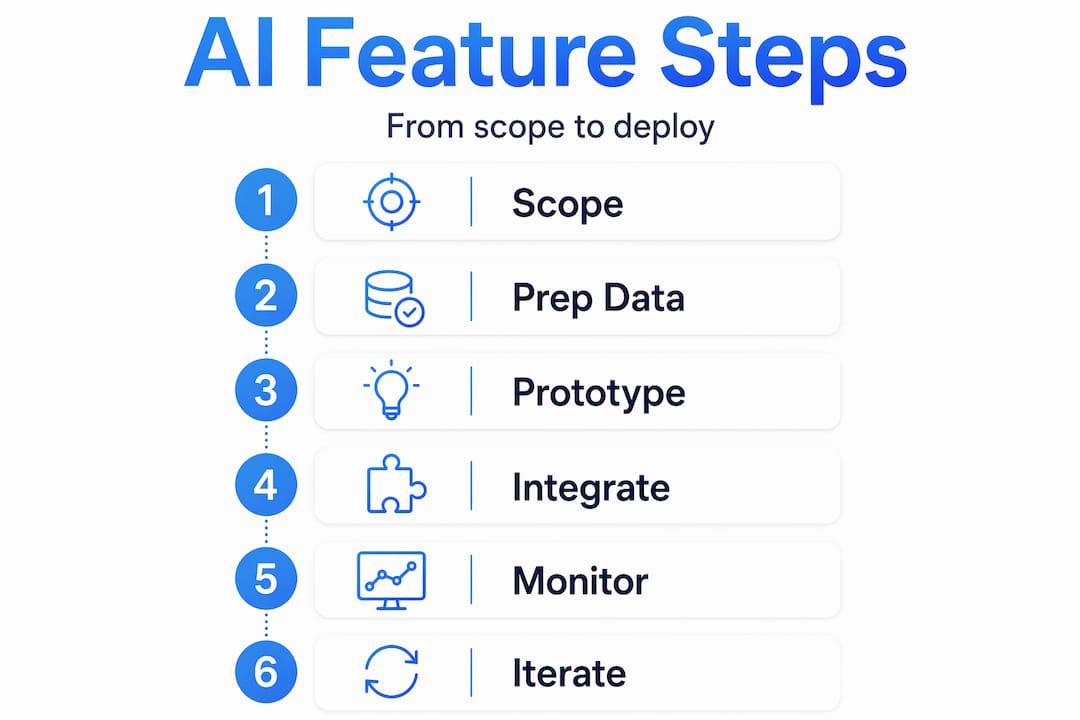
Building AI-powered features step by step starts with scoping
Before you open a code editor, you need to answer one question honestly: does this feature solve a real problem, or does it just use AI because AI is available? Strategic AI prioritization based on customer value and feasibility prevents wasted engineering effort on low-impact or technically unsuitable features.
A practical scoping process looks like this:
- Map the customer pain point. Write one sentence describing the specific friction your user faces. If you cannot write that sentence clearly, the feature is not ready to build.
- Assess value versus effort. Score the feature on expected user impact, development complexity, data availability, and alignment with your product roadmap. Features that score low on data availability almost always underdeliver.
- Define success criteria upfront. Concrete metrics matter here. For a summarization feature, that might be "P90 summary quality score above 4.0 on a 5-point rubric, measured weekly." Vague goals like "improve user experience" cannot be evaluated.
- Choose the right type of AI feature. Common categories include content generation, classification and routing, retrieval-augmented Q&A, recommendation, and structured extraction. Each carries different data, latency, and accuracy trade-offs.
- Confirm the AI feature's business fit before committing your sprint capacity. Not every product benefits from AI at every stage.
Pro Tip: Write a one-page feature brief before any technical design. Include the customer problem, the proposed AI behavior, the success metric, and the rollback criteria. This document will save you hours in later debates about scope.
The scoping phase sets the ceiling on everything that follows. A poorly scoped feature will consume engineering cycles regardless of how well it is built.
Data and infrastructure preparation
Data is where most AI feature implementations quietly break down. You can have the best model and the worst outcomes if your data pipeline is poorly designed. Before writing model code, audit your data across four dimensions: volume, label accuracy, freshness, and schema consistency.
Here is a practical sequence for preparing your data and infrastructure:
- Audit existing data. Identify what you have, what is labeled, and what the label error rate is. For classification tasks, even 5% label noise can degrade model accuracy significantly.
- Build the minimal pipeline. Design an ingestion, transform, storage, and serving pipeline. Start small. A single Postgres table with a vector extension beats an over-engineered distributed system you cannot debug.
- Address training-serving skew. This is a silent failure mode. The features you compute at training time must match exactly what the serving path computes at inference time. Mismatches cause production accuracy to fall below evaluation benchmarks without any obvious error.
- Handle privacy and compliance requirements. DPIAs and explicit consent are required before deploying AI features that involve automated decision-making or large-scale profiling. Build your consent and data retention logic before you build your model.
- Choose your compute starting point. For most teams, hosted foundation model APIs get you to production faster and cheaper than custom training. Solo developers have shipped AI MVPs in under a weekend for under $50 per month using APIs. Start there. Train custom models only when you have the data and a clear accuracy gap that APIs cannot close.
| Infrastructure choice | Best for | Trade-off |
|---|---|---|
| Hosted API (e.g., Claude, GPT) | Fast prototyping, limited training data | Cost at scale, less customization |
| Fine-tuned open model | Domain-specific accuracy needs | Training cost, infrastructure burden |
| On-device model | Privacy, offline, low latency | Limited model size, update complexity |
| RAG pipeline | Knowledge-grounded Q&A | Engineering overhead, retrieval quality |
Pro Tip: Log every input and output from your AI calls starting on day one, even in development. This data becomes your golden evaluation set. Without it, you are evaluating against nothing.

Step-by-step development: prototyping to production integration
This is where developing AI features moves from design to code. The single most important principle: build a small hand-crafted implementation first, then graduate to a production framework. That "build it then use it" approach prevents frameworks from becoming black boxes you cannot debug when things go wrong at 2am.
Follow this sequence:
- Prototype the core logic manually. Write the prompt, call the API directly, and parse the response yourself. No abstractions yet. Understand what the model actually does.
- Abstract the model interface. Once your logic works, decouple model calls from business logic behind a clean interface. This means you can swap Claude for GPT-4o or an open model without rewriting your application.
- Add fallback paths. Every AI call needs a fallback. If the LLM call times out or returns an invalid structure, your application should degrade gracefully, not crash. Fallbacks like keyword search or cached partial outputs reduce user-facing errors in production.
- Engineer your prompts iteratively. Prompt engineering is not a one-time task. Maintain versioned prompt files, test each change against your evaluation harness, and track quality metrics across iterations. This discipline is what separates teams that improve over time from teams that regress.
- Implement feature flags. Incremental percentage-based rollout with feature flags gives you the ability to expose the new feature to 1% of users, monitor quality, and expand or roll back with a config change.
- Stream AI responses where latency matters. Streaming via SSE is the industry standard in 2026, with the expectation that first tokens arrive within one second. For long-form outputs, streaming dramatically reduces perceived wait time.
For RAG-based features specifically, do not underestimate the pipeline engineering. Query expansion, custom chunking, and cross-encoder reranking reduced hallucinations and improved production chatbot accuracy by 40% in one documented case. The retrieval layer is not an afterthought.
Pro Tip: Put your AI feature behind a feature interface from day one. Something as simple as an "AIFeatureClientclass with a singlegenerate()` method means you can mock the AI entirely in unit tests and swap providers without touching application code.
Testing, monitoring, and quality control
AI features fail in production in ways that synchronous unit tests will not catch. Silent accuracy degradation, hallucinations, and drift from model updates are the real threats. You need an evaluation framework and observability stack from launch, not as a later sprint item.
Here is what that looks like in practice:
- Build a golden-example harness. Collect 20 to 50 representative inputs and expected outputs. An LLM-as-judge evaluation pattern with these golden examples enables automated quality checks that run on every deployment, catching regressions before users see them.
- Track implicit feedback signals. User behavior tells you things explicit ratings do not. Signals like copy rate, regeneration requests, session abandonment after an AI response, and fallback invocation rates are all meaningful quality indicators.
- Monitor confidence scores. Set thresholds and alert when model confidence drops outside expected bounds. This is your early warning system for model drift and distribution shift.
- Measure latency and error rates at the AI call level separately from your application-level metrics. A slow model and a failing model look identical to your users but require completely different responses from your team.
- Validate output structure. For features that depend on structured outputs (JSON, specific fields), validate the schema on every response and log failures. Unstructured failures accumulate silently and corrupt downstream processes.
| Quality signal | What it detects | Response action |
|---|---|---|
| Fallback invocation rate | Model failures and timeout spikes | Investigate API latency, adjust timeouts |
| Golden-example pass rate | Prompt or model regressions | Rollback deployment, review changes |
| User regeneration rate | Perceived output quality drop | Audit prompts, review feedback logs |
| Confidence score distribution | Model drift or data distribution shift | Trigger retraining or prompt revision |
Pro Tip: Wire your LLM-as-judge tests into your CI/CD pipeline so every prompt change triggers an automated quality gate. If the pass rate drops below your threshold, the deployment blocks. This is the highest-leverage testing investment you can make for an AI feature.
For observability across multi-agent systems, you need trace-level visibility into each reasoning step, not just top-level request logs. Without it, debugging agentic behavior is guesswork.
Deployment best practices and iterative improvement
Getting your AI feature to production is not the finish line. It is the beginning of a continuous improvement loop. Here is how to deploy safely and build the feedback systems that let the feature get better over time:
- Use staged rollouts. Start at 1% to 5% of traffic. Monitor your quality and latency metrics for 24 to 48 hours before expanding. Set explicit rollback triggers, such as fallback rate exceeding 10% or golden-example pass rate dropping below your threshold.
- Separate model releases from feature releases. When you update a model or prompt, treat it as a distinct deployment event with its own monitoring window. Mixing model changes with feature changes makes regressions impossible to attribute.
- Build structured feedback loops. Explicit thumbs up/down signals, output edits, and regeneration events should feed a labeled dataset that informs your next prompt revision or fine-tuning run. Feedback that is not captured is feedback wasted.
- Evaluate on-device versus API inference. For features with strict latency requirements or privacy constraints, small quantized models running on-device may outperform a round-trip to an external API. The privacy by design requirements for AI personalization features increasingly favor on-device inference.
- Plan for multi-model routing. As your feature matures, you will likely route different request types to different models: a small fast model for simple classifications, a larger model for complex generation. Design your model interface layer to support routing from day one.
- Handle human-in-the-loop workflows explicitly. For high-stakes decisions, build review queues and escalation paths directly into your feature. Do not bolt them on later. Define the confidence threshold below which a human review is triggered.
Iterative improvement is the multiplier. A feature that ships with basic monitoring and a feedback loop will outperform a "perfect" feature shipped without either, every time.
My take on the engineering realities of AI feature development
I've watched a lot of AI feature projects fail in ways that were entirely predictable. The most common pattern: the team treats the AI integration as a research spike, defers the engineering rigor, and then cannot understand why the feature behaves differently in production than it did in the notebook.
In my experience, the single most valuable shift is committing to abstraction from day one. When your model calls sit behind a clean interface, you can test them in isolation, mock them for unit tests, and swap providers without touching business logic. It sounds like overhead. It is not. It is the difference between a maintainable feature and a feature that nobody wants to touch six months after launch.
What I've learned is that data monitoring and evaluation are not polish. They are load-bearing walls. Silent accuracy degradation is real, and it is far more common than outright failures. The features that age well are the ones where someone cared enough to build 30 golden examples and a judge harness before the first production deploy.
The teams that consistently ship reliable AI features share one trait: they stay humble about what the model will do in production versus what it did in a demo. That humility translates directly into better fallback design, better monitoring, and faster recovery when something goes wrong.
— Kevin
How MLflow supports your AI feature development workflow
If you are working through this development process and looking for an open-source platform that handles the hard parts, MLflow is built for exactly this kind of work.
MLflow provides production-grade tooling across the entire AI feature lifecycle. For prompt engineering, the MLflow prompt engineering cookbook gives you versioned prompt management and experiment tracking so you can iterate with confidence. For evaluation, LLM-as-a-Judge frameworks let you automate quality gates against your golden examples without building your own judge infrastructure. For observability, LLM and agent tracing gives you trace-level visibility into every reasoning step in your pipeline. And the MLflow AI Gateway handles secure cross-provider routing and prompt governance so your team is not managing API keys and rate limits manually. It is open source, production-proven, and integrates with the frameworks you are already using.
FAQ
What does "building AI-powered features step by step" actually mean?
It refers to a structured engineering methodology for integrating AI capabilities into applications, covering scoping, data preparation, architecture, development, testing, and deployment in a deliberate sequence rather than ad hoc.
How do I choose which AI feature to build first?
Strategic feature prioritization focuses on alignment with real customer pain points, data availability, and value potential. Score candidates on impact, feasibility, and fit before committing engineering resources.
Why do AI features fail in production when they worked in development?
The most common causes are training-serving skew, silent accuracy degradation from model updates, missing fallback paths, and insufficient monitoring. Building an evaluation harness and observability stack before launch addresses most of these.
Do I need to train a custom model to build AI-powered features?
Not usually. Hosted foundation model APIs let developers ship capable AI features quickly and affordably. Custom training makes sense only when you have domain-specific accuracy requirements and sufficient labeled data to justify the cost.
How should I handle privacy compliance for AI features?
DPIAs and explicit user consent are required before deploying AI features that involve automated decision-making or large-scale profiling of personal data. Build consent logic and data retention rules into your architecture before your first production release.