What Is Cross-Department AI Reuse? A Governance Playbook

Cross-department AI reuse means treating models, prompt templates, agent skills, and evaluation harnesses as shared assets that multiple business functions consume instead of rebuilding from scratch. It sounds simple, but Deloitte's research found that the real barrier to scaling AI across an enterprise is no longer technical. It's organizational: pilots stay isolated because no one owns the handoff between teams. The immediate takeaway is that reuse only works with governance and a shared platform behind it, not just good intentions.
- Reuse cuts duplicate engineering work across marketing, finance, ops, and HR.
- Governance frameworks like the NIST AI RMF or an internal AI Coordination Council prevent conflicting model outputs.
- A platform like Mlflow gives teams a common layer for versioning, routing, and evaluation.
Pro Tip: Before building anything new, search your model registry first. If a discoverable asset already exists, adopting it beats reinventing it almost every time.
Key Takeaways
Cross-department AI reuse succeeds when a shared platform handles routing, observability, governance, and sandboxing while stage gates and named owners keep pilots accountable.
| Point | Details |
|---|---|
| Reuse cuts duplicate work | Shared assets across departments reduce redundant engineering and conflicting model outputs. |
| Barrier is organizational | Deloitte finds governance gaps, not technical limits, block AI from scaling past pilots. |
| Four capabilities stay central | Model routing, observability, governance, and sandbox belong to a shared platform team. |
| Stage gates control spend | Retiring pilots at gate two, as seen in the Fortune 500 case, keeps costs disciplined. |
| Mlflow supports the stack | Mlflow's versioning, tracing, and evaluation tools map directly to the four core reuse capabilities. |
Table of Contents
- What Counts as Cross-Department AI Usage in Practice
- Why Cross-Functional AI Usage Pays Off
- Common Failure Modes That Break AI Collaboration Between Teams
- The Organizational Shape That Makes Reuse Possible
- Core Platform Capabilities Every Reuse Program Needs
- A Stepwise Playbook From Pilot to Embedded Reuse
- Metrics That Prove AI Resource Sharing Is Working
- Your First 30, 60, and 90 Days
- How Mlflow Fits an AI Model Reuse Program
- Why Platform Discipline Beats Both Extremes
- Mlflow Gives You the Shared Platform Layer Without the Rebuild
- Frequently Asked Questions
- Sources
What Counts as Cross-Department AI Usage in Practice
Reuse isn't limited to model weights. It covers evaluation harnesses (including LLM-as-a-Judge test suites), prompt templates, agent skills, CI/CD jobs, and the deployment wiring that connects them to production systems. If it can be versioned and discovered, it can be reused.
A lead-scoring model built by marketing might power sales prioritization with zero retraining. A prompt template written by legal for contract clause extraction can serve procurement's vendor-review workflow with minor edits. That's the pattern: one team solves a problem once, and a registry makes the solution visible to everyone else.
- Reusable assets: model binaries, prompt templates, agent skills, eval harnesses, CI jobs.
- Real reuse requires versioning and discoverability, not a shared folder of copy-pasted scripts.
- A catalog entry with an owner and a version tag is what separates reuse from duplication with extra steps.
Why Cross-Functional AI Usage Pays Off
The business case is concrete. Faster time-to-value, lower maintenance cost, and a single coherent customer experience across departments all follow from not rebuilding the same model five times. IEEE research on AI-driven software reuse found development-time reductions near 25% and maintenance-cost reductions near 20% in case studies that adopted structured reuse practices.
Deloitte's data reinforces this from the governance side: organizations that treat reuse as an organizational design problem, not a tooling purchase, are the ones getting pilots into production. A systematic review of 160 articles backs this up, tying successful cross-functional scaling to data governance, capability building, and socio-technical alignment rather than raw model quality.
- Faster time-to-value from adopting existing assets instead of starting from zero.
- Lower total cost of ownership when one team maintains a model that three teams consume.
- Consistent customer-facing decisions instead of contradictory outputs from parallel models.
By the numbers: AI-driven reuse practices cut development time by roughly 25% and maintenance cost by roughly 20% in documented case studies.
Common Failure Modes That Break AI Collaboration Between Teams
Most reuse programs don't fail because the model was bad. They fail because of predictable structural gaps.
Data fragmentation is the most common one: finance and marketing each hold a slightly different version of "customer lifetime value," so any shared model produces answers nobody trusts. The fix is a shared data layer, sometimes called an AI Data Spine, that defines which fields are the single source of truth for cross-functional handoffs. Conflicting AI signals show up when two departments deploy separate models answering the same question differently. A model registry with semantic search solves the discoverability problem that causes this in the first place. Agent sprawl, where dozens of ungoverned agents accumulate across business units, is well documented in AWS's guidance on managing agent sprawl, which recommends a hub-and-spoke governance model with a central registry and risk-based classification.
- Data fragmentation: mitigate with a shared data spine defining single-source-of-truth fields.
- Conflicting signals: mitigate with a searchable registry that surfaces existing models before new ones get built.
- Agent sprawl and duplicate procurement: mitigate with stage gates and centralized spend visibility.
Pro Tip: Make the shared platform the fastest way to ship. If self-service through governed infrastructure is quicker than building shadow tools, teams will publish instead of duplicate.
The Organizational Shape That Makes Reuse Possible
The pattern that keeps recurring in successful programs is a small central platform team paired with lean function-specific implementation teams. The platform team owns model routing, observability, governance, and the sandbox environment. Function teams (marketing AI, finance AI, ops AI) own their specific use cases and domain judgment, but they build on the shared foundation instead of standing up parallel infrastructure.
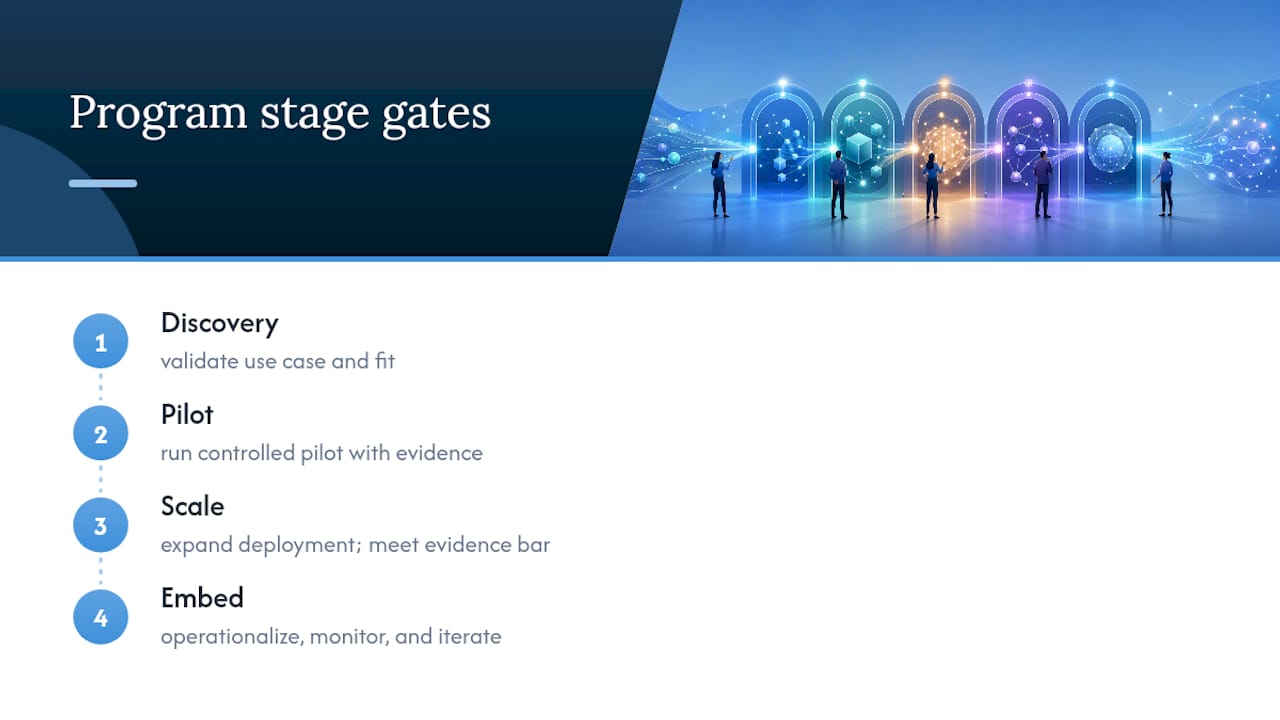
A Fortune 500 case study documents this structure directly, built over 18 months around a compact platform team and four stage gates: discovery, pilot, scale, and embed. Quarterly executive review meetings kept spend visible and gave leadership a consistent narrative for the board. Typical roles include a platform product lead, a security partner, a function-AI lead paired with an engineer, and a business owner who signs off at each gate. That review cadence, not just the technology, is what kept the program from splintering into disconnected pilots.
- Central platform team: owns routing, observability, governance, sandbox.
- Function teams: own domain use cases, stay lean, consume shared services.
- Four stage gates plus quarterly executive review keep spend and scope under control.
Core Platform Capabilities Every Reuse Program Needs
Four capabilities belong in the shared layer, not duplicated inside every department. Model routing gives every team a single endpoint with version pinning, fallback logic, and cost allocation by function. Observability captures traces of agentic reasoning, eval pass rates, and latency at the p95 percentile, so teams can debug without instrumenting from scratch. Governance handles data classification, automated PII detection, and audit logs centrally. The sandbox gives teams a self-serve evaluation harness and CI templates so a new use case can be tested without waiting on the platform team.
Centralizing these four cuts per-function headcount and shrinks the audit surface leadership has to defend during a compliance review.
| Capability | Core Responsibility | Measurable Output |
|---|---|---|
| Model routing | Version pinning, fallback, cost allocation | Cost-per-request by function |
| Observability | Agentic trace capture, latency monitoring | Eval pass rate, latency p95 |
| Governance | Data classification, PII detection, audit logs | Audit trail completeness |
| Sandbox | Self-serve eval harness, CI templates | Time-to-first-pilot |
Mlflow's model lifecycle management capabilities map directly onto the routing and versioning row, while its access control patterns support the governance layer.
A Stepwise Playbook From Pilot to Embedded Reuse
Moving from scattered pilots to embedded, reusable AI assets follows a repeatable sequence.
- Assess. Run a readiness inventory across departments to build a tools-gap matrix: what exists, who owns it, what's duplicated.
- Catalog. Stand up a registry and a data spine so every asset has a discoverable entry with an owner and a version.
- Pilot. Launch on top of shared platform services, with explicit pass criteria tied to eval scores and observability traces before anything ships.
- Scale. Move qualifying pilots through stage gates with documented ownership and a cost-attribution plan by function.
- Embed. Fold the asset into business-as-usual with a named owner and a service-level agreement, per Deloitte's finding that pilots need BAU ownership to survive past the demo stage.
Gate two, the transition from pilot to scale, is where discipline matters most. The Fortune 500 case study cited above retired roughly one-third of pilots at gate two, a deliberate spend-control mechanism rather than a failure signal. Killing a pilot that can't clear eval thresholds is cheaper than propping it up in production.
Metrics That Prove AI Resource Sharing Is Working
Executives and auditors need concrete numbers, not a status update that says "it's going well." Track the handoff rework rate (how often work gets redone because a handoff between teams failed), eval pass rate, cost-per-request, latency p95, pilot retirement rate, and cross-function adoption rate as your core KPI set.
Governance signals matter just as much as performance metrics. A quarterly executive review document, named approvers at each stage gate, registered owners in the catalog, and a unified audit trail all tell leadership the program is under control rather than sprawling. The Fortune 500 program's stage-gate discipline and quarterly review cadence are what gave it board-level credibility over 18 months, not the underlying model architecture.
- Handoff rework rate: flags where cross-team processes are breaking down.
- Eval pass rate and latency p95: core technical health signals for any shared model.
- Pilot retirement rate: a sign of spend discipline, not program weakness.
Programs with named gate approvers and a recurring executive review cadence are the ones that survive past the first year, based on the Fortune 500 case study's documented structure.
Your First 30, 60, and 90 Days
Start small and concrete this week.
- Day 30: Inventory every existing model and agent across departments; note owners and overlap.
- Day 30: Stand up one minimal registry entry so at least one asset becomes discoverable.
- Day 60: Define a single shared handoff field in your data spine (start with one, not ten).
- Day 60: Build a sandbox CI job template that any function team can clone.
- Day 90: Run your first cross-functional discovery workshop and identify the next candidate for reuse.
How Mlflow Fits an AI Model Reuse Program
Mlflow's model versioning and routing tools, observability traces for agentic reasoning, and LLM-as-a-Judge evaluation harnesses map directly onto the four platform capabilities discussed earlier. Centralized prompt and gateway management means function teams consume governed infrastructure instead of rebuilding it.

Pro Tip: Publish a baseline skill or prompt template in your registry with opt-in semantics. Function teams can adopt it safely without a mandate, which drives organic reuse faster than a top-down rollout.
Why Platform Discipline Beats Both Extremes
Over-centralize and you get a bottleneck where every function waits on one team. Under-govern and you get agent sprawl and five versions of the same broken model. The evidence points to a middle path: a small platform team providing leverage, paired with disciplined stage gates that force accountability at each handoff. This scales down fine, too. A mid-market team can run the same structure with lighter artifacts and fewer gates, but the same core discipline.
Mlflow Gives You the Shared Platform Layer Without the Rebuild
If you're weighing whether to build routing, observability, governance, and a sandbox in house or adopt something ready, Mlflow gives you all four as an open-source foundation instead of a from-scratch engineering project.
Enterprise teams that need compliance support, managed deployment, or bespoke integration can layer enterprise support and managed services on top of the free, open-source core. The observability tracing and LLM-as-a-Judge evaluation harnesses map directly to the governance and sandbox capabilities your reuse program needs, so you're not stitching together three separate tools. If your next step is standing up agent and prompt management for a cross-functional pilot, start with Mlflow's agent and LLM engineering platform and see how the registry and gateway map onto your existing stage gates.
Frequently Asked Questions
What is cross-department AI reuse in simple terms? It's the practice of sharing models, prompt templates, agent skills, and evaluation harnesses across business functions instead of each department building its own from scratch.
Why does organizational structure matter more than technology for AI reuse? Because the models themselves usually work fine in isolation. What breaks is the handoff between teams, which is why Deloitte's research points to governance as the primary barrier.
How many stage gates should a cross-functional AI program have? Four is the pattern that worked in the documented Fortune 500 case: discovery, pilot, scale, and embed, each with its own evidence requirements.
What is an AI Data Spine? It's a shared data layer defining which fields serve as the single source of truth for cross-functional handoffs, preventing departments from working off conflicting versions of the same metric.
Does cross-department AI reuse work for smaller organizations? Yes, the same platform-plus-function-team structure scales down with lighter artifacts and fewer formal gates for mid-market teams.
Sources
- State of AI in enterprise (Deloitte)
- Case study: Cross-Functional AI Program at Fortune 500
- Implementation of artificial intelligence in organizations by functional areas: a review and conceptual model (Journal of Management and Organization)
- AI techniques for predicting software component reusability (IEEE CICTN 2025)