MLOps Pipeline Automation Best Practices in 2026

Automating an MLOps pipeline is one of the highest-leverage investments a data science team can make, and also one of the easiest to get wrong. The gap between a notebook that runs locally and a production system that retrains, validates, and deploys models reliably is enormous. MLOps pipeline automation best practices exist precisely to close that gap, but not every practice deserves equal priority at every stage of team maturity. This article gives you a structured, opinionated framework for evaluating and implementing the practices that actually move the needle.
Table of Contents
- Key Takeaways
- 1. MLOps pipeline automation best practices: evaluation criteria
- 2. Version everything: code, data, environments, and hyperparameters
- 3. Build multi-level CI/CD pipelines for ML
- 4. Automated validation and governance gates
- 5. Production monitoring, alerting, and continuous retraining
- 6. Choosing your MLOps architecture: cloud-native vs. Kubernetes-first vs. hybrid
- My take on what actually works in MLOps automation
- How MLflow accelerates your MLOps automation
- FAQ
Key Takeaways
| Point | Details |
|---|---|
| Version everything, not just code | Data, environments, and hyperparameters must be versioned to achieve true reproducibility in automated pipelines. |
| Gates prevent costly failures | Automated data validation and model evaluation gates stop bad models from reaching production before humans notice. |
| Alerts need runbooks | Every monitoring alert must link to a defined response procedure, or it creates noise instead of action. |
| Start simple, then layer governance | Teams should add automation controls incrementally based on maturity, not try to implement everything at once. |
| Architecture beats tooling | Most MLOps failures trace back to architectural gaps like silent breaking changes, not model performance issues. |
1. MLOps pipeline automation best practices: evaluation criteria
Before you adopt any specific practice, you need a framework for deciding which ones to prioritize. Not all teams are at the same maturity level, and not all use cases carry the same risk. We evaluate MLOps automation practices across six dimensions.
- Reproducibility: Can you recreate any past training run exactly? This requires versioning data, code, environments, and hyperparameters together.
- Automation and CI/CD rigor: Does the pipeline trigger, test, and deploy without manual intervention at every step?
- Validation and gating: Are there automated checks that block bad data or underperforming models from advancing?
- Monitoring and alerting: Does the system detect drift, latency spikes, and error rate increases in real time?
- Compliance and governance: Can you produce an audit trail for any model decision or deployment event?
- Scalability and cost: Does the architecture hold up when you add more models, teams, or data volume without proportional cost increases?
Pro Tip: Rank your current pipeline against each criterion on a 1 to 5 scale before reading further. The lowest scores tell you exactly where to focus first.
2. Version everything: code, data, environments, and hyperparameters
The most common source of pipeline failures is not a bad model. It is a lack of versioned datasets and environments, combined with undetected breaking changes. When you cannot reproduce a training run from six months ago, debugging production issues becomes guesswork.
ML CI/CD exists to eliminate the "it worked on my machine" problem by versioning code, data, and hyperparameters together so that every pipeline run is traceable and repeatable. In practice, this means tagging datasets with content hashes, pinning Docker image versions, storing hyperparameter configs in version control alongside the training code, and using experiment tracking to log every run's inputs and outputs automatically.
A production-ready training pipeline should also enforce reproducible data splits, such as a fixed 80/10/10 train/validation/test ratio with a seeded random state, so that evaluation metrics are comparable across runs.
3. Build multi-level CI/CD pipelines for ML
Software CI/CD and ML CI/CD share the same philosophy but differ significantly in execution. CI/CD for ML must handle long training times, non-deterministic outputs, multi-artifact deployments, and multi-environment orchestration. A single test level is not enough.
The testing pyramid for MLOps looks like this:
- Data quality validation at the base: schema checks, null rate thresholds, distribution comparisons against a reference dataset.
- Unit and integration tests in the middle: test individual pipeline components and their interactions, including feature transformers and model wrappers.
- End-to-end tests at the top: full pipeline runs on a representative data sample, validating that the final artifact meets quality thresholds before merging to main.
End-to-end tests are expensive and time-consuming, but they are non-negotiable before major merges. Use orchestration tools like Kubeflow Pipelines or Apache Airflow to standardize pipeline definitions as code, and store all pipeline artifacts in a central model registry so that every version is traceable from training run to deployment.
Pro Tip: Parameterize every pipeline step so you can swap data sources, model architectures, or evaluation thresholds without rewriting pipeline logic. This is the single change that most accelerates iteration speed.

4. Automated validation and governance gates
Automation without gating is just faster failure. Effective MLOps pipelines treat models as release artifacts with defined promotion, rollback, and monitoring strategies, and that means inserting hard gates at multiple points in the pipeline.
The gates that matter most are:
- Data validation gate: Runs before training. Checks schema conformance, feature distributions, and null rates. Fails the pipeline if data quality drops below defined thresholds.
- Model evaluation gate: Compares the candidate model against the current production champion on a held-out test set. Only promotes the challenger if it meets or exceeds baseline performance.
- Fairness and explainability checks: For regulated or sensitive use cases, automated bias audits and SHAP-based explainability reports should be generated and logged before any deployment.
In regulated industries, independent model validation is a structural requirement. Distinct teams must handle validation with formal escalation paths, which adds engineering overhead but is non-negotiable for compliance. Automate the documentation layer: generate audit logs, model cards, and approval records as pipeline artifacts so that compliance evidence is always current.
Automated gates are not bureaucracy. They are the mechanism that lets you move fast without breaking production. Every gate you skip is a manual review you will do later, under pressure, after an incident.
5. Production monitoring, alerting, and continuous retraining
Deploying a model is not the end of the pipeline. It is the beginning of a monitoring problem. Industry-standard monitoring tracks two categories of metrics simultaneously: operational and model-specific.
| Metric category | Example metrics | Alert threshold |
|---|---|---|
| Operational | Latency (p95), error rate, throughput | p95 latency > 1s, error rate > 0.5% |
| Data drift | Population Stability Index (PSI) | PSI > 0.2 (moderate), PSI > 0.3 (high) |
| Model performance | Accuracy, F1, AUC on labeled samples | Drop > 5% from baseline |
| System health | CPU/memory utilization, queue depth | > 85% sustained utilization |
The PSI thresholds above are widely used in financial services and are a reasonable starting point for most domains. Set your own thresholds based on the cost of false positives versus false negatives in your specific use case.
Alerting without runbooks leads to noise and team burnout. Every alert must link to a specific, defined response procedure. A PSI alert above 0.3, for example, should trigger an automatic investigation report and optionally kick off a retraining pipeline. Scheduled automated retraining is a reasonable starting point, with weekly cadence and conditional deployment gated on a quality threshold such as accuracy above 0.85. Use AI monitoring tooling that connects drift signals directly to retraining triggers, so the system responds to data changes without requiring manual intervention.
Pro Tip: Do not wait for labeled data to detect model degradation. Proxy metrics like prediction distribution shift and feature drift can surface problems days or weeks before you have enough labeled feedback to measure accuracy directly.
6. Choosing your MLOps architecture: cloud-native vs. Kubernetes-first vs. hybrid
The right architecture depends on your data residency requirements, team size, and existing infrastructure. Here is a comparison of the three most common patterns.
| Architecture | Strengths | Weaknesses | Best for |
|---|---|---|---|
| Cloud-native managed services | Fast setup, low ops overhead, integrated monitoring | Vendor lock-in, limited customization, egress costs | Startups and teams prioritizing speed to production |
| Kubernetes-first (self-managed) | Full control, portable across clouds, cost-efficient at scale | High ops burden, requires MLOps platform expertise | Platform teams with dedicated infrastructure engineers |
| Hybrid (cloud + on-premises) | Meets data residency requirements, flexible compute | Complex networking, inconsistent tooling, harder to govern | Regulated industries with on-premises data obligations |
Regardless of architecture, every production MLOps pipeline needs the same core components: an orchestration layer, an artifact and model registry, a serving layer, and a monitoring stack. Best MLOps architectures evolve from a minimal viable setup toward layered governance with automated gates and drift monitoring, enabling safe scaling across teams and models. Start with the simplest architecture that meets your current requirements, and add governance layers as your model portfolio grows.
For teams working with generative AI or LLM-based pipelines, the architecture considerations expand to include prompt versioning, trace-level observability, and evaluation frameworks. MLflow's GenAI engineering capabilities are built specifically for these requirements.
My take on what actually works in MLOps automation
I've reviewed a lot of MLOps implementations, and the pattern I see most often is teams that try to automate everything at once and end up with a fragile system that nobody trusts. The teams that succeed start with two things: a working data validation gate and a model evaluation gate. Those two controls alone eliminate the majority of production incidents I've encountered.
The second thing I've learned is that most MLOps failures are architectural, not algorithmic. Silent breaking changes, missing environment pins, and unversioned datasets cause more outages than model drift ever will. Before you invest in sophisticated monitoring dashboards, make sure your pipeline is actually reproducible. Run the same training job twice with the same inputs and check whether you get the same outputs. If you don't, fix that first.
Ownership is the other thing that gets underestimated. Automation does not remove the need for clear human accountability. Every pipeline needs a named owner who is responsible for alert response, retraining decisions, and governance documentation. Without that, automated alerts become background noise and gating becomes a bottleneck that everyone tries to route around.
My honest recommendation: pick the three practices from this article that address your biggest current pain point, implement them well, and validate that they work before adding more. MLOps maturity is built incrementally, and a pipeline that your team actually trusts is worth more than a theoretically complete system that nobody understands.
— Kevin
How MLflow accelerates your MLOps automation
If you are ready to put these practices into production, MLflow gives you a single open-source platform that covers the core infrastructure needs discussed throughout this article.
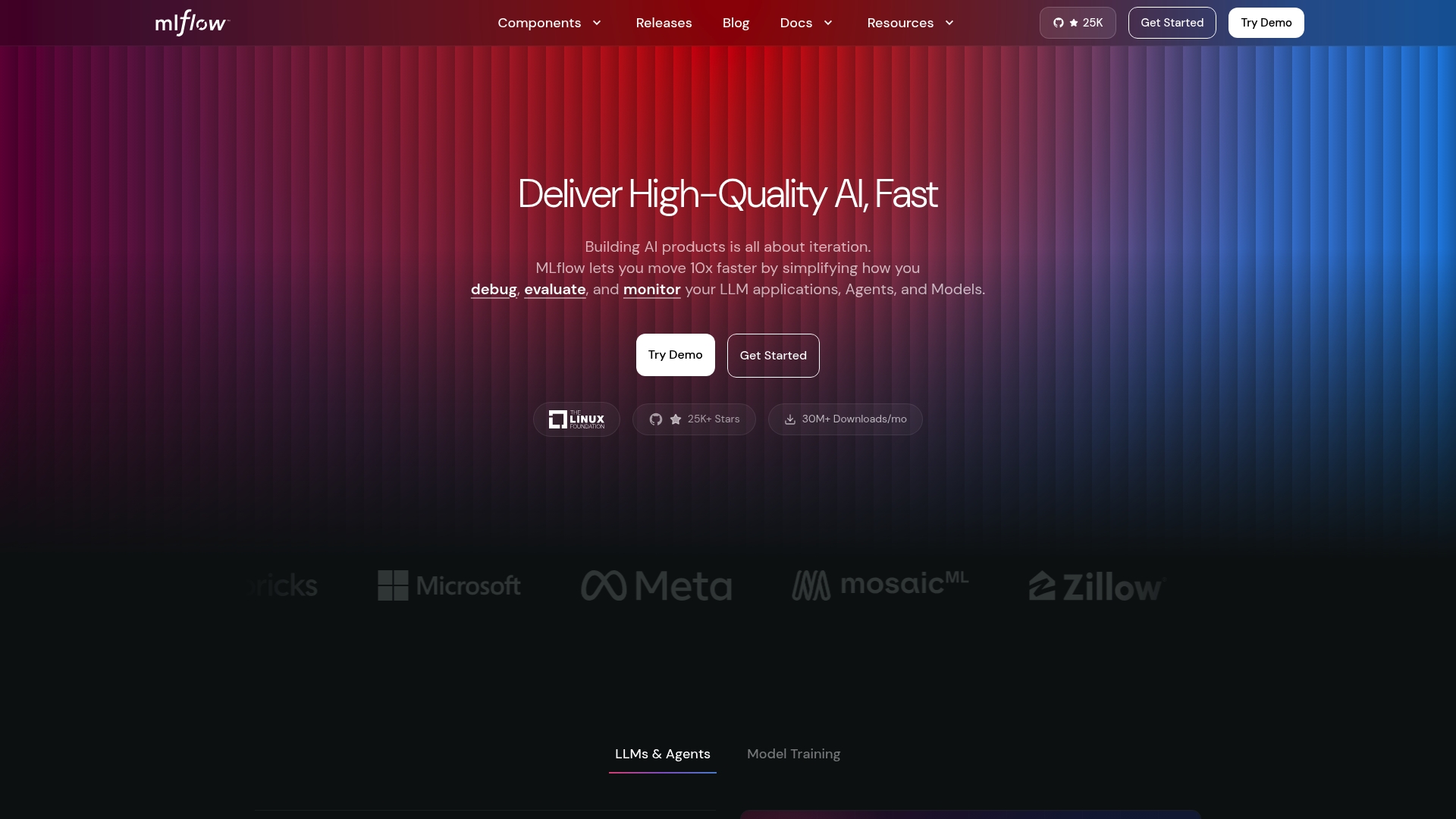
MLflow's model registry handles artifact versioning and promotion workflows out of the box. Its experiment tracking captures every run's parameters, metrics, and artifacts automatically, making reproducibility a default rather than an afterthought. For model evaluation, MLflow provides structured evaluation frameworks that integrate directly with your CI/CD gates. And for teams scaling into generative AI, MLflow's AI platform adds production-grade tracing, LLM-as-a-Judge evaluation, and a centralized AI Gateway for cross-provider governance. It integrates with Kubeflow, Airflow, and most major cloud orchestrators, so you are not locked into a single deployment target.
FAQ
What are the most critical MLOps pipeline automation best practices?
The highest-impact practices are data validation gates before training, model evaluation gates before deployment, and full versioning of code, data, and environments. These three controls prevent the majority of production incidents in automated ML systems.
How do you detect model drift in a production pipeline?
Use Population Stability Index to measure input data drift, with alert thresholds at PSI 0.2 for moderate drift and PSI 0.3 for high drift. Complement this with prediction distribution monitoring and, where possible, periodic accuracy checks on labeled samples.
When should you trigger automated model retraining?
A weekly scheduled retraining cadence is a practical starting point, with conditional deployment gated on a quality threshold such as accuracy above 0.85. Drift alerts above your PSI threshold should also trigger an out-of-cycle retraining evaluation.
What is the difference between CI/CD for software and CI/CD for ML?
ML CI/CD must handle long training times, non-deterministic model outputs, multi-artifact deployments, and data versioning in addition to standard code testing. It requires a multi-level testing pyramid that includes data quality validation, unit tests, and full end-to-end pipeline runs.
Do regulated industries need different MLOps practices?
Yes. Regulated industries require independent model validation by a separate team, formal approval gates with documented escalation paths, and automated audit trail generation. These requirements add engineering overhead but are mandatory for compliance in sectors like financial services and healthcare.