Enterprise AI Adoption Challenges: A 2026 Playbook

The most common enterprise AI adoption challenges include data fragmentation and lineage gaps, governance bottlenecks, talent and operating model ambiguity, the pilot-to-production trap (with about 30% of generative AI pilots expected to be abandoned after proof-of-concept by the end of 2025), MLOps and observability shortfalls, vendor lock-in, security and privacy control failures, and difficulty proving ROI at scale. Each of these blockers has its specific operational and organizational drivers detailed in the sections below. Industry reporting confirms that most programs stall because of organizational and operational gaps, not model capability. The single first artifact your leadership team should produce is a prioritized risk-impact matrix that maps each blocker to a named owner and a measurable gate criterion.
Here is the fast-reference map of each challenge and its highest-impact first action:
- Data fragmentation and lineage gaps → Assign a domain data owner and certify one canonical dataset before any model training begins.
- Governance and compliance bottlenecks → Convert your highest-risk policy to a machine-readable rule embedded in the pipeline, not a manual approval queue.
- Talent gaps and operating model ambiguity → Name a model operator for every production system before the system goes live, not after.
- Pilot-to-production mismatch → Require a written integration and monitoring plan as a gate criterion before any proof-of-concept receives continued funding.
- MLOps and observability shortfalls → Stand up drift detection and a golden dataset regression suite on your first production model, then replicate the pattern.
- Vendor lock-in → Audit every proprietary API dependency in your current stack and document the exit cost before signing a multi-year contract.
- Security and privacy control failures → Make data access permissions machine-readable and enforce them at the pipeline level, not through spreadsheet-based reviews.
- Proving ROI and TCO → Define success metrics and baseline measurements before the pilot starts, not after it ends.
Pro Tip: Before your next program review, build a one-page AI adoption heat map: list every active initiative, its owner, its current gate status, and whether a monitoring runbook exists. Any row missing an owner or a runbook is a production risk, not a pilot.
Key Takeaways
Enterprise AI programs that scale share three properties: named ownership at every production system, machine-readable governance embedded in pipelines, and an eval infrastructure that catches drift before it affects business outcomes.
| Point | Details |
|---|---|
| Name owners before building | Assign a named model operator and product owner before any PoC receives continued funding. |
| Governance must be machine-readable | Policies-as-code enforced at runtime scale; manual approval queues do not work for agentic systems. |
| Eval infrastructure is a gate, not an afterthought | A golden dataset regression suite and LLM-as-evaluator scoring should be deployment prerequisites, not post-launch additions. |
| TCO includes ops, not just development | Budget explicitly for integration engineering, ongoing monitoring, retraining cycles, and compliance overhead. |
| Mlflow closes multiple gaps with one open platform | Mlflow's registry, agent tracing, automated evaluation, and AI Gateway reduce technical debt and governance friction without vendor lock-in. |
Table of Contents
- What are the most common enterprise AI adoption challenges?
- How do you overcome the most common AI integration issues?
- How does governance and compliance scale for high-frequency AI systems?
- What MLOps and observability practices prevent model decay at scale?
- Who should own AI delivery, and how do you close the talent gap?
- What does a realistic pilot-to-production roadmap look like?
- How do lifecycle, registry, and observability practices close multiple adoption gaps?
- What enterprise AI programs that scaled actually did differently
- Mlflow accelerates the path from pilot to production AI
- Sources
What are the most common enterprise AI adoption challenges?
Most programs share the same catalog of blockers. Understanding which ones apply in your organization, and what business risk each creates, is the diagnostic step that separates programs that scale from those that stall.
Data quality, readiness, and lineage
Poor data quality is not just a technical inconvenience. When an agentic AI system queries a dataset with inconsistent field definitions across business units, it cannot reason reliably about what the data means. KPMG identifies fragmented data, missing context, and low trust as the primary gaps preventing enterprise AI from scaling to production. The downstream effect is compounding: a model trained on uncertified data produces outputs that compliance teams cannot audit, which triggers manual review cycles that slow deployment to a crawl.

Semantic inconsistency is a subtler version of the same problem. Two systems may both store a field called "customer status," but one means account tier and the other means payment standing. An LLM or agent that ingests both without lineage metadata will hallucinate conclusions that look plausible and are factually wrong.
Governance, compliance, and explainability
Manual governance does not scale to agentic systems. When a human reviewer must approve every model output before it reaches a downstream process, the throughput ceiling is the reviewer's calendar. Grant Thornton's 2026 AI impact survey found that many boards have approved AI investments while nearly half have not set governance expectations, creating a gap between executive approval and operational accountability. That gap shows up as approval queues, inconsistent risk decisions, and audit findings that surface months after deployment.
Talent gaps and operating model ambiguity
Deloitte's State of AI 2026 reports that 84% of companies have not redesigned jobs around AI and that insufficient worker skills remain the leading barrier to adoption. The talent gap is real, but the operating model gap is often larger. When no one owns a model in production, no one monitors it, no one updates it, and no one is accountable when it degrades. The absence of named operators is one of the most common integration failures practitioners document.
The pilot-to-production trap
Gartner predicted that roughly 30% of generative AI projects would be abandoned after proof-of-concept. The pattern is consistent: a pilot succeeds in a sandboxed environment with clean data and dedicated attention, then fails to scale because the integration work, monitoring infrastructure, and production ownership were never planned. The PoC budget covers the experiment; it rarely covers the handover.
MLOps and observability shortfalls
Models degrade. Prompts drift. Agent action traces reveal unexpected reasoning paths that no one anticipated during development. Without drift detection, latency monitoring, and scheduled regression evaluations, a model that performed well at launch can silently erode business outcomes for weeks before anyone notices. Most enterprises underinvest in eval infrastructure until after a production incident forces the issue.
Vendor lock-in and architecture decisions
Proprietary AI stacks create hidden costs that compound over time. Upgrade cycles, API deprecations, and pricing changes controlled by a single vendor can force expensive re-platforming projects. Open, modular architectures with clear interface contracts and open-source tools reduce that exposure materially.
Security, privacy, and data access controls
When enterprise data policies live in spreadsheets rather than machine-readable controls, enforcement is inconsistent. A model that can query a data source it should not access, or an agent that can take an action outside its authorized scope, creates both a security risk and a compliance liability. Access controls need to travel with the data and the action, not sit in a separate governance document.
Proving ROI and total cost of ownership
HBR analysis shows that many organizations report regular AI use while struggling to integrate models into workflows and demonstrate measurable returns. The TCO blind spot is a related problem: teams budget for model training and initial deployment but underestimate integration engineering, ongoing infrastructure, retraining cycles, and compliance overhead. The result is a program that looks expensive relative to its visible output because the full cost was never scoped.
How do you overcome the most common AI integration issues?
Each blocker has a prioritized remediation sequence. The pattern is consistent: stop the bleeding with a low-cost operational fix, build the capability that prevents recurrence, then embed it in the operating model so it holds at scale.
-
Data fragmentation. Immediate: assign a domain data owner and run a source-system audit to identify which datasets are certified and which are not. Medium-term: implement data productification, where datasets are versioned, documented, and owned like software products. Long-term: establish semantic standards and a data contract framework so every consumer of a dataset knows what it means and who to call when it changes.
-
Governance bottlenecks. Immediate: identify the three highest-risk policy decisions in your current approval queue and convert them to automated checks. Medium-term: implement policies-as-code in your ML pipeline so that sensitivity flags, access controls, and audit trails are enforced at runtime, not reviewed after the fact. Long-term: build a tiered risk classification system so low-risk use cases bypass manual review entirely.
-
Talent and operating model gaps. Immediate: name a model operator for every system currently in production. That person is accountable for monitoring, incident response, and scheduled re-evaluation. Medium-term: redesign roles rather than running awareness training. A data analyst who becomes an AI product owner needs a different job description, different incentives, and a different career path. Long-term: build middle-manager enablement programs, because managers who do not understand AI cannot prioritize it in their teams' work.
-
Pilot-to-production mismatch. Immediate: require a written integration and monitoring plan as a gate criterion before any PoC receives continued funding. Medium-term: create a standard handover checklist that covers data access, API contracts, monitoring setup, runbook documentation, and named ownership. Long-term: build a reusable pilot-to-prod template that every team uses, so the institutional knowledge compounds rather than resets with each project.
-
MLOps and observability shortfalls. Immediate: stand up data drift detection and a golden dataset regression suite on your highest-priority production model. Medium-term: automate regression evaluations on a scheduled cadence and require eval suite passage as a deployment gate. Long-term: build an AI model management practice with SLOs, on-call ownership, and post-incident review processes.
-
Vendor lock-in. Immediate: audit every proprietary API dependency and document the exit cost. Medium-term: prefer open APIs and modular architectures that allow component-level replacement. Long-term: adopt an open-source AI approach that preserves portability across providers and reduces single-vendor dependency.
-
Security and privacy. Immediate: map every data source your AI systems can access and verify that access controls match your data classification policy. Medium-term: make permissions machine-readable and enforce them at the pipeline level. Long-term: implement a risk-based approach to AI controls and governance that scales with your system count.
-
Proving ROI. Immediate: define success metrics and baseline measurements before the next pilot starts. Medium-term: build a TCO model that includes integration engineering, infrastructure, retraining, and compliance costs alongside model development. Long-term: establish a portfolio-level ROI reporting cadence that connects AI program spend to business outcomes, not just model performance metrics.
Pro Tip: Waiting for perfect data before starting is one of the most common counterproductive choices we see. Start with the best certified dataset available, document its known limitations, and build the data quality improvement work in parallel. A model trained on documented, imperfect data is more trustworthy than one trained on undocumented data that someone assumed was clean.
How does governance and compliance scale for high-frequency AI systems?
Manual review is a throughput constraint. For agentic systems that execute hundreds of actions per hour, a human-in-the-loop approval step at every decision point is not a governance strategy. It is a deployment blocker.
The design pattern that scales is policy-as-code: governance rules expressed as executable checks that run in the pipeline, not as documents that humans read before approving a deployment. Sensitivity flags embedded in data schemas, permissions that travel with data records, and audit trails that attach to every agent action are the building blocks of a governance architecture that can keep pace with production systems.
For U.S. enterprises, the practical evidence that legal and compliance teams request during audits includes:
- Data lineage documentation showing where training and inference data originated, how it was transformed, and who certified it.
- Model certification records including eval suite results, known failure modes, and the threshold criteria used to approve deployment.
- Access control logs demonstrating that the system only queried data sources it was authorized to access.
- Incident and drift records showing that the team detected, investigated, and resolved any performance degradation during the model's production lifetime.
- Prompt version history for LLM-based systems, because prompt changes are functionally equivalent to model updates and carry the same audit obligation.
SANS recommends a risk-based approach to AI controls, where the depth of governance applied to a system is proportional to the risk it creates. That framing is practically useful: it lets low-risk use cases move quickly while concentrating review resources on high-stakes decisions.
The Grant Thornton survey finding that nearly half of boards have not set governance expectations is a board-level risk, not just an ops problem. When the board has not defined what "responsible AI" means in their organization, every team below them is making that definition up independently. The result is inconsistent risk decisions and audit findings that surprise leadership.
A short evidence checklist for reviewers at each deployment gate:
- Lineage documentation complete and certified by domain owner
- Eval suite results above the agreed threshold for this use case's risk tier
- Access control audit confirming no unauthorized data source queries
- Monitoring and alerting configured with named on-call owner
- Runbook documented and tested
What MLOps and observability practices prevent model decay at scale?
Production AI systems fail in ways that development environments do not reveal. Data distributions shift. User behavior changes. Prompt updates that seemed minor alter model behavior in ways that only show up in downstream metrics weeks later. The observability signals that matter most in production are:
- Data drift: statistical changes in the distribution of inputs relative to the training distribution.
- Concept drift: changes in the relationship between inputs and the correct output, often caused by real-world changes the model was not trained on.
- Latency and throughput: degradation here is often the first visible symptom of an infrastructure or model-size problem.
- Error rate and failure modes: tracked at the action level for agents, not just at the model output level.
- Prompt change logs: every prompt modification should be versioned and logged, because prompt changes are model changes.
- Agent action traces: for agentic systems, tracing the full reasoning chain, including sub-agent calls and tool invocations, is the only way to diagnose unexpected behavior.
Evaluation infrastructure is the complement to monitoring. Golden datasets, maintained by the team that owns the use case, provide a stable regression baseline. Automated regression suites run against that baseline on a scheduled cadence and as a deployment gate. LLM-as-evaluator patterns extend this to subjective quality dimensions that rule-based metrics cannot capture, using a judge model to score outputs against defined criteria at scale.
Architectural choices compound the observability problem or reduce it. Modular stacks with open APIs and clear interface contracts allow component-level replacement without rebuilding the entire observability layer. A model and artifact registry that tracks every version, its training data lineage, its eval results, and its deployment history gives teams the context they need to diagnose incidents quickly. Proprietary stacks that bundle model serving, monitoring, and governance into a single vendor's toolchain create a single point of failure and a single point of negotiation.
Operational checklist for production readiness:
- Drift detection configured with alert thresholds and named recipient
- Golden dataset registered and version-controlled
- Automated regression suite passing as a deployment gate
- Runbook documented: what to do when drift is detected, when latency spikes, when error rate exceeds threshold
- On-call ownership assigned and tested with a tabletop exercise
- Post-incident review process defined before the first incident occurs
Who should own AI delivery, and how do you close the talent gap?
Ownership ambiguity is the most reliable predictor of production failure. When a model goes live without a named operator, it is effectively unowned. No one monitors it, no one updates it, and no one is accountable when it degrades. The CIO reporting is consistent: mis-scoped projects and missing production ownership are leading causes of AI initiative stalls, not model capability.
The role structure that works in practice:
- CDAO (Chief Data and AI Officer): owns the data governance framework, the AI product portfolio, and the enterprise-wide standards for data certification and model evaluation.
- Named model/operator owner: accountable for a specific model or agent in production. Monitors performance, owns the runbook, and makes the call on retraining or rollback.
- AI product owner: defines the use case requirements, the success metrics, and the user acceptance criteria. Bridges the business need and the technical implementation.
- Security and compliance reviewer: certifies that access controls, lineage documentation, and eval results meet the organization's risk standards before deployment.
- Platform SRE (Site Reliability Engineer): owns the infrastructure, the deployment pipeline, and the incident response process for the AI platform layer.
Deloitte's finding that 84% of companies have not redesigned jobs around AI points to the core problem: most organizations are running awareness training when they need role redesign. A data analyst who attends an AI literacy workshop is not equipped to own a production model. The job description, the incentives, and the career path all need to change.
Practical talent strategies that work:
- On-the-job simulations: pair a new model operator with an experienced one through the full lifecycle of one production deployment before they own one independently.
- Career path definition: create a visible progression from AI practitioner to AI product owner to platform lead, with defined competency criteria at each level.
- Middle-manager enablement: managers who cannot evaluate AI work cannot prioritize it, cannot protect it from scope creep, and cannot advocate for the resources it needs. This is the most underinvested training category in most programs.
- Incentive alignment: measure and reward data quality contributions and model health maintenance, not just pilot launches. A team incentivized only on new deployments will deprioritize the monitoring work that keeps existing systems healthy.
For data ownership specifically, the CDAO or a designated data domain owner certifies semantic standards and lineage for each data product. That certification is a prerequisite for any model training that uses that data. Without it, the lineage documentation that compliance teams require during audits does not exist.
What does a realistic pilot-to-production roadmap look like?
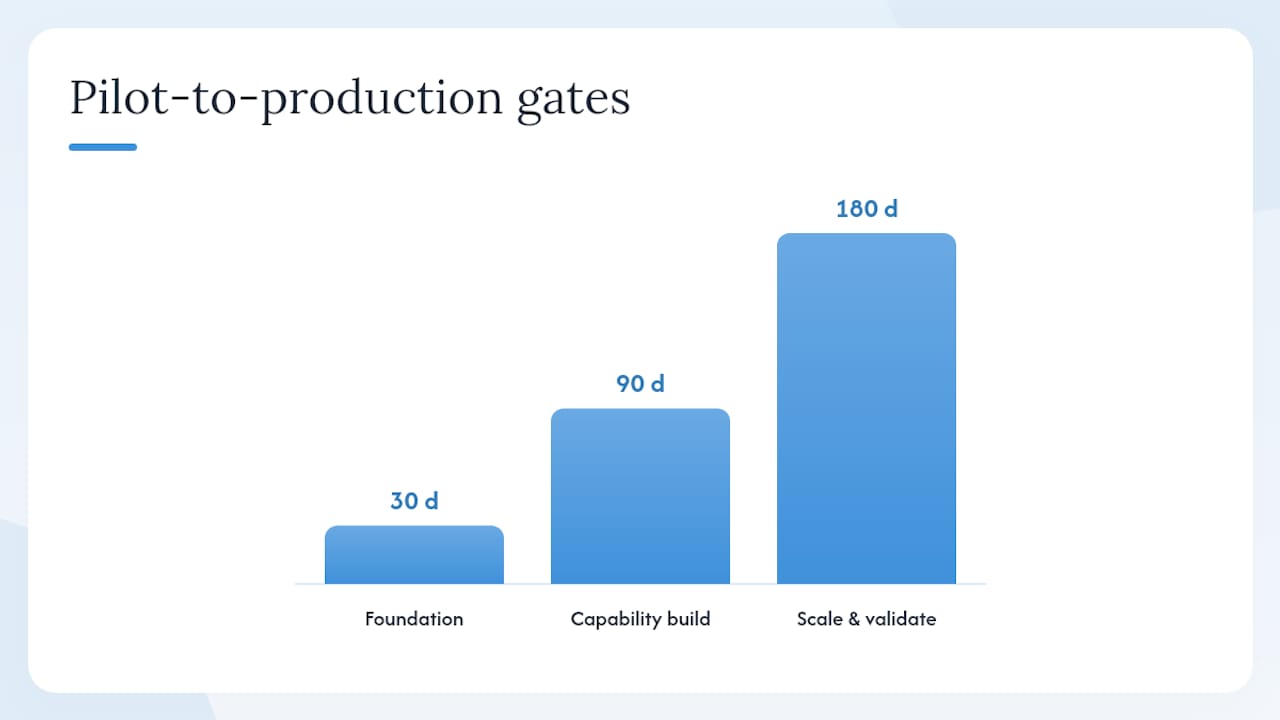
The timeline that enterprise teams consistently underestimate is not the model development phase. It is the integration, governance, and operationalization work that follows a successful PoC. A realistic planning template looks like this:
30-day gates (foundation):
- Risk-impact matrix complete with named owners for each blocker
- Source-system audit complete, at least one canonical dataset certified
- Governance tier assigned to the use case (low, medium, high risk)
- Pilot success metrics and baseline measurements defined
- Integration and monitoring plan written and reviewed
90-day gates (capability build):
- Eval suite standing with golden dataset and automated regression
- Drift detection configured on the first production model
- Policies-as-code implemented for the highest-risk governance check
- Named model operator assigned and runbook documented
- TCO model complete including integration, infrastructure, and ongoing ops
180-day gates (scale and validate):
- At least one model through the full pilot-to-prod handover using the standard checklist
- ROI measurement against pre-defined baseline complete
- Governance evidence package ready for audit (lineage, cert status, eval results, access logs)
- Operating model review: are role definitions, incentives, and career paths working?
- Architecture review: are there proprietary dependencies that need an exit plan?
Suggested KPIs to track adoption and impact:
- Usage rate: percentage of target users actively using the AI-assisted workflow versus the manual alternative.
- Task completion time: measured before and after AI integration for the specific workflow.
- Error rate: model output errors per 1,000 inferences, tracked over time.
- Time to detect drift: how quickly the team identifies and responds to performance degradation.
- Cost per model-hour: total infrastructure and ops cost divided by model inference hours, tracked monthly.
- Pilot-to-prod conversion rate: percentage of PoCs that reach production within 180 days.
Common cost buckets to budget explicitly:
| Cost Bucket | What It Covers |
|---|---|
| Integration engineering | API work, data pipeline connections, UI changes |
| Infrastructure | Compute, storage, serving, monitoring tooling |
| Ongoing ops | On-call, retraining cycles, drift response |
| Personnel | Named operators, product owners, SRE time |
| Compliance | Audit prep, lineage documentation, legal review |
| Retraining | Data refresh, fine-tuning, eval suite updates |
The Stanford HAI AI Index 2026 provides sector-level adoption benchmarks useful for calibrating where your program stands relative to industry peers. For board presentations, the Gartner PoC abandonment figure and the Deloitte job-redesign finding are the two statistics that most reliably shift executive attention from "are we doing AI?" to "are we doing AI in a way that will actually scale?"
How do lifecycle, registry, and observability practices close multiple adoption gaps?
The most durable programs we see share a common technical foundation: a model and artifact registry that tracks every version of every model, its training data lineage, its eval results, and its deployment history. That single capability closes three adoption gaps simultaneously. It gives compliance teams the lineage documentation they need. It gives operators the context to diagnose incidents quickly. It gives architects the visibility to manage technical debt before it compounds.
Agent tracing is the observability capability that matters most for agentic systems. When an agent takes an unexpected action, the trace of its reasoning chain, including every sub-agent call, every tool invocation, and every intermediate decision, is the only artifact that lets you understand why. Without it, debugging is guesswork. With it, you can identify the prompt change, the data shift, or the tool failure that caused the behavior and fix it precisely.
Automated evaluation using LLM-as-evaluator patterns extends quality assurance to dimensions that rule-based metrics cannot reach. Coherence, factual grounding, tone, and task completion are all assessable at scale when a judge model scores outputs against defined criteria. This is what makes a deployment gate meaningful: not just "did the model produce an output?" but "did the output meet the quality standard we defined?"
A policy-enforcing gateway centralizes prompt management, enforces access controls, and provides cross-provider governance in one place. For enterprises running models from multiple providers, the gateway is the control plane that makes the architecture manageable without locking into any single provider's toolchain.
Short patterns from production programs that turned failing pilots into stable flows:
- A financial services team added runtime lineage tracking to their data pipeline and cut their compliance audit preparation time from weeks to days, because the documentation was generated automatically rather than assembled manually.
- A healthcare analytics team implemented a golden dataset regression suite and caught a data drift event within 48 hours of its onset, before it affected clinical reporting. Without the suite, the drift would have been invisible until a downstream user noticed anomalous outputs.
- A retail team adopted a modular architecture with open APIs and replaced their model serving layer without disrupting their monitoring or governance setup, because the interface contracts were explicit and the components were independently replaceable.
Platform evaluation checklist for teams assessing lifecycle and observability tools:
- Can you export models and artifacts to a standard format without vendor-specific tooling?
- Does the registry track training data lineage, eval results, and deployment history for every version?
- Can agent decisions be traced at the sub-agent and tool-invocation level?
- Does the evaluation framework support automated regression against a golden dataset?
- Can governance policies be expressed as code and enforced at runtime?
- Does the gateway support multiple model providers without requiring provider-specific integrations?
Pro Tip: During a proof-of-life evaluation, test three things specifically: export a model artifact to a standard format and verify it runs outside the platform, trace an agent's full reasoning chain for a multi-step task, and run an automated regression suite against a golden dataset. If any of those three fail, the platform will create lock-in or observability gaps that compound over time.
What enterprise AI programs that scaled actually did differently
The programs that successfully moved from pilot to production at scale share one practice that most struggling programs skip: they named an owner before they started building. Not after the PoC succeeded. Not when the model went live. Before the first line of code was written, there was a named person accountable for the model's production health, and that person was involved in every architectural decision from day one.
The second differentiator is prompt versioning. Teams that treat prompts as first-class artifacts, versioned, tested, and deployed with the same rigor as code, catch prompt-drift failures before they reach production. Teams that treat prompts as configuration strings that anyone can edit in a shared document discover the problem when a user reports that the system "started acting differently."
The C-suite prescription is simple but rarely followed: allocate executive attention to the handover, not just the launch. The pilot demo is the easy part. The governance review, the integration engineering, the monitoring setup, and the operating model change are where programs fail. When the CDAO or CIO is visibly engaged in those phases, the organization treats them as real work. When executive attention disappears after the demo, the organization treats them as optional.
Mlflow accelerates the path from pilot to production AI
The remediation patterns in this guide, from model registries and agent tracing to automated evaluation and policy-enforcing gateways, are exactly what Mlflow is built to deliver. As an open-source platform for GenAI and LLM lifecycle management, Mlflow gives enterprise teams production-grade AI observability with deep agentic reasoning traces, automated LLM-as-a-Judge evaluation, and a centralized AI Gateway for cross-provider governance, without locking you into a proprietary stack.
Teams using Mlflow get a model and artifact registry that tracks lineage, eval results, and deployment history for every version. They get agent tracing that makes agentic reasoning auditable. They get an agent and LLM engineering platform that integrates with the frameworks your team already uses. The architecture is modular and open, which means you can replace components, export artifacts, and govern across providers without rebuilding your observability layer.
If you are planning your next 90-day gate or evaluating platforms for your pilot-to-prod handover, explore Mlflow's capabilities at Mlflow and run the proof-of-life evaluation checklist from this guide against it.
Sources
The sources below underpin the guidance in this guide. Each is worth bookmarking for executive briefings.
- Why enterprise AI initiatives stall — and what CIOs can do about it | CIO
- Gartner
- Close the five gaps preventing enterprise AI from scaling
- Why AI adoption stalls, according to industry data | HBR
- The State of AI in the Enterprise (State of AI 2026) | Deloitte
- Grant Thornton 2026 AI impact survey
- AI Index 2026 report | Stanford HAI
- Twohundred