Load Balancing AI Services: A Complete Infrastructure Guide

Load balancing in AI services does one thing above all else: it keeps inference requests moving to the right compute at the right time, without stalling, overloading, or wasting GPU cycles. Unlike traditional web load balancing, which distributes HTTP requests across stateless servers, AI service load management must account for token sequence length, key-value cache state, GPU memory pressure, and the synchronization barriers that govern parallel decoding. The core goals are consistent across deployments: maximize resource utilization, minimize latency for time-sensitive workloads like LLM inference and embedding generation, and maintain availability when upstream providers degrade.
The workloads that depend on effective load distribution include:
- LLM inference (chat, summarization, code generation) with variable prompt and decode lengths
- Embedding generation for retrieval-augmented generation pipelines
- Reranker services that score candidate documents before final response assembly
- Agentic workflows where sub-agents call multiple AI services in sequence
Monitoring tools like NVIDIA DCGM give infrastructure teams real-time visibility into GPU memory utilization, temperature, and power draw, feeding those signals directly into routing decisions. When load balancing is done well, GPU utilization climbs and tail latency drops. When it is done poorly, even a fleet of high-end accelerators idles at a fraction of its capacity.
Why AI workloads break traditional load balancing assumptions
Standard load balancers were built for stateless, short-lived HTTP transactions. AI inference is neither stateless nor uniform, and that gap creates real operational pain.

Variable request cost is the first problem. A 128-token prompt and a 4,096-token prompt look identical at the network layer but impose wildly different compute loads. Round-robin routing ignores this entirely, which means one backend can be processing a long-context generation while another handles trivial embedding calls, and the balancer keeps sending traffic to both at the same rate.

Stateful inference and cache locality compound the issue. LLM serving systems maintain a key-value cache for each active sequence. Migrating that cache between instances carries a high cost, so assignments are effectively sticky once made. Routing a returning user's request to a different backend than the one holding their KV cache forces a cold start, destroying the throughput gains that cache-aware routing is designed to preserve.
Barrier synchronization in data-parallel deployments is the challenge that most infrastructure teams underestimate. When a model is sharded across devices via tensor parallelism and replicated across many data-parallel workers, every decode step ends at a synchronization barrier. The slowest replica sets the pace for the entire fleet. Research on production LLM deployments shows that more than 40% of accelerator time can be lost to barrier idle at scale, with idle accelerators continuing to draw power throughout.
Additional constraints that traditional balancers cannot handle include:
- GPU memory limits: a backend that is near its memory ceiling will evict KV cache entries, spiking latency unpredictably
- Hardware heterogeneity: mixing GPU generations in a fleet means identical request loads produce different completion times
- Model versioning: routing must account for which model version each backend is serving, especially during rolling updates
- Non-stationary arrivals: LLM request rates shift dramatically by time of day, making static weight configurations stale within hours
What architectures and algorithms actually work for AI routing
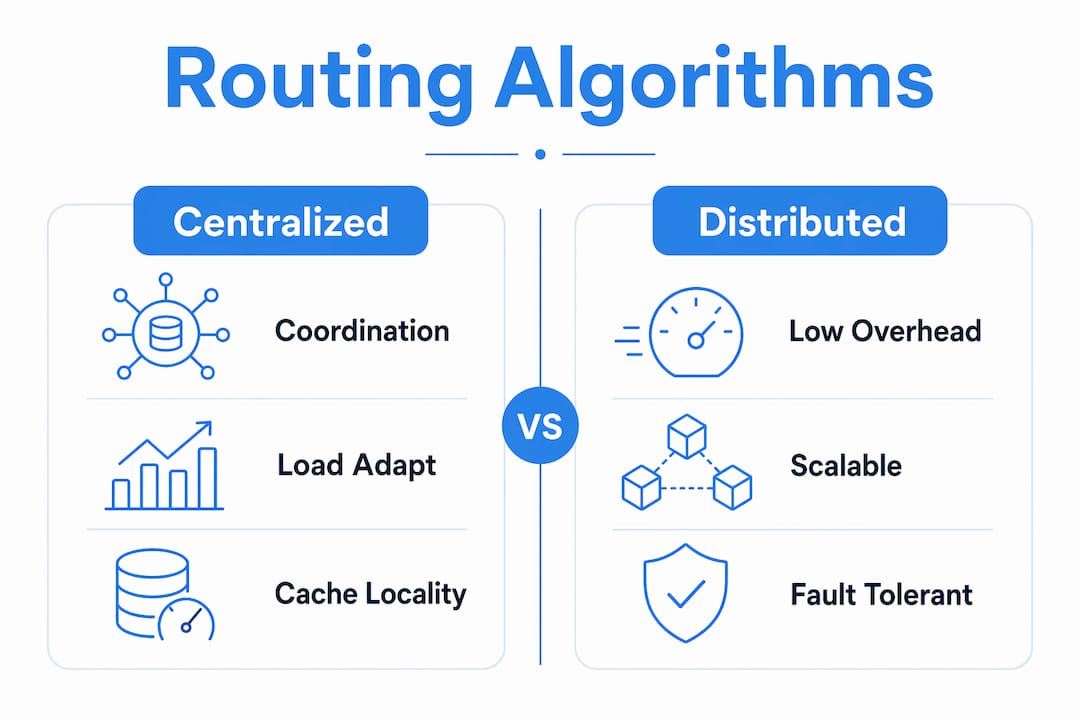
The architectural choices for AI load balancing fall into three broad categories: centralized, distributed, and hybrid. Centralized designs give a single control plane full visibility into fleet state, which enables precise decisions but introduces a coordination bottleneck. Distributed designs push routing logic to each caller, reducing overhead but limiting global awareness. Hybrid approaches, which are increasingly common in production, combine a lightweight local decision with periodic synchronization from a central telemetry plane.
Routing algorithms compared
| Algorithm | Coordination overhead | Adapts to real-time load | Cache locality | Best fit |
|---|---|---|---|---|
| Round-robin | None | No | Destroys it | Stateless, uniform workloads |
| Least-loaded | Low | Partially | No | Short-lived connections |
| Consistent hashing | Low | No | Preserves it | Cache-sensitive, stable fleets |
| Latency-aware | High | Yes | No | Structured, fast calls |
| Power of Two Choices | Very low | Yes | Configurable | Adaptive AI routing |
The Power of Two Choices (P2C) algorithm deserves particular attention. Rather than ranking all backends globally (which causes herding) or selecting randomly (which ignores load), P2C samples two backends at random and routes to the better-scoring one. That single extra comparison drops maximum load from O(log n / log log n) to O(log log n), an exponential improvement with no distributed state required. A production deployment of a service-aware load balancer built on P2C demonstrated automatic failover across four upstream incidents and a near-elimination of manual routing interventions after deployment.
Service-aware scoring is what separates a well-designed AI balancer from a generic one. Embeddings and rerankers are structured, fast calls where recent latency is a reliable routing signal. LLMs are different: end-to-end latency is dominated by prompt length, cache behavior, and output token count, not backend queue depth. Routing LLM traffic on raw latency is noisy and actively breaks cache locality. The right signal for LLM routing is reliability and current load, not completion time.
Cache-aware routing addresses the KV cache locality problem directly. By tracking which backend holds the cache for a given session or prefix, the router can send follow-up requests to the same instance. The throughput gains are substantial: cache-aware routing improves throughput by up to 108% over naive round-robin in LLM serving environments.
Pro Tip: For LLM workloads, implement short-lived sticky routing rather than chasing the lowest measured latency. Cache locality compounds over a session; latency-chasing destroys it.
How to operationalize AI load balancing at data center and cloud scale
Getting AI load balancing right in production requires more than picking the right algorithm. It demands tight integration between the routing layer, the GPU telemetry plane, and the serving framework.
GPU telemetry integration is where most teams underinvest. Static health checks that ping a backend every 30 seconds tell you whether the process is alive, not whether it is about to OOM or is running at 98% memory utilization. NVIDIA DCGM provides per-GPU metrics including memory used, SM utilization, temperature, and power draw. Feeding those metrics into routing weights in real time means the balancer can deprioritize a backend that is approaching its memory ceiling before latency spikes, not after. Real-time GPU metrics fed into dynamic routing weights represent a meaningful architectural shift from stale health checks to genuine control-plane awareness.
Fault tolerance and graceful degradation require explicit design. When an upstream provider degrades, the balancer must detect unhealthy backends quickly, drain them from the active pool, and redistribute traffic without manual intervention. Equally important is graceful recovery: a backend that returns to health should rejoin the pool automatically, with a ramp-up period to avoid immediately overloading it with redirected traffic.
Container orchestration and ML serving frameworks are the operational layer where load balancing decisions get executed. Kubernetes service meshes handle east-west traffic between microservices, but AI-specific routing logic typically sits above the mesh in a dedicated gateway or proxy. Mlflow's ML model serving capabilities integrate with this layer, providing lifecycle management and orchestration for LLM and GenAI applications. Mlflow's AI agent orchestration platform supports production-grade tracing and observability, which gives infrastructure teams the visibility needed to validate that routing decisions are producing the expected latency and throughput outcomes.
Key operational metrics and KPIs to track include:
- Time to First Token (TTFT): the latency from request submission to the first generated token, critical for interactive applications
- Time Between Tokens (TBT): inter-token latency during streaming, which affects perceived responsiveness
- GPU utilization per backend: target utilization above 80% while keeping memory headroom for burst traffic
- DP imbalance ratio: the gap between the most-loaded and average-loaded data-parallel worker at each decode step
- Failover detection time: how quickly the balancer removes an unhealthy backend from rotation
Security considerations for AI load balancing go beyond standard TLS termination. Prompt injection attacks can target the routing layer if request metadata is used in routing decisions. Access controls must be enforced at the gateway before requests reach model backends, not after. For multi-tenant deployments, tenant isolation at the routing layer prevents one tenant's burst traffic from degrading another's latency. Mlflow's centralized AI Gateway provides secure prompt management and cross-provider governance, which addresses the access control and audit requirements that enterprise deployments need.
What the latest research reveals about AI load balancing performance
The gap between generic load balancing heuristics and AI-aware routing is now well-quantified in published research, and the numbers are large enough to matter at any serious scale.
Workload-aware routing that distinguishes between LLM prefill and decode phases achieves over 11% lower end-to-end latency compared to round-robin on mixed public LLM datasets. The key insight is that prefill and decode have fundamentally different compute and memory profiles. A router that treats them as a single monolithic job cannot make an informed placement decision. By predicting output length and estimating the performance impact of mixing diverse workloads on a single instance, a workload-aware router can assign requests to the instance where they will complete fastest.
Barrier synchronization and the BalanceRoute approach address the data-parallel bottleneck that compounds at scale. When model replicas are tied together through a step-wise collective barrier, a slow replica delays every other replica at every decode step. BalanceRoute, a family of practical online routing algorithms, targets this bottleneck directly. Evaluated on a 144-NPU cluster, BalanceRoute improves end-to-end throughput by over 30% at scale, with the advantage over the strongest baseline growing from 13.4% at four data-parallel groups to 34.5% at sixteen groups. The algorithm uses a piecewise-linear scoring function that captures the sharp asymmetry between requests that fill safe margin and those that overflow into the danger zone, keeping per-step scheduling cost within the millisecond budget that production deployments require.
Research finding: Workload-aware LLM routing cuts end-to-end latency by over 11% on mixed public datasets by treating prefill and decode as distinct scheduling problems rather than a single monolithic job.
Energy efficiency is an emerging dimension of AI load balancing research. Load imbalance in barrier-synchronized parallel processing causes idle accelerators to draw power while producing nothing. Online integer optimization techniques applied to routing decisions can reduce this wasted energy at fleet scale, establishing a path toward more sustainable high-performance AI infrastructure.
Intelligent control-plane integration represents the direction the field is moving. Rather than treating load balancing as a traffic distribution problem, leading teams are building systems that treat it as a GPU state management problem. The router's job is not just to count connections or measure latency; it is to track memory utilization, cache state, and decode progress across the fleet and make placement decisions that keep every accelerator productive. Performance tracking in AI infrastructure, including real-time GPU telemetry from tools like NVIDIA DCGM, is what makes this level of routing intelligence possible.
The trajectory is clear: AI load balancing is moving from simple traffic distribution to stateful, GPU-aware orchestration. Teams that treat their routing layer as a first-class component of their AI infrastructure, rather than an afterthought, will see the difference in both latency and hardware efficiency.
Key Takeaways
Effective AI load balancing requires GPU-aware, stateful routing that accounts for KV cache locality, barrier synchronization, and real-time telemetry rather than simple traffic distribution.
| Point | Details |
|---|---|
| Cache-aware routing doubles throughput | Routing that preserves KV cache locality improves LLM serving throughput by up to 108% over round-robin. |
| Workload-aware routing cuts latency | Distinguishing prefill from decode phases reduces end-to-end latency by over 11% on mixed LLM workloads. |
| Barrier sync wastes over 40% of compute | In data-parallel LLM deployments, barrier idle can consume more than 40% of accelerator time at production scale. |
| BalanceRoute improves throughput at scale | On a 144-NPU cluster, BalanceRoute improves end-to-end throughput by over 30% versus standard baselines. |
| GPU telemetry enables proactive routing | NVIDIA DCGM metrics fed into routing weights let balancers deprioritize overloaded backends before latency spikes occur. |