What is AI model access control? A guide for enterprise teams

Most enterprise security teams assume that deploying an AI model behind an authenticated API endpoint means access is controlled. It isn't. What is AI model access control? It's not just a login gate. AI model access control is a set of policies and enforcement mechanisms that operate continuously at runtime, focusing on authorization rather than just authentication. If your current approach stops at "the user has a valid API key," you're missing the governance layer that actually prevents data leakage, privilege escalation, and compliance failures at scale. This guide walks you through the full picture.
Table of Contents
- Understanding AI model access control and how it differs from traditional access management
- Governance frameworks and compliance standards guiding AI model access control
- Technical implementation of AI model access control: runtime enforcement and prevention of governance drift
- Evolving access control models for AI: from credential-based to capability-based approaches
- Best practices for implementing AI model access control in enterprise environments
- Why treating AI models as independent policy subjects is essential for real security
- Strengthen AI model access control with MLflow's integrated platform
- Frequently asked questions
Key Takeaways
| Point | Details |
|---|---|
| Runtime authorization | AI model access control requires continuous authorization evaluation at runtime, not just static permission checks. |
| Governance frameworks | NIST AI RMF and SOC 2 Type II provide essential guidelines for AI access control, demanding logging, accountability, and least privilege. |
| Centralized enforcement | Using an AI gateway centralizes policy enforcement and credential management to prevent fragmented controls. |
| Capability-based access | Modern AI access control shifts from credential checks to capability-based policies that evaluate actions dynamically. |
| External policy control | Deterministic systems must enforce access independently from the AI model to ensure security and compliance. |
Understanding AI model access control and how it differs from traditional access management
Traditional identity and access management (IAM) was designed for humans logging into systems. The model is simple: authenticate once, get a token, and your static role determines what you can read or write. That worked well when the "actor" in your system was a person making deliberate, traceable requests.
AI agents break that model entirely. An agent acting on a user's behalf can chain dozens of tool calls autonomously, generate ephemeral sessions mid-task, and escalate privileges through multi-step reasoning in ways no static role policy anticipated. Consider a data retrieval agent that starts with a read-only scope but, during an intermediate reasoning step, decides to call a write-enabled API because it interprets that as the most efficient path to the goal. Static RBAC (role-based access control) never fires. The action executes. The damage is done.
What distinguishes AI model access control is the shift from one-time authentication to continuous authorization at runtime. Every tool invocation, every external API call, every query against a data store requires a fresh policy evaluation informed by current context. Supporting this requires signals that traditional IAM never tracked.
Key contextual signals that must feed a runtime AI access policy include:
- User role and trust level at the time of the specific request, not just at session start
- Query intent inferred from the agent's current task context
- Data sensitivity classification of the target resource
- Agent identity as a distinct IAM entity, separate from the user it serves
- Temporal and environmental factors such as time of day, geographic origin, or anomaly score
This is where agent and LLM engineering demands a rethink of your authorization architecture. Static models like RBAC are useful as a foundation but cannot carry the full load when your agents act autonomously and chain tasks across trust boundaries.
With the need for continuous, context-based authorization established, let's explore the governance frameworks and compliance demands shaping modern AI access control.
Governance frameworks and compliance standards guiding AI model access control
Access control doesn't exist in a vacuum. For enterprise teams, it must map to governance frameworks that auditors, regulators, and risk officers recognize. Two frameworks matter most right now.
The NIST AI RMF requires organizations to implement governance functions including AI inventory and accountability mechanisms. It structures AI risk management into four functions: Govern, Map, Measure, and Manage. For access control, the Govern function is most directly relevant. It demands clear accountability for AI system behavior, defined roles and responsibilities for model lifecycle decisions, and documented policies governing who can do what with each model in your inventory.
SOC 2 Type II compliance adds a sharper technical edge. SOC 2 auditors expect implementation of logical access security with API key rotation every 90 days and full prompt/completion logging on AI systems. That last point is frequently underestimated. Logging isn't optional. If you can't produce a complete audit trail of every prompt sent to a model and every completion it returned, you cannot pass a SOC 2 Type II audit for AI systems.
Here's a quick map of compliance requirements to specific access control mechanisms:
| Requirement | Framework | Access control mechanism |
|---|---|---|
| AI system inventory and accountability | NIST AI RMF (Govern) | Model registry with ownership metadata |
| Continuous monitoring of AI behavior | NIST AI RMF (Measure) | Runtime telemetry and alerting |
| Logical access controls | SOC 2 Type II (CC6) | Role-scoped API credentials |
| API key rotation | SOC 2 Type II (CC6.1) | Automated key rotation, max 90 days |
| Audit logging | SOC 2 Type II (CC7) | Full prompt/completion logging pipeline |
| Least privilege enforcement | SOC 2 Type II (CC6.3) | Scoped API permissions per agent |
Building your controls against this table gives auditors exactly what they need, and gives your team a concrete implementation checklist. Pairing your governance documentation with AI monitoring for compliance and formalized AI governance practices closes the gap between policy and evidence.
Understanding these frameworks helps clarify what rigorous access control looks like, including how it must be enforced practically.
Technical implementation of AI model access control: runtime enforcement and prevention of governance drift
Policy documents don't stop unauthorized actions. Enforcement code does. The core technical requirement for AI model access control is a pre-execution hook that intercepts every tool call an agent wants to make before it executes.

AI access control must enforce policies at the pre-execution hook to prevent unauthorized actions in real-time. Think of this as a policy decision point (PDP) that sits between your agent's reasoning layer and every external capability it can invoke. The PDP receives the full context of the intended action: agent identity, target resource, operation type, sensitivity classification, and current session state. It evaluates that context against your policy rules and either permits, denies, or escalates the action. The agent never reaches the API unless the PDP approves it.
Without this layer, you're relying on provisioning-time permissions alone. Those are set when you deploy the agent, not when it runs. They don't know what the agent is doing right now or why.
Centralizing AI traffic through an AI gateway enables unified logging, consistent policy enforcement, and centralized credential management. Without centralization, each team that builds an agent manages its own credentials, writes its own logging, and makes its own policy decisions. The result is governance drift: every team's agent has slightly different controls, audit trails live in five different systems, and a single compromised key can expose capabilities across multiple models.
Key technical requirements for runtime AI access control:
- Pre-execution interception of all agent tool calls with full contextual metadata
- Policy engine evaluating identity, intent, resource sensitivity, and risk score dynamically
- Centralized AI gateway handling all model API traffic with unified credential storage
- Immutable audit logs capturing every access attempt, approval, and denial
- Anomaly detection triggering alerts or blocking when agent behavior deviates from baseline patterns
| Enforcement approach | When it evaluates | Can block real-time actions? | Context-aware? |
|---|---|---|---|
| Static provisioning | At deployment | No | No |
| Token-based auth only | At session start | No | Limited |
| Runtime PDP with pre-execution hook | Before every tool call | Yes | Yes |
| Centralized AI gateway | On every model API request | Yes | Yes |
Pro Tip: Don't build your pre-execution hook inside the agent's own code. If the agent's reasoning layer is compromised via prompt injection, a hook inside that layer is equally compromised. The enforcement point must live outside the agent, in a trusted system layer.
Once the technical foundations of AI access control are understood, it's important to recognize evolving industry trends in identity and capability management.
Evolving access control models for AI: from credential-based to capability-based approaches
Credential-based access asks one question: does this caller have valid credentials? Capability-based access asks a fundamentally different one: is this agent permitted to perform this specific action, in this specific context, for this specific purpose, right now?
The industry is transitioning from credential-based to capability-based access control, requiring continuous evaluation of AI agents' permitted actions. This shift has real architectural consequences. An agent is no longer just a service account with a fixed permission set. It becomes a first-class IAM entity with its own identity, a defined capability profile, and policies that update dynamically based on risk signals.
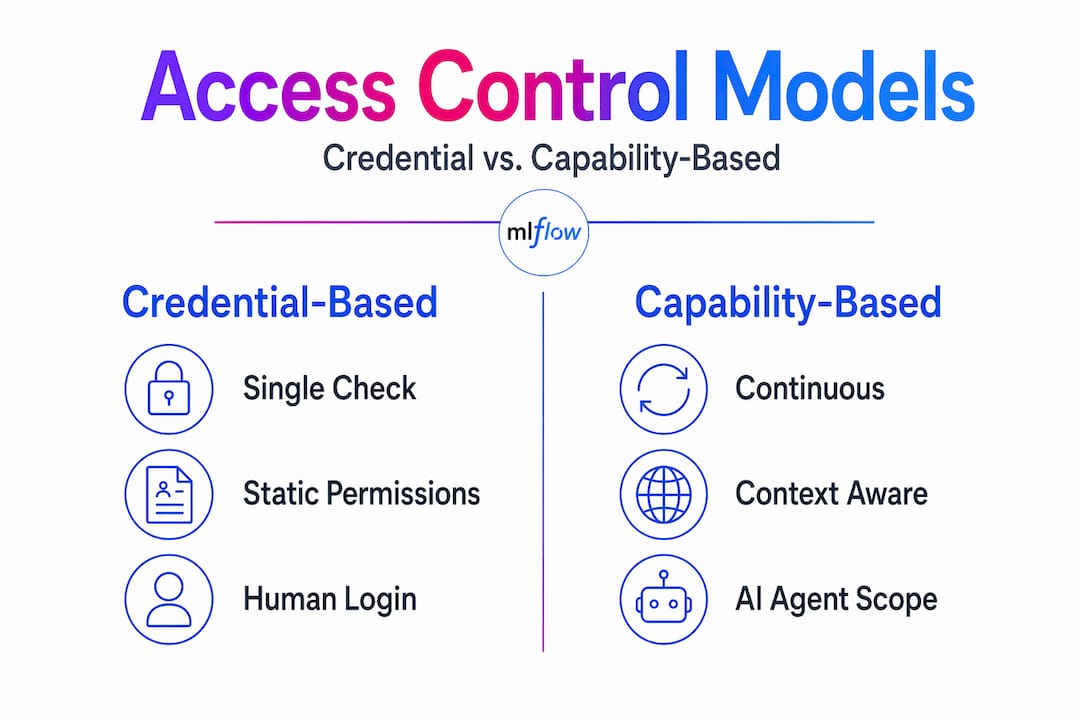
Here's how the two models compare side by side:
| Dimension | Credential-based | Capability-based |
|---|---|---|
| Core question | Does the caller have access? | Can the agent take this action now? |
| Evaluation timing | At authentication | Before every action |
| Context considered | Identity only | Identity, intent, resource, risk score |
| Handles autonomous agents? | Poorly | Yes |
| Revocation granularity | Whole credential | Specific capability in specific context |
| Prompt injection resilience | Low | High (enforcement is external) |
The critical principle here is that authorization must be enforced by deterministic system controls independent from AI model self-regulation. A model cannot be an enforcer of its own access rules. Its outputs are probabilistic. Its interpretations vary. Enforcement must happen in deterministic infrastructure outside the model.
Practical implications for your team:
- Assign each deployed agent a unique identity in your IAM system, not a shared service account
- Define capability profiles specifying which tools, data stores, and APIs each agent can access
- Attach risk levels to capabilities and require elevated justification for high-risk ones
- Use observability in AI tooling to track capability usage patterns and detect anomalies
Pro Tip: When defining capability profiles, start from zero permissions and add only what each agent's current task requires. Designing down from maximum access is how privilege creep starts.
With a clear understanding of these advanced access control concepts, let's explore how teams apply them in practice to secure AI model access.
Best practices for implementing AI model access control in enterprise environments
Knowing the theory is one thing. Shipping controls that hold up under audit and adversarial pressure is another. Here are six concrete steps your team should be executing now.
-
Centralize all model API traffic through a dedicated gateway. Every call to every model, internal or third-party, flows through one control point. This eliminates credential sprawl, ensures uniform logging, and gives you a single place to update policy without touching individual agents. Review AI gateway solutions for how this pattern is implemented at scale.
-
Deploy a runtime policy engine that evaluates context on every tool invocation. Your policy engine needs access to agent identity, target resource metadata, current user context, and a risk classification for the operation. Evaluations must complete in milliseconds to avoid unacceptable latency in your agent workflows.
-
Treat every AI agent as a distinct IAM entity. Create dedicated service identities for each agent with descriptive names, defined capability profiles, and ownership metadata. Shared service accounts for multiple agents are an audit failure waiting to happen.
-
Automate API key rotation at or before the 90-day mark. Effective AI access controls include least privilege scoping, API key rotation, mandatory audit trails, and human approval gates for sensitive actions. Automate this rotation in your CI/CD pipeline so it never relies on human memory.
-
Log every prompt, completion, and access decision with tamper-evident storage. Your audit trail must include what was requested, what policy decision was made, what the model returned, and which user or agent initiated the chain. Store these logs in a system your agents cannot write to directly.
-
Implement human approval workflows for high-risk or irreversible actions. Any agent action that deletes data, transfers funds, modifies production configuration, or sends external communications should require human sign-off. Automate the detection of these action types in your pre-execution hook.
Common pitfalls to avoid:
- Relying on the model's own refusal behavior as a security control
- Using the same API key across multiple agents or environments
- Logging only completions without the originating prompt and agent identity
- Building access control logic inside the agent's prompt rather than in infrastructure
Pro Tip: Use AI observability tooling from day one, not as a retrofit. Teams that add logging after deployment consistently find gaps in their coverage that require architectural changes to fix. Building it in early is dramatically cheaper.
Having covered practical steps, let's share a perspective often overlooked in AI access control discussions.
Why treating AI models as independent policy subjects is essential for real security
Here's something we see organizations get wrong repeatedly: they add access controls around AI models while still assuming the model itself is a trustworthy policy actor. It isn't, and that assumption creates real vulnerabilities.
Authorization must be enforced by deterministic system controls at trust boundaries independent of the model's interpretation. This isn't just a technical recommendation. It reflects a fundamental property of language models. They are probabilistic text generators. Asking them to self-enforce access rules is like writing your security policy in a document and trusting that anyone who reads it will comply. Prompt injection attacks exploit exactly this gap. An adversarial payload in a retrieved document can instruct your agent to ignore its access restrictions, and the model may comply because it cannot distinguish between policy instructions and adversarial ones.
The stronger framing is to treat AI models the same way you treat user-space processes in an operating system. A process doesn't decide what system calls it's allowed to make. The kernel decides. The model doesn't decide what tools it can call. The policy engine decides. AI policy enforcement diverges from traditional models by requiring real-time, context-aware control outside the model. That external determinism is what makes the control real.
This also means that securing AI access isn't just a policy tweak you apply to your existing IAM setup. It requires architectural decisions: where enforcement points live, how agent identities propagate through your stack, how context signals are captured and passed to the PDP. Teams that treat AI access control as a checkbox on their existing security program consistently underestimate the scope of what needs to change. Explore how AI gateway role thinking reframes enforcement architecture to understand the depth of the shift required.
Strengthen AI model access control with MLflow's integrated platform
If you're building the access control architecture described in this article, you need a platform that was designed for this environment from the start, not one that retrofitted AI governance onto a traditional ML tool.
MLflow's enterprise platform gives your team the integrated tooling to make this work in production. The AI gateway solutions centralize all model API traffic through a single control point, eliminating credential sprawl and providing uniform policy enforcement across every model your agents call. Deep tracing through AI observability gives you the full audit trail auditors require, capturing prompt, completion, agent identity, and policy decision in every trace. And the agent and LLM engineering capabilities let your teams build, evaluate, and govern agents with governance baked into the workflow rather than bolted on afterward.
Frequently asked questions
What makes AI model access control different from traditional access control?
AI model access control requires continuous runtime authorization evaluating context like user role and data sensitivity, unlike traditional static login-based controls that authenticate once and assign fixed permissions.
How often should API keys for AI models be rotated?
Best practice, and SOC 2 audit expectation, is to rotate API keys every 90 days or less. Automate this rotation to remove the risk of human error in scheduling.
What is the role of AI gateways in access control?
AI gateways centralize all model traffic to provide unified logging, consistent policy enforcement, and centralized credential management, preventing the governance drift that occurs when individual teams manage their own model credentials.
Why can't AI models self-regulate access control?
Because authorization must be enforced independently of the model's interpretation. Language models are probabilistic and can be manipulated via prompt injection, making them unreliable as enforcers of their own access policies.
What governance frameworks support AI model access control?
The NIST AI RMF organizes AI risk governance into Govern, Map, Measure, and Manage functions, providing a structured foundation for implementing access controls across the full AI system lifecycle.