Model Deployment Pipelines: The Backbone of Reliable MLOps

A model deployment pipeline is the automated system that moves a validated model from training into production, controls how traffic reaches it, and feeds live performance data back into retraining. It exists because a model sitting in a notebook helps no one, and a model pushed to production by hand is a liability waiting to surface. The pipeline is the control point for everything that makes ML reliable at scale: safe releases, reproducible versioning, and continuous quality enforcement.
Three roles define what a deployment pipeline actually does for you:
- Safe release and traffic control — routing requests through canary, blue-green, or shadow rollouts so a bad model never reaches every user at once.
- Reproducible versioning and rollback — tracking every model artifact through a model registry so you can instantly revert a broken release.
- Continuous quality and closed-loop retraining — detecting drift in production and triggering retraining before accuracy quietly decays.
Google Cloud's own MLOps guidance frames this well: pipelines that include automated data and model validation enable continuous training and continuous delivery, not just continuous integration. That distinction, CI/CD versus CI/CD/CT, is the whole story of why ML deployment looks different from standard software CI/CD.
Key Takeaways
A model deployment pipeline works because it closes the loop between production monitoring and automated retraining, turning model decay into a solvable, repeatable process instead of a recurring emergency.
| Point | Details |
|---|---|
| Pipelines beat manual deployment | Automated gates, registries, and rollout controls catch problems before they reach every user. |
| Drift is the top failure mode | Feature and data drift, not code bugs, cause most silent production model decay. |
| Rollout strategy depends on risk | Use blue-green for high-stakes cutovers, canary for gradual exposure, shadow when ground truth is delayed. |
| Start with a walking skeleton | Prove the deploy and rollback path first, then add validation, canaries, and retraining triggers. |
| Mlflow covers registry and observability | Its model registry and AI observability tooling support versioning, rollback, and drift monitoring directly. |
Table of Contents
- What Is the Role of Model Deployment Pipelines in Production ML?
- Which Deployment Type and Rollout Strategy Should You Use?
- What Are the Core Stages of a Deployment Pipeline?
- What Validation and Quality Gates Should Run Before Deployment?
- How Do You Monitor Production Models and Close the Retraining Loop?
- Which Serving Infrastructure Fits Your Deployment Needs?
- What Governance and Reproducibility Controls Do You Need?
- How Do You Start Building a Deployment Pipeline?
- Why Deployment Pipelines Are the Real Bottleneck in ML Reliability
- How Mlflow Supports Every Stage of Your Deployment Pipeline
- Frequently Asked Questions
- Sources
What Is the Role of Model Deployment Pipelines in Production ML?
A model deployment pipeline is an automated, repeatable workflow that packages a trained model, validates it against quality gates, and promotes it through staging into production while keeping every version traceable and reversible. That's the definition. What makes it different from a normal software pipeline is what it has to track along the way.
Picture the lifecycle as a chain: data flows in, gets versioned, trains a model, the model lands in a registry, moves to staging for validation, gets served in production, gets monitored continuously, and if performance degrades, the cycle loops back to retraining. A traditional CI/CD pipeline stops caring once code passes tests and ships. A model deployment pipeline never really stops caring, because the model's accuracy depends on the world staying similar to the data it trained on. When the world shifts, the pipeline needs to notice.
Software CI/CD tests code logic: does the function return the right value, does the build compile, does the integration test pass. A model deployment pipeline has to test all of that plus the data feeding the model, the statistical behavior of the model's outputs, and whether the feature pipeline that generated training data still matches the one generating live predictions. BMC's engineering documentation describes the four core stages of any deployment pipeline as source, build, test, and deploy. ML pipelines keep all four, but "test" balloons to include:
- Schema validation on incoming data (are the right columns and types present?)
- Statistical drift checks (has the feature distribution shifted since training?)
- Model performance checks against a held-out or shadow dataset
- Fairness and bias checks where the use case demands them
This is where model registries, artifact repositories, and experiment tracking earn their place. The registry is the handoff point between the team that trained the model and the system that serves it. Snowflake's breakdown of model deployment lays out the sequence clearly: package, register, stage and validate, approve, deploy, route traffic, monitor, then rollback or promote. Skip the registry step and you lose the audit trail that tells you which model version is actually serving traffic right now, which is a question that becomes urgent fast the moment something breaks at 2 a.m.
One statistic worth sitting with: practitioners consistently point to data drift as the leading cause of production model failure, not bugs in the serving code. That single fact is why "deployment" for ML can't just mean "ship it and walk away."
Which Deployment Type and Rollout Strategy Should You Use?
Four runtime types and four rollout patterns cover almost every production ML scenario: batch, real-time, serverless/async, and edge for runtime; blue-green, canary, shadow, and A/B for how you introduce a new model version safely. Picking the wrong combination is usually what turns a routine model update into an incident.
Runtime types, briefly:
- Batch — predictions run on a schedule against stored data (nightly churn scoring, weekly demand forecasts).
- Real-time — a live endpoint responds to individual requests within milliseconds (fraud checks, recommendation serving).
- Serverless/async — event-triggered inference that scales to zero when idle, useful for spiky or unpredictable traffic.
- Edge — the model runs on-device or on local hardware, for cases where latency or connectivity rules out a round trip to a server.
Rollout patterns determine how a new model version actually reaches users:
- Blue-green: two full production environments run side by side; you cut traffic over all at once once the new version is verified. Choose this when you need instant rollback and can afford duplicate infrastructure. A payment-fraud model update is a good fit, since you want zero ambiguity about which version is live.
- Canary: a small percentage of traffic a small percentage of traffic hits the new model while the rest stays on the current version, and you expand gradually as metrics hold up. This suits high-traffic consumer apps where you want real user signal before full commitment, like a recommendation engine update on an e-commerce site.
- Shadow: the new model receives a copy of live traffic and generates predictions that are logged but never shown to users. This works well when you need to compare model behavior against the incumbent without any user-facing risk, such as testing a new credit-scoring model against years of regulatory scrutiny before it touches a single real decision.
- A/B testing: two model versions are compared on a business metric, not just technical performance. Use this when the question isn't "does it work" but "does it work better", like testing two ranking models against click-through rate.
PagerDuty's research on deployment pipelines confirms this pattern: teams choose canary or blue-green largely based on risk tolerance, cost, and whether duplicate environments are practical to maintain.
Decide based on three questions: How much does a bad prediction cost you? How fast do you need to detect a problem? How often are you shipping new versions? High-stakes, low-frequency updates lean blue-green or shadow. High-frequency, lower-stakes updates lean canary.
Pro Tip: Reach for shadow deployment over canary when ground truth is delayed, like credit default or long-cycle churn models. Canary needs fast feedback to be useful; if you won't know whether a prediction was right for 90 days, shadow lets you compare outputs against the incumbent model without waiting on real-world outcomes to judge quality.
What Are the Core Stages of a Deployment Pipeline?
Six stages make up a working deployment pipeline: data versioning, training and experiment tracking, CI/CD for pipeline code, packaging, model registry and staging, and production serving with observability. Miss one and you've built a pipeline with a blind spot.
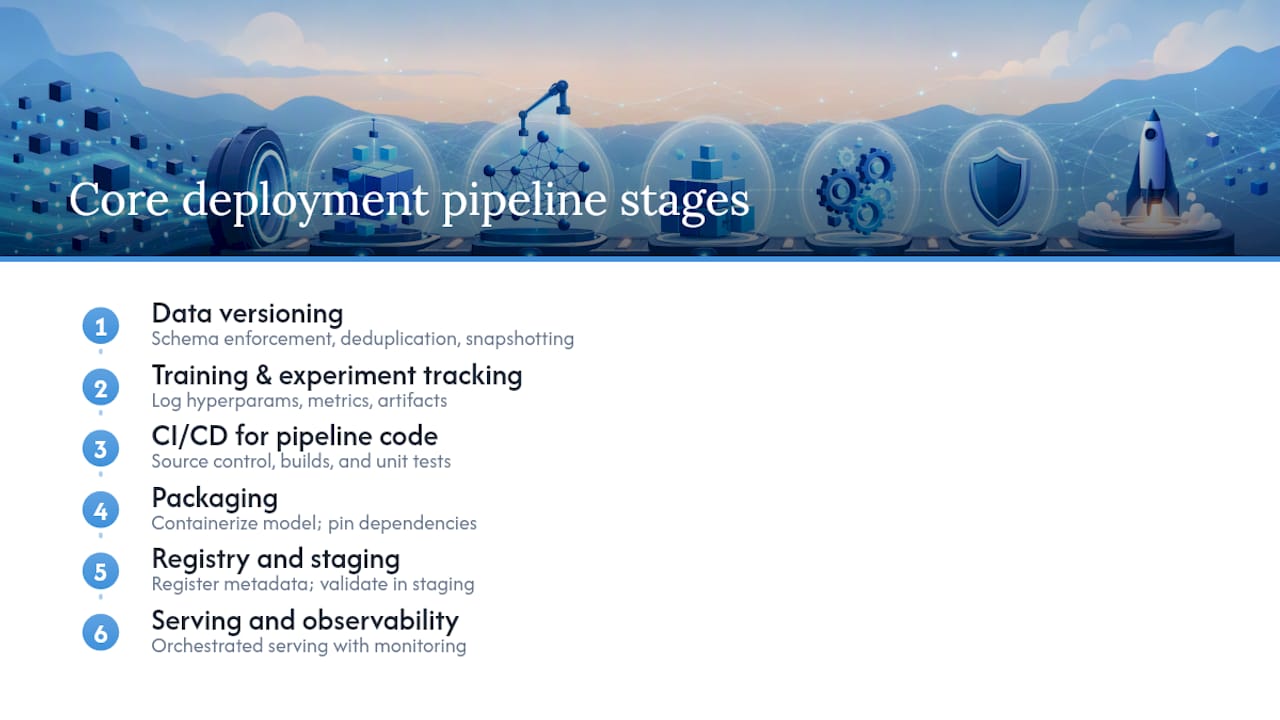
1. Data ingestion and versioning. Every dataset that trains a model should be versioned the same way code is. Responsibilities here include schema enforcement, deduplication, and snapshotting so you can reproduce the exact training set behind any model version. Tools in this category range from data version control systems to feature stores. The artifact produced is a versioned dataset with a hash or tag you can reference forever.
2. Training and experiment tracking. This stage runs the training job and records every hyperparameter, metric, and artifact that comes out of it. The check that matters most: does the new model beat the current baseline on a held-out set by a meaningful margin, not just a rounding error? Experiment tracking tools log this automatically so nobody has to reconstruct "which run produced this model" from memory.
3. CI/CD for pipeline code. The pipeline's own code, feature transformations, preprocessing scripts, serving logic, needs the same source control, build, and test discipline as any software project. Unit tests here check that transformations produce expected outputs on known inputs, catching silent bugs before they poison a training run.
4. Packaging. The trained model gets wrapped into a deployable artifact, typically a container image, with its dependencies pinned. This is where Anaconda's guide to AI model deployment makes an important point: packaging alone isn't deployment. The artifact still needs orchestration, an API layer, and monitoring hooks before it's production-ready.
5. Registry and staging. The packaged model registers with metadata (training data version, metrics, approver) and moves to a staging environment for validation against production-like traffic. This is the gate that separates "trained" from "trusted."
6. Serving and observability. The model goes live behind an orchestrated serving layer with monitoring wired in from day one, not bolted on after an incident.
Tool categories that support these stages, described generically rather than by vendor: source control systems, CI runners, container registries, model registries, workflow orchestrators, and monitoring/observability platforms. The specific tools matter less than making sure every stage has one.
Treat datasets and model artifacts as first-class citizens alongside code. A mature pipeline versions data, features, and models with the same rigor as source code, because an unreproducible rollback (you can revert the code but not the exact model that was serving) is an audit gap waiting to become a production incident.
What Validation and Quality Gates Should Run Before Deployment?
Every production pipeline needs four categories of automated gates before a model ships: data validation, unit tests, model performance and fairness checks, and integration or load tests. Skip any one of these and you're deploying on faith.
A practical checklist to automate:
- Schema validation: incoming data matches expected column names, types, and ranges.
- Statistical checks: feature distributions fall within acceptable bounds of the training distribution (a threshold like population stability index under a set value).
- Unit tests: transformation and preprocessing code produces expected outputs on fixed test inputs.
- Model performance tests: accuracy, precision, recall, or business-relevant metrics meet or exceed a defined threshold against a held-out set.
- Fairness and bias checks: performance parity across relevant subgroups where the application demands it.
- Integration and load tests: the full serving stack handles expected request volume within latency targets.
The gating flow itself follows a simple, non-negotiable logic:
- Fail any gate → stop promotion immediately and notify the owning team; nothing proceeds silently.
- Pass all gates → promote to staging or canary with a limited traffic percentage.
- Canary metrics hold steady → promote to full production traffic.
- Canary metrics degrade → automatic rollback to the previous version, no manual intervention required.
BMC's engineering team frames this as the core value of CI/CD discipline applied to deployment: automated gates make releases faster and lower-risk, because humans stop being the bottleneck for catching regressions.
For a latency-sensitive real-time model, a gating policy might require p99 latency under a fixed millisecond threshold at expected peak load, zero increase in error rate over the incumbent version during a 30-minute canary window, and no drop in prediction confidence distribution beyond a defined tolerance. Fail any one, and the rollout halts automatically.
How Do You Monitor Production Models and Close the Retraining Loop?
Effective pipelines link monitoring metrics directly to automated retraining triggers, because a model that isn't watched will drift into irrelevance without anyone noticing until the business impact shows up in a quarterly report. Monitoring isn't a dashboard you check when something feels off. It's the sensor system that keeps the whole pipeline honest.
Metrics worth tracking fall into two buckets, technical and model-specific:
| Metric category | Why it matters | Suggested alert logic |
|---|---|---|
| Latency and throughput | A slow model degrades user experience even if predictions are accurate | Alert on sustained p95/p99 increases over a rolling window |
| Error rate | Signals infrastructure or serving failures separate from model quality | Alert on error rate spikes above baseline |
| Prediction distribution | Sudden shifts often precede accuracy problems | Alert when output distribution deviates from a trailing baseline |
| Feature drift | Live input data diverging from training data is the top cause of silent decay | Alert on sustained divergence across multiple windows, not a single spike |
| Accuracy or label-based metrics | The ground-truth check on whether the model is still right | Alert when delayed labels show a sustained accuracy drop |
| Business KPIs | Technical health doesn't guarantee business value | Track alongside model metrics, not as a replacement for them |
Pro Tip: Noisy retrain triggers are the fastest way to burn trust in an automated pipeline. Require sustained deviation across multiple time windows, not a single spike, before firing a retrain job, and tie the trigger to actual ground-truth sampling wherever possible rather than proxy signals alone. A pipeline that retrains on every blip trains your team to ignore its alerts.
A worked example of the closed loop: drift detection flags that a feature's distribution has diverged from the training baseline for three consecutive monitoring windows. That trigger kicks off an offline retraining job using the most recent labeled data. The retrained model runs through the same validation gates as any new model, no shortcuts because it was triggered automatically. It lands in staging, then a canary rollout at limited traffic, and only gets promoted to full production once canary metrics confirm it performs at least as well as the model it's replacing.
This is precisely the mechanism Google Cloud's MLOps documentation describes as the higher levels of pipeline maturity: automated retraining tied to validated data and model checks, not a human deciding ad hoc that "the model feels stale."
Which Serving Infrastructure Fits Your Deployment Needs?
Choose your serving infrastructure based on latency requirements, scalability needs, and governance constraints, not on what's trendy. Kubernetes, serverless endpoints, managed platforms, and edge deployment each solve a different problem.
- Kubernetes and containers: full control over scaling, networking, and multi-model resource isolation, at the cost of real operational overhead. Fits teams running many models with varied resource profiles who need fine-grained rollout control (canary and blue-green map naturally onto Kubernetes traffic-splitting primitives).
- Serverless endpoints: scale to zero, near-instant provisioning, minimal ops burden. Fits spiky or low-volume workloads where paying for idle compute doesn't make sense, though cold-start latency can be a problem for strict real-time use cases.
- Edge deployment: model runs where the data is generated. Fits scenarios where network round-trip time is unacceptable or connectivity isn't guaranteed, at the cost of harder version management across many devices.
Whatever you pick, the orchestrator has to handle scheduling, autoscaling, health checks, rolling updates, and resource isolation so one misbehaving model doesn't starve the others on a shared cluster. Anaconda's deployment guide is direct about this: packaging a model is the easy part, orchestration and monitoring at scale is where most teams underestimate the work.
Before any of this goes live, load test the prediction service against expected queries-per-second and confirm memory and compute match production, not a laptop. A model that scores perfectly offline and then times out under real traffic has failed just as completely as one with bad accuracy.
What Governance and Reproducibility Controls Do You Need?
Three imperatives cover governance in any regulated or high-risk ML environment: access control and secrets management, lineage and audit trails, and compliance documentation. Skipping these doesn't just create risk, it makes incident response nearly impossible.
- Model registry metadata and approvals — every promoted model records who approved it, what data trained it, and what metrics it passed.
- Signed artifacts in artifact repositories, so a deployed container can be verified against tampering.
- Role-based access control limiting who can promote a model to production or trigger a rollback.
- Audit logs for every promote, rollback, and configuration change, timestamped and attributable to a person or automated process.
- Reproducible build images that pin every dependency, so a model deployed six months ago can be rebuilt exactly if you need to investigate an incident.
The model registry is what makes rollback and auditability practical rather than theoretical. Without it, "what was serving in production last Tuesday" is a question you answer by grepping logs and hoping. With it, it's a single query.
How Do You Start Building a Deployment Pipeline?
Start small with a walking-skeleton pipeline, then iterate. Trying to automate data validation, canary rollouts, drift detection, and retraining all in the first sprint is the most common reason deployment automation projects stall out before they ship anything.
A practical sequence:
- Establish a model registry as the single source of truth for model versions and metadata.
- Containerize a golden artifact — take one known-good model and wrap it in a reproducible container image.
- Automate the deploy path end-to-end for that single artifact, even with a placeholder model, to prove infrastructure, access controls, and rollback actually work.
- Add automated data validation as the first real quality gate.
- Add a canary rollout so new versions get limited exposure before full traffic.
- Add monitoring and a retrain trigger, closing the loop last, once everything upstream is stable.
A high-level CI/CD flow you can adapt:
on push to model-training branch:
  stage: validate_data
    run schema and drift checks against reference dataset
  stage: train
    run training job, log metrics and artifacts
  stage: test
    run unit tests + model performance gate
  stage: package
    build container image, tag with model version
  stage: register
    push artifact and metadata to model registry
  stage: deploy_canary
    route [5%](https://shattered.io/cloudflare-workers-setup-guide/) traffic to new version
  stage: evaluate_canary
    compare metrics against baseline over fixed window
  stage: promote_or_rollback
    if metrics pass: shift to 100% traffic
    if metrics fail: rollback automatically, notify team
Pro Tip: The minimal automation to start with is the deploy and rollback path, not the fanciest validation logic. A walking-skeleton pipeline that can reliably deploy and revert a dummy model proves your infrastructure and access controls work before you layer in drift detection or automated retraining, which are much harder to debug if the underlying deploy mechanism itself is shaky.
Why Deployment Pipelines Are the Real Bottleneck in ML Reliability
The uncomfortable truth about most ML reliability problems is that they get blamed on the model when the actual failure is upstream in the pipeline that shipped it. Teams that treat deployment as an afterthought, something you figure out after the model works in a notebook, consistently see the same outcomes: silent drift, unreproducible rollbacks, and incidents nobody can explain because there's no audit trail connecting a production prediction back to the exact model version and data that produced it.
The caution worth repeating: don't try to automate everything at once. A team that spends three months building a perfect retraining trigger before it has a working canary rollout has built the wrong thing first. Start with the walking skeleton, prove the deploy and rollback path, then layer in validation and drift detection.
This is exactly where capabilities like MLflow's model registry and observability tooling earn their keep, giving teams a reproducible source of truth for versions and a way to trace model behavior in production without building that infrastructure from scratch.
How Mlflow Supports Every Stage of Your Deployment Pipeline
Mlflow gives you a working answer to nearly every responsibility covered above without forcing you to stitch together a registry, an evaluation framework, and a monitoring system from separate vendors.
The mapping is direct:
- Model registry and rollback → Mlflow's model registry tracks every version, its metadata, and approval status, so promoting or reverting a model is a controlled action, not a scramble.
- Observability and drift signals → Mlflow's AI observability tooling traces model and agent behavior in production, including the reasoning steps behind agentic predictions, giving you the signal you need to catch degradation before users do.
- Automated evaluation for closed-loop quality gates → Mlflow's LLM-as-a-Judge framework automates the kind of acceptance testing that used to require manual review, particularly for GenAI and agent workflows where traditional accuracy metrics fall short.
- GenAI and agent deployment → for teams moving beyond classical ML into agent and LLM engineering, Mlflow standardizes the serving and evaluation patterns that agentic systems need.
If you're building or hardening a deployment pipeline right now, the fastest path forward is to set up a registry for your current models and wire in observability before your next release. Start at Mlflow to see how the open-source platform fits into the pipeline stages you've just read about.
Frequently Asked Questions
What is the main role of a model deployment pipeline? Its main role is moving a validated model into production reliably, controlling how traffic reaches it, and feeding live performance data back into retraining so accuracy doesn't silently decay.
How does a model deployment pipeline differ from regular CI/CD? Regular CI/CD tests code logic and stops once a build passes. A model deployment pipeline also validates data schemas, checks for statistical drift, and often triggers retraining automatically when production data shifts.
What's the difference between canary and shadow deployment? Canary sends a small percentage of live traffic to the new model and users see its predictions. Shadow sends a copy of live traffic to the new model, but its predictions are logged for comparison, never shown to users.
How often should a production model be retrained? There's no fixed schedule that works universally. The better approach is triggering retraining based on sustained drift signals across multiple monitoring windows, rather than a calendar-based schedule that ignores actual model behavior.
What tools support automating model deployment? Automating model deployment typically involves a model registry for versioning, a CI/CD system for pipeline code, container orchestration for serving, and an observability layer for monitoring drift and performance in production.
Sources
- MLOps: Continuous delivery and automation pipelines in machine learning | Cloud Architecture Center | Google Cloud Documentation
- What Is Model Deployment in Machine Learning? | Snowflake
- MLOps Pipeline Explained: The Assembly Line Nobody Shows You in the Tutorials
- AI Model Deployment: The Ultimate Guide | Anaconda
- Deployment Pipeline: CI/CD in Software Engineering – BMC Software | Blogs