What Is AI Policy Enforcement: A 2026 Compliance Guide

AI policy enforcement is the process of converting an organization's AI governance rules into real-time, automated controls that monitor and regulate AI system usage to ensure compliance, security, and ethical operation. The industry term for this practice is "AI governance enforcement," though "AI policy enforcement" accurately describes the operational function. Projected data shows that 80% of unauthorized AI transactions in 2026 will result from internal policy violations, not external attacks. That figure reframes the threat model entirely: your biggest compliance risk sits inside your own organization. Frameworks like the EU AI Act, NIST AI RMF, and ISO 42001 all require evidence of active enforcement, not just written policy.
What is AI policy enforcement and how does it work?
AI policy enforcement is the active runtime mechanism that translates an AI governance framework from a document into operational controls. It sits at the boundary between an authenticated user and an AI endpoint, making synchronous decisions before any AI model executes. Enforcement decision points operate with a fail-closed design, meaning any request that lacks context or triggers a system fault is denied automatically. No AI interaction bypasses enforcement under that model.
The core architecture relies on policy bundles. Each bundle packages identity rules, data classification rules, and route-level rules into a versioned unit. When a request arrives, the enforcement engine matches it against the active bundle and records the decision, the matched rule, and a reason code. That record becomes the audit trail regulators require.

Deterministic rules-based enforcement produces the same decision for identical inputs every time. Model-based enforcement, by contrast, can produce inconsistent outputs under the same conditions. For regulated organizations, that inconsistency breaks audit trail integrity. A deterministic rules engine is the only architecture that satisfies regulator-ready evidence requirements.
| Rule type | Runtime control example |
|---|---|
| Identity rule | Block requests from unapproved user roles |
| Data classification rule | Deny prompts containing PII or confidential data labels |
| Route-level rule | Restrict access to specific AI endpoints by department |
| Content policy rule | Flag or block outputs matching prohibited topic categories |
| Approval workflow rule | Require manager sign-off for high-risk AI tool access |
Pro Tip: Version every policy bundle with a timestamp and a change log. When a regulator asks why a specific request was denied six months ago, you need to reconstruct the exact bundle that was active at that moment.
How does AI policy enforcement ensure regulatory compliance?
The EU AI Act sets the clearest enforcement deadline in the current regulatory cycle. High-risk AI systems must comply starting august 2, 2026, with fines reaching €35 million or 7% of global annual turnover for the most serious violations. That penalty structure makes enforcement a financial risk issue, not just a legal one. Organizations without immutable audit trails face the highest exposure.
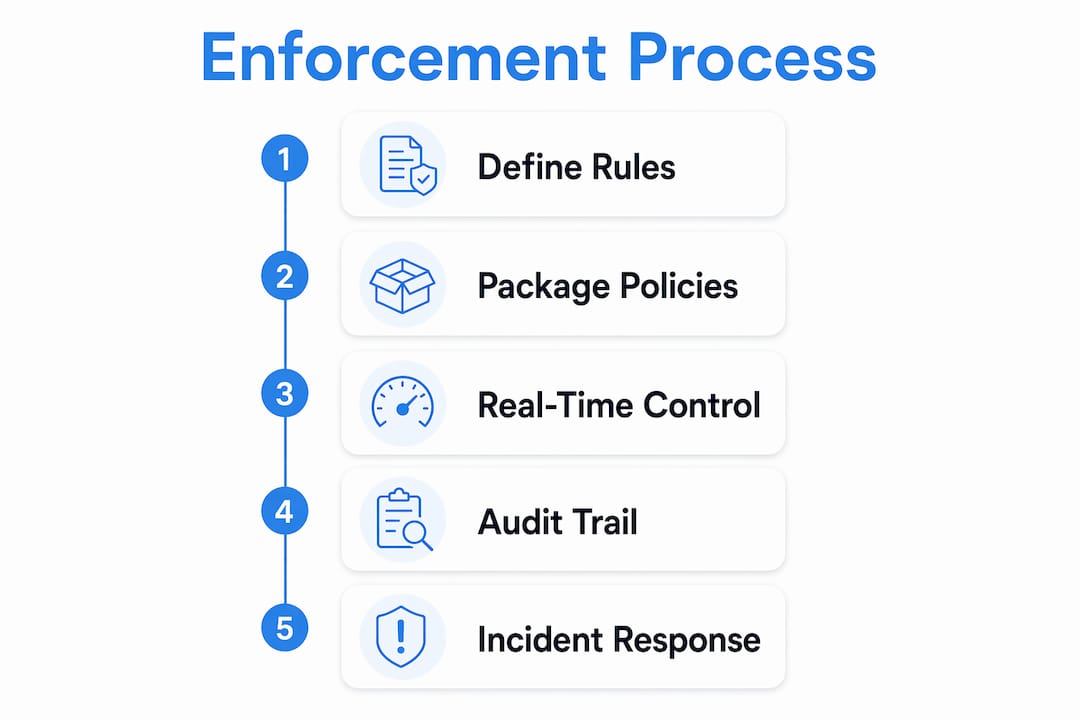
Compliance under the EU AI Act requires two technical capabilities: audit trail generation and documented incident response. Audit trails must capture every enforcement decision, the policy version active at the time, and the outcome. Incident response procedures must show how violations are detected, escalated, and resolved. Neither requirement can be met by passive monitoring alone.
Frameworks like NIST AI RMF and ISO 42001 share significant structural overlap with the EU AI Act. A "map once, comply at scale" approach unifies governance documentation across all three, reducing redundant audit workloads. Organizations that maintain separate compliance programs for each framework spend more time on documentation than on actual enforcement improvement.
| Regulation | Key deadline | Enforcement requirement | Maximum penalty |
|---|---|---|---|
| EU AI Act (high-risk) | August 2, 2026 | Immutable audit trails, incident response | €35 million or 7% of turnover |
| NIST AI RMF | Ongoing | Risk documentation, governance mapping | No direct fine; contract and procurement risk |
| ISO 42001 | Certification-based | Management system audit evidence | Certification loss |
Statistic callout: 80% of unauthorized AI transactions in 2026 are projected to originate from internal policy violations. That means enforcement gaps inside your organization carry more compliance risk than external threats.
The importance of auditing AI interactions extends beyond regulatory checkboxes. Audit records reveal usage patterns, identify policy gaps, and provide the evidence base for continuous governance improvement.
What best practices optimize AI policy enforcement implementation?
A phased deployment approach produces the most reliable enforcement outcomes. Shadow mode enforcement runs policy rules against live traffic without blocking requests, generating empirical data on rule impacts before any user-facing change. That data lets you tune rules safely before active cutover. Organizations that skip shadow mode often discover high false-positive rates only after blocking legitimate work.
The four phases of an enforcement lifecycle follow a clear progression:
- Discovery. Catalog all AI tools in use, map data flows, and identify enforcement points. Without a complete tool inventory, enforcement has blind spots.
- Shadow mode. Deploy enforcement logic in observe-only mode. Collect decision logs, measure false positives, and refine rule bundles before going live.
- Active cutover. Switch enforcement to blocking mode for the highest-risk categories first. Expand coverage incrementally based on audit feedback.
- Continuous refinement. Review audit logs on a regular cadence, update policy bundles as regulations change, and retire rules that no longer reflect current risk.
Cross-department ownership is non-negotiable for enforcement to work. Legal defines the compliance requirements. IT builds and maintains the enforcement infrastructure. HR owns the training and consequence framework. The board sets risk tolerance. Without clear role assignments, enforcement decisions fall into gaps between teams.
Pro Tip: Build an accessible tool registry that employees can check before adopting a new AI application. Visible, self-service governance reduces shadow AI adoption far more effectively than blanket restrictions.
Heavy-handed enforcement drives shadow AI. Lighter processes with visible accountability, such as spot checks, delegated manager accountability, and accessible approval workflows, increase compliance without reducing productivity. The goal is governance that employees work with, not around.
You can also use AI development workflow tools to update enforcement rules dynamically without requiring full policy rewrites, keeping governance current as your AI stack evolves.
Which challenges arise during AI policy enforcement, and how can you address them?
Passive monitoring is the most common enforcement failure mode. Agentic AI actions, once executed, cannot be reversed. A monitoring system that detects a data exfiltration event after the fact provides no remediation path. Inline enforcement, positioned before model execution, is the only architecture that prevents irreversible violations.
Common enforcement challenges and their solutions:
- Visibility gaps. Shadow AI tools operate outside enforcement scope. Solution: Require all AI tool procurement through a central registry with mandatory enforcement point integration before approval.
- Context-awareness failures. Enforcement engines that lack user context approve requests they should block. Solution: Include identity, role, and data classification metadata in every enforcement decision payload.
- Model-based enforcement instability. AI-driven enforcement produces inconsistent decisions. Solution: Use deterministic rules engines for all blocking decisions; reserve model-based analysis for advisory or flagging functions only.
- Policy staleness. Static policies written at deployment become outdated as regulations and AI capabilities change. Solution: Schedule quarterly policy bundle reviews tied to regulatory update cycles.
- Organizational inertia. Teams bypass enforcement when it creates friction. Solution: Involve end users in rule design during shadow mode to surface usability issues before active cutover.
- Audit trail fragmentation. Enforcement logs stored across multiple systems create reconciliation problems during audits. Solution: Centralize all enforcement decision records in a single, immutable log store with version-linked bundle references.
Effective AI compliance policies cover seven core operational areas: approved tools, data classification, roles, approvals, auditing, incidents, and consequences. Enforcement architecture must map directly to each of those areas. Gaps in any one area create audit vulnerabilities that regulators will find.
Understanding how to audit AI decisions is the practical complement to enforcement design. Audit methods validate that your enforcement logic is producing the decisions your policy intends.
Key Takeaways
Effective AI policy enforcement requires deterministic runtime controls, cross-functional ownership, phased deployment, and immutable audit trails aligned to frameworks like the EU AI Act, NIST AI RMF, and ISO 42001.
| Point | Details |
|---|---|
| Enforcement is runtime, not documentation | Static policy documents do not prevent violations; inline controls at the AI endpoint do. |
| Deterministic rules engines are required | Only rules-based enforcement produces stable, regulator-ready audit trails for identical inputs. |
| Shadow mode reduces deployment risk | Running enforcement in observe-only mode before cutover prevents high false-positive rates in production. |
| Cross-functional ownership is mandatory | Legal, IT, HR, and executive teams each own distinct enforcement responsibilities that cannot overlap. |
| Regulatory deadlines are firm | The EU AI Act's high-risk AI enforcement deadline is august 2, 2026, with fines up to €35 million. |
Why enforcement is the hardest part of AI governance to get right
The organizations I see struggle most with AI governance are not the ones that lack policies. They are the ones that have excellent policy documents and almost no enforcement infrastructure. The policy says "no PII in prompts." The enforcement layer does not exist. The audit trail is empty. When a regulator asks for evidence of compliance, there is nothing to show.
Deterministic rules engines deserve more attention than they get in governance discussions. The appeal of using an AI model to enforce AI policy is obvious. It feels elegant. But model-based enforcement introduces the exact unpredictability you are trying to govern. A rules engine that produces the same decision for the same input every time is boring. It is also the only thing that holds up in a regulatory audit.
The other lesson I keep returning to is that enforcement is a living technical process, not a project with a completion date. Regulations change. AI capabilities change. Your organization's risk tolerance changes. The enforcement architecture that was adequate in january 2025 may have significant gaps by august 2026. Teams that treat enforcement as a one-time deployment will find those gaps at the worst possible moment.
Separating high-level policy from adaptable enforcement workflows is the governance design pattern that ages best. Write your policy at the principle level. Build your enforcement bundles at the operational level. Update bundles frequently without rewriting policy. That separation keeps governance current without creating document management chaos.
— Kevin
Mlflow and AI policy enforcement in production
Mlflow provides the observability and tracing infrastructure that enforcement teams need to generate audit-ready evidence at scale.

Mlflow's LLM tracing capabilities capture every step of agentic reasoning, producing the immutable decision records that regulators require under the EU AI Act and NIST AI RMF. The AI observability platform gives compliance teams runtime visibility into model behavior, enforcement decision outcomes, and policy coverage gaps. For teams running LLM-based evaluation alongside enforcement, Mlflow's LLM-as-a-Judge framework provides automated, reproducible quality checks that complement deterministic rules engines. You can also use the AI search audit tool to validate that your AI interactions generate the audit signals your governance program depends on.
FAQ
What is AI policy enforcement in simple terms?
AI policy enforcement is the process of turning written AI governance rules into automated, real-time controls that block, allow, or log AI interactions based on predefined criteria. It operates at the boundary between users and AI systems before any model executes.
How is AI policy enforcement different from AI monitoring?
Monitoring detects violations after they occur. Enforcement prevents them before execution. For agentic AI actions that cannot be reversed, inline enforcement is the only effective control.
Which regulations require AI policy enforcement?
The EU AI Act mandates enforcement for high-risk AI systems starting august 2, 2026. NIST AI RMF and ISO 42001 both require documented governance controls and audit evidence that only active enforcement can produce.
What makes an audit trail acceptable to regulators?
A regulator-ready audit trail captures the enforcement decision, the policy bundle version active at the time, the matched rule, the reason code, and the outcome. It must be immutable and reproducible for any given input.
How long does it take to implement AI policy enforcement?
Effective AI policies can be drafted in approximately 14 days after a board decision. Technical enforcement deployment timelines vary based on infrastructure complexity, but a phased approach starting with shadow mode reduces implementation risk significantly.