LLM Experiment Tracking Best Practices That Actually Scale
Six practices separate teams that can debug a production incident in minutes from teams that spend a week guessing: instrument every LLM call from day one, emit structured JSON logs alongside OpenTelemetry GenAI spans, record prompt.version and the exact model checkpoint on every run, tie each run to a git commit and its artifacts, run experiments hypothesis-first (Hypothesis → Experiment → Finding), and redact PII before anything gets written to disk. Compute cost_usd at the moment of the API call, not after a billing cycle closes.
Get these right and four things fall into place. Reproducibility stops being aspirational: anyone on the team can rerun a past experiment and get the same answer. Root-cause analysis takes minutes because a trace_id pulls the entire request path. Cost attribution becomes a query, not a spreadsheet reconciliation. And every finding is auditable back to the run, the prompt version, and the commit that produced it.
You can start proving this in under an hour. Wrap one LLM call in an OpenTelemetry GenAI span and log the output as structured JSON. Add a prompt.version field to your prompt template and start incrementing it. Write down one hypothesis before your next experiment and log the run ID that will confirm or kill it.
Key Takeaways
Reliable LLM experiment tracking works because it treats every model call as an auditable, versioned event rather than a disposable API response.
| Point | Details |
|---|---|
| Instrument before you scale | Wrap LLM calls in OpenTelemetry GenAI spans with structured JSON logs from the first endpoint you build. |
| Version prompts and models | Emit prompt.version on every trace and store checkpoints in a registry, not a shared doc. |
| Redact PII at the collector | Strip sensitive data before the write, since redaction after storage is far less reliable. |
| Require a hypothesis before a run | Use a Hypothesis → Experiment → Finding chain so no finding exists without a cited supporting run. |
| Compute cost at call time | Log cost_usd and token counts per request to enable same-day cost anomaly detection. |
| Use MLflow to wire it together | MLflow's automatic tracing, prompt versioning, and model registry implement much of this stack directly. |
Table of Contents
- What Are the Best Practices for LLM Experiment Tracking?
- What Metrics Should You Log for LLM Experiments?
- How Do You Instrument LLM Calls for Reliable Logging?
- How Do You Make LLM Experiments Reproducible?
- How Do You Structure LLM Experiments Around a Hypothesis?
- What LLM-Specific Practices Do You Need Beyond Standard ML Tracking?
- How Does Experiment Tracking Fit Into LLMOps and Observability?
- How Does MLflow Support These LLM Tracking Practices?
- What Should You Do in the Next 90 Minutes?
- How Should You Handle Human Feedback and Annotations in LLM Experiments?
- What Privacy and Compliance Rules Apply to Logging LLM Experiments?
- What's the Real Trade-off in Adopting These Practices?
- Where MLflow Fits Into Your LLM Tracking Stack
- Sources
What Are the Best Practices for LLM Experiment Tracking?
LLM experiment tracking best practices come down to treating every model call as an auditable event rather than a disposable API round trip. That means structured logging over free-text dumps, version control over "which prompt was this again," and a hypothesis before a run rather than a vibe check after one.
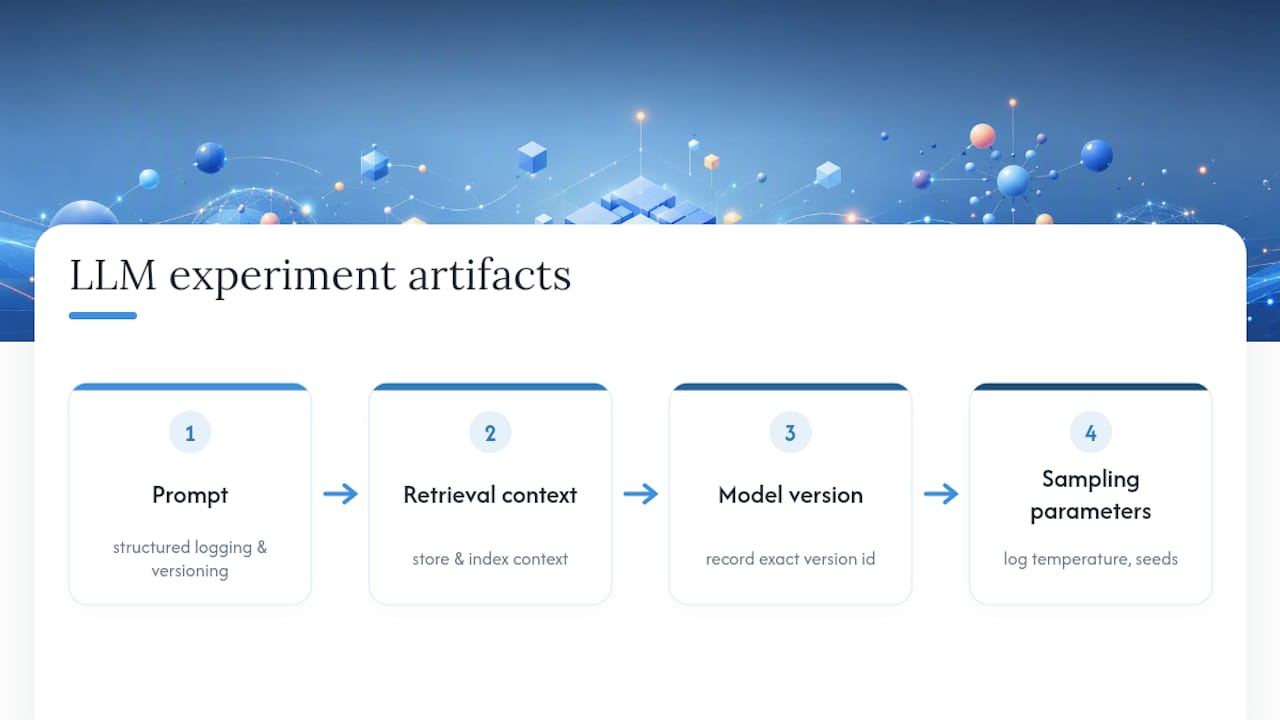
Best practices for LLM tracking differ from classical ML experiment management in one crucial way: the artifact under test isn't just a model checkpoint, it's a combination of prompt, retrieval context, model version, and sampling parameters. Miss any one of those and your "reproducible" experiment isn't. This is also where the discipline connects to LLM experiment management as a broader practice, not a one-off logging habit. You're not just tracking ML experiments the way you would a gradient-boosted tree; you're tracking a system with multiple moving parts that can each silently shift between runs.
What Metrics Should You Log for LLM Experiments?
Most teams log too little on quality and too much on noise. Get the priority order right before you build a single dashboard.
Quality metrics come first, and they need to be task-specific. Faithfulness proxies (does the output stay grounded in retrieved context) matter far more for RAG systems than raw perplexity, which tells you how "surprised" a model is by its own output but says nothing about whether that output is correct. Use perplexity only as a coarse sanity check on model behavior drift, never as your primary quality signal.
Operational metrics are non-negotiable and cheap to capture:
tokens_inandtokens_out, logged per call, not aggregated after the factcost_usd, computed at request time using the provider's per-token rate at that moment- Latency broken into time-to-first-byte, p95, and p99, not just an average
- Model and endpoint identifiers so you can slice cost and latency by version
Stability and safety signals catch the failures quality metrics miss:
- Refusal rate, tracked over time and by prompt version
- Hallucination proxies, such as claims in the output unsupported by retrieved context
- Tool-call error rate for agentic workflows
- Escalation rate to human review
Log dataset and slice metadata (source, language, difficulty tier, user segment) on every run so you can answer "does this regression only hit non-English inputs?" without rerunning anything.
Structured logging that captures typed fields instead of free text is what makes these metrics queryable and aggregateable after the fact, which is the entire point of tracking them in the first place. Pick one or two primary metrics per experiment, set a directional threshold ("faithfulness must not drop below 0.85"), and let the rest ride as secondary signals. Trying to optimize eight metrics simultaneously usually means optimizing none of them.
How Do You Instrument LLM Calls for Reliable Logging?
Instrumentation is where most teams fail quietly. The logs exist, but they're unstructured strings nobody can query at 2 AM during an incident. Here's the sequence that avoids that trap.
- Adopt OpenTelemetry GenAI semantic conventions for every span. Capture
trace_id,span_id, model name, token counts, andprompt.versionas span attributes. These conventions were built specifically to make LLM traces auditable and consistent across different providers and frameworks, so you're not reinventing a schema for every model you swap in. - Write structured JSON logs with typed fields, not narrative text. A log line should have
model,tokens_in,tokens_out,cost_usd,latency_ms, andprompt_versionas named keys, never buried in a sentence. - Redact PII at the instrumentation or collector layer, not in application code you'll forget to update. Store prompt text in span events rather than attributes so a Collector can drop or mask it centrally, keeping content separate from metadata without touching your instrumented service.
- Keep every failure and safety event, and sample by outcome once volume gets large. A nine-rule production framework recommends full retention on errors and refusals, with tail-based sampling on routine successful calls to control storage cost.
- Wire alerts to
prompt.versionand model identifiers, not just error rate. When latency or refusal rate spikes, the alert should already tell you which prompt version and model shipped the regression.
Pro Tip: Redacting PII after storage is a compliance liability waiting to happen. Redact at the collector, before the write, so a leaked backup can never expose raw user input.
How Do You Make LLM Experiments Reproducible?
Reproducibility for an LLM experiment means something stricter than "the code ran again." It means the prompt, model checkpoint, retrieval index, and sampling parameters are all frozen and retrievable months later.
- Record the git commit hash, hypothesis ID, and experiment ID on every run, and freeze the resolved configuration (not just the config template) at execution time.
- Version prompts and models in a registry, not a shared doc or Slack thread. Include
prompt.versionas a span attribute so it travels with every trace automatically. - Snapshot the environment: container digest or a frozen package list, stored alongside the run metadata rather than assumed from memory.
- Keep a DAG-like history of experiment state so you can step backward to an intermediate result instead of rerunning an entire multi-hour pipeline from scratch. Curie's Experiment Knowledge Module implements exactly this kind of time-machine record for agent-driven experiments, and its Intra-ARM validation module checks each stage as it runs rather than waiting for a final failure.
- Run a repeatability check, meaning the same run executed twice with the same frozen conditions, before you promote any finding out of exploratory status.
Pro Tip: If you can't tell someone which exact model checkpoint and prompt version produced a result from six weeks ago, you don't have an experiment tracking practice. You have a log file.
Continuous, staged validation like Curie's approach catches an error at step three instead of step thirty, which matters enormously once experiments start chaining multiple LLM calls together.
How Do You Structure LLM Experiments Around a Hypothesis?
Running an LLM experiment without a stated hypothesis is how teams end up with three contradictory Slack threads about "why the new prompt performed better," none of which cite an actual run. The fix is a Hypothesis → Experiment → Finding chain, enforced at write time rather than left to discipline.
- Write the hypothesis before touching the run button. State what you expect and why, and tag the experiment as pre-registered or exploratory so nobody later mistakes a fishing expedition for a confirmed result.
- Declare your conditions and stopping criteria up front. Decide how many samples you need and when you'll stop collecting data, then freeze those resolved conditions at run time so nobody can quietly change the sample size mid-experiment to chase significance.
- Record variables, seeds, and sample size in the run metadata itself, not in a separate spreadsheet that drifts out of sync within a week.
- Enforce citation integrity: every finding must cite the run IDs that support it. Frameworks like agentic-experiments (
aexp) implement this literally, blocking a write that would create an orphaned finding with no run behind it, which is a stronger guarantee than a wiki page nobody audits. - For multi-job campaigns, use a queueing and runner pattern that materializes each job with its own frozen conditions, so a batch of a hundred variant tests produces a hundred independently reproducible runs, not one shared, contaminated state.
This is the difference between "we think prompt B is better" and "run exp-0447 under hypothesis hyp-0031 shows a 4-point faithfulness gain, confirmed across three seeds."
What LLM-Specific Practices Do You Need Beyond Standard ML Tracking?
Classical ML experiment tracking never had to deal with a prompt silently changing behavior or a retrieval index drifting under a static model. LLM systems force a few practices that don't have a clean analog in traditional ML.
- Version every system and user prompt in your version control system, and emit
prompt.versionon every single trace, no exceptions, even for "quick" manual test calls. - Compute token counts and
cost_usdat call time, and tag each record with afeaturelabel so cost attribution rolls up by product surface, not just by model. Computing cost at request time instead of reconstructing it from a monthly invoice is what makes same-day cost anomaly detection possible. - Log retrieved document IDs and relevance scores for any RAG system. Without this, a hallucination investigation has no way to tell whether the model invented a claim or the retriever handed it bad context in the first place, which collapses root-cause analysis time from hours to minutes when it's present.
- Route safety events (refusals, jailbreak attempts, policy violations) into a dedicated stream with longer retention and tighter access control than routine operational logs.
- Sample production traffic continuously for quality signals, and feed the results from human or automated graders back into a golden evaluation set so your quality bar improves instead of stagnating on a dataset frozen at launch.
How Does Experiment Tracking Fit Into LLMOps and Observability?
Experiment tracking data is only useful if it flows into the systems your team actually watches during an incident, not a separate archive nobody opens until a postmortem.
- Emit one trace per request, correlated end to end across prompt assembly, retrieval, tool calls, and final response, so a single
trace_idreconstructs the whole story. - Build dashboards around cost and latency sliced by model,
prompt.version, and feature, alongside a faithfulness trendline and a tool-call error rate panel. Aggregate averages hide the regression that only hits one prompt version. - Alert on silent degradation and cost anomalies tied to specific versions, not just global thresholds, so a bad prompt rollout to 5% of traffic doesn't hide inside a healthy overall average.
- Set a tiered retention policy: full retention for failures and safety events, shorter retention for routine successful calls once you've mined them for aggregate metrics.
- Run incidents through a fixed playbook: take the
trace_id, pull the full trace, then replay the exact request in staging using the same model andprompt.versionthat produced the failure.
How Does MLflow Support These LLM Tracking Practices?
None of this requires building an in-house observability stack from scratch. MLflow implements several of these practices directly, which is worth knowing before you reinvent them.
- Automatic LLM tracing records inputs, outputs, token counts, and latency for each call without manual span instrumentation in your application code.
- Prompt versioning lets you log
prompt.versionagainst a run so you can trace a quality regression back to the exact prompt text that shipped it. - A model registry understands fine-tuned checkpoints and supports promotion from Staging to Production, giving you the artifact versioning that reproducibility depends on.
- Run metadata and artifacts capture the git commit, environment, and resolved configuration alongside the trace itself, closing the gap between "we ran an experiment" and "we can rerun it."
This wiring pattern in practice looks like MLflow traces feeding an OpenTelemetry collector for cross-service correlation, with structured JSON logs as the durable audit trail underneath. Independent frameworks make the same case from a research angle: MLflow's native LLM tracing and registry support map directly onto the run metadata and checkpoint-promotion patterns that reproducible LLM tracking requires.
Hypothesis-first harnesses that enforce a Hypothesis → Experiment → Finding chain at write time produce stronger provenance than any policy document, because the system itself refuses to let a finding exist without a run behind it.
That's the standard MLflow's run tracking and registry are built to support: not just storing results, but making it structurally hard to lose the thread between a claim and the evidence for it.
What Should You Do in the Next 90 Minutes?
You don't need a six-week rollout plan to start. Here's a sequence that gets real tracking coverage on one endpoint before lunch.
- Instrument one endpoint end to end. Add OpenTelemetry GenAI spans and a structured JSON log capturing
trace_id,tokens_in,tokens_out,model, andprompt.versionfor every call that endpoint makes. - Attach provenance to every run. Record the git commit hash and a experiment ID in the run metadata, and snapshot the resolved configuration, not the template, at execution time.
- Redact before you store. Implement PII redaction in the collector layer, and set your sampling policy to keep 100% of failures while sampling routine successes.
- Run one real hypothesis-first experiment. Pre-register a single hypothesis, execute the run, and write the finding with the supporting run ID cited directly. No orphaned conclusions.
Do these four things on one endpoint and you have a working template. Everything after that is copying the pattern to the next feature.
How Should You Handle Human Feedback and Annotations in LLM Experiments?
Human feedback is a first-class experiment signal, not an afterthought bolted onto a dashboard. Treat annotator judgments the same way you treat model outputs: versioned, attributed, and tied to a specific run.
Log each annotation with the annotator ID (or a pseudonymous equivalent), the rubric version they used, the timestamp, and the specific model output they scored. Rubrics change over time as teams learn what "good" means for their use case, and an annotation without a rubric version attached becomes unusable the moment the rubric shifts.

Feed high-agreement human labels into your golden evaluation set, and route low-agreement or contested labels into a review queue rather than averaging them away. Disagreement between annotators is itself a signal that a task is ambiguous or a rubric needs revision, not noise to be smoothed over.
For scale, blend human review with automated grading. Route a sampled percentage of production traffic through human annotation continuously, and use LLM-as-a-judge scoring for the volume no human team could cover. Track agreement between the two so you catch drift in the automated judge before it silently corrupts your golden set. Store both signals with the same run and trace metadata as every other experiment output, so a quality regression traces back to a specific prompt version and model checkpoint, not just a vague "the judges disagreed this week."
What Privacy and Compliance Rules Apply to Logging LLM Experiments?
LLM logs are one of the easiest places in a stack to accidentally create a compliance incident, because prompt inputs and outputs routinely contain names, emails, health details, or financial information typed by a user who never expected it to sit in a log warehouse for a year.
Redact PII before the write happens, not after. Once sensitive data lands in storage, it propagates into backups, into downstream analytics pipelines, and into any team member's local debugging session, and redaction after storage is far less reliable than catching it at the instrumentation or collector layer. Store prompt text in span events specifically so a Collector can drop or mask it centrally without touching application code.
Set retention limits deliberately. Safety events and failures often need longer retention for audit purposes, but routine successful call logs don't need to live forever once you've extracted the aggregate metrics from them. Restrict access to raw logs containing any unredacted context to the smallest team that needs it, and separate that access tier from your general observability dashboards.
If your organization operates under GDPR, HIPAA, or sector-specific rules, treat prompt and response logs as regulated data by default until proven otherwise, not the other way around. That default catches the accidental PII you didn't anticipate a user would type into a chat box.
What's the Real Trade-off in Adopting These Practices?
The honest tension here is storage cost against debuggability, and sampling complexity against signal retention. Full-fidelity tracing for every call gets expensive fast, and tail-based sampling that's too aggressive can quietly delete the exact failure case you needed six weeks from now.
I'd rather see a team adopt this incrementally than try to roll out every practice in this article simultaneously. Start with one endpoint, one hypothesis-first campaign, and a genuinely enforced H→E→F chain before expanding. The cultural shift, requiring a stated hypothesis before a run, is a harder sell than any piece of tooling, and it sticks better when a team feels the payoff on a small win first rather than being handed a mandate.
Where MLflow Fits Into Your LLM Tracking Stack
Everything in this article, structured traces, prompt versioning, run provenance, and hypothesis-linked findings, needs somewhere to live that your whole team can query without reading raw log files. That's the gap MLflow is built to close: automatic LLM tracing captures inputs, outputs, tokens, and latency without hand-rolled instrumentation, and the model registry gives you the checkpoint versioning that reproducibility depends on.
If you're setting up tracing for the first time, start with MLflow's AI observability page for the tracing and dashboard patterns this article covers. For teams building evaluation loops around human feedback and automated grading, MLflow's LLM-as-a-Judge documentation walks through wiring automated graders into your golden set. And if prompt versioning is your first fix, the prompt engineering cookbook has working examples you can adapt today rather than build from scratch.
Sources
- Curie: Toward Rigorous and Automated Scientific Experimentation with AI Agents
- AI Logging and Observability 2026: Structured Logs, LLM Tracing & OpenTelemetry
- agentic-experiments
- LLM Logging Best Practices: 9 Production Rules 2026