Shared Model Registry: The Backbone of MLOps Governance
A shared model registry is the single system of record for every model version, its lifecycle state, and the metadata that proves how it got there. If your organization runs more than a handful of production models across more than one team, you need one. Without it, you get duplicated training runs, silent version drift, and no defensible answer when someone asks which model is actually serving predictions right now.
The operational payoff shows up fast once a registry is in place:
- Versioning and rollback: every model version stays immutable, so reverting to a known-good state takes minutes, not a fire drill.
- Reproducibility: training data snapshots, commit hashes, and metrics travel with the artifact, so any registered version can be rebuilt or debugged later.
- Cross-team discovery: engineers stop retraining models that already exist somewhere else in the company.
- Gated promotion: models move from staging to production through defined checkpoints instead of a Slack message and a prayer.
- Audit trail: every promotion, approval, and rollback is logged, which matters the moment a regulator or internal auditor asks for evidence.
You know you have outgrown ad-hoc model tracking when three things happen at once: multiple teams are shipping models independently, the number of production models has grown past what one person can track in their head, and regulatory or internal risk review has started asking questions your spreadsheet cannot answer. That combination is the real trigger, not the size of your data science org chart.
Key Takeaways
A shared model registry works because it converts model governance from a manual, after-the-fact process into an automated gate that every production deployment has to pass through.
| Point | Details |
|---|---|
| Registry is the system of record | Every model version, its metadata, and its lifecycle state live in one queryable place, not scattered across teams. |
| Immutability enables rollback | Versions are never overwritten, so reverting to a known-good state takes minutes during an incident. |
| Metadata schema is non-negotiable | Owner, data snapshot ID, commit hash, metrics, and risk tier should be required fields, not optional ones. |
| Governance depends on gating, not reporting | No model should reach production without a completed registry entry, since a bypassable gate is not really a gate. |
| Start with one pilot model family | A focused 30-day pilot with automated CI/CD promotion proves the pattern before expanding to more teams. |
| MLflow maps the checklist directly | Tags, stage transitions, and API access implement metadata schema, lifecycle states, and CI/CD integration without custom tooling. |
Table of Contents
- What Is the Role of a Shared Model Registry in MLOps Architecture?
- What Capabilities Should a Shared Registry Provide?
- How Do Shared Registries Enable Collaboration Across Teams?
- What Do You Need Before Rolling Out a Registry?
- What Does a Typical Model Lifecycle Workflow Look Like?
- How Does a Registry Support Governance and Compliance?
- What Operational Practices Keep a Registry Reliable?
- How Do You Map This Checklist to an MLflow Registry?
- What's a Realistic Roadmap for Your First 90 Days?
- Where MLflow Fits Into Your Registry Strategy
- Frequently Asked Questions
- Sources
What Is the Role of a Shared Model Registry in MLOps Architecture?
A model registry is an immutable, versioned store for model artifacts, paired with a metadata layer that tracks lifecycle state, ownership, and lineage. It is not a folder of pickled files on shared storage. Every registered version is a fixed bundle that includes model weights, preprocessing code, a model signature, and enough metadata to answer "what is this, who owns it, and where did it come from" without asking anyone.
That combination matters because the artifact bundle itself is treated as an immutable entity: once version 7 of a fraud model is registered, it never changes. Version 8 is a new record, not an edit. That immutability is what makes rollback trustworthy. If a canary deployment starts throwing errors, you point traffic back at version 7 knowing exactly what that version contains, because nobody quietly patched it last Tuesday.
Registry vs. catalog vs. artifact store
These three systems get conflated constantly, and the confusion causes real architecture mistakes. An artifact store (think object storage) holds raw files with no opinion about lifecycle. A model registry adds versioning, stage transitions, and governance metadata on top of those artifacts. A model catalog goes broader still, indexing models alongside datasets, pipelines, and dashboards for enterprise-wide search and lineage. Registries focus on versioned artifacts and deployment lifecycle; catalogs handle discovery and governance across the wider data estate.
| System | Primary role | Typical handoff |
|---|---|---|
| Artifact store | Stores raw files (weights, containers, logs) with no lifecycle logic | Feeds the registry when a training run completes |
| Model registry | Tracks versions, lifecycle stages, ownership, and approval status | Feeds CI/CD for deployment and monitoring for telemetry |
| Model catalog | Indexes models, datasets, and pipelines for enterprise search and lineage | Pulls metadata from the registry to enrich cross-asset discovery |
Picture the flow left to right: training pipelines push artifacts and metrics into the registry. The registry feeds CI/CD, which handles validation and promotion. Serving infrastructure pulls the approved version, monitoring writes telemetry back into the registry's metadata, and a governance layer sits on top pulling audit reports on demand. That loop, not the registry alone, is what makes the registry the connective tissue between training and production.
What Capabilities Should a Shared Registry Provide?
Evaluating a registry (or deciding whether MLflow's built-in registry meets your needs) comes down to a specific set of capabilities, not a vague sense of "does model tracking." Here is what has to be present:
- Immutable artifact versioning, so no version can be silently overwritten after registration.
- Model signatures, which define expected input and output schemas and catch integration mismatches before they hit production.
- A structured metadata schema, capturing owner, training data snapshot, commit hash, and metrics for every version.
- Lineage tracking, linking each model version back to the exact training run, dataset version, and code that produced it.
- Promotion stages, typically experimental, staging, production, and archived, with explicit transitions between them.
- Role-based access control and approval workflows, so promotion to production requires sign-off from the right people, not just permission to push a button.
- API and SDK access, so registration and querying can be automated inside pipelines rather than done by hand in a UI.
- Audit logs, recording who did what to which version and when.
- Integration hooks for CI/CD and monitoring systems, so the registry is a live participant in deployment, not a bystander.
Here's a compact view of what a well-designed metadata schema captures at registration time, and why each field earns its place:
| Metadata field | Purpose | Typical storage type |
|---|---|---|
| Model ID | Unique identifier for the model family | String |
| Version number | Immutable sequential identifier for this artifact bundle | Integer |
| Owner | Individual or team accountable for the model | String / user reference |
| Training data snapshot ID | Points to the exact dataset version used | String / URI reference |
| Commit hash | Ties the model to the exact training code | String |
| Metrics | Accuracy, calibration, or fairness scores at registration | Structured JSON/key-value |
| Risk tier | Classification driving review cadence and approval depth | Enum (low/medium/high) |
| Model signature | Expected input/output schema | Structured schema object |
Pro Tip: Enforce mandatory metadata at the API level, not through a wiki page nobody reads. If the registration call rejects a submission missing an owner, risk tier, or data snapshot ID, you never end up with orphaned models six months later that nobody can explain.
Skipping any one of these fields does not save time. It just moves the cost to the day someone needs to explain a bad prediction in production and discovers the training data snapshot was never recorded.
How Do Shared Registries Enable Collaboration Across Teams?
The value of a registry multiplies the moment more than one team touches it. A registry that only one engineer understands is a filing cabinet. A registry that a platform team, three product teams, and a compliance function all query independently is infrastructure.
The core workflow looks the same regardless of scale:
- A training job publishes an immutable version. The pipeline calls the registry API at the end of a successful run, attaching metrics, the data snapshot ID, and the code commit hash automatically, with no manual copy-paste step.
- Teams discover models through metadata search, not tribal knowledge. Someone building a churn model in a different business unit searches the registry for "customer churn" and finds three existing candidates instead of starting from zero.
- Consumers pull a specific version into their own pipeline using the registry's SDK, referencing the version number rather than a loose file path, so their integration is pinned to something that cannot change underneath them.
In pseudocode, that consumption pattern is close to:
model = registry.get_model(name="customer-churn-v2", stage="production")
predictions = model.predict(input_batch)
And publishing looks like:
registry.register_model(
    name="customer-churn-v2",
    artifact_path=run.artifact_uri,
    metadata={"owner": "growth-ml", "risk_tier": "medium"}
)
Published documentation for cross-workspace registry sharing follows this same register, promote, and share pattern, which is a useful template if you are writing your own internal playbook.
Organizations tend to settle into one of three sharing patterns. A single organization-wide registry with namespaces works well when governance needs to stay centralized and teams are comfortable sharing infrastructure. Federated registries, where each business unit runs its own instance under shared governance rules, fit larger enterprises with regulatory boundaries between divisions. Workspace-level registries with cross-registry discovery suit companies running semi-autonomous product teams that still need occasional visibility into each other's models.
Whichever pattern you pick, do not forget environment sharing. A model without its dependency manifest or container image is only half portable. Package the environment (a requirements.txt, a Conda spec, or a container image reference) alongside the model artifact so a consuming team can actually run what they just discovered.

What Do You Need Before Rolling Out a Registry?
Standing up a registry without a plan produces a registry nobody trusts by month three. Work through this checklist before your first production model goes in:
- Storage choice: pick object storage or a managed backend that supports versioned, immutable writes.
- Artifact immutability: confirm the registry rejects overwrites of an existing version rather than relying on team discipline.
- Metadata schema: finalize required fields before onboarding models, not after.
- RBAC model: define who can register, who can promote, and who can approve production transitions.
- Integration points: wire the registry into CI/CD, monitoring, and your feature store or data catalog from day one.
- Audit logging: turn on logging for every state change, not just production promotions.
- Retention policy: decide how long archived versions stay queryable versus cold-stored.
- Backup and disaster recovery plan: know how you would restore the registry itself if it went down.
- Queryability SLA: set a target for how fast a governance query needs to return, because a registry that takes hours to answer "which models touch health data" is functionally useless during an audit.
A minimum viable metadata schema should include model ID (required), version (required), owner (required), training data snapshot ID (required), commit hash (required), metrics (required), risk tier (required), and model signature (recommended, required for anything customer-facing). Anything beyond that is nice to have, not blocking.
On the security side, use dedicated service accounts for pipeline-to-registry calls rather than personal credentials, apply least-privilege RBAC so most engineers can register but not promote, and require an explicit approval gate before any version reaches production stage.
Pro Tip: When retrofitting existing models into a new registry, do not try to backfill everything at once. Prioritize by risk tier and blast radius first: customer-facing and regulated models go in during week one, internal experimentation models can wait until the backlog naturally clears.
What Does a Typical Model Lifecycle Workflow Look Like?
A registry earns its keep across the full lifecycle, not just at the registration step. Here is the sequence most enterprise teams converge on:
- Training run completes and produces metrics, artifacts, and a data snapshot reference.
- Register the version in the registry, attaching all required metadata automatically through the pipeline.
- Automated validation tests run, checking accuracy thresholds, calibration, and, for regulated use cases, fairness metrics against a held-out evaluation set.
- Staging promotion, often as a canary serving a small percentage of live traffic, to observe real-world behavior before full rollout.
- Production promotion, gated by human approval for high-risk models and fully automated for low-risk ones that clear every threshold.
- Runtime monitoring begins, tracking latency, prediction distributions, and business metrics.
- Drift detection flags when incoming data or outputs diverge from what the model was trained and validated on.
- Retrain or rollback, depending on whether drift reflects a genuine shift worth retraining for or an anomaly best reversed.
- Archive or retire older versions once they are no longer serving traffic, keeping them queryable for audit purposes without cluttering active production views.
A workable promotion policy ties specific gates to specific risk tiers. A low-risk internal model might auto-promote once it clears an accuracy threshold and passes a data-snapshot validation check. A high-risk model touching credit decisions or health data should require a calibration check, a fairness check across protected groups, and a named human approver before it ever reaches production stage, regardless of how clean its metrics look.
The step that gets skipped most often is feeding monitoring telemetry back into the registry's metadata. Without that loop, the registry knows what got deployed but has no memory of how it actually performed, which makes drift detection and future model comparisons much harder to trust.
How Does a Registry Support Governance and Compliance?
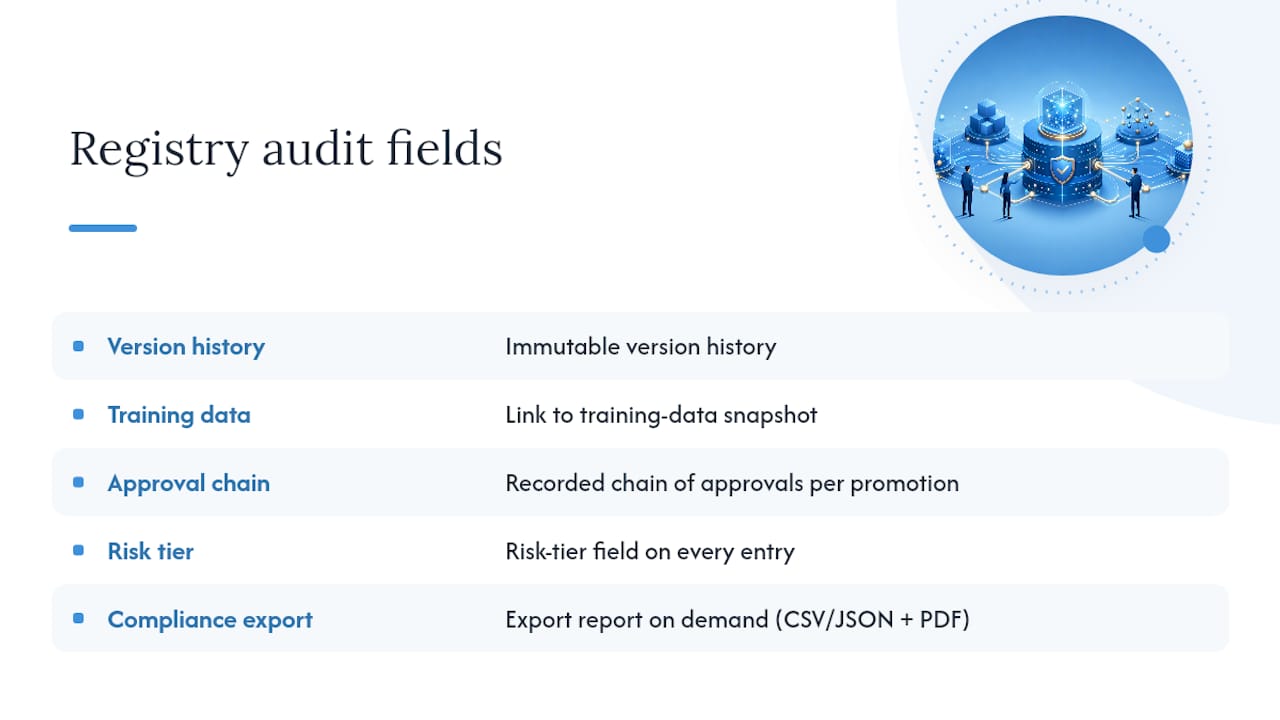
Governance is not a separate system bolted onto MLOps. It is what the registry's audit fields exist to serve. An auditor's core questions map almost one-to-one onto registry capabilities: what versions exist, who approved each promotion, what data trained each one, and how risky is each model classified as being.
A defensible audit trail needs immutable version history, a link from every model version to its training data snapshot, a recorded chain of approvals for each promotion, a risk tier field on every entry, and the ability to export a compliance report on demand rather than assembling one by hand under deadline pressure. Governance guidance is explicit that no model should reach production without a completed registry entry and a finished risk assessment, which makes the registry entry itself the hard gate, not a courtesy step.
That structure covers three concrete use cases that come up constantly in enterprise environments. Regulators ask for evidence of model provenance and approval history, and a queryable registry turns that from a weeklong scramble into an export job. Post-incident forensics after a bad prediction or an outage rely on knowing exactly which version was live, when it was promoted, and what data trained it. Internal control reviews need periodic proof that risk-tiered models are being re-reviewed on schedule, not just approved once and forgotten.
Integration challenges remain one of the most common barriers enterprises report when connecting registries to governance frameworks and broader compliance tooling, a friction point consistent with what implementation guides describe as the hardest part of rolling registries out at scale. Registries that plug into structured governance frameworks, rather than sitting as isolated tools, tend to get past that friction fastest. Teams formalizing controls under frameworks like NIST's AI Risk Management Framework or ISO 42001 often lean on dedicated compliance automation tooling to keep registry metadata synchronized with the broader control environment, particularly for ISO 42001 alignment or resilience obligations under frameworks like DORA for regulated financial entities.
Pro Tip: Export audit reports in a plain, portable format like CSV or JSON alongside a human-readable PDF summary. Auditors rarely want to log into your registry UI; they want a file they can attach to their own report, and building that export path early saves a scramble later.
What Operational Practices Keep a Registry Reliable?
A registry that works well on day one can degrade badly by year two if teams treat it as a formality instead of a control system. A short list of habits separates the registries that stay trustworthy from the ones that quietly turn into shelfware:
- Do require complete metadata at registration, with the API rejecting incomplete submissions.
- Don't ever allow a version to be overwritten; every change is a new version, full stop.
- Do make the registry genuinely queryable, with governance questions answerable in seconds rather than hours.
- Do enforce model signatures so input/output mismatches get caught before deployment, not after.
- Do automate promotion gates wherever the risk tier allows it, reserving manual review for genuinely high-stakes models.
- Do schedule periodic reviews of production models tied to their risk tier, not just at initial approval.
The mistakes that keep showing up across organizations are strikingly consistent: model files dumped into object storage with no attached metadata, missing model signatures that only surface as bugs once a downstream consumer changes their input format, no rollback plan tested until an actual incident forces one, and isolated team-level registries that never connect to any central governance layer. Registries combined with promotion gates and automated rollback measurably reduce incidents and cut the time it takes to reverse a bad deployment, but only when those gates are actually enforced rather than theoretical.
Pro Tip: A federated governance model, where central platform teams set non-negotiable standards (immutability, mandatory fields, audit logging) while individual teams retain autonomy over their own namespaces and promotion cadence, tends to scale better than either pure centralization or pure team-by-team freedom. Rigid centralization creates bottlenecks; total autonomy creates governance gaps. Federation splits the difference.
How Do You Map This Checklist to an MLflow Registry?
MLflow's model registry implements most of this checklist directly, which makes it a practical reference point for translating the general design into something concrete. Metadata maps cleanly onto MLflow's tagging system: owner, training data snapshot ID, risk tier, and commit hash all become model version tags attached at registration time, queryable later through the same API.
The core operational flow in MLflow follows the same register, validate, promote, deploy sequence described earlier:
- Register a model version after a training run completes, attaching tags for owner, data snapshot, and risk tier at the same call.
- Run automated validation as a CI step, checking accuracy and calibration thresholds against the newly registered version before allowing any stage transition.
- Transition the model's stage from staging to production once validation passes and, for high-risk models, once a named approver signs off.
- Query the registry from serving infrastructure to pull the current production version by name and stage, rather than a hardcoded path.
- Roll back by transitioning traffic back to the previous production-tagged version the moment monitoring flags a regression, since that prior version was never overwritten.
On the integration side, CI pipeline hooks should call MLflow's API to run validation tests immediately after registration and only proceed to a stage transition if those tests pass. Monitoring systems should write performance metrics and drift scores back into MLflow as tags on the live production version, closing the telemetry loop described earlier in the lifecycle section. Audit exports can pull directly from MLflow's version history and tag metadata to generate the compliance reports regulators or internal reviewers request. Teams building this out find MLflow's tagging and lifecycle documentation useful for structuring that mapping without reinventing field names from scratch, and the governance framework resources helpful when aligning stage transitions with formal approval requirements.
Pro Tip: Version your environment and dependency manifests with the same rigor as your model weights, and keep the previous production version's serving container warm rather than fully torn down. When a rollback decision has to happen at 2 a.m., the difference between "flip traffic back" and "rebuild a container from scratch" is the difference between a five-minute incident and a two-hour one.
What's a Realistic Roadmap for Your First 90 Days?
Rolling out a shared registry works best as a phased effort rather than a big-bang migration. A 30/60/90 structure keeps momentum visible to stakeholders while giving the platform team room to fix mistakes before they compound.
Days 1 to 30 (pilot): pick one team and one model family with clear ownership. Deliverables: finalized metadata schema, RBAC roles defined, and one model fully registered with automated CI/CD promotion working end to end.
Days 31 to 60 (expand): onboard two to three additional teams, focusing on those with the highest-risk or highest-visibility models first. Deliverables: cross-team discovery tested in practice, monitoring telemetry writing back into registry metadata, and a documented rollback drill completed successfully.
Days 61 to 90 (govern): formalize the review cadence, connect audit export tooling, and socialize the registry as the mandatory gate for production deployment across the organization. Deliverables: compliance report export validated against a real audit request format, periodic review schedule published, and a retirement policy for archived versions in place.
Getting this right requires the right people at the table from day one: platform owners who run the registry infrastructure, model owners accountable for individual entries, a security representative defining access controls, a compliance stakeholder validating the audit fields actually satisfy regulatory needs, and SRE or infrastructure staff who own the monitoring integration.
Track a small set of metrics from the pilot onward rather than waiting until "later" to measure success: time-to-deploy for a new model version, mean time to rollback when something breaks, the percentage of production models actually living in the registry versus still floating outside it, and an audit-readiness score based on how completely metadata fields are populated across all registered models. The implementation checklist resources and broader lifecycle management guidance are useful reference points as this roadmap moves from pilot into enterprise-wide policy.
Running registries at scale taught me one uncomfortable lesson
The failure pattern that shows up most often is not a missing feature. It is a registry that becomes documentation instead of infrastructure. Teams register their models diligently, fill out every metadata field, and then deploy through a completely separate manual path that never actually consults the registry to decide what gets served. The registry looks healthy from the outside. Nobody notices the gap until an incident review asks "which version was live" and the honest answer is "the registry says one thing, but someone pushed a hotfix directly to the serving container three weeks ago."
The checklist item that would have caught this is deceptively simple: the deployment pipeline should be technically incapable of serving a model that is not the current registry-tagged production version. Not discouraged. Incapable. If a rollback or hotfix is urgent enough to bypass the registry, it needs to go through the registry anyway, immediately, even if that means registering the emergency fix five minutes after the fact rather than skipping the step entirely.
The lesson for platform teams and model owners is the same: a registry only governs what it actually gates. Metadata completeness is necessary but not sufficient. If deployment infrastructure can route around the registry, the registry is a reporting tool, not a control, and every audit trail it produces is describing a process that was optional rather than mandatory.
Where MLflow Fits Into Your Registry Strategy
Mapping this article's checklist onto a real platform is straightforward with MLflow. Metadata fields like owner, risk tier, and data snapshot ID become model version tags. Lifecycle states (experimental, staging, production, archived) are built into the model registry's stage transitions. Registration, querying, and promotion all run through a documented API and CLI, so your CI/CD pipeline can call MLflow directly rather than relying on manual UI clicks. Observability hooks let monitoring systems write drift and performance data straight back into the registry's metadata, closing the loop this article keeps coming back to.
If you are further along and working specifically with generative models and agents, MLflow's GenAI and agent engineering tools extend this same registry-and-lifecycle discipline to LLM-based systems, including prompt versioning through the prompt engineering cookbook and automated quality checks through LLM-as-a-Judge evaluation. For teams validating high-risk models before promotion, the red-teaming cookbook covers safety testing patterns that fit directly into the validation gate described earlier in this article.
MLflow is open-source and free to run yourself, with enterprise support and managed options available for teams that need dedicated help scaling it across a large organization. The concrete next step: register your first model through MLflow's tracking API this week, attach the minimum metadata schema from this article's checklist, and wire one CI step to enforce it before you try to onboard a second team.
Frequently Asked Questions
What is the main role of a shared model registry in MLOps? Its main role is acting as the single source of truth for every model version, its metadata, and its lifecycle state, so training, deployment, and monitoring systems all reference the same authoritative record instead of separate, drifting copies.
How does a model registry differ from a model catalog? A registry focuses on versioning and deployment lifecycle for models specifically, while a catalog provides broader discovery and lineage across datasets, pipelines, and models together, often pulling metadata from the registry to enrich its own index.
Do small teams need a shared registry, or is it only for large enterprises? Smaller teams with one or two production models can often get by with lighter tracking, but the moment you have multiple teams shipping models independently or any regulatory exposure, the collaboration and audit benefits of a registry outweigh the setup cost.
Can a shared registry work across multiple business units with different compliance needs? Yes, through a federated pattern where each unit runs its own namespace or instance under shared governance standards, letting teams retain autonomy over promotion cadence while central policy enforces mandatory fields and audit logging everywhere.
What happens to old model versions in a shared registry? They move to an archived stage rather than being deleted, staying queryable for audit and forensic purposes while no longer serving live traffic, with retention policy determining how long they remain in active versus cold storage.
This article provides general information about model registry practices and is not a substitute for a formal compliance or risk assessment from qualified legal or regulatory counsel.
Sources
- How do we build and maintain an AI model registry? | AI Governance Institute
- ML Model Registry -- AI / ML Infrastructure | System Design Concepts — Vetora
- Ml-ops