The Role of an AI Center of Excellence in 2026

An AI Center of Excellence (AI CoE) is the centralized operational and strategic hub that drives consistent, governed, and scalable AI adoption across an enterprise. It is not a review committee or an advisory panel sitting at arm's length from delivery. The AI CoE owns methodology, tools, capability development, and governance, making it the single organizational unit accountable for turning AI ambition into measurable business outcomes.
The core roles an AI CoE fulfills include:
- AI strategy and roadmap ownership: Translating corporate priorities into a sequenced AI investment plan
- Governance and ethical oversight: Establishing model validation standards, compliance audits, and responsible AI policies
- Capability building: Running training programs, certification tracks, and mentorship to close AI skills gaps across the organization
- Platform and tooling standardization: Providing shared infrastructure, reusable pipelines, and approved toolchains that every team can access
- Business unit consultation: Identifying, prioritizing, and supporting AI use cases in partnership with domain teams
- Emerging technology evaluation: Piloting new AI approaches before broader enterprise adoption
Understanding the full scope of these responsibilities is what separates AI CoEs that generate real competitive advantage from those that stall at proof-of-concept.
What are the core responsibilities of an AI Center of Excellence?
An AI CoE is an operational unit, not a governance committee. That distinction matters because governance committees review and approve; AI CoEs actively build tools, develop capabilities, and deliver solutions. Conflating the two creates bottlenecks that slow every team waiting for sign-off.
The primary functions break down across several domains:
- AI strategy alignment: Partnering with business leaders to identify and prioritize AI opportunities tied to measurable business value, not just technical novelty
- Governance and compliance: Establishing review processes for new AI applications, defining model validation and bias-testing standards, and conducting routine data security and compliance audits
- Talent development: Administering training initiatives, learning journeys, and certification programs that build AI fluency beyond the specialist team
- Tooling and platform management: Providing standardized development environments, automated training and deployment workflows, and monitoring capabilities that eliminate redundant build work
- Resource allocation: Managing GPU clusters, cloud compute, and specialized hardware centrally so individual projects can access capacity they could not justify independently
- Intake and prioritization: Running a formal process to evaluate AI requests against business value, feasibility, and resource demands before committing engineering time
- Emerging technology scouting: Evaluating new AI tools and techniques so individual teams do not chase every new release at the cost of delivery focus
The table below maps each function to its primary owner within a typical AI CoE structure.
| Function | Primary Owner |
|---|---|
| AI strategy and roadmap | AI CoE leader + executive sponsor |
| Governance and compliance audits | AI governance and security specialists |
| Talent development and certification | CoE learning lead + HR partnership |
| Platform and tooling standards | ML engineers and AI operations professionals |
| Business unit consultation | Domain experts and embedded data scientists |
| Resource and infrastructure management | AI operations and cloud infrastructure team |
| Emerging technology evaluation | Senior data scientists and research leads |
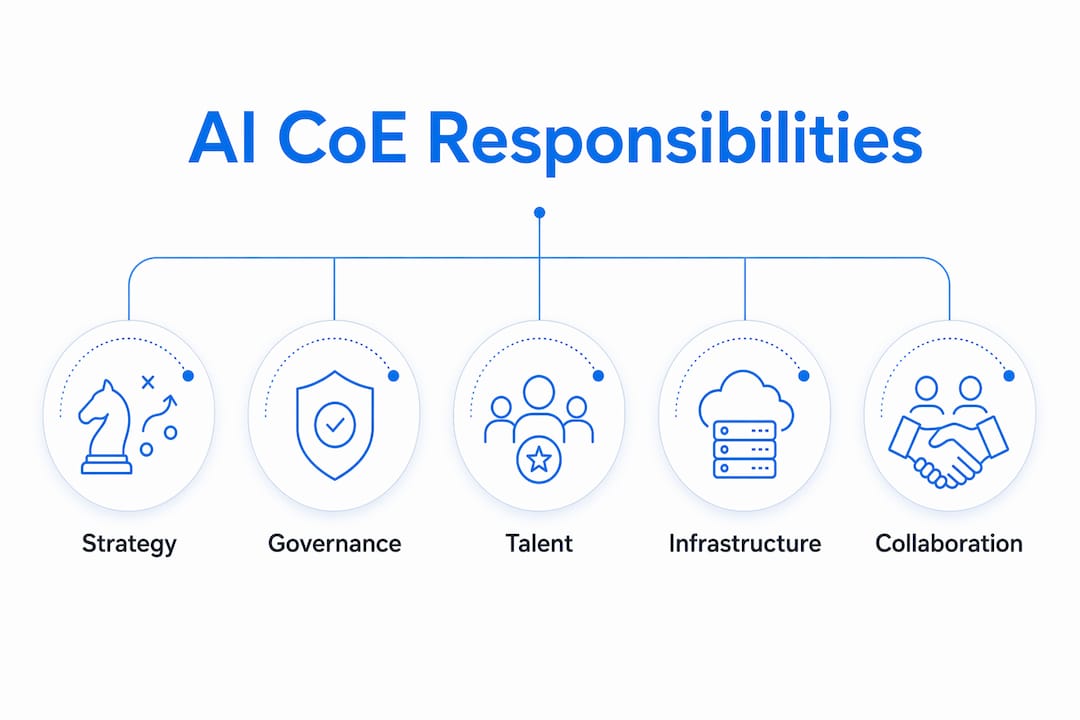
AI centers standardize platforms, provide governance frameworks, manage resources, cultivate talent, and democratize AI knowledge. That combination is what makes the CoE a force multiplier rather than just another internal team.

Why establishing an AI CoE gives your organization a real edge
The most direct benefit of a well-run AI CoE is the elimination of "shadow AI," which refers to ungoverned AI solutions built by individual teams without standards, security review, or compliance oversight. Organizations with a CoE reduce AI adoption risk by consolidating AI tools and infrastructure, preventing these ungoverned pockets from accumulating technical and regulatory debt.
Beyond risk reduction, the strategic benefits include:
- Accelerated innovation: Reusable platforms and shared pipelines mean teams spend time on the problem, not rebuilding infrastructure from scratch
- Talent concentration and retention: Data scientists and ML engineers prefer working where they collaborate with peers and tackle diverse challenges, making the CoE a recruiting advantage
- Measurable business alignment: By tying every AI initiative to a business priority during intake, the CoE ensures AI spending maps to outcomes executives can defend
- Knowledge compounding: Organizational learning about AI accumulates centrally and propagates outward, rather than staying siloed in individual project teams
- Ethical and regulatory confidence: Centralized governance means bias testing, privacy controls, and transparency requirements are applied consistently, not left to individual team judgment
AI CoEs also play a direct role in closing the skills gap that limits enterprise AI adoption. Some organizations lack specialized AI skills, and another 26% reported too few employees trained to work with AI effectively. A CoE addresses both problems simultaneously by centralizing hard-to-find expertise and running training programs that build capability across the broader workforce.
The AI productivity gains that organizations report from structured AI programs are rarely accidental. They trace back to the kind of coordinated governance and capability-building that a functioning AI CoE provides.
How to build and staff an AI CoE team that actually works
Getting the team structure right before hiring is the single most common point of failure. AI CoE mandates should be finalized before hiring, signed by executives, and clearly define advisory versus delivery scope along with budget ownership. Without that document, scope disputes and resource conflicts are almost guaranteed.
The staffing process follows a clear sequence:
- Secure executive sponsorship first: The executive sponsor provides budget authority, organizational credibility, and the mandate to enforce standards. Without this, the CoE has no teeth.
- Appoint a dedicated CoE leader: This person drives AI initiatives, acts as the single point of contact for AI strategy, and must combine deep AI expertise with the ability to influence stakeholders at every level of the organization.
- Build a multidisciplinary core team: The team needs senior data scientists, ML engineers, AI governance experts, AI security specialists, and AI operations professionals. Business leaders who can identify use cases and evaluate model effectiveness are equally important as the technical staff.
- Define the reporting line and organizational placement: If a Cloud Center of Excellence already exists, integrating AI practices into that team avoids unnecessary complexity. A standalone AI CoE makes sense only when existing teams genuinely cannot support AI adoption.
- Include change managers and domain experts: Technical execution without change management produces tools that nobody uses. Domain experts ensure AI solutions address real business problems rather than technically impressive but operationally irrelevant ones.
- Partner with HR on talent development: Successful AI CoEs administer talent development, certification, and mentorship programs to close enterprise AI skill gaps and improve retention over time.
The CoE leader's profile deserves particular attention. Strong AI knowledge is necessary but not sufficient. The role requires a visionary but execution-focused approach, the ability to practice candor with teams and leadership alike, and the flexibility to adapt decisions as AI technology shifts. Managing AI project teams at this scale demands both technical credibility and organizational influence.

How AI CoE operations and governance should evolve over time
Every AI CoE starts centralized. That is the right call early in an organization's AI journey because consolidating expertise and foundational practices accelerates adoption and prevents fragmentation. The mistake is staying centralized too long.
Mature AI CoEs distribute expertise to product and platform teams, enabling innovation while maintaining governance. The transition happens when specific organizational signals appear:
- Approval delays and knowledge bottlenecks where CoE experts cannot support all teams simultaneously
- Growing friction between product teams and the CoE over priorities rather than value delivery
- Platform teams capable of enforcing governance independently without CoE involvement in every decision
When those signals appear, the CoE's role shifts from gatekeeper to advisor. Mature AI CoEs operate as federated models, embedding data scientists in business units and focusing centrally on platforms and policy rather than direct execution. The "hub and spoke" structure, where core expertise stays central while practitioners embed in business units, is the most common mature-state configuration.
The practical steps for this transition include:
- Embed AI delivery into platform operations: Transfer delivery responsibility to platform teams that enforce consistent governance and manage reliable deployments across all workloads
- Build self-service capabilities: Platforms that allow analysts to train models and APIs that make predictions accessible reduce dependency on the CoE without sacrificing quality standards
- Shift CoE focus to guidance and policy: The CoE sets guardrails, shares knowledge, and handles mentorship while frontline teams own execution
- Measure success continuously: KPIs tied to business value, adoption rates, and risk management keep the CoE accountable as its operating model changes
Effective AI governance frameworks are what make this transition possible without losing control. Without them, distributing delivery responsibility just distributes risk.
How AI lifecycle platforms amplify the impact of your AI CoE
The difference between an AI CoE that scales and one that stalls often comes down to the platforms it puts in place. AI lifecycle platforms provide traceability, centralized governance, reproducibility, and operational monitoring, all of which are critical for CoE success and scaling.
Mlflow is purpose-built for exactly this context. As an open-source platform for GenAI and LLM application lifecycle management, Mlflow gives AI CoEs the operational infrastructure to move from experimental prototypes to production-grade AI agents with full transparency. Key capabilities that directly support CoE functions include:
- Deep tracing of agentic reasoning: Mlflow's observability features trace AI decision-making at the step level, making it possible to audit model behavior and satisfy governance requirements without treating AI systems as a black box
- Automated evaluation with LLM-as-a-Judge: Mlflow's LLM-as-a-Judge evaluation framework automates quality assessment across GenAI workflows, reducing the manual review burden on CoE governance teams
- Centralized AI Gateway: Secure prompt management and cross-provider governance through a single gateway gives the CoE control over how AI capabilities are accessed and used across the organization
- Reproducibility and auditability: Standardized experiment tracking and model versioning create the audit trail that compliance and ethical AI requirements demand
- Integrated collaboration workflows: Mlflow connects AI engineering, data science, and business teams through shared tooling, reducing the handoff friction that slows delivery
AI model governance at enterprise scale requires this kind of infrastructure. Without it, governance becomes a manual, inconsistent process that the CoE cannot realistically enforce as the number of AI initiatives grows.
Pro Tip: Select your AI lifecycle platform before you scale the CoE's delivery capacity. Platform selection shapes every downstream governance and collaboration workflow. Getting it right early prevents the technical debt that forces painful migrations later.
Building the infrastructure, assets, and reusable playbooks your CoE needs
One of the most tangible contributions an AI CoE makes is developing the shared infrastructure and reusable assets that prevent every project team from rebuilding the same foundations. Centralized platforms eliminate redundant work by providing standardized environments for model development, automated workflows for training and deployment, monitoring and logging capabilities, and integration points with enterprise systems.
Reusable playbooks are the CoE's institutional memory made operational. They capture the distilled lessons from every completed project and translate them into repeatable processes: data pipeline templates, model validation checklists, deployment runbooks, and bias-testing protocols. Teams using these playbooks avoid the common pitfalls that slow first-time implementations and produce production-ready solutions faster.
The asset library a mature CoE maintains typically includes pre-approved model architectures for common use cases, data access and preprocessing utilities, governance documentation templates, and a catalog of evaluated third-party AI tools with adoption recommendations. These assets compound in value over time because each new project contributes back to the library rather than starting from zero.
Infrastructure management is equally concrete. AI workloads require significant computing power, especially for training large models. Centralized management of GPU clusters, cloud resources, and specialized hardware allows the organization to invest at a scale that individual projects cannot justify, then allocate capacity across initiatives based on priority and timeline.
How AI CoEs collaborate with business units and external partners
An AI CoE that operates in isolation from the business units it serves will eventually be bypassed. Cross-functional collaboration between data scientists, domain experts, finance, and legal teams is what translates AI prototypes into repeatable solutions that align spending with business strategy.
The collaboration model that works in practice combines structured intake with embedded partnership. Business units submit AI requests through a formal intake process where the CoE evaluates feasibility, business value, and resource requirements. High-priority initiatives get dedicated data science support embedded directly in the business unit team. Smaller projects receive consultation and access to self-service platforms. This tiered model ensures critical work gets the expertise it needs without the CoE becoming a bottleneck for every request.
External partnerships extend the CoE's reach in two directions. Academic and research partnerships give the CoE early access to emerging techniques before they reach commercial availability. Vendor partnerships, managed centrally by the CoE, prevent individual business units from signing contracts with overlapping or incompatible AI tools. The CoE evaluates vendor capabilities, negotiates enterprise agreements, and maintains a vetted catalog of approved external AI services. Team collaboration tools that support distributed AI development workflows are a practical component of this external coordination layer.
The role of AI in business strategy increasingly depends on how well the CoE connects internal capability with external innovation, making partner management a core CoE function rather than an afterthought.
Scaling AI initiatives across the enterprise without losing governance
Scaling AI is where most enterprise programs hit their hardest wall. The approaches that work at the pilot stage, where a small CoE team manages every initiative directly, break down when the number of active AI projects grows beyond what any central team can handle.
The answer is not to scale the CoE headcount indefinitely. It is to scale the CoE's influence through platforms, standards, and embedded expertise. As the organization's AI maturity grows, the CoE shifts from executing AI projects to enabling other teams to execute them well. Self-service platforms that allow business analysts to train models, APIs that make AI predictions accessible to application developers, and documentation that enables independent problem-solving all reduce dependency on the CoE while maintaining quality.
Measuring CoE impact at scale requires KPIs that go beyond project counts. Business value delivered, adoption rates across business units, time from use case identification to production deployment, and risk incidents avoided are the metrics that tell the real story. The CoE should publish these metrics to its executive sponsor and steering committee on a regular cadence, creating the accountability loop that sustains senior leadership support over time.
Change management is the often-underestimated factor in enterprise AI scaling. Technical platforms and governance frameworks are necessary but not sufficient. The CoE needs a deliberate cultural adoption strategy: internal communities of practice, executive communication about AI wins, and training programs that make AI accessible to non-specialists. Organizations that treat cultural adoption as a parallel workstream to technical delivery scale AI faster and with fewer rollbacks than those that treat it as an afterthought.
Key Takeaways
An AI Center of Excellence succeeds when it combines centralized governance with distributed delivery, backed by the right platforms, people, and executive mandate.
| Point | Details |
|---|---|
| CoE is an operational unit | It owns methodology, tools, and delivery, not just review and approval like a governance committee. |
| Skills gaps are a primary driver | 30% of organizations lack specialized AI skills, and 26% have too few employees trained; the CoE closes these gaps through centralized expertise and training programs. |
| Mandate before hiring | Executive-signed mandates defining scope and budget ownership must precede any staffing decisions to prevent failure. |
| Centralized to federated evolution | CoEs start centralized for control, then shift to advisory and federated models as organizational AI maturity grows. |
| Platform selection shapes governance | AI lifecycle platforms like Mlflow provide the traceability, reproducibility, and centralized governance that CoE scaling requires. |