The Real Role of AI in Business Outcomes

Most business leaders have already approved AI spending. The approvals came fast, the pilots launched quickly, and the dashboards filled with activity metrics. Yet the role of AI in business outcomes is proving far more complex than a procurement decision. Only 16% of organizations that have AI in production report high measurable value. The gap between deployment and results is not a technology problem. It is an integration and leadership problem, and this article breaks down exactly how to close it.
Table of Contents
- Key Takeaways
- How AI in business outcomes actually works
- Why AI investment alone fails to deliver
- Leadership and organizational design as AI multipliers
- Translating AI productivity gains into P&L results
- Future-proofing with agentic AI and observability
- My honest take on what leaders get wrong
- Operationalize your AI with MLflow
- FAQ
Key Takeaways
| Point | Details |
|---|---|
| Integration beats spending | Embedding AI into core workflows drives measurable value far more reliably than AI investment volume alone. |
| Workflow redesign is non-negotiable | Simply layering AI on existing processes accelerates activity without reducing costs or improving outcomes. |
| Leadership shapes AI success | Governance structures, role realignment, and clear accountability determine whether AI delivers real business results. |
| Measure beyond productivity | Linking AI deployments to P&L metrics, EBITDA targets, and cost reduction goals is what converts gains into lasting advantage. |
| Agentic AI is the next frontier | Autonomous AI workflows require observability and orchestration infrastructure to scale reliably and safely. |
How AI in business outcomes actually works
The data on AI's impact is striking, but the interpretation requires precision. 88% of executives report that AI increased annual revenue and 87% report cost reductions. Those numbers reflect real progress, but they also mask enormous variation in how different organizations achieve those results.
The companies seeing the strongest performance share a specific pattern. They treat AI not as a tool deployed alongside existing work, but as a force that restructures the work itself. Companies investing above 1.6% of revenue in AI and embedding it into core processes achieve stronger EBITDA growth, shareholder returns, and revenue performance than peers who spend similarly but leave their processes intact.
Where AI in business strategy is already delivering measurable results:
- Finance automation: Accounts payable, reconciliation, and financial close cycles are compressing dramatically when AI handles document processing and exception flagging.
- IT operations: Incident detection, root cause analysis, and ticket resolution are faster when AI monitors system behavior continuously instead of waiting for human escalation.
- Supply chain optimization: Demand forecasting models trained on real-time data reduce inventory carrying costs and improve service levels simultaneously.
- Decision support: AI surfaces patterns in customer behavior, market signals, and operational data that no human analyst team could process at the same speed or scale.
The role of machine learning in business also extends to risk management. Predictive models now flag credit risk, compliance anomalies, and operational failures earlier than traditional rule-based systems ever could. The competitive implication is direct: organizations that use AI to make faster, better-informed decisions compound their advantage over time, while those still reviewing weekly reports lose ground quarter by quarter.
Why AI investment alone fails to deliver
The workflow overlay failure mode is the most expensive mistake in AI implementation today. An organization buys a generative AI tool, deploys it alongside existing processes, and watches employees use it to produce more output faster. Nothing is eliminated. No roles are redesigned. No approval steps are removed. The result is higher activity volume with roughly the same cost structure.
Layering AI on existing work accelerates activity but does not reduce costs without operational simplification and role redesign. This is the finding that most AI project sponsors prefer not to hear, because it means the work is not done once the model is deployed.
The structural barriers that block AI value realization tend to cluster around three problems:
- Legacy systems with siloed data: AI models require clean, accessible, connected data. When source systems are fragmented across business units or decades of technical debt, the model cannot see the full picture, and its outputs reflect that limitation.
- Missing skills at the process level: Deploying AI at the enterprise level requires people who understand both the business process and the AI system well enough to identify where automation adds value and where human judgment remains necessary.
- No change to decision rights: When AI surfaces a recommendation but the approval chain remains unchanged, the speed benefit disappears. The model waits for humans who were not redesigned out of the loop.
Pro Tip: Before deploying any AI capability into a business process, map every step in that process and explicitly mark which steps AI will replace, which it will augment, and which can be eliminated entirely. This map becomes your governance document and your ROI baseline.
Organizations that embed AI into workflows report substantially higher AI-derived business value and financial returns compared to those using standalone tools. The practical implication: your AI implementation plan should spend as much time on process redesign as it does on model selection.
Leadership and organizational design as AI multipliers
There is a version of AI adoption that treats the technology as a staff augmentation tool. You add AI, people do more, and the org chart stays the same. Then there is the version that actually changes business outcomes. It starts with leaders who understand that AI integration is an organizational design problem, not just a technology deployment issue.
"The organizations getting the most from AI are not the ones with the most models in production. They are the ones that have changed how decisions get made."
That shift requires leaders to do four specific things well:
- Establish governance with real teeth: AI governance means more than a policy document. It means defined guardrails, human review checkpoints calibrated to risk level, and named accountability for AI-driven decisions that go wrong.
- Redesign roles around AI-augmented work: When AI handles the first draft, the data aggregation, or the anomaly detection, the human role shifts from execution to judgment. That shift requires explicit role definition, not informal adaptation.
- Build psychological safety around AI use: AI increases productivity by around 15% especially for less experienced workers, when leadership creates supportive conditions for AI-assisted work. Fear of appearing less capable without AI, or fear of being replaced by it, suppresses adoption in exactly the employees who benefit most.
- Invest in reskilling as a capital allocation decision: Training budgets for AI fluency are not discretionary HR line items. They are the mechanism by which your organization captures the return on its AI infrastructure investment.
AI governance embedded within workflows accelerates value creation and reduces the risk of unintended consequences. Financial services firms that embed continuous AI supervision directly into credit and compliance workflows consistently outperform peers who treat governance as a post-deployment audit function.
Translating AI productivity gains into P&L results
This is where most AI programs stall. The productivity gains are real, visible on individual dashboards and team output metrics, but they do not appear in the P&L. The reason is almost always the same: freed capacity was not reinvested or reduced; it was absorbed into the existing workload without structural change.
Here is a practical framework for converting AI gains into lasting financial outcomes:
-
Define the target before deployment. Set a specific financial metric for each AI use case. Cycle time reduction in accounts payable by 40%, headcount redeployment of 3 FTEs per region, or cost per customer service interaction reduced by 30%. Vague productivity goals produce vague financial results.
-
Eliminate steps before automating them. Running AI on a process that contains unnecessary approvals, redundant data entry, or legacy compliance theater just automates the waste. The simplification should precede the deployment.
-
Reinvest freed capacity deliberately. When AI reduces the time a team spends on a task, that time needs an explicit destination: growth activities, quality review, new service capability, or workforce reduction depending on your strategy.
-
Track decision quality, not just decision speed. AI-driven decision making should improve accuracy and outcomes, not just throughput. Measure error rates, exception volumes, and downstream impact, not only cycle time.
| Approach | Productivity gain | Cost impact | Scalability |
|---|---|---|---|
| AI layered on existing process | High | Minimal | Limited |
| AI with workflow redesign | High | Significant reduction | Strong |
| AI with role realignment and governance | High | Structural cost advantage | Sustained |
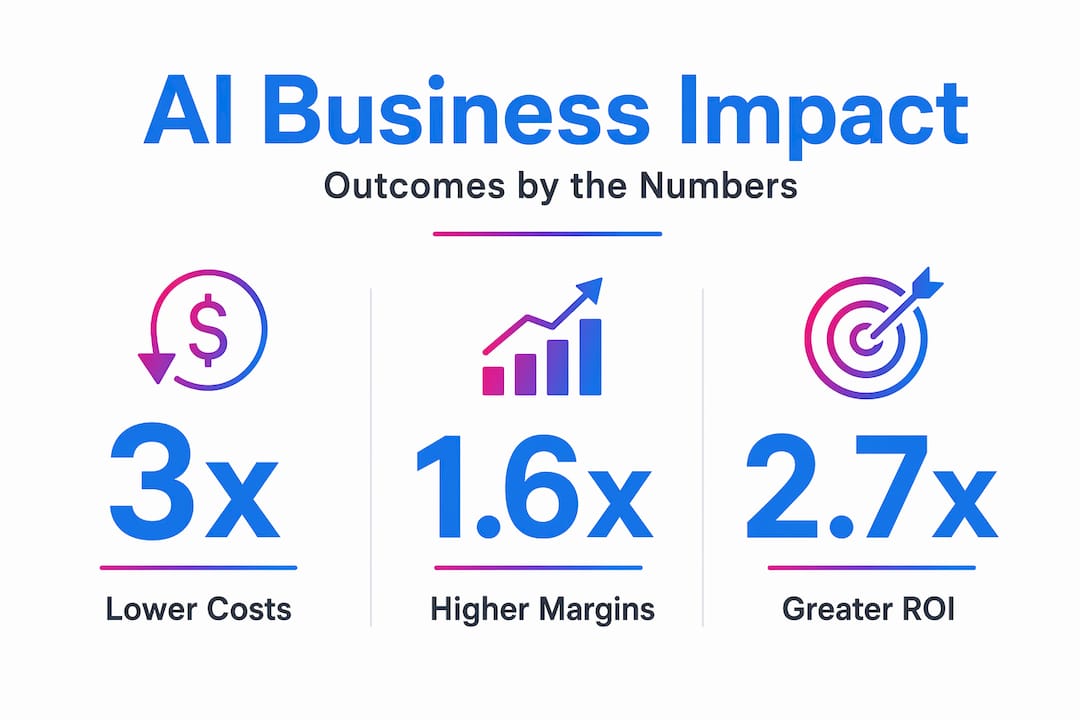
AI-first leaders reduce costs 3x more, achieve 1.6x higher EBIT margins, and realize 2.7x greater ROI than peers by treating AI integration and cost transformation as a single strategy. The differentiation is not the AI itself. It is the deliberate connection between AI deployment and operational redesign.
Pro Tip: Set a board-level threshold for AI investment tied directly to EBITDA and shareholder return targets. This prevents pilot programs from floating indefinitely without scaling and forces honest evaluation of which use cases are actually delivering.
Future-proofing with agentic AI and observability
The next phase of AI's effect on productivity moves well beyond copilots and assistants. Agentic AI systems, models that plan, execute, and iterate on multi-step tasks autonomously, are already driving measurable results in specific domains. AI agents capable of autonomous actions can drive major cost reductions and efficiency gains across finance, HR, customer service, and IT.
Preparing for this shift requires building infrastructure before the use cases arrive:
- Observability at the agent level: When an AI agent makes a sequence of decisions to complete a task, you need to trace each step, not just the final output. Without that visibility, debugging failures and auditing outcomes becomes nearly impossible.
- Orchestration across providers and models: Business AI environments will not converge on a single model or vendor. You need governance infrastructure that works across providers, tracks prompt behavior, and manages cost and latency at scale.
- Continuous evaluation in production: AI models drift. The evaluation frameworks that validated a model at deployment need to run continuously against live outputs to catch degradation before it affects business outcomes.
- Scaling with governance intact: The organizations that will sustain AI-driven advantage are those that can scale new capabilities without rebuilding governance from scratch for each deployment.
| Infrastructure component | What it enables | Risk if absent |
|---|---|---|
| Agent-level tracing | Full visibility into agentic reasoning chains | Unexplained failures, audit gaps |
| Cross-provider governance | Consistent policy enforcement | Cost overruns, prompt inconsistency |
| Automated evaluation | Continuous quality assurance in production | Silent model degradation |
My honest take on what leaders get wrong
I've seen AI programs with genuinely impressive technology produce essentially no financial results, and I've seen much simpler deployments generate millions in savings within a quarter. The difference was never the model.

What leaders consistently underestimate is how deeply organizational structure resists AI-driven change. They commission a model, celebrate the pilot results, and then wonder why those results never show up in the financial statements. The answer is almost always that no one changed who makes decisions, who owns which outcomes, or what happens to the time that AI freed up.
The governance piece gets the least attention and causes the most damage when ignored. An AI system making consequential decisions without clear accountability structures is not an efficiency tool. It's a liability. The companies I've seen succeed treat governance as a design constraint from day one, not a compliance checkbox after deployment.
My advice to every business leader reading this: approach AI as organizational evolution. The technology is the easy part. Changing how your organization makes decisions, allocates work, and measures success is the real project. Start there, and the AI will have somewhere productive to go.
— Kevin
Operationalize your AI with MLflow
Connecting AI deployments to real business outcomes requires more than good models. It requires the infrastructure to manage, evaluate, and monitor those models across their full lifecycle.
MLflow is the open-source AI platform built specifically for this challenge. It gives teams production-grade tracing of agentic reasoning chains, automated evaluation using LLM-as-a-Judge frameworks, and a centralized AI Gateway for cross-provider governance and prompt management. Whether you are scaling GenAI workflows or deploying autonomous agents into business-critical processes, MLflow provides the observability and structured AI evaluation your team needs to move from prototype to production with confidence. Explore MLflow's AI agent deployment capabilities to see how teams are operationalizing AI at scale.
FAQ
What is the main reason AI fails to improve business outcomes?
Most AI deployments fail to generate measurable business results because AI is layered onto existing workflows without redesigning processes, realigning roles, or changing decision rights. Productivity gains without structural change do not reduce costs or improve the P&L.
How does AI-driven decision making improve business performance?
AI-driven decision making improves performance by surfacing patterns in data faster than human analysts, reducing decision latency, and lowering error rates in high-volume processes like credit assessment, demand forecasting, and customer routing.
What percentage of companies with AI in production realize high value?
Only 16% of organizations that have AI in production report high measurable value, according to a Harvard Business Review Analytic Services survey, largely because most lack the workflow integration and modernization needed to convert activity into outcomes.
How should leaders measure the ROI of AI implementation in business?
Leaders should set specific financial targets for each AI use case before deployment, tracking metrics like cost per transaction, cycle time reduction, and headcount redeployment rather than generic productivity scores. Tying AI investment thresholds to EBITDA targets prevents programs from stalling in pilot mode.
What is agentic AI and why does it matter for business outcomes?
Agentic AI refers to systems that plan and execute multi-step tasks autonomously, without constant human instruction. These systems can drive significant cost reductions across finance, HR, and IT, but they require observability and governance infrastructure to operate reliably in production environments.