Benefits of AI Provider Diversification: Resilience Guide

Diversifying across AI/LLM providers is the most direct way to buy production resilience, control inference costs, and maintain compliance flexibility in enterprise GenAI systems. The immediate next step: run a provider-plus-use-case inventory, drop an abstraction gateway in front of your endpoints, and tier every integration by criticality so redundancy investments land where they matter most. Tools like Mlflow, OpenTelemetry, and frameworks aligned with the EU AI Act give you the observability and governance layer to make that diversification auditable, not just architectural.
Quick actions to take now:
- Inventory every provider endpoint and the workload it serves
- Add an API gateway or proxy to normalize provider interfaces
- Classify integrations by criticality tier (premium, mid-tier, open-source/on-prem)
- Instrument traces with OpenTelemetry before your next provider swap
Pro Tip: Don't wait for a deprecation notice to start your inventory. A live provider registry — even a simple spreadsheet mapping model, use case, data class, and contract expiry — is the foundation every other control depends on.
Table of Contents
- Why AI vendor lock-in is a different kind of system risk
- What are the concrete benefits of diversifying AI providers?
- What architecture patterns make multi-provider routing practical?
- Operational checklist for safe provider swaps
- Three-tier orchestration: a compact implementation example
- How does Mlflow support a production diversification strategy?
- Key Takeaways
- Why models should be replaceable parts, not strategic anchors
- Mlflow gives your team the control plane diversification requires
- Useful sources
Why AI vendor lock-in is a different kind of system risk
Traditional software lock-in is painful but predictable. You migrate a database, rewrite a few adapters, and the blast radius is contained. AI vendor lock-in spreads differently: it creeps in through proprietary data formats, fine-tuned embeddings stored in a vendor's vector store, API semantics that differ enough to break prompt logic, and commercial terms that restrict data portability. By the time a team realizes the exposure, the migration cost is measured in months, not sprints.
The failure modes unique to AI providers include model deprecation mid-project with limited notice requiring prompt reevaluation, pricing changes between contract cycles, geographic access restrictions affecting compliance, and varying API limits that can degrade performance.
Model centralization creates a single point of failure that can ripple across every product surface simultaneously. A deprecation that hits a shared embedding model, for example, doesn't just break one pipeline — it breaks every downstream agent, retrieval system, and evaluation harness that depend on vector consistency.
Statistic callout: Practitioner reports indicate that multi-model ensembles can cost 3–5x or more than a single-model setup at comparable volume without routing discipline—a cost exposure that compounds when a primary provider goes down and fallbacks route traffic to premium endpoints.
What are the concrete benefits of diversifying AI providers?
The advantages of AI provider diversity map directly to engineering and business outcomes your platform team can measure and report.
Resilience and failover. A multi-provider routing layer lets you define fallback chains so that when a primary endpoint degrades, traffic shifts automatically to a secondary. Uptime patterns targeting 99.99% availability require at least two independent provider paths for every critical user-facing flow. Without that, a single provider outage is your outage.

Cost and performance routing. Not every task needs your most capable model. Tiered routing — sending long-context summarization to a premium model, short classification to a low-cost or open-source endpoint, and regulated data to on-prem inference — can reduce API costs by up to 60% when paired with a governance-first sequencing approach. That figure comes from governance-first projects that mapped their data estate and built a cost-attribution schema before deploying routing logic.
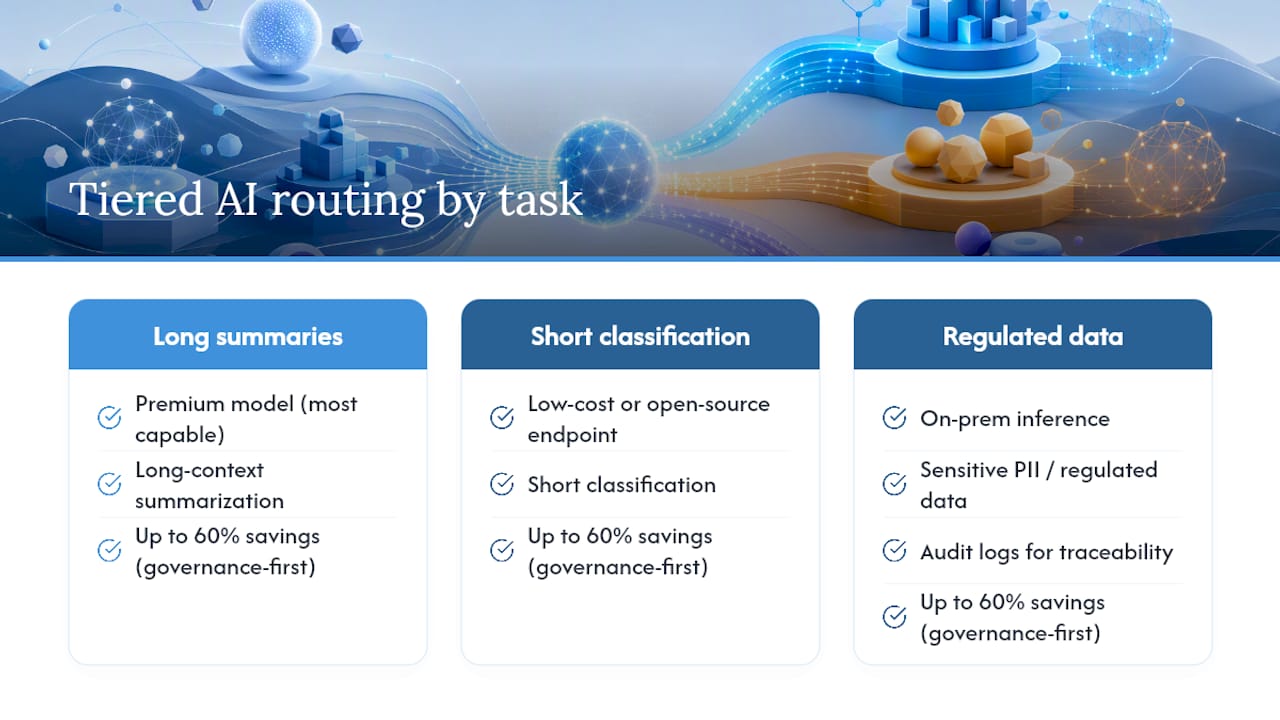
Governance and compliance flexibility. Provider choices can be driven by data classification. Sensitive PII routes to an on-prem model; general-purpose queries route to a cloud provider. The EU AI Act and emerging US AI governance frameworks both require traceability of which model processed which data class. A multi-provider architecture with audit logs satisfies that requirement; a single-provider black box does not.
Negotiation leverage. When you can credibly re-balance spend across providers, your procurement position changes. SLA enforcement, pricing negotiations, and deprecation notice periods all become more favorable when a vendor knows you have a tested fallback path. The advantages of AI provider diversity extend beyond engineering into commercial relationships.
What architecture patterns make multi-provider routing practical?
The three most common patterns enterprise teams implement are gateway normalization, metadata-driven routing, and ensembling with arbitration.
Gateway normalization places a policy engine in front of all provider endpoints. Every application call hits the gateway, which normalizes the API contract and enforces routing policies. Build, buy, or hybrid approaches all work; hybrid gateways are most common in production because they combine a commercial routing layer with internal policy logic specific to your data classification needs.
Three-tier topology:
- Application proxy layer — receives requests, attaches metadata (data class, latency budget, cost tier), and forwards to the router
- Mid-layer router — a Python + Redis dispatch service that reads metadata and applies routing rules (e.g., latency threshold, cost cap, governance tier)
- Base provider/key manager — handles API key rotation, provider-specific retry logic, and response normalization
Metadata-driven routing rules (examples):
- Long-context documents → premium model endpoint
- Short classification tasks → low-cost or open-source endpoint via OpenLLM
- Regulated data classes → on-prem inference (ONNX runtime or self-hosted model)
- Agentic reasoning traces → OpenTelemetry spans forwarded to Mlflow for evaluation
Interoperability standards that reduce migration friction:
- ONNX for portable model serialization across runtimes
- OpenLLM for serving open-source models with a consistent API surface
- Model Context Protocol (MCP) for standardized tool and context passing between agents and providers
- Apache Parquet for provider-agnostic storage of inference logs and evaluation datasets
- OpenTelemetry for distributed tracing across the full request path
Pro Tip: Prefer open-source AI platform standards like ONNX and Apache Parquet for your data layer from day one. Vendor-specific storage formats are where lock-in actually lives — not in the API call.
Operational checklist for safe provider swaps
Running provider diversification without outages requires governance controls, not just routing code.
- Tier every integration by criticality. Premium tier: user-facing, revenue-critical flows requiring redundancy. Mid-tier: internal tools and batch jobs. Open-source/on-prem: experimental or regulated workloads. Prioritize redundancy investment in that order.
- Set performance baselines before any swap. Measure latency (p50, p95, p99), accuracy on a golden evaluation set, and throughput under peak load. These become your acceptance criteria for any fallback or replacement model.
- Write switchover runbooks. Document every step: traffic shift percentage, rollback trigger conditions, estimated engineering hours to complete the swap, and a test harness that validates output quality post-switch. Teams that document this in advance cut switchover time from days to hours.
- Review contracts for deprecation notice periods, data portability rights, and pricing-change clauses. A 30-day deprecation notice with no data export right is a material risk. Negotiate minimum 90-day notice and Apache Parquet export as contract terms.
- Instrument observability before you need it. Trace every input-to-output path with OpenTelemetry. Log model version, provider, latency, token count, and data class for every request. Multi-provider routing requires evaluation suites and observability to confirm fallbacks preserve task quality — not just availability.
Additional controls:
- Run LLM-as-a-Judge automated evaluation on fallback outputs to catch quality regressions
- Maintain a live provider registry with contract expiry dates and deprecation watch flags
- Schedule quarterly portfolio reviews to re-evaluate provider mix against cost and capability benchmarks
Pro Tip: Circuit breakers on your routing layer prevent a fallback from auto-routing all traffic to a premium model when a primary goes down. Set a spend cap per time window and route excess to a queued or degraded-mode response instead.
Three-tier orchestration: a compact implementation example
A mid-size enterprise platform team running daily multimodel operations implemented the three-tier pattern described above with the following topology and routing rules.
Topology: Application proxy (FastAPI) → Python + Redis mid-layer router → base provider manager handling API key rotation for three providers.
Routing rules in production:
- Documents over 8,000 tokens → premium model (highest context window, highest cost)
- Classification and intent detection → open-source model via OpenLLM (lowest latency, lowest cost)
- Any request tagged with a regulated data class → on-prem ONNX runtime (no external API call)
Lessons learned:
- Engineering hours to swap a non-critical provider dropped from roughly two weeks to under two days once the runbook and test harness were in place
- Routing regulated data to on-prem inference eliminated a compliance review cycle that previously blocked deployments
- An arbitration layer comparing outputs from two providers on high-stakes requests improved output consistency, at a cost increase worth monitoring
| Routing tier | Model type | Trigger condition |
|---|---|---|
| Premium | Large context model | Tokens > 8,000 or SLA-critical |
| Mid-tier | Low-cost cloud model | Standard classification, summarization |
| On-prem | ONNX runtime | Regulated data class flag |
How does Mlflow support a production diversification strategy?
Mlflow maps directly to the governance and observability controls this guide describes. Its AI observability and tracing capabilities instrument the full agentic reasoning path, giving you the OpenTelemetry-compatible spans needed to audit which model processed which request and why.
| Diversification need | Mlflow capability |
|---|---|
| Cross-provider routing governance | AI Gateway with prompt management and provider policy enforcement |
| Fallback quality assurance | LLM-as-a-Judge automated evaluation on fallback outputs |
| Audit trail and compliance tracing | Deep agentic reasoning tracing with full input/output logging |
| Provider registry and model versioning | Model Registry with lifecycle stage tracking |
| Evaluation harness for provider swaps | Evaluation framework with golden sets and acceptance criteria |
Mlflow's GenAI and agent engineering platform integrates with the routing patterns above: the gateway enforces provider policies, the evaluation harness validates fallback quality, and the tracing layer produces the audit logs that compliance reviews require. Teams using Mlflow can treat provider swaps as configuration changes validated by automated evaluation, rather than engineering projects requiring manual QA.
- The LLM-as-a-Judge evaluation framework runs automatically on fallback outputs, flagging quality regressions before they reach users
- The Model Registry tracks which model version served which request, satisfying traceability requirements under emerging AI governance frameworks
- Prompt versioning ensures that when a provider changes, prompt variants are tested and logged before traffic shifts
Key Takeaways
A governance-first approach to AI provider diversification, backed by a gateway, criticality tiering, and automated evaluation, is the most reliable path to production resilience and cost control.
| Point | Details |
|---|---|
| Run a provider inventory first | Map every endpoint, use case, data class, and contract expiry before adding routing logic. |
| Gateway normalization reduces migration cost | A hybrid gateway makes provider swaps configuration-driven rather than engineering-heavy. |
| Tiering controls spend | Route by criticality and data class; circuit breakers prevent fallbacks from routing to premium endpoints unchecked. |
| Baselines are acceptance criteria | Measure latency, accuracy, and throughput before any swap; use these as pass/fail gates for fallbacks. |
| Mlflow closes the governance loop | Mlflow's AI Gateway, LLM-as-a-Judge evaluation, and tracing layer map directly to the diversification checklist. |
Why models should be replaceable parts, not strategic anchors
The conventional wisdom in enterprise AI still treats the model choice as a strategic decision made once and defended. That framing is wrong, and it's costing teams. Models deprecate. Pricing shifts. Capability gaps close. A team that has built its architecture around a specific provider's API semantics, embedding dimensions, or output format has made a structural bet on a vendor's roadmap — and that bet rarely pays off over a two-year horizon.
The teams navigating this well have reframed the question. They don't ask "which model is best?" They ask "what does our control plane need to make any model swappable?" That shift requires governance ownership (a named team or role responsible for the provider registry and quarterly reviews), training so engineers understand abstraction patterns rather than provider-specific SDKs, and a cultural norm that treats a provider swap as routine maintenance, not a crisis. The AI strategy frameworks that survive disruption are the ones that own the control plane and treat models as inputs, not foundations.
Mlflow gives your team the control plane diversification requires
Production AI teams face a concrete problem: the benefits of AI provider diversification are clear, but the governance and observability infrastructure to make it safe takes time to build from scratch. Mlflow removes that friction. Its AI Gateway normalizes cross-provider routing and enforces prompt policies from a single control point. Its LLM-as-a-Judge evaluation framework validates fallback quality automatically, so you know a provider swap preserves output standards before traffic shifts. Deep agentic reasoning tracing gives you the audit trail compliance reviews require, without instrumentation overhead.
The path from a single-provider dependency to a governed, multi-provider architecture doesn't require a platform rebuild. Start with Mlflow's GenAI engineering platform, connect your existing providers through the gateway, and run your first automated evaluation suite against your golden set. The operational controls described in this guide are already built in.
Useful sources
Key standards, frameworks, and platform documentation for procurement, design, and compliance reviews:
| Resource | Why it's useful |
|---|---|
| MLflow | Cross-provider gateway, observability, LLM-as-a-Judge evaluation, and model registry for production diversification |
| Best practices to avoid AI vendor lock-in | Covers data format lock-in, API migration debt, and modular stack design |
| Your AI vendor is now a single point of failure | Documents deprecation risks, ensemble cost multipliers, and the three-tier orchestration pattern |
| Manage Multiple LLM Providers at Scale | Governance-first framework: data estate mapping, cost attribution, and provider registry design |
| Multi Provider LLM Routing: Why Single-Vendor Fails | Policy-driven routing, evaluation suites, and observability requirements for fallback quality |
| Model-Agnostic AI Architecture | Gateway strategy comparison (build/buy/hybrid) and enterprise switching cost analysis |
- Your AI vendor is now a single point of failure
- Best practices to avoid AI vendor lock-in
- Manage Multiple LLM Providers at Scale: Enterprise Framework
- Your AI Vendor Just Became Your Biggest Risk | THE DAILY BRIEF
- Multi Provider LLM Routing: Why Single-Vendor Fails — PartnerInAI
- MLflow