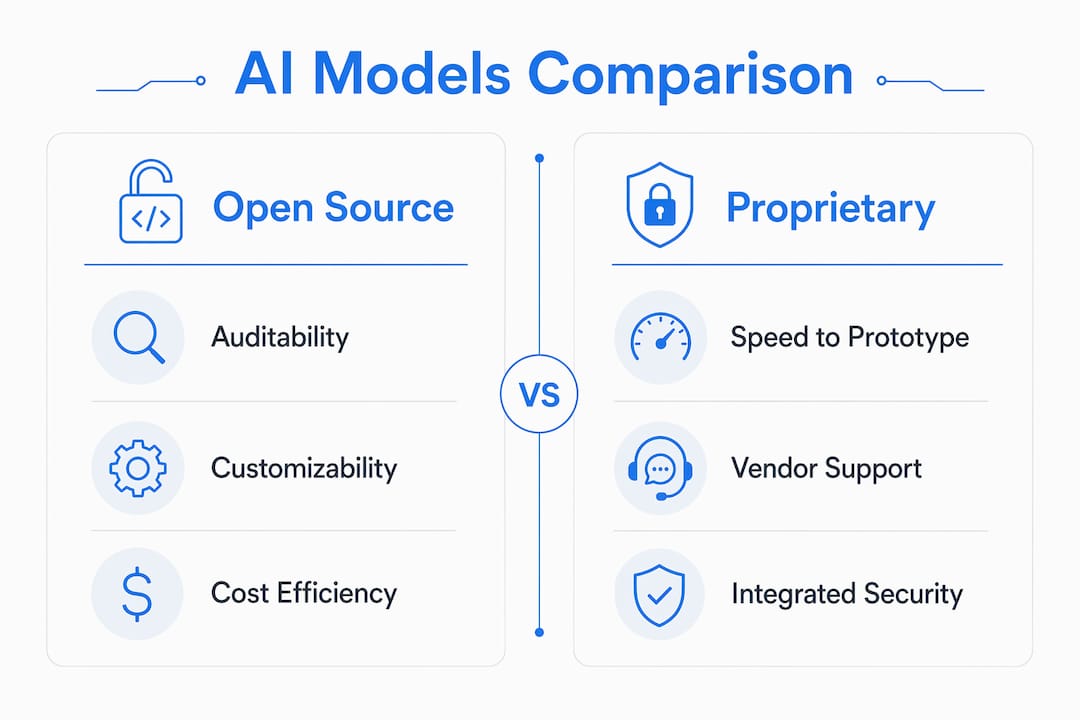
Benefits of Open-Source AI Platforms for Developers

Open-source AI platforms are defined as publicly available frameworks, models, and tooling where source code, weights, and development infrastructure are fully accessible for inspection, modification, and redistribution. The benefits of open-source AI platforms span three dimensions that matter most to engineering teams: architectural freedom, dramatically lower inference costs, and a global contributor base that accelerates iteration faster than any single vendor can. Frameworks like PyTorch, Hugging Face Transformers, and LangChain have become the default starting point for production AI systems precisely because they offer what closed APIs cannot: full control over the stack. We built this guide to give you a concrete, research-backed breakdown of why open-source wins for most workloads and where the trade-offs still exist.
1. Benefits of open-source AI platforms: flexibility and customization
Open-source AI enables flexibility for customization, integration with existing systems, and compliance-ready deployment that proprietary APIs simply cannot match. When you self-host a model like Llama 3 or Mistral on your own infrastructure, you control every layer: the serving stack, the hardware, the network boundary, and the data path. That control is not a luxury for most regulated industries. It is a hard requirement.

Fine-tuning on domain-specific data is the most direct expression of this flexibility. A healthcare team can fine-tune a base model on clinical notes and achieve task-specific performance that a general-purpose API will never reach, without sending patient data to a third-party endpoint. The same logic applies to legal, financial, and government workloads where data residency rules govern what can leave the perimeter.
Avoiding vendor lock-in gives teams long-term architectural independence, which matters when a vendor changes pricing, deprecates a model, or gets acquired. Open-source frameworks also support hybrid and multi-cloud deployment strategies natively. You can run inference on AWS, fine-tune on Azure, and serve via GCP without renegotiating a contract.
- Self-hosting: Deploy on-premises, in a private cloud, or across multiple cloud providers without API dependency.
- Fine-tuning: Adapt base models like Llama 3, Mistral, or Falcon to domain-specific tasks using your own labeled data.
- Integration freedom: Connect directly to internal databases, message queues, and orchestration layers without middleware constraints.
- Compliance alignment: Meet GDPR, HIPAA, and sector-specific data residency requirements by keeping data within your own infrastructure.
Pro Tip: When evaluating a model for fine-tuning, run a baseline evaluation on your domain data before committing to training compute. A model that scores well on general benchmarks may underperform on your specific token distribution, and you want to know that before spending GPU hours.
2. Cost advantages over proprietary models
Cost-efficiency from open-source AI becomes transformative at scale, and the numbers are not marginal. DeepSeek API pricing is 95% cheaper than OpenAI's, and Llama 3.3 costs approximately 19.8 times less per token than GPT-4o. At low request volumes, that gap is manageable. At production scale, it determines whether a product is economically viable.
The structural reason for this gap is that open-source inference converts variable per-token fees into fixed infrastructure investments. You pay for GPU capacity upfront, and every additional token processed after that reduces your effective cost per inference. This is the same economic logic that makes owning compute favorable over renting it once utilization crosses a threshold, typically around 40 to 60 percent sustained load.
| Cost factor | Proprietary API | Open-source self-hosted |
|---|---|---|
| Inference pricing | Per-token, variable | Fixed infrastructure cost |
| Licensing fees | Ongoing subscription | None |
| Fine-tuning costs | Per-job fees or unavailable | GPU compute only |
| Vendor price changes | Immediate impact | No exposure |
| Cost at scale | Increases linearly | Decreases per token |
Operational cost control requires more than just switching models. Tools like InferCost provide GPU amortization and token-level cost attribution so you can identify which agents, prompts, or pipelines are consuming disproportionate resources. In multi-provider agent systems, orchestration-layer cost routing tools prioritize cheaper providers per tool call, reducing total spend without degrading output quality.
Pro Tip: Before migrating a workload from a proprietary API to self-hosted inference, model your GPU utilization curve. The break-even point depends on your request volume, model size, and hardware amortization period. A 70B parameter model on A100s breaks even against GPT-4o pricing at roughly 2 to 3 million tokens per day, depending on your cloud region.
3. Community-driven collaboration and innovation
Thousands of developers fix issues, add features, and deploy improvements to open-source AI projects more rapidly than any proprietary development cycle allows. The Hugging Face model hub alone hosts over 900,000 models, and the pace of new architecture releases, fine-tuned variants, and evaluation benchmarks accelerates every quarter. That is a compounding advantage for teams building on top of these foundations.
Transparency is the mechanism that makes community trust possible. When you can inspect the training data, the model architecture, and the evaluation methodology, you can understand and manage AI risks including limitations and biases, rather than accepting a vendor's assurances. This verifiability is increasingly a procurement requirement in enterprise and government contexts.
The hiring dimension is underappreciated. Engineers experienced in PyTorch, LangChain, and Hugging Face are far easier to recruit than specialists in proprietary platforms. When your stack is built on widely adopted open-source tooling, onboarding is faster, documentation is richer, and your team is not dependent on a single vendor's certification program.
- Rapid iteration: Community contributors identify and patch issues in days rather than the weeks or months typical of closed development cycles.
- Shared benchmarks: Open evaluation frameworks like HELM and MMLU create common ground for comparing models without relying on vendor-reported metrics.
- Ecosystem tooling: Integrations with MLflow, Ray, and vLLM are built and maintained by the community, reducing the engineering burden on individual teams.
- Knowledge transfer: Stack Overflow threads, GitHub issues, and community Discord servers provide practical debugging support that no enterprise support contract replicates.
4. Security, privacy, and governance benefits
Self-hosted open models improve data control and privacy compared with third-party API reliance, and this is the primary driver for adoption in healthcare, finance, and government environments. When inference runs inside your network perimeter, sensitive data never traverses a public API endpoint. That eliminates an entire class of data exfiltration risk and simplifies compliance documentation.
Model transparency enables a level of auditability that closed systems cannot provide. You can inspect weights, trace inference paths, and run adversarial probes against your own deployment. Trustworthiness in open source derives from verifiability of build details and transparent governance frameworks, not from a vendor's security whitepaper.
Regulatory alignment is becoming a concrete technical requirement. The EU AI Act, GDPR, and HIPAA each impose obligations that are easier to satisfy when you control the model and the data pipeline. Open-source deployments let you produce the documentation, audit logs, and model cards that regulators increasingly require.
- Define data residency requirements before selecting a model or deployment architecture.
- Audit model cards and training data documentation for known biases and data provenance gaps.
- Implement access control at the inference layer using tools like MLflow's AI model access control to enforce role-based permissions.
- Generate audit logs for every inference request, including prompt, response, latency, and token counts.
- Review governance frameworks from projects like Tidus for vendor-agnostic routing layers that enforce spending limits and produce transparent telemetry.
Open-source AI governance is not a feature you add after deployment. It is an architectural decision you make before you write the first line of serving code.
5. How open-source AI compares to proprietary options in practice
Open models deliver equivalent results to proprietary systems for 80 to 90 percent of real-world enterprise use cases. The performance gap that existed two years ago has narrowed substantially, with models like Llama 3.1 405B and Mistral Large matching GPT-4 class performance on most standard benchmarks. For classification, summarization, extraction, and retrieval-augmented generation tasks, open-source is now the rational default.
The remaining gap concentrates in complex agentic workflows and safety alignment. Closed models from Anthropic and OpenAI still lead on multi-step reasoning chains, tool use reliability, and out-of-the-box safety behavior. This is not a permanent architectural advantage. It reflects the current state of post-training investment, which the open-source community is closing rapidly.
| Capability | Open-source | Proprietary |
|---|---|---|
| Standard NLP tasks | Equivalent performance | Equivalent performance |
| Complex agent workflows | Improving, some gaps | Current leader |
| Inference cost at scale | 80 to 95% cheaper | Higher, variable |
| Data privacy control | Full control | Limited |
| Customization depth | Unlimited | Restricted |
| SLA guarantees | Self-managed | Vendor-provided |
Hybrid AI strategies balance open-source flexibility with proprietary platform stability. The practical pattern is to route high-volume, well-defined tasks to self-hosted open models and reserve closed APIs for complex reasoning tasks where quality variance is unacceptable. This approach captures most of the cost savings while maintaining output quality where it matters most. Managing model serving latency across this hybrid architecture requires careful instrumentation, but the economics justify the operational investment.
Key takeaways
Open-source AI platforms give engineering teams the cost control, architectural freedom, and community-driven velocity that closed APIs cannot replicate at production scale.
| Point | Details |
|---|---|
| Cost reduction is structural | Self-hosted inference converts per-token fees into fixed costs, reducing spend by up to 95% at scale. |
| Flexibility enables compliance | Self-hosting on private infrastructure satisfies GDPR, HIPAA, and EU AI Act data residency requirements. |
| Community accelerates iteration | Global contributor bases fix issues and ship improvements faster than any single vendor development cycle. |
| Performance parity is real | Open models match proprietary performance for 80 to 90% of enterprise use cases today. |
| Hybrid strategies capture both | Route high-volume tasks to open models and complex agentic workflows to closed APIs for optimal cost and quality. |
Why open-source AI is the right bet for most engineering teams in 2026
My view is that the debate between open-source and proprietary AI has largely been settled for the majority of production workloads, and the teams still defaulting to closed APIs for routine tasks are leaving significant money and control on the table.
What changed my thinking was watching teams in regulated industries spend months negotiating data processing agreements with API vendors, only to discover that the vendor's compliance documentation did not actually satisfy their legal team's requirements. Every one of those teams eventually moved to self-hosted open models. The compliance path was shorter, not longer, once they controlled the infrastructure.
The collaboration argument is also stronger than it looks on paper. When your entire stack is built on PyTorch, Hugging Face, and LangChain, you are hiring from a talent pool of hundreds of thousands of engineers. When you build on a proprietary platform, you are hiring from a much smaller certified specialist pool and paying a premium for it.
My pragmatic advice: start with open-source for any workload where you can define clear evaluation criteria. Use MLflow's shared AI development workspace patterns to standardize how your team tracks experiments and compares models. Reserve proprietary APIs for the specific agent tasks where you genuinely cannot close the quality gap with open models. That boundary will shrink every quarter.
The teams that invest now in operational readiness, governance tooling, and evaluation infrastructure around open-source models will have a durable advantage. The teams waiting for open-source to "mature" are already behind.
— Kevin
How MLflow helps you get more from open-source AI
MLflow is purpose-built for the workflows that make open-source AI viable in production. When you are running self-hosted models and need to track experiments, evaluate agent behavior, and monitor inference quality across providers, MLflow provides the observability layer that ties it all together. The prompt engineering cookbook gives you structured workflows for iterating on prompts against open-source models without losing track of what changed and why. For teams building agentic systems, LLM and agent observability tools trace every reasoning step, tool call, and token so you can debug failures and measure quality systematically. MLflow's LLM-as-a-Judge evaluation framework automates quality assessment at scale, which is the missing piece for most teams moving from prototype to production on open-source foundations.
FAQ
What are the main benefits of open-source AI platforms?
The primary benefits are architectural flexibility, dramatically lower inference costs, full data privacy control, and access to a global contributor community that accelerates model improvements. Open models like Llama 3 and Mistral now match proprietary performance for 80 to 90% of enterprise use cases.
Why use open-source AI frameworks instead of proprietary APIs?
Open-source frameworks eliminate vendor lock-in, convert variable per-token costs into fixed infrastructure investments, and allow fine-tuning on domain-specific data. For regulated industries, self-hosting is often the only path to GDPR and HIPAA compliance.
How much cheaper is open-source AI inference compared to closed models?
DeepSeek API pricing runs 95% cheaper than OpenAI's, and Llama 3.3 costs approximately 19.8 times less per token than GPT-4o at comparable quality levels. The savings compound at scale, where high request volumes make self-hosted inference the economically dominant choice.
Is open-source AI secure enough for enterprise use?
Self-hosted open models are more secure for data privacy than third-party APIs because sensitive data never leaves your infrastructure. Code transparency also enables full auditability of model behavior, which is a requirement under the EU AI Act and similar regulations.
What is a hybrid AI strategy and when should you use it?
A hybrid strategy routes high-volume, well-defined tasks to self-hosted open models for cost efficiency and reserves closed proprietary APIs for complex agentic workflows where quality requirements are highest. Most production teams benefit from this pattern once they have instrumented their inference layer to measure quality per workload type.