The Role of Evaluation Datasets in AI: A Practical Guide

Evaluation datasets are the independent, labeled artifacts that define the contract between what your product promises and what your model actually delivers. They are not training data with a different label. They are not a validation split you carved off before fine-tuning. They are a purpose-built, stable reference that measures real-world generalization, surfaces reasoning failures, and enables reproducible regressions across every model iteration you ship.
Three things an evaluation dataset must guarantee: strict separation from any data the model has seen during training or validation, explicit golden answers with documented provenance, and coverage of the critical real-world scenarios your deployment will actually face. Without all three, your evaluation tells you how well your model memorized your pipeline, not how well it performs for users.

The practical payoffs are concrete. A well-designed eval dataset lets you run regression tests before every deployment, compare two model versions on identical inputs, and align your metrics to the business trade-offs that actually matter, whether that is recall over precision for a fraud-detection system or latency over quality for a real-time assistant. OPENEVAL demonstrates that item-level archives across millions of responses reveal low-quality items that aggregate scores completely hide, which is exactly the kind of signal you need before a production release.

Table of Contents
- What are evaluation datasets and why do they matter?
- What does a modern evaluation dataset actually contain?
- What types of evaluation datasets should you know about?
- How do you design and build a solid evaluation dataset?
- How do you run evaluations and choose the right metrics?
- Which tools and frameworks support evaluation at scale?
- What are the most common evaluation failure modes?
- How do you organize evaluation for continuous quality?
- What does a minimal evaluation dataset schema look like?
- How does Mlflow support evaluation datasets end to end?
- Key Takeaways
- Why evaluation dataset engineering deserves a seat at the table
- Mlflow gives you production-grade evaluation from day one
What are evaluation datasets and why do they matter?
The distinction between training, validation, and evaluation data is sharper than most teams treat it. Training data teaches the model. Validation data guides hyperparameter choices and early stopping. An evaluation dataset does neither. It is a held-out, fixed reference used only to measure final performance, and it must stay untouched by any decision that feeds back into model development.
That separation is not just good hygiene. It prevents data leakage, the condition where your model has implicitly learned patterns from the test distribution, inflating your reported metrics and giving you false confidence before deployment. LlamaIndex's guidance on dataset selection emphasizes domain relevance, class balance, and bias representativeness as the core selection criteria, precisely because a leaky or unrepresentative eval set produces numbers that look good in a notebook and fail in production.
Beyond leakage prevention, evaluation datasets serve four practical roles that teams often underestimate. They act as a final acceptance test before a model ships. They enable cross-model comparability on identical inputs. They give you a regression baseline so you can detect when a new fine-tuning run degrades a capability you already had. And they function as an auditable product contract: when a stakeholder asks why the model behaved a certain way, your eval dataset is the evidence trail.
Standards like GLUE and SuperGLUE established the value of shared, reproducible benchmarks for NLP capability, and MMLU extended that to broad knowledge coverage. Platforms like Mlflow operationalize these principles at the team level, connecting dataset versions to run metadata so every evaluation is traceable. The governance argument is equally strong: regulators and auditors increasingly expect documented, reproducible evidence of model behavior, and a well-maintained eval dataset is the foundation of that evidence.
What does a modern evaluation dataset actually contain?
Every evaluation dataset needs a minimum set of fields to be machine-readable and reproducible. The core record for a single-turn task looks like this:
id: a stable, unique identifier for the test caseinput/prompt: the exact query or context the model receivesreference/golden: the expected output, anchored to verifiable evidenceprovenance: a pointer to the source document, annotation session, or generation methodrubric: explicit acceptance criteria defining what counts as correctmetadata: task type, difficulty bin, topic tags, and any demographic or domain labels
For agentic and multi-turn systems, three additional fields become non-negotiable: intermediate_events (function call logs, retrieval traces, planner steps), conversation_history (prior turns for multi-turn sessions), and session_inputs (any persistent context the agent carries). Without intermediate event traces, you cannot attribute a failure to a specific component in a multi-module stack. You only know the final output was wrong, not which reasoning step broke.
Measurement-level metadata matters just as much as the record fields. Each item should carry annotation provenance (who labeled it, when, with what guidelines) and inter-annotator agreement (IAA) scores. IAA is your signal that the rubric is unambiguous. If two annotators disagree on 30% of items, your golden answers are not golden. They are contested, and any metric computed against them is noisy.
Quality controls round out the picture. Pin a reference_date for any test case involving time-sensitive facts so the golden answer does not silently expire. Run deduplication against your training corpus before every release. Define explicit acceptance criteria at the dataset level, not just the item level, so your eval harness knows what pass and fail mean.
Pro Tip: Treat your eval dataset like production code. Version it, write changelogs, and require a pull request review before any golden answer is modified. A golden eval dataset that changes without a paper trail is worse than no dataset at all, because it silently invalidates every historical comparison.
What types of evaluation datasets should you know about?
Not every evaluation task calls for the same kind of dataset. The choice between a public benchmark, a domain-specific set, and a synthetic golden set is a product decision as much as a technical one.
| Dataset Type | Best For | Key Limitation |
|---|---|---|
| General-purpose benchmarks (GLUE, SuperGLUE, MMLU) | Baseline NLP and knowledge capability comparisons | May not reflect your deployment distribution |
| Code benchmarks (HumanEval) | Measuring functional code generation | Narrow scope; does not cover system design or debugging |
| Hallucination benchmarks (TruthfulQA) | Detecting knowledge boundary failures | Static; models can be fine-tuned to game it |
| QA benchmarks (SQuAD) | Extractive reading comprehension | Limited to Wikipedia-style passages |
| Vision benchmarks (ImageNet, COCO) | Image classification and object detection | Domain shift is severe for specialized imagery |
| Domain-specific real-world sets | Production-aligned accuracy measurement | Expensive to build; requires annotation expertise |
| Synthetic / generated sets | Coverage of rare edge cases and adversarial inputs | May misrepresent real-world complexity |
| Golden / custom anchored sets | Product-specific acceptance testing and regression | Requires ongoing curation and versioning discipline |
GLUE and SuperGLUE remain useful for sanity-checking general NLP capability, but they were designed for a pre-LLM world. MMLU's 57-subject breadth makes it a reasonable proxy for broad knowledge, though models trained on web data have seen significant overlap with its questions. HumanEval tests functional correctness of Python code against unit tests, which is a meaningful signal for coding assistants but tells you nothing about latency or style. TruthfulQA targets the specific failure mode of confident hallucination, making it valuable for any application where factual accuracy is a safety concern.
The deeper problem with all public benchmarks is benchmark overfitting: once a benchmark is public, model developers optimize for it, and the benchmark stops measuring generalization. For any production deployment, you need a private golden set built from your actual user intents and internal documents. Public benchmarks tell you where your model sits on a shared leaderboard. Your golden set tells you whether it is ready to ship.
How do you design and build a solid evaluation dataset?
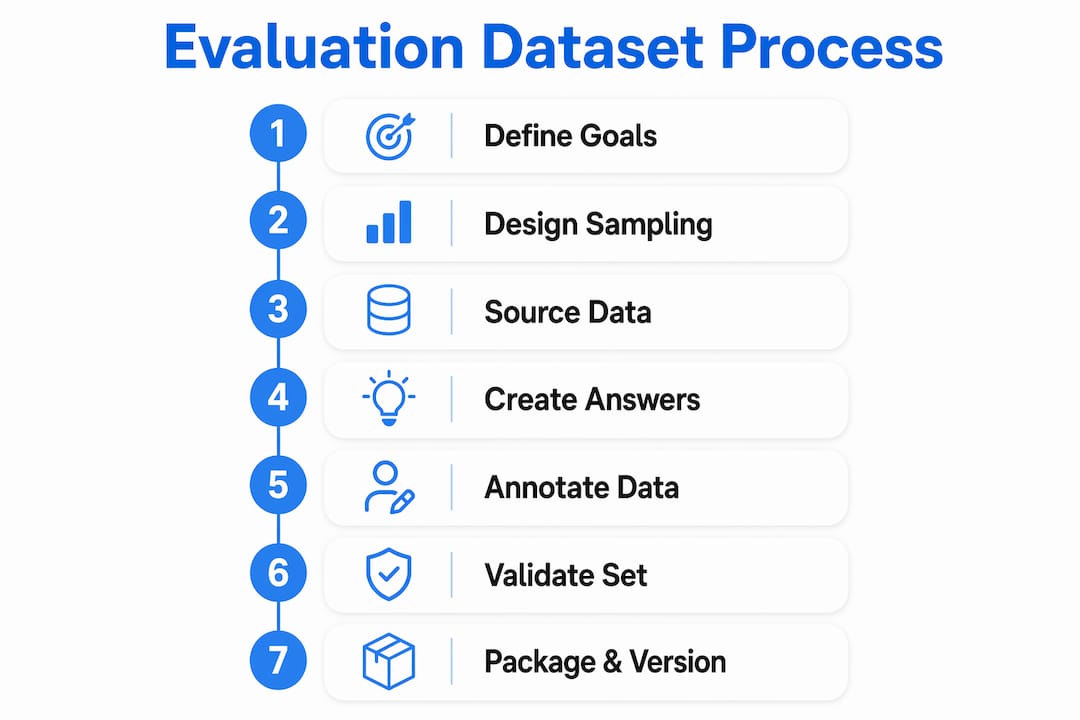
Building a reliable eval dataset is a six-step engineering process, not a one-afternoon task. Here is the runbook.
Step 0: Define evaluation objectives and success criteria. Before you write a single test case, answer two questions: what does "good" mean for this model, and what failure modes are unacceptable? Map your objectives to business metrics. A customer support bot might prioritize resolution rate and hallucination rate. A code assistant might prioritize functional correctness and latency. Write these down as explicit thresholds, not vague goals.
Step 1: Design your sampling strategy. Decide which strata you need to cover: common cases, edge cases, adversarial inputs, demographic slices, and difficulty bins. A dataset that is 95% easy examples will not catch the failures that matter. Aim for intentional coverage of the long tail.
Step 2: Source your data with provenance capture. Pull from production logs (with PII stripped and consent documented), curated user examples, and synthetic generation for rare scenarios. Record the source of every item. Privacy filtering is not optional: if your data contains personal information, you need a documented anonymization step before the item enters the dataset.
Step 3: Create golden answers and rubrics. Anchor every golden answer to verifiable evidence. For factual QA, cite the source document. For generation tasks, write a rubric that specifies what dimensions matter (accuracy, fluency, completeness) and what scores mean. Vague rubrics produce noisy labels. Product teams that align rubric dimensions to business priorities, such as prioritizing recall to catch fraud at the cost of precision, get evaluation results they can actually act on.
Step 4: Run annotation workflows with IAA procedures. Write annotation guidelines before you recruit annotators. Train them on examples. Run a pilot batch, measure IAA, and revise the guidelines if agreement is below your threshold. Spot-check completed batches and have a dispute resolution process for contested items.
Step 5: Validate the dataset automatically. Deduplicate. Run overlap checks against your training corpus to detect leakage. Validate schema compliance for every record. Flag items where the golden answer references a time-sensitive fact without a pinned reference_date.
Step 6: Package and version for automation. Serialize to JSONL or a Pandas-compatible schema. Write a changelog entry. Tag the release. Store the dataset in a location your CI pipeline can pull from, and record the dataset version in every evaluation run's metadata.
Pro Tip: Reproducing large benchmark suites is expensive. IBM Research estimates reproducing aggregated results across 2,200 benchmarks could cost up to $370,000, excluding agentic and multi-turn workflows. Keep your golden set small and focused on business-critical scenarios. Depth beats breadth.
The checklist for a release-ready dataset:
- Objectives and success criteria documented
- Sampling strategy covers all required strata
- Every item has a provenance pointer
- Golden answers are anchored to evidence
- IAA scores meet your threshold
- Deduplication and leakage checks passed
- Schema validated against your eval harness
- Changelog entry written and version tagged
How do you run evaluations and choose the right metrics?
Converting your golden dataset into actionable evaluation results requires three decisions: how to score each item, which metrics to aggregate, and how to interpret multi-dimensional results for production risk decisions.
Scoring approaches. Deterministic scoring works for exact-match tasks: the model's output either matches the golden or it does not. BLEU and ROUGE scores give you n-gram overlap for generation tasks, though both are notoriously poor proxies for semantic quality. Embedding similarity (cosine distance in a shared embedding space) and BERTScore capture semantic equivalence better. For open-ended generation, rubric-driven human judgment or LLM-as-a-Judge is the most practical path.
LLM-as-a-Judge patterns have become the standard approach for non-deterministic outputs. You write a judge prompt that presents the model output alongside the golden answer and rubric, then ask a capable LLM to score the response on each dimension. The key discipline is writing the judge prompt as carefully as you write your golden rubrics. A vague judge prompt produces scores as noisy as a vague human rubric. For high-stakes items, add a human-in-the-loop audit layer to catch systematic judge errors.
Aggregate headline metrics are insufficient on their own. Accuracy and F1 hide item-level failures, and item-level analysis is what reveals construct misalignment and benchmark contamination. Track hallucination rate, latency distribution, consistency across paraphrased inputs, and per-subgroup performance alongside your headline numbers. A model that scores 92% overall but fails on a specific demographic slice or topic category is not ready for production.
Metric selection by trade-off. For fraud detection or medical triage, prioritize recall: missing a true positive is more costly than a false alarm. For a real-time assistant, latency is a first-class metric alongside quality. For a content moderation system, precision matters more than recall if false positives damage user trust. Make these trade-offs explicit in your acceptance criteria before you run a single evaluation.
Pro Tip: Track evaluation metrics at the subgroup level from day one. A model that passes your aggregate threshold but underperforms on a specific topic or user segment will cause production incidents that are expensive to diagnose after the fact.
Aggregation strategy matters too. Report item-level scores, not just means. Segment results by difficulty bin, task type, and any demographic or domain slice you defined in your sampling strategy. Set explicit thresholds tied to your product SLAs, and treat any subgroup that falls below threshold as a blocking issue, not a footnote.
Which tools and frameworks support evaluation at scale?
The tooling ecosystem for evaluation dataset management has matured considerably, but fragmentation remains a real problem. IBM Research's EveryEvalEver project was built specifically to address poor documentation rates and the high cost of repeated evaluation runs by standardizing JSON-format metadata and making prior results reusable.
Key tools and patterns worth knowing:
- Evaluation harnesses: lm-eval-harness provides a standard interface for running LLM benchmarks against a wide range of public datasets. HELM (Holistic Evaluation of Language Models) adds a multi-metric, multi-scenario framework that covers accuracy, calibration, robustness, and fairness in a single run.
- Dataset formats: JSONL is the most portable format for evaluation datasets. Pandas DataFrames work well for in-memory analysis. OpenAI chat format is widely supported for multi-turn evaluations. Platforms like Mlflow accept all three, parsing
conversation_historyandintermediate_eventsautomatically. - Version control for datasets: treat dataset releases like software releases. Use Git-LFS or a dedicated dataset registry for large files. Tag every release with a semantic version and write a changelog entry that describes what changed, why, and what the impact on historical comparisons is.
- CI/CD integration: wire your evaluation harness into your CI pipeline so every model checkpoint triggers an evaluation run against your golden set. Gate promotions on passing your defined thresholds. This turns evaluation from a periodic manual task into a continuous quality gate.
- Cost-aware sampling: for expensive agentic evaluations, run full golden-set evaluations on a schedule (weekly or per major release) and use a prioritized critical-slice subset for every commit. This keeps CI costs manageable without sacrificing coverage on the scenarios that matter most.
Mlflow's AI workflow evaluation integrations connect dataset versions to run metadata, store item-level judge outputs, and surface tracing data for agentic reasoning, giving you a single audit trail from dataset version to deployment decision. For teams building on agent architectures, the ability to capture intermediate events alongside final outputs is the difference between a debuggable system and a black box.
What are the most common evaluation failure modes?
| Failure Mode | Operational Consequence | Mitigation |
|---|---|---|
| Benchmark overfitting | Model optimized for the test, not real users | Rotate held-out sets; use private golden datasets |
| Data leakage | Inflated metrics; production failures | Automated overlap checks vs. training corpus |
| Weak / ambiguous goldens | Noisy metrics; wasted tuning cycles | Rubric-driven annotation with IAA thresholds |
| Poor documentation | Irreproducible results; audit failures | Changelogs, provenance metadata, versioned releases |
| Metadata inconsistency | Broken subgroup analysis; silent regressions | Schema validation on every dataset update |
| Synthetic test mismatch | False confidence; real-world distribution shift | Supplement with production log samples |
Benchmark overfitting is the most insidious failure mode because it looks like success. When your eval set is public or poorly curated, your team optimizes for the benchmark rather than for real-world behavior. The fix is a private, stable golden set that no one outside your evaluation team can see before a run. Rotate a held-out blind test set periodically to catch models that have been inadvertently tuned toward your golden distribution.
Data leakage is the second most common and the hardest to detect without automation. If any item in your evaluation set appeared in your training corpus, even in paraphrased form, your metrics are inflated. Run automated overlap detection before every dataset release and before every training run that uses new data.
The NeurIPS position paper on benchmarking practices makes a pointed argument: community incentives currently undervalue dataset curation, producing inconsistent metadata and licensing that harm reproducibility and fair comparisons. The consequence is not just academic. Teams that cannot reproduce their own evaluation results cannot debug production failures, cannot audit model decisions, and cannot demonstrate compliance.
Pro Tip: When synthetic tests start diverging from your production error distribution, that is a signal to pull a fresh sample from production logs and add it to your golden set. Synthetic data covers the cases you imagined. Production logs cover the cases your users actually sent.
How do you organize evaluation for continuous quality?
Evaluation is not a one-time event. It is a continuous engineering discipline that requires versioning, monitoring, and regression testing to stay meaningful as models and data evolve.
Versioning scheme. Use semantic versioning for your datasets: major versions for changes that invalidate historical comparisons (new rubric, new sampling strategy), minor versions for additions that extend coverage, and patch versions for bug fixes to individual items. Every release gets an immutable tag and a changelog entry. Never modify a released version in place.
Regression testing patterns to implement:
- Scheduled full-suite runs: run your complete golden set on a weekly cadence or before every major release. Store results in your evaluation registry so you can compare any two versions.
- Gated promotions: block model promotion to staging or production if any subgroup falls below its defined threshold. Treat evaluation gates the same way you treat unit test gates in your CI pipeline.
- Canary evaluations on critical slices: for high-stakes scenarios (safety, compliance, core product functionality), run a targeted critical-slice evaluation on every commit. This is fast and cheap compared to a full suite run.
- Telemetry-triggered human review: monitor production telemetry for error spikes, hallucination rate increases, and subgroup drift. When a signal crosses a threshold, trigger a human review of the affected slice before deciding whether to roll back.
Cost control is a real constraint. Reproducing large benchmark suites is expensive, and agentic evaluations with intermediate event traces are more expensive still. Use adaptive sampling: run the full suite on a schedule, run critical slices on every commit, and archive item-level results so you can reuse past run outputs rather than re-running from scratch. EveryEvalEver's approach of standardizing JSON-format metadata for reuse is the right model for teams managing large evaluation portfolios.
For integrating evaluation into AI workflows, the key is making evaluation a first-class step in your deployment pipeline, not an afterthought that happens after the model is already in production.
What does a minimal evaluation dataset schema look like?
Here is a concrete, copy-ready JSONL schema for a single-turn QA test case:
{
  "id": "qa-001",
  "prompt": "What is the capital of France?",
  "reference": "Paris",
  "provenance": "Wikipedia/France, retrieved 2024-11-01",
  "metadata": {
    "task_type": "factual_qa",
    "difficulty": "easy",
    "tags": ["geography", "europe"],
    "annotator_id": "ann-042",
    "iaa_score": 0.97
  }
}
For an agentic trace example, the schema expands:
{
  "id": "agent-007",
  "prompt": "Book a flight from SFO to JFK for next Monday.",
  "reference": "Confirmed booking with flight number, departure time, and confirmation code.",
  "provenance": "synthetic/travel-agent-v2, generated 2025-03-15",
  "intermediate_events": [
    {
      "step": 1,
      "action": "search_flights",
      "input": { "origin": "SFO", "dest": "JFK" },
      "output": "[flight list]"
    },
    {
      "step": 2,
      "action": "select_flight",
      "input": { "flight_id": "AA123" },
      "output": "selected"
    },
    {
      "step": 3,
      "action": "confirm_booking",
      "input": { "passenger": "..." },
      "output": "confirmed"
    }
  ],
  "metadata": {
    "task_type": "agentic_booking",
    "difficulty": "medium",
    "tags": ["travel", "multi-step"],
    "reference_date": "2025-03-17"
  }
}
A few packaging notes worth following:
- Store inputs and references in separate fields, never concatenated, so your eval harness can score them independently.
- Record the model config (model name, version, temperature, system prompt hash) in the run metadata, not in the dataset itself. The dataset is fixed; the model config varies per run.
- Capture judge outputs (scores, rationale, judge model version) as a separate artifact linked to the run ID. This gives you a complete audit trail from golden answer to final score.
Supported formats for most evaluation platforms include JSONL, Pandas DataFrames, and OpenAI chat format. JSONL is the most portable and the easiest to version-control. For multi-turn evaluations, the conversation_history field follows the same structure as the OpenAI messages array, which most platforms parse automatically.
How does Mlflow support evaluation datasets end to end?
Mlflow implements the full lifecycle described in this guide, from dataset registration to automated judge scoring to production tracing, as a connected set of features rather than a collection of separate tools.
Key Mlflow capabilities for evaluation dataset workflows:
- Dataset and version tracking: log your evaluation dataset as a named artifact with version metadata attached to every run. Every evaluation result is permanently linked to the exact dataset version that produced it.
- Run metadata capture: every evaluation run records the model config, dataset version, judge prompt version, and scoring parameters. You can reproduce any historical run from the stored metadata.
- Automated LLM-as-a-Judge integration: Mlflow's LLM-as-a-Judge evaluation framework accepts your rubric, applies it via a configurable judge model, and stores item-level scores alongside the aggregate results. You get per-item rationale, not just a headline number.
- Deep agentic tracing: for agent evaluations, Mlflow captures intermediate reasoning steps, function call logs, and retrieval traces. This is the observability layer that makes agentic system debugging tractable rather than a guessing game.
- Prompt registry and versioning: the Mlflow prompt registry stores judge prompts and system prompts alongside dataset versions, so a change to your judge prompt is as traceable as a change to your golden answers.
- CI/CD integration: Mlflow runs can be triggered from any CI system. Gated promotions based on evaluation thresholds are a standard pattern in Mlflow-based pipelines.
For teams building on frameworks like LlamaIndex or DeepEval, Mlflow integrates at the run-logging layer, capturing evaluation outputs from those frameworks alongside Mlflow's own tracing data. The result is a unified audit trail that spans your entire evaluation stack.
Key Takeaways
Evaluation datasets are the engineering foundation of reliable AI: without a stable, grounded, versioned golden set, every metric you report is an estimate of how well your model fits your pipeline, not how well it serves your users.
| Point | Details |
|---|---|
| Separate eval from training data | Strict separation prevents data leakage and ensures metrics reflect real generalization, not memorization. |
| Build golden sets anchored to evidence | Every test case needs a provenance pointer, explicit rubric, and IAA score before it earns "golden" status. |
| Go beyond aggregate metrics | Track hallucination rate, latency, and per-subgroup performance; item-level analysis reveals failures that headline accuracy hides. |
| Version and changelog every release | Treat dataset releases like software releases with immutable tags and changelogs to keep historical comparisons valid. |
| Mlflow for end-to-end traceability | Mlflow connects dataset versions, run metadata, LLM-as-a-Judge scores, and agentic traces in a single auditable pipeline. |
Why evaluation dataset engineering deserves a seat at the table
The AI field has a recognition problem. Model architecture papers get cited thousands of times. Dataset curation work gets a footnote. That imbalance has a direct operational cost: teams ship models with poorly documented eval sets, discover production failures they cannot reproduce, and spend weeks debugging regressions that a well-maintained golden set would have caught in minutes.
Treating eval dataset engineering as a first-class discipline changes the incentive structure. When dataset work is reviewed, versioned, and credited the same way model work is, teams produce more consistent metadata, better annotation guidelines, and more reproducible results. The NeurIPS position paper on benchmarking makes exactly this argument: the field's current norms around dataset documentation actively harm reproducibility and fair comparison.
The practical implication for your team is straightforward. Assign ownership of the eval dataset to a named engineer or team. Require changelogs. Block model promotions on evaluation gates the same way you block deploys on failing unit tests. The teams that do this ship fewer production incidents and debug the ones they do ship far faster. That is not a philosophical argument. It is an engineering trade-off with a clear return.
Mlflow gives you production-grade evaluation from day one
Most teams cobble together evaluation from a spreadsheet of golden answers, a script that calls an LLM judge, and a Slack message when something looks off. Mlflow replaces that with a connected pipeline: dataset versioning, automated LLM-as-a-Judge scoring, deep agentic tracing, and a prompt registry that keeps every component of your evaluation reproducible.
The concrete advantage over ad hoc tooling is auditability. Every Mlflow evaluation run records the dataset version, judge prompt version, model config, and item-level scores in a single artifact. When a production incident happens, you have a complete paper trail from the golden answer to the deployment decision. For teams subject to compliance or governance requirements, that trail is not optional.
Mlflow is open source, free to use, and integrates with LlamaIndex, DeepEval, and every major model provider. If you are ready to move from ad hoc tests to a production-grade evaluation pipeline, explore Mlflow's LLM-as-a-Judge features and see how automated rubric-driven scoring works in practice.