LLM Evaluation Frameworks Explained for AI Practitioners

LLM evaluation frameworks are standardized software architectures designed to test and measure large language model performance under consistent, auditable, and reproducible conditions. Without them, comparing GPT-4o against Llama 3 or Mistral across benchmarks becomes an exercise in comparing apples to oranges, since every team's custom test harness introduces its own measurement biases. Frameworks like EleutherAI's lm-evaluation-harness and OpenAI's monitorability evaluation suite exist precisely to eliminate those biases. This article covers the core components of these systems, how rubric design shapes model behavior, a comparison of leading open-source options, and practical steps for integrating evaluation into your development and deployment workflows.
What are LLM evaluation frameworks and why do they matter?
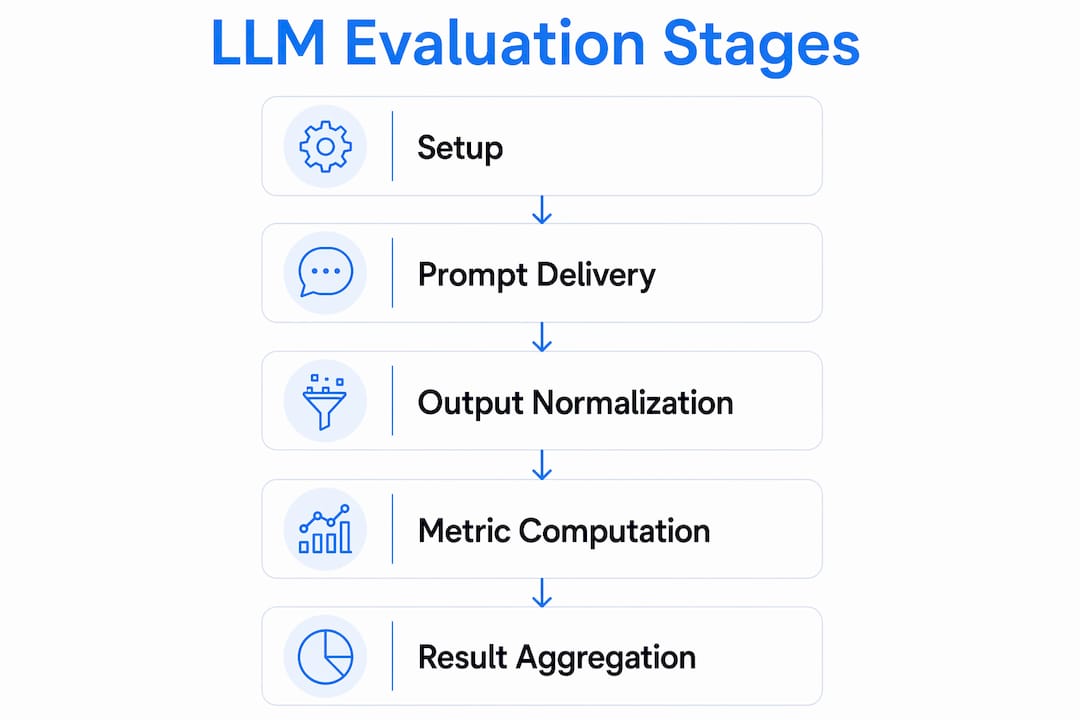
An LLM evaluation framework is a structured pipeline that standardizes every stage of model assessment, from prompt delivery and output collection to scoring and result aggregation. The core reason evaluation results become comparable across teams and papers is the elimination of "measurement degrees of freedom" in prompts, scoring, and aggregation. When each team fixes these variables identically, a score on MMLU or HellaSwag carries the same meaning regardless of who ran the evaluation. That reproducibility is what makes published benchmarks trustworthy rather than marketing.
The practical stakes are high. A team that evaluates a fine-tuned model using a custom prompt template and a different answer extraction heuristic than the original benchmark authors will report scores that cannot be compared to any published baseline. Evaluation frameworks solve this by encoding the exact prompt, normalization logic, and metric computation into a shared, versioned codebase. This is why Hugging Face's Open LLM Leaderboard runs entirely on EleutherAI's lm-evaluation-harness rather than accepting self-reported numbers.

What are the essential components of an LLM evaluation framework?
Every production-grade evaluation framework runs through a defined sequence of stages. Understanding each stage helps you diagnose score discrepancies and customize the pipeline for domain-specific tasks.
- Config loading. A YAML or JSON configuration file specifies which tasks to run, which model backend to use, batch size, and any task-specific overrides. Versioning this file is the first step toward reproducibility.
- Task instantiation. The framework loads benchmark datasets, applies prompt templates, and constructs the exact input sequences the model will receive. Standardized templates are non-negotiable here: even minor wording changes shift scores on sensitive benchmarks.
- Model binding. The framework connects to the model backend through a common interface. In lm-evaluation-harness, this interface exposes three primitives: "generate_until()
,loglikelihood(), andloglikelihood_rolling()`. This modular interface design means you can swap a Hugging Face transformers model for a vLLM-served endpoint without changing a single line of task code. - Batch processing. Requests are batched and dispatched to the model. Fast inference backends like vLLM dramatically reduce wall-clock evaluation time for large models, making nightly evaluation runs feasible in CI pipelines.
- Output filtering. Raw model outputs pass through normalization filters: whitespace trimming, case normalization, and answer extraction logic tailored per benchmark. Variations in these filters are a leading cause of score discrepancies across frameworks, even when the underlying model and benchmark are identical.
- Metric computation and aggregation. Normalized outputs are scored against ground truth using task-specific metrics such as exact match, F1, perplexity, or ROUGE. Results are then aggregated across examples and subtasks into final benchmark scores.
Pro Tip: Version your YAML config files alongside your model checkpoints in the same Git commit. If you can't reproduce a score six months later because the config drifted, the number is scientifically worthless.
How does rubric design affect hallucination and abstention rates?
Rubric design is one of the most underappreciated variables in large language model assessment, and getting it wrong can actively make your model worse. A closed rubric rewards only correct final answers, with no credit for expressing uncertainty or declining to answer. An open rubric explicitly scores calibrated uncertainty and abstention as positive behaviors.
The behavioral consequences are significant. Research published in Nature (2026) shows that evaluation incentives directly change hallucination rates: models evaluated under accuracy-only closed rubrics learn to guess confidently rather than abstain, because abstention yields zero points. Open rubrics that reward well-calibrated uncertainty produce models that adopt abstention strategies and achieve higher reliability scores overall. The implication is that your evaluation design is not just measuring model behavior. It is shaping it.
Key distinctions between the two approaches:
- Closed rubrics score only final answer correctness, making them fast to implement and easy to interpret, but they systematically penalize appropriate uncertainty.
- Open rubrics assign partial or full credit for responses that express calibrated confidence, flag low-certainty answers, or explicitly abstain when evidence is insufficient.
- Scoring visibility matters too: when models are trained with reinforcement learning from human feedback (RLHF) or direct preference optimization (DPO) against evaluation signals, the rubric becomes a training objective in disguise.
"Many teams misattribute reliability problems to model weaknesses; evaluation mechanism design can be the real cause shaping hallucination behavior." — Nature (2026)
If you are building a medical, legal, or financial LLM where overconfident wrong answers carry real costs, open rubric design is not optional. It is a safety requirement. MLflow's LLM-as-a-Judge framework supports configurable rubric definitions that let you encode abstention rewards directly into your automated evaluation pipeline.
What are the leading open-source LLM evaluation frameworks?
Three frameworks dominate serious LLM evaluation work today, each with a distinct design philosophy and ideal use case.
EleutherAI's lm-evaluation-harness is the de facto standard for academic benchmarking. It supports 60+ academic benchmarks and hundreds of subtasks, with native support for Hugging Face transformers, LoRA adapters, and fast inference backends. Its model interface abstraction is the cleanest in the field, which is why Hugging Face's Open LLM Leaderboard uses it as the sole evaluation engine. If you need a number that is directly comparable to published literature, this is your starting point.
Stanford's HELM (Holistic Evaluation of Language Models) takes a multi-metric approach that goes well beyond accuracy. HELM evaluates models across accuracy, calibration, robustness, fairness, bias, toxicity, and efficiency simultaneously. This makes it the right tool when you need a complete picture of model behavior across societal dimensions, not just task performance. The tradeoff is computational cost: a full HELM run is substantially more expensive than a targeted lm-evaluation-harness run.
OpenAI's monitorability evaluation suite addresses a different problem entirely. Rather than measuring what a model outputs, it measures whether a model's chain-of-thought reasoning is informative and legible to human auditors. This matters for safety monitoring: a model that produces correct answers through opaque or deceptive reasoning traces is a liability in high-stakes deployments. The suite includes datasets and reference code to track monitorability over time, supporting frontier model system audits.
| Framework | Primary focus | Benchmark coverage | Key strength | Best for |
|---|---|---|---|---|
| lm-evaluation-harness | Task accuracy | 60+ benchmarks | Reproducibility, speed | Academic comparison, leaderboards |
| HELM | Multi-dimensional | Broad, multi-metric | Fairness and calibration | Societal impact assessment |
| OpenAI monitorability suite | Safety, CoT legibility | Safety-focused | Chain-of-thought auditing | Frontier model safety reviews |
Pro Tip: Run lm-evaluation-harness for your baseline accuracy numbers, then layer HELM's fairness metrics and OpenAI's monitorability checks before any production deployment. Treating these as separate concerns rather than a single pass prevents you from optimizing one dimension at the expense of another.
How can practitioners implement LLM evaluation frameworks effectively?
Translating framework knowledge into a working evaluation pipeline requires deliberate setup choices. Here is how to approach it systematically:
- Install and configure your backend first. For Hugging Face models,
pip install lm-eval[transformers]gets you started. For vLLM-accelerated evaluation, use the--model vllmflag and specify your model path. For API-served models, configure the appropriate API adapter and set rate limit parameters before running any benchmarks. - Pin your prompt templates. Store all prompt templates in version-controlled YAML files. Any change to a template invalidates historical comparisons, so treat template changes the same way you treat schema migrations: with a version bump and documented rationale.
- Customize metrics for your domain. Out-of-the-box exact match scoring is inadequate for open-ended generation tasks. For RAG systems, add ROUGE-L and BERTScore. For code generation, add pass@k. MLflow's custom LLM judges let you define domain-specific scoring rubrics that run automatically alongside standard metrics.
- Integrate evaluation into CI/CD. Schedule nightly evaluation runs against a fixed benchmark suite on every model checkpoint. Set score thresholds as pass/fail gates. A regression in MMLU accuracy of more than 1 percentage point should block a deployment the same way a failing unit test does.
- Audit your filter pipeline. Before trusting any score, inspect the output normalization logic for each benchmark. OpenAI's framework for third-party evaluation explicitly recommends separate audit trails for scoring methods and model versioning to prevent result contamination.
- Watch for benchmark saturation. When a model approaches ceiling performance on a benchmark, scores lose discriminative power. Saturated benchmarks produce accurate but uninformative results. Rotate in harder or more recent benchmarks before saturation makes your evaluation suite useless.
For production observability beyond offline benchmarking, MLflow's AI tracing capabilities let you capture evaluation traces alongside production inference traces, giving you a unified view of model behavior across both contexts.
Key takeaways
Effective LLM evaluation requires standardized pipelines, deliberate rubric design, and framework selection matched to your specific assessment goals.
| Point | Details |
|---|---|
| Standardization drives comparability | Fixing prompts, scoring, and aggregation across runs eliminates measurement noise and makes scores meaningful. |
| Rubric design shapes model behavior | Open rubrics that reward abstention reduce hallucinations; closed rubrics optimized for accuracy alone incentivize overconfident guessing. |
| Framework choice depends on goal | Use lm-evaluation-harness for academic benchmarks, HELM for multi-dimensional assessment, and OpenAI's suite for chain-of-thought safety audits. |
| Filter pipelines require auditing | Output normalization differences across frameworks cause score discrepancies independent of actual model quality. |
| Benchmark saturation is a real risk | Near-ceiling scores lose discriminative power; rotate benchmarks before saturation renders your evaluation suite uninformative. |
Why evaluation framework design deserves more engineering attention than it gets
Most teams I have worked with treat evaluation as an afterthought: something you run once before a release to generate a number for a slide deck. That framing is wrong, and it leads to genuinely bad outcomes.
The most counterintuitive lesson from working with evaluation pipelines is that your evaluation design is a training signal, whether you intend it to be or not. If you use a closed-rubric accuracy benchmark to guide fine-tuning decisions, you are implicitly telling your model that confident wrong answers are better than honest uncertainty. The Nature (2026) findings on this are not theoretical. They show up in production as models that hallucinate fluently rather than flag gaps in their knowledge.
The second issue is benchmark saturation. Teams celebrate hitting 90% on MMLU without asking whether MMLU still discriminates between their model and a model that is meaningfully better. When a benchmark saturates, you are not measuring model quality anymore. You are measuring how well your model memorized the benchmark's distribution. The solution is not to abandon benchmarks but to treat them as perishable assets that need rotation and supplementation with domain-specific tasks.
The third issue is the gap between offline evaluation and production behavior. A model that scores well on held-out benchmarks can still fail in production because the prompt distribution shifts, user inputs are adversarial, or the model's chain-of-thought reasoning is opaque in ways that make failures hard to detect. Monitorability evaluation, as OpenAI's suite demonstrates, is the right response to this gap. Measuring whether reasoning traces are legible to auditors is not a luxury for frontier labs. It is a practical requirement for any team deploying models in regulated or high-stakes environments.
The teams doing this well treat evaluation as a first-class engineering discipline with its own versioning, CI integration, and dedicated ownership. That investment pays back every time a regression is caught before deployment rather than after.
— Kevin
How MLflow supports your LLM evaluation workflows
MLflow provides a production-grade platform for the full LLM evaluation lifecycle, from prompt engineering through automated scoring to production observability. Its LLM-as-a-Judge evaluation framework lets you define custom rubrics, including open rubrics that reward calibrated uncertainty, and run them automatically against model outputs at every stage of development. Deep tracing of agentic reasoning gives your team visibility into chain-of-thought legibility, directly supporting the kind of monitorability audits that safety-conscious deployments require. For teams building and deploying GenAI applications, MLflow's AI platform for agents and LLMs connects evaluation, observability, and deployment into a single governed workflow.
FAQ
What is an LLM evaluation framework?
An LLM evaluation framework is a standardized pipeline that controls prompt delivery, output normalization, metric computation, and result aggregation to produce reproducible, comparable scores across models and benchmarks.
How do I choose between lm-evaluation-harness and HELM?
Use lm-evaluation-harness when you need fast, reproducible accuracy scores comparable to published literature. Use HELM when you need multi-dimensional assessment covering fairness, calibration, and toxicity alongside task performance.
Why do scores differ across evaluation frameworks for the same model?
Score differences typically trace back to variations in output filter pipelines, prompt templates, or aggregation methods rather than actual model quality differences. Standardizing these variables is the core function of a shared evaluation harness.
What is monitorability evaluation and why does it matter?
Monitorability evaluation measures whether a model's chain-of-thought reasoning is informative and legible to human auditors, not just whether the final answer is correct. OpenAI's open-source suite tracks this metric to support safety audits of frontier reasoning models.
How should evaluation integrate with production deployment pipelines?
Evaluation should run as an automated gate in your CI/CD pipeline, with score thresholds triggering pass/fail decisions on every model checkpoint. Combining offline benchmark evaluation with production tracing gives you coverage across both controlled and real-world conditions.