LLM Application Architecture: A 2026 Engineer's Guide

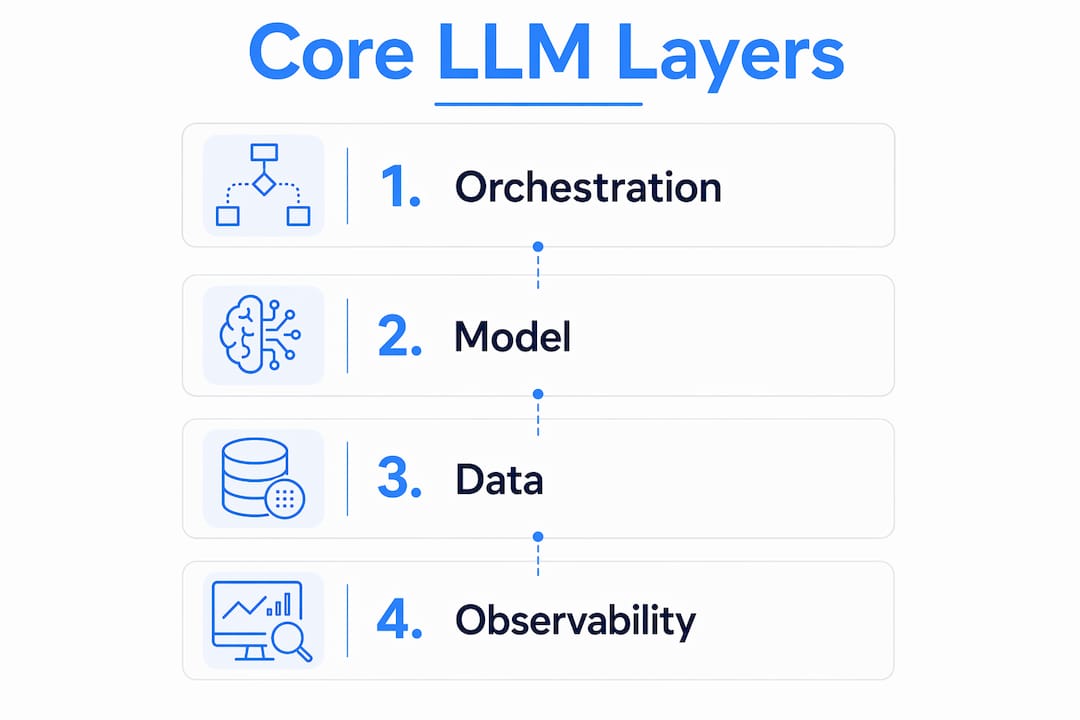
LLM application architecture is defined as the multi-layered system design that converts large language models into reliable, production-ready applications by orchestrating model access, data inputs, and monitoring mechanisms. Understanding what is LLM application architecture means looking well beyond the model itself. The real complexity lives in the four critical layers: Orchestration, Model, Data, and Observability. Each layer handles a distinct set of responsibilities, and together they determine whether your AI system survives contact with real production traffic. Mlflow is built specifically to address these layers, giving engineering teams the tracing, evaluation, and gateway tooling needed to operate LLM systems at scale.
What are the core layers of LLM application architecture?
LLM application architecture decomposes into four layers that each carry distinct responsibilities. Skipping or underbuilding any one of them creates fragile systems that fail in production in ways that are hard to debug.
Orchestration layer
The Orchestration Layer is the control plane of your application. It handles request routing, workflow sequencing, tool calling, and state management across multi-step interactions. Frameworks like LangChain and LangGraph implement this layer through directed graphs and plan-and-execute state machines. Without a well-designed orchestration layer, even the best model produces inconsistent, unreliable outputs.

Model layer
The Model Layer manages how your application accesses and calls language models. This includes model hosting, API gateway configuration, response caching, and fallback strategies when a primary model is unavailable. Modularity at this layer is what lets you swap providers or add fallback chains without rewriting core application logic. A well-abstracted model layer treats the underlying model as a replaceable component, not a hard dependency.
Data layer
The Data Layer governs how your application retrieves and prepares context for the model. Vector stores, document ingestion pipelines, and Retrieval-Augmented Generation (RAG) workflows all live here. This layer determines the factual grounding of your application's responses. A weak data layer produces hallucinations even when the model itself is capable.
Observability and guardrail layer
The Observability and Guardrail Layer monitors everything that happens at runtime. It covers logging, tracing, hallucination detection, safety enforcement, and output validation. This layer is what separates a prototype from a production system. Without it, you are operating a black box.
| Layer | Primary components | Core function |
|---|---|---|
| Orchestration | LangGraph, workflow engines, state machines | Route requests, manage state, call tools |
| Model | API gateways, caching, fallback chains | Access and manage model calls |
| Data | Vector DBs, RAG pipelines, document ingestion | Retrieve and prepare context |
| Observability | Tracing, metrics, guardrails, judge frameworks | Monitor, validate, and enforce safety |
Pro Tip: Design each layer behind a clean interface. When you need to swap a vector database or upgrade a model provider, you change one module, not the entire application.
How does modern LLM architecture treat distributed system challenges?
Production-grade LLM systems treat architecture as a distributed system problem, not a simple API integration. LLM workloads are non-deterministic and latency-heavy by nature. That combination demands async handling, message queues, and careful session memory management that most teams underestimate at the start.
The infrastructure surrounding the model matters as much as the model itself. Dedicated API gateways enforce rate limits and authentication. Caching layers reduce redundant model calls and cut costs. Session memory management preserves conversation context across requests without blowing through context window limits. Each of these components requires its own design decisions.
Multi-model routing strategies add another dimension of complexity. Capability-based routing sends complex reasoning tasks to larger models and simple classification tasks to smaller, cheaper ones. Cost-aware routing dynamically selects models based on budget thresholds. Latency-aware routing prioritizes speed for user-facing interactions. Hybrid patterns combine all three signals to make routing decisions at runtime.
Distributed LLM systems also face failure modes that traditional web services do not. The following challenges are specific to LLM applications in production:
- Context window overflow: Conversations that exceed token limits silently truncate history, causing incoherent responses.
- Non-deterministic outputs: The same prompt can produce different outputs across calls, making regression testing harder.
- Cascading latency: A slow embedding call or a reranking step can push total response time past acceptable thresholds.
- Rate limit collisions: Multiple concurrent users hitting the same model provider endpoint without a gateway causes request failures.
- Memory state drift: Long-running agent sessions accumulate stale context that degrades response quality over time.
Pro Tip: Observability for LLMs goes far beyond standard API logging. You need to trace reasoning chains, track token costs per request, and use LLM-as-a-Judge frameworks to evaluate output quality automatically.
What are advanced architectural patterns used in LLM applications?
Advanced LLM application structure relies on a set of well-established design patterns. Each pattern addresses a specific production requirement, and most real systems combine several of them.
Retrieval-Augmented Generation pipelines
RAG pipelines are the most widely deployed pattern for grounding LLM responses in real data. RAG improves factuality by loading relevant data chunks through embedding-based search before the model generates a response. The pipeline runs through document ingest, chunking, embedding generation, vector DB storage, retrieval, reranking, and prompt assembly. Each step introduces a potential failure point, which is why hybrid search combining keyword-based and vector search indexes is the production standard. Relying on vector search alone misses exact-term queries that semantic search handles poorly.
Agent architectures
Agent architectures enable LLMs to call external tools and APIs, supporting complex workflows with plan-and-execute state machines. An agent does not just generate text. It decides which tool to call, interprets the result, and plans the next step. LangGraph implements this as a directed graph where each node represents a reasoning or action step. This pattern transforms a language model from a text generator into an AI system that can complete multi-step tasks.
Model routing patterns
Different routing patterns suit different use cases. The table below maps each pattern to its tradeoffs:
| Pattern | Use case | Latency | Cost | Quality |
|---|---|---|---|---|
| Single model | Simple Q&A, low complexity | Low | Low | Moderate |
| Sequential | Multi-step reasoning chains | High | Medium | High |
| Parallel | Ensemble outputs, redundancy | Medium | High | Very high |
| Hierarchical | Routing by task complexity | Low to medium | Optimized | High |
| Ensemble | Critical decisions, voting | High | Very high | Highest |
Prompt management as code
Treating prompts as code means versioning them in Git, decoupling them from orchestration logic, and A/B testing them in production without redeployments. This approach directly improves experimentation velocity. Teams that manage prompts as first-class artifacts can iterate on model behavior without touching application code. Mlflow's centralized AI Gateway supports this pattern by providing a single control point for prompt versioning and cross-provider governance.
How to ensure robustness, observability, and safety in LLM applications?
Production failures in LLM systems stem mostly from orchestration issues, not model quality. Missing retry logic, poor context window management, and unhandled tool call failures cause the majority of outages. Fixing these requires deliberate design at the orchestration layer, not a better model.
Observability for LLM systems covers a wider surface than traditional application monitoring. Tracing, token cost tracking, hallucination detection, and guardrail violation metrics are all required for a complete picture of system health. Mlflow's LLM tracing capabilities instrument agentic reasoning at the step level, giving you visibility into exactly where a multi-step workflow went wrong. That level of detail is not available from standard API logs.
Safety guardrails operate at both the input and output stages. Input validation and prompt sanitization block injection attacks before they reach the model. Output filtering and content safety checks catch harmful or off-topic responses before they reach the user. These guards should be decoupled from core orchestration logic so you can update them independently.
Key monitoring metrics and safety techniques for production LLM systems include:
- Token usage per request: Tracks cost and flags context window abuse.
- End-to-end latency by step: Identifies bottlenecks in RAG pipelines or tool call chains.
- Hallucination rate: Measured through LLM-as-a-Judge evaluation against ground truth.
- Guardrail trigger rate: Tracks how often safety filters activate, signaling prompt injection attempts or model drift.
- Retry and fallback frequency: High rates indicate upstream reliability problems that need architectural fixes.
- Prompt version performance: Compares output quality across prompt versions to guide safe rollouts.
Pro Tip: Treat prompts as versioned artifacts and decouple your safety guards from your core orchestration logic. This lets you update guardrails or roll back a prompt change without a full application redeploy.
Key Takeaways
LLM application architecture succeeds when it treats orchestration, data, model access, and observability as equal engineering concerns, not afterthoughts.
| Point | Details |
|---|---|
| Four-layer structure | Every production LLM system requires Orchestration, Model, Data, and Observability layers working together. |
| Orchestration causes most failures | Missing retry logic and poor context management cause more outages than model quality issues. |
| RAG grounds responses in real data | Hybrid search combining vector and keyword indexes is the production standard for reliable retrieval. |
| Prompts are code | Version prompts in Git, decouple them from logic, and A/B test in production without redeploys. |
| Observability goes beyond logging | Tracing reasoning chains and using LLM-as-a-Judge evaluation are required for production reliability. |
Why architecture is the real work in LLM engineering
The most common mistake I see from teams building LLM applications is treating the model as the product. They spend weeks on prompt tuning and model selection, then ship a system with no retry logic, no tracing, and no fallback chain. The first time the primary model provider has an outage, the entire application goes down.
The model is one component. The architecture is the product. I have watched teams rebuild their entire data layer three months after launch because they chose a vector database that could not handle their retrieval patterns at scale. That kind of rework is avoidable when you design the layers explicitly from the start.
Modularity is not a nice-to-have. It is the property that lets you swap a model provider, upgrade a RAG pipeline, or tighten a guardrail without a full system rewrite. Teams that build behind clean interfaces move faster six months in. Teams that hardcode dependencies spend that time firefighting.
Start simple. A single model, a basic RAG pipeline, and minimal tracing will teach you more about your actual failure modes than any architecture diagram. Add complexity only when a specific production problem demands it. The LLM observability framework you instrument early will tell you exactly where to invest next.
The structured data audit tools available for LLM-optimized systems are also worth evaluating early, particularly if your application surfaces content that needs to be discoverable by AI-powered search.
— Kevin
Mlflow for LLM application architecture and observability
Building a production LLM application means managing tracing, evaluation, prompt versioning, and agent orchestration across every layer of your system. Mlflow's GenAI and agent engineering platform brings all of those concerns into one place.
Mlflow provides deep tracing of agentic reasoning at the step level, so you can see exactly where a multi-step workflow fails. Its LLM-as-a-Judge evaluation framework automates output quality assessment against your own criteria, replacing manual review with a repeatable, scalable process. The centralized AI Gateway handles prompt versioning and cross-provider governance, so your team can experiment safely without touching production code. For teams moving from prototype to production, Mlflow's AI observability tooling gives you the visibility to operate reliably at scale.
FAQ
What is LLM application architecture?
LLM application architecture is the structured, multi-layered system design that integrates a language model with orchestration logic, data retrieval, and observability tooling to produce a reliable production application. It covers the Orchestration, Model, Data, and Observability layers as defined by industry standards.
What causes most failures in production LLM systems?
Production failures stem mostly from orchestration issues such as missing retry logic and poor context window management, not from model quality. Robust async handling and state management at the orchestration layer reduce these failure risks significantly.
What is a RAG pipeline in LLM architecture?
A RAG pipeline retrieves relevant data chunks through embedding-based search and injects them into the prompt before the model generates a response. The standard production implementation uses hybrid search combining vector and keyword indexes to cover both semantic and exact-term queries.
How does multi-model routing work in LLM systems?
Multi-model routing selects which model handles a given request based on capability, cost, or latency signals. Fallback chains route to cheaper or local models progressively when the primary model is unavailable or over budget.
Why should prompts be treated as code?
Versioning prompts in Git and decoupling them from orchestration logic lets teams A/B test prompt changes in production without redeployments. This practice improves experimentation velocity and makes it safe to roll back a prompt change that degrades output quality.