When Can an LLM Judge Another LLM's Output?

LLM-as-a-Judge works, but only under specific conditions: you validate the judge against a human-labeled gold set, you measure agreement with chance-corrected statistics, and you keep monitoring after deployment. Skip validation and you're shipping a black box that scores your production traffic with no idea whether its verdicts mean anything.
If you're standing at the "should we use this" decision point right now, here's the immediate checklist before you write a single rubric:
- Pick a stronger judge. Use a more capable model than the one you're evaluating, and ideally from a different model family, to reduce self-preference bias.
- Define a rubric before you prompt. Write the scoring criteria down as if you were briefing a human annotator, not an LLM.
- Validate on a gold set. Label a small representative set of examples by hand, run your judge against them, and compute Cohen's kappa or Krippendorff's alpha, not just raw percent agreement.
The go/no-go threshold is simple: if your judge's chance-corrected agreement with human raters lands in the "substantial" range or higher, you can automate. If it doesn't, you're not ready. That's the whole verdict. Everything below explains why it works this way, and how to build it properly.
Key Takeaways
LLM-as-a-Judge delivers reliable, scalable evaluation only when paired with human gold-set validation, chance-corrected agreement metrics, and continuous bias monitoring.
| Point | Details |
|---|---|
| Validate before trusting | Build a 30 to 50 example gold set and compute Cohen's kappa or Krippendorff's alpha, not raw agreement. |
| Choose judge model carefully | Use a stronger, different-family model than the one being evaluated to limit self-preference bias. |
| Test for known biases | Run position-swap checks and length-control regressions before deploying any pairwise or scored judge. |
| Prefer simple scales | Binary pass/fail rubrics produce more consistent verdicts than open-ended Likert scoring. |
| Instrument for production | Mlflow's tracing and AI Gateway let teams log full judge reasoning chains and version rubrics like code. |
Table of Contents
- What LLM-As-A-Judge Actually Means
- Building the Evaluation Pipeline Step by Step
- Writing Prompts and Scoring Formats That Actually Parse
- The Biases That Quietly Corrupt Judge Scores
- The Validation Recipe: Gold Sets, Kappa, and Ongoing Checks
- Your Implementation Checklist for Production
- How MLflow Fits Into the Judge Pipeline
- What I'd Actually Tell a Team Starting This Today
- Put Your Judge Pipeline on Solid Ground
- Sources
What LLM-As-A-Judge Actually Means
LLM-as-a-Judge is an evaluation method where a language model scores another AI system's output using a natural-language rubric instead of a fixed formula. Rather than counting overlapping word sequences the way BLEU or ROUGE does, the judge model reads the output, applies criteria you've written in plain English, and returns a structured verdict.
There are two axes worth knowing before you build anything. The first is reference-free versus reference-guided: a reference-free judge scores an output on its own merits (is this answer helpful, accurate, safe?), while a reference-guided judge compares the output against a known correct answer or a gold response. The second axis is pointwise versus pairwise: pointwise judging assigns a score to a single output in isolation, while pairwise judging shows the judge two candidate outputs and asks which one is better. A comprehensive academic survey on LLM-as-a-Judge formalizes this taxonomy and treats reliability, not raw capability, as the central open problem in the field.
The reason this method caught on so fast is straightforward: n-gram metrics can't tell you if a chatbot response is polite, if a RAG answer is grounded in the retrieved context, or if a summary preserves the source's actual meaning rather than just its vocabulary. An LLM judge can assess all of that because it's reasoning about semantics, not string overlap.
Where does this actually get used in production systems?
- Chatbot and assistant quality scoring, where tone, helpfulness, and coherence matter more than exact phrasing.
- RAG evaluation, checking whether a generated answer is faithful to retrieved documents rather than just fluent.
- RLHF and preference data generation, where pairwise judging can substitute for or supplement human preference labeling at scale.
- Agent evaluation, scoring multi-step reasoning traces where the final answer alone doesn't tell you whether the agent's process was sound.
Building the Evaluation Pipeline Step by Step
Every LLM-as-a-Judge pipeline has the same four moving parts, regardless of what you're evaluating: input composition, judge prompt, structured output, and aggregation. Get any one of these wrong and your scores become noise that happens to look like signal.
- Input composition. Decide what the judge actually sees: the candidate output alone, the output plus a reference answer, the output plus the original context (retrieved documents, conversation history), or two candidates side by side for pairwise comparison. What you feed in determines what kind of judgment you can get out.
- Rubric design. Write the scoring criteria explicitly, the same way you'd brief a new human annotator. Decide your scale here: binary pass/fail is the most reliable and easiest to audit; a Likert scale (1 to 5) gives you finer granularity but introduces more disagreement between runs; additive scoring, where you sum points across several sub-criteria (accuracy, tone, completeness), works well for composite quality attributes but requires more rubric engineering up front.
- Judge call and structured output. Send the rubric and inputs to the judge model and require a structured response, ideally JSON, with a score field and a rationale field separated cleanly.
- Aggregation. Combine scores across examples, and if you're running multiple judges or repeated calls, decide how disagreement gets resolved (majority vote, averaging, or flagging for human review).
On operational architecture, you have three real choices. A single-call judge is one model making one pass, cheap and fast but the most exposed to individual model quirks. An agent-as-judge setup lets the judge use tools, like a code interpreter or a search function, to verify claims before scoring, which helps with factual grounding checks. A multi-judge panel runs the same input through several models and aggregates, trading cost for robustness against any single model's blind spots.
Pro Tip: Start with a single-call judge and a binary rubric. It's tempting to build a five-model panel with a nine-point Likert scale on day one, but you can't tell if your added complexity is helping until you've measured the baseline it's supposedly improving on.
Writing Prompts and Scoring Formats That Actually Parse
The single biggest source of wasted engineering time in LLM-as-a-Judge work isn't bad models, it's judge outputs that don't parse cleanly. Fix your output format before you touch your rubric wording.
Require structured JSON with explicit fields every time. A reasonable minimum schema includes a score field (constrained to your chosen scale), a rationale field (a short natural-language explanation), and an evidence field (a quote or reference pointing to the specific part of the output that drove the score). Hugging Face's evaluation cookbook recommends exactly this pattern, paired with iterative prompt refinement against a small labeled set, and treats structured output as non-negotiable for anything you plan to run at scale.
On prompting patterns, three approaches cover most cases:
- Rubric-first prompting puts your scoring criteria at the top of the prompt, before the content to be judged, so the model anchors on your standard rather than its own default sense of "good."
- Few-shot examples show the judge two or three scored examples (including edge cases and disagreements) before asking it to score the real input, which measurably tightens consistency.
- Chain-of-thought prompting, asking the judge to reason step by step before outputting a score, helps when you need explainability for a human reviewer, though it costs more tokens and can occasionally let the model talk itself into a worse answer.
On scale choice: prefer binary pass/fail wherever the task allows it, because two humans agree on "did this violate the safety policy, yes or no" far more reliably than they agree on "rate helpfulness 1 to 10." Langfuse's evaluation documentation frames this as a rubric-first design principle: build structured verdicts around the smallest scale that still captures the distinction you care about, and reserve additive multi-criterion scoring for genuinely composite attributes where a single number would hide too much.
Pro Tip: If your rationale field regularly runs longer than your rubric, that's a signal the rubric is under-specified. A good rubric makes the judge's job boring. If the model has to work hard to justify its score, you've left too much interpretation on the table.
The Biases That Quietly Corrupt Judge Scores
Every LLM judge inherits systematic biases, and if you don't test for them, they will silently reshape your evaluation results in ways that look like real signal.
Position bias is the most documented failure mode in pairwise judging: the judge tends to favor whichever answer appears first (or second, depending on the model) regardless of actual quality. The fix is a position-swap check, running every pairwise comparison twice with the candidates in both orders and flagging cases where the verdict flips.

Verbosity bias means judges reward longer answers even when length adds no informational value, and format bias means judges reward outputs with markdown structure, headers, and bullet points over equally correct plain-text answers. Practitioner analyses of production judge deployments identify both as consistent, measurable patterns rather than occasional edge cases, which is why a length-control regression belongs in your validation suite from day one.
Self-preference bias shows up when the judge and the evaluated model share a family or training lineage: the judge rates its relatives' outputs more favorably than an independent judge would. This is exactly why judge selection matters as much as rubric design, and why a stronger, different-family judge model reduces this specific risk rather than just improving raw judgment quality.
There's also a sharper adversarial angle worth knowing: outputs can contain tokens or phrasing specifically crafted to manipulate the judge's scoring, independent of actual output quality, a risk the academic survey on LLM-as-a-Judge flags as an open reliability concern rather than a solved problem.
The core statistical warning across this research: raw percent agreement between judge and human overstates reliability, because two raters can agree by chance alone on skewed distributions. That's exactly why chance-corrected measures like Cohen's kappa matter more than the agreement percentage most teams report first.
The Validation Recipe: Gold Sets, Kappa, and Ongoing Checks
Trust in an LLM judge isn't something you establish once and forget. It's a recipe you run before launch and repeat on a schedule.
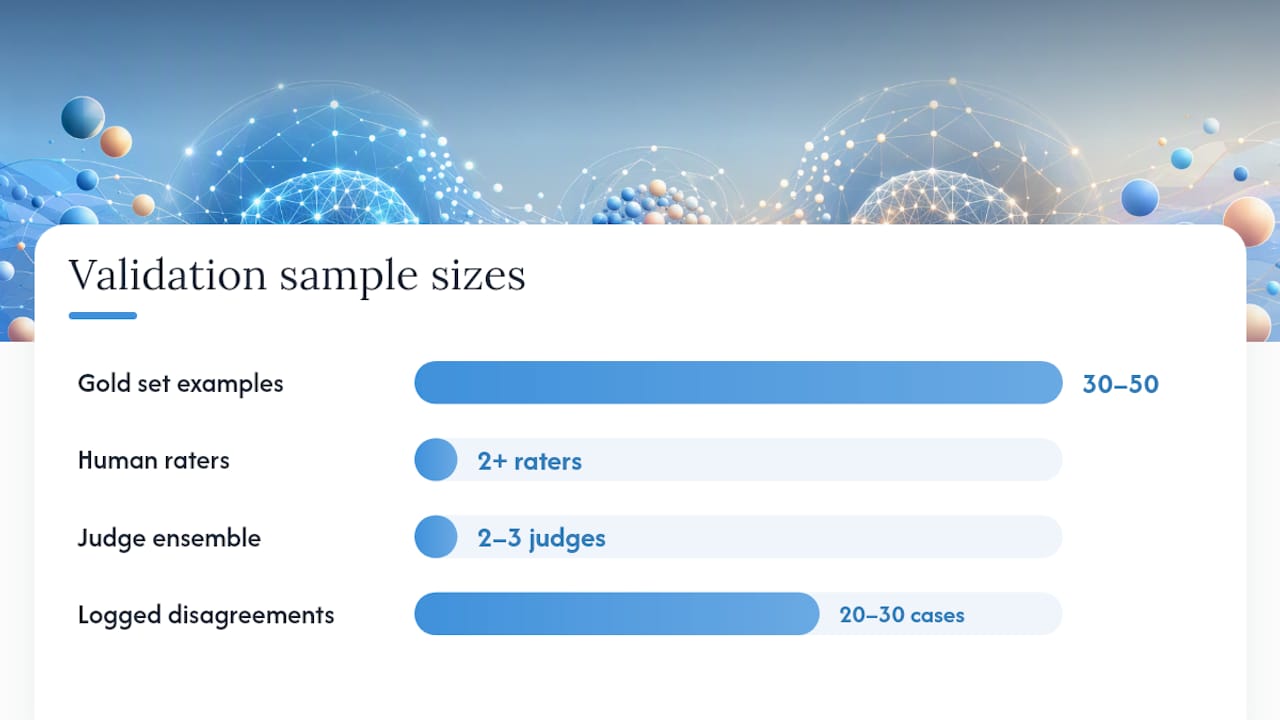
- Build a gold set. Sample 30 to 50 examples that represent the real distribution of inputs your judge will see in production, not just the easy cases. Hugging Face's cookbook treats roughly 30 human-labeled examples as a workable starting point for initial calibration, enough to catch obvious rubric problems before you scale.
- Have humans label it independently. Two or more human raters score the same examples without seeing each other's judgments or the model's output, so you get a genuine independent baseline.
- Compute chance-corrected agreement. Calculate Cohen's kappa (for two raters) or Krippendorff's alpha (for more than two, or for ordinal scales). The academic survey on LLM-as-a-Judge specifically recommends these over raw percent agreement, since percent agreement inflates apparent reliability whenever most examples land in the same easy category.
- Apply mitigations before you re-test. Run order-swap averaging for pairwise setups, ensemble across two or three judge models and take the majority verdict, add a length-control regression to check whether score correlates with output length more than it should, and where possible, switch to reference-guided judging so the model has a concrete anchor instead of an open-ended quality assessment.
Rubric decomposition helps here too: instead of asking one judge call to score "overall quality," split it into separate calls for accuracy, tone, and completeness, then combine the sub-scores. It's more expensive, but each sub-judgment is easier for both the model and your validation process to get right.
Once you're in production, validation isn't a one-time gate. Schedule periodic revalidation against a refreshed gold set, since model updates (yours or the judge provider's) can silently shift scoring behavior. Watch for drift by tracking the judge's score distribution over time and flagging sudden shifts, and keep a small stream of human spot checks running continuously, not just at launch.
Pro Tip: Log every gold-set disagreement with a note on why the judge got it wrong. After 20 or 30 of these, you'll usually spot a pattern, like the judge systematically undervaluing terse-but-correct answers, that's worth a targeted rubric fix rather than a full re-architecture.
Your Implementation Checklist for Production
Here's the sequence, in order, for taking LLM-as-a-Judge from idea to production system.
- Select the judge model. Choose a stronger model than the one being evaluated, preferably from a different family, to limit self-preference bias.
- Draft the rubric. Write it as plain-language scoring criteria, choose your scale (binary first, if at all possible), and get a colleague to sanity-check it against a handful of examples by hand.
- Build the gold set. Thirty to fifty representative examples, labeled independently by at least two humans.
- Run validation tests. Compute Cohen's kappa or Krippendorff's alpha, run position-swap checks on pairwise setups, and run a length-control regression.
- Deploy with structured logging from day one. Don't bolt this on later.
For observability, log every one of these fields on every judge call: the input prompt, the candidate output, the reference (if any), the structured verdict, the rationale text, judge model metadata (name, version, temperature), call latency, and per-call cost. Set alert thresholds on score distribution shifts and on latency or cost spikes, since a silent provider-side model update can change your judge's behavior overnight without touching your code.
- Batch judge calls where latency isn't critical to cut cost.
- Cache verdicts for identical or near-identical inputs, especially in regression testing.
- Fall back to human review for high-stakes decisions (safety violations, legal content, medical claims) regardless of how well your judge has validated on lower-stakes categories.
Pro Tip: *Treat your judge's cost-per-thousand-evaluations as a first-class metric next to accuracy.
How MLflow Fits Into the Judge Pipeline
The checklist above only works if you can actually see what your judge is doing, which is the observability problem MLflow is built to solve. MLflow's tracing captures the full agentic reasoning chain behind a judge call, not just the final score, so when a verdict looks wrong you can trace back through the exact prompt, intermediate steps, and rationale that produced it.
For the automated evaluation workflows described above, MLflow supports:
- Structured trace logging for every judge call, including prompt, candidate output, reference, verdict, and model metadata, matching the observability fields your checklist calls for.
- A centralized AI Gateway for versioning judge prompts across providers, so a rubric change is tracked the same way you'd track a code change.
- Evaluation workflows for running gold-set validation and revalidation jobs on a schedule rather than manually.
If you're building this pipeline from scratch, MLflow's evaluation tooling gives you a place to run the gold-set comparison and log the resulting agreement metrics alongside your production traces, instead of maintaining a separate spreadsheet nobody trusts by the third quarter.
What I'd Actually Tell a Team Starting This Today
Adopt LLM judges to speed up iteration, not to eliminate human judgment. The realistic gain is velocity: you can evaluate a thousand outputs overnight instead of waiting a week for human annotators, which changes how fast you can catch a regression. But for anything genuinely high-stakes, a safety-critical decision, a legal claim, a medical suggestion, humans stay in the loop regardless of how well your kappa scores look.
The research gaps that matter most right now are adversarial robustness (judges are still easy to manipulate with the right token sequences), meta-evaluation standards for auto-annotation pipelines, and reproducible benchmarks that don't get stale the moment a provider updates a model. Treat judge development like model engineering: version your rubrics, run regression tests before every prompt change, and put it in CI. A judge that isn't tested like code isn't infrastructure, it's a guess with better prompt formatting.
— Kevin
Put Your Judge Pipeline on Solid Ground
Once you've built a rubric and validated it against a gold set, the harder problem is keeping that judge honest over months of production traffic, catching drift, tracking cost, and knowing exactly which prompt version produced which verdict six weeks ago. That's infrastructure work, not a one-off script, and it's where most teams quietly lose confidence in their own evaluation numbers.
Mlflow gives you that infrastructure without asking you to build an observability stack from scratch. Deep tracing captures the full reasoning chain behind every judge call, the AI Gateway versions your rubrics and prompts the way you'd version code, and built in evaluation workflows let you run gold-set revalidation on a schedule instead of remembering to do it manually. If you're testing your judge against adversarial or edge-case inputs, MLflow's red-teaming cookbook walks through exactly that workflow. For teams ready to move past ad hoc scripts, MLflow's GenAI and agent engineering platform is a solid place to start building the pipeline described above, and it costs nothing to try since the core platform is open source.