Stop 2 AM Failures: Multi Agent Workflows for Engineers
The most reliable multi agent workflows enforce three things at once: typed interfaces between agents, orchestration decisions made at execution time rather than baked into a static graph, and centralized observability across the whole run. Skip any one of those and you get drift, silent failures, or a system nobody can debug at 2 a.m. The core patterns are typed I/O schemas, action schemas that limit each agent to one valid move per turn, and a Planner-Evaluator-Updater loop that adapts the plan as task state changes. MLflow is one of the few production platforms built to trace, evaluate, and govern that stack end to end.
TL;DR:
- Enforcing strict typed schemas for agent payloads prevents silent failures and interface drift that can lead to incorrect outputs in multi agent workflows.
- An explicit, structured task state object enables better debugging, auditability, and decision-making, reducing black-box behavior during failures.
- Dynamic, runtime-adaptive workflows outperform fixed sequences in complex tasks that require ongoing adjustments based on previous results.
- Implementing comprehensive controls like correlated tracing, budget enforcement, and replay logging is crucial for operational reliability in production environments.
- Using versioned schemas, strict credentials scoping, and careful fallback strategies minimizes errors, security risks, and cost escalations as workflows scale.
Table of Contents
- What Makes Multi Agent Workflows Fail (And How to Fix It)
- Designing the Orchestration and Control Layer
- Should Your Workflow Adapt at Runtime or Stay Fixed?
- Operational Controls Every Production Agent Fleet Needs
- A Practitioner Checklist for Shipping Multi Agent Workflows
- How MLflow Supports Production-Grade Agent Engineering
- Versioning Workflow Components Without Breaking Production
- Coordination Protocols Beyond MCP
- Security and Access Control Across an Agent Fleet
- Scaling Multi Agent Workflows Without Losing Control
- Error Handling and Fallback Design
- Getting Latency and Cost Down Without Cutting Reliability
- What Nobody Tells You About Shipping These Systems
- Start Building With MLflow's Agent Engineering Tools
- Sources
What Makes Multi Agent Workflows Fail (And How to Fix It)
Most multi agent workflow failures trace back to one root cause: agents talking to each other in freeform natural language. When Agent A hands Agent B a paragraph instead of a structured payload, small ambiguities compound. A missing unit, an implied default, a synonym the receiving agent parses differently than intended. Over a ten-step chain, that drift turns into a wrong answer nobody can trace back to its origin. Enforcing typed schemas and an MCP-style enforcement layer reduces agent hallucination and interface drift, which research identifies as the leading cause of these breakdowns.
The fix starts at the interface, not the prompt.
- Define typed I/O schemas (JSON Schema or Protocol Buffers) for every handoff, so a malformed payload fails validation instead of silently corrupting downstream state.
- Constrain agent outputs with action schemas: one valid action per turn, from an enumerated set, never open-ended text.
- Treat schema violations as contract failures. Validate every handoff with a machine-checkable schema and route violations to retry, repair, or escalation logic, not straight to the user.
- Push enforcement into a middle layer, similar to how the Model Context Protocol standardizes tool and data access, so validation is a guarantee rather than a convention every team member has to remember.
Pro Tip: Log every schema rejection with the payload that triggered it. Those rejected payloads are the fastest way to find where your agent instructions are ambiguous, long before a user ever notices.
Designing the Orchestration and Control Layer
The orchestrator is the one component in a multi agent workflow that has visibility across the whole run, and its job list is longer than most teams assume. It plans task decomposition, schedules subagent calls, tracks dependencies between tasks, manages shared state, retries failed steps, and enforces token or budget ceilings so one runaway agent doesn't blow the whole run's cost target.
Agent orchestration requires the same architecture and governance primitives as production systems: a control unit, execution units, telemetry, and governance modules working together, not bolted on after the fact.
Two protocols do different jobs in this stack, and mixing them up is a common design mistake:
- MCP (Model Context Protocol) governs how an agent talks to tools and data sources. It's the interface between an agent and the outside world.
- A2A (agent-to-agent) governs how agents talk to each other. Enforcement here means typed messages, explicit roles, and no direct replies to the end user from a subagent.
Persist task state explicitly, not implicitly in a message history. A structured state object, updated after every step, gives you both a working memory the orchestrator can condition decisions on and an audit trail you can replay later. That state object is what separates a debuggable system from a black box.
Should Your Workflow Adapt at Runtime or Stay Fixed?
Static, one-shot workflows plan the whole agent sequence up front and never revisit it. That works fine for short, predictable tasks. It falls apart on long-horizon work where the right next step depends on what happened three steps ago.
The alternative is a Planner-Evaluator-Updater pipeline: a planner proposes the next stage, an evaluator checks the current task state against progress so far, and an updater revises the plan before the next agent runs. Execution-time workflow construction produces stage-specific workflows that adapt as task state evolves, and this pattern outperforms static workflows on tasks that unfold over many turns.
Use this decision logic when choosing an architecture:
- Fixed workflow: Task steps are known in advance, low variance between runs, cost and latency matter more than adaptability.
- Planner-Evaluator-Updater: Task length or shape is unpredictable, intermediate results change what should happen next, or you're running an orchestrated multi-agent workflow across heterogeneous specialist agents.
- Single-agent multi-turn simulation: A single LLM reusing KV cache across turns can match or exceed homogeneous multi-agent workflows on many benchmarks, at a fraction of the token cost, when you don't actually need model diversity.
The single-agent baseline has a real limit: it can't simulate genuine heterogeneity. If your task benefits from different models with different strengths, or truly independent reasoning paths that catch each other's errors, collapsing to one agent throws that benefit away.
Operational Controls Every Production Agent Fleet Needs
Treat agent orchestration governance the way you'd treat container orchestration: as a first-class engineering problem, not an afterthought bolted on before launch. Centralized observability, audit logging, automated retries, and token or budget controls are the primitives that separate a production system from a demo.
Five controls matter most in practice:
- Correlated tracing. Every subagent run needs a parent run ID so a failure three layers deep can be traced back to the top-level request that triggered it.
- Token and budget enforcement. Set hard ceilings per run and per agent, with automatic fallback to a cheaper model when a budget threshold is crossed.
- Fail-closed on unauthorized actions. An agent that hits a permission boundary should stop and escalate, never guess and proceed.
- Durable execution with dead-letter handling. Failed steps go to a queue for inspection instead of silently disappearing from the run.
- Replay and time-travel debugging. Every step's inputs, outputs, and intermediate state should be reconstructable after the fact.
That last point matters more than most teams realize during incident review. Without replay, you're debugging a distributed system with no logs, which is close to impossible once more than two agents are involved in a failure.
A Practitioner Checklist for Shipping Multi Agent Workflows
Subagent instructions need two things every parent agent should enforce: the single-response principle (only the orchestrator replies to the end user) and a distinct knowledge source per subagent, so two agents never contradict each other from the same underlying data. Design parent instructions to always combine child findings and pass a "no direct reply" constraint in both the subagent's system instructions and its delegated task payload.
Run this checklist during code review or CI, not just before a launch:
| Check | What it catches |
|---|---|
| Schema validation on every handoff | Malformed payloads and silent state corruption |
| Unique knowledge source per subagent | Contradictory answers from overlapping data |
| Directive, not suggestive, instructions | Vague delegation that produces inconsistent outputs |
| Delegation context includes "no direct reply" | Duplicate or out-of-order responses to the user |
| Domain-mismatch test cases | Fragile subagent behavior outside its intended scope |
Test suites should include domain-mismatch queries (ask a billing agent a shipping question and confirm it escalates rather than guesses), deliberate failure injection at each handoff, full integration replay of a real production trace, and defined end-to-end success criteria tied to task completion, not just response formatting.
How MLflow Supports Production-Grade Agent Engineering
Every pattern above needs a place to live in production, and that's exactly the gap MLflow closes. Its tracing captures the full agentic reasoning chain, correlating parent and subagent calls automatically instead of leaving you to stitch logs together manually.
- Deep tracing for the parent-child correlation and replay debugging covered above, viewable through MLflow's observability tooling.
- LLM-as-a-judge evaluation for automated, repeatable scoring of agent outputs against your domain-mismatch and success-criteria tests.
- A centralized AI Gateway for cross-provider governance, including the budget and fallback enforcement a control plane needs.
- A worked example of these patterns in a real system: seeing inside a multi-agent system with MLflow.
The platform doesn't replace the engineering decisions in this guide. It gives you the instrumentation to verify those decisions are actually holding up once real traffic hits the system.
Versioning Workflow Components Without Breaking Production
Multi agent workflows accumulate version drift fast: a prompt tweak on one subagent, a schema change on another, and suddenly a run that worked last week fails silently because two components disagree about a field name. Version every component independently, not just the workflow as a whole. That means separate version numbers for agent instructions, action schemas, and the orchestration graph itself.
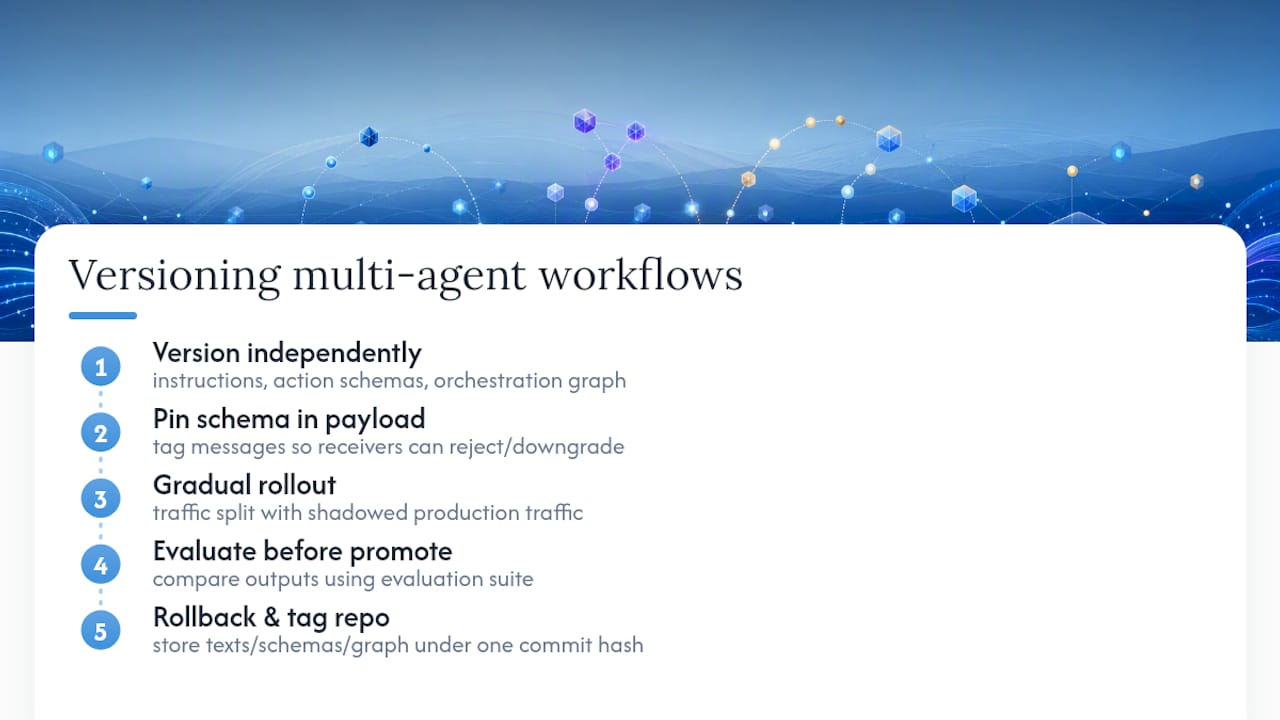
Pin schema versions explicitly in the payload rather than assuming compatibility. A message tagged schema_version: 3 lets a receiving agent reject or gracefully downgrade instead of misinterpreting a field that changed meaning between versions. This is the same discipline API teams have used for years with versioned REST endpoints, and it applies just as directly to agent-to-agent contracts.
Roll out changes to one agent at a time behind a traffic split, not as a full-fleet deployment. Run the new agent version against a shadow copy of production traffic, compare its outputs against the current version using your evaluation suite, and only promote it once the scores hold steady across your domain-mismatch tests. This catches the failure mode where an update improves one metric while quietly regressing another.
Keep a rollback path for every component, including prompts. Agent instructions change more often than code, and teams that don't version them the same way they version code lose the ability to bisect a regression. Store instruction text, schema definitions, and orchestration logic in the same repository, tagged together at each release, so a single commit hash tells you the exact state of the whole workflow at any point in time.
Coordination Protocols Beyond MCP
MCP standardizes how an agent reaches a tool or data source, but it says nothing about how agents negotiate with each other mid-task, and that gap is where a surprising number of production incidents originate. Agent-to-agent coordination needs its own explicit protocol layer, separate from tool access.
Message-passing patterns matter here. A publish-subscribe model lets multiple agents react to a shared event (a new task state update, a completed subtask) without the orchestrator having to poll each one individually. This scales better than direct request-response chains as the agent count grows, since it decouples producers from consumers.
Shared blackboard state is another pattern worth knowing: instead of agents messaging each other directly, they read and write to a common structured state object, and the orchestrator's Evaluator step decides what happens next based on that shared view. This is the same task-state pattern behind Planner-Evaluator-Updater architectures, and it doubles as your audit trail for free.
For workflows that need durable, addressable communication outside the agent runtime itself, such as sending an approval request to a human reviewer or notifying an external system, a dedicated inbox layer built for agents, like Sendmux's email API for AI agents, gives you a structured, traceable channel instead of a fragile webhook or an unmonitored inbox.
Distributed and privacy-aware workflow synthesis adds another layer worth knowing about: when agents operate across separate trust boundaries or data domains, local workflow generation has to stay regularized so the pieces still compose into one coherent global workflow instead of drifting into inconsistent local decisions.
Security and Access Control Across an Agent Fleet
Every agent in a multi agent workflow is a credential holder, and that's the security model most teams get wrong early on. An agent with tool access to a payments API or a customer database needs the same least-privilege discipline you'd apply to a human employee, scoped narrowly to what its specific role requires.
Scope credentials per agent, not per workflow. If a research agent and a billing agent share one API key, a prompt injection that compromises the research agent's reasoning also exposes billing access it never needed. Separate credentials mean a compromised agent has a blast radius limited to its own permissions.
Validate every tool call against an allowlist, not a denylist. Denylists require you to anticipate every bad action in advance, which is a losing game against a system that generates novel outputs. An allowlist of permitted actions, enforced at the MCP layer, means anything not explicitly approved simply fails closed.
Treat prompt injection as an input validation problem, not a prompt engineering problem. Content pulled from external tools, documents, or user input should be sanitized and clearly delineated from system instructions before it reaches an agent's context window, the same way you'd separate user input from SQL in a database query. Log every action an agent takes against an external system with enough context to reconstruct intent after the fact. That log is your only real defense when an incident review asks why an agent did what it did.
Scaling Multi Agent Workflows Without Losing Control
Scaling a multi agent workflow from a handful of agents to a large fleet exposes problems that don't show up in a prototype. Coordination overhead grows faster than agent count. Each additional agent adds potential handoff points, and each handoff point is a place typed schemas and A2A enforcement either hold or don't.
Latency compounds across sequential agent calls. A workflow with five agents each averaging two seconds of reasoning time isn't a ten-second workflow. Network overhead, queueing delays, and retry logic push real-world latency well past the sum of individual agent times. Parallelize independent subtasks wherever the task graph allows it, and reserve sequential chains for steps with genuine dependencies.

Token and compute costs scale with agent count in ways budget forecasts often miss, especially once retries and evaluator passes are counted. This is exactly where the single-agent multi-turn baseline earns its place: before scaling out to more agents, confirm the added heterogeneity is actually buying you a benchmark improvement, not just added cost.
State management gets harder as agent count grows, because more components are reading and writing to shared task state simultaneously. A structured, versioned state object with clear write ownership per agent avoids the race conditions that show up once concurrent subagents start operating on the same task.
Error Handling and Fallback Design
Errors in a multi agent workflow are not exceptions to plan for after launch. They're a design input from day one, because agents fail in ways traditional software doesn't: a valid-looking response that's factually wrong, a tool call that times out mid-reasoning, a schema-compliant payload with nonsensical content.
Build retries around schema and evaluator checks, not just HTTP status codes. A tool call can return 200 and still hand back garbage. Your retry logic needs to check the content against the expected schema and, where possible, an evaluator pass before accepting the result and moving the workflow forward.
Fallback to a simpler model or a narrower action set before failing the whole run. If a complex reasoning step fails twice, dropping to a smaller model with a more constrained action schema often succeeds where the original attempt didn't, because the smaller schema leaves less room for the kind of ambiguity that caused the first failure.
Escalate to a human or a dead-letter queue rather than looping indefinitely. Cap retries explicitly per step, and route anything that exhausts its retry budget to a queue for manual review instead of letting the orchestrator spin. Every fallback path should be logged with the same rigor as a successful run, since fallback frequency is one of the clearest early signals that a schema or instruction needs revision.
Getting Latency and Cost Down Without Cutting Reliability
Performance tuning in a multi agent workflow usually comes down to cutting unnecessary agent calls before it comes down to making individual calls faster. Audit your task graph for steps that could be handled by the orchestrator directly instead of delegated to a subagent. Every delegation adds a network round trip and a reasoning pass that a simpler rule-based check might replace entirely.
Cache aggressively at the tool-call layer. If multiple agents in a workflow query the same data source with the same parameters, a shared cache with a short time-to-live cuts redundant calls without risking stale results in most operational contexts.
Batch independent evaluator passes rather than running them one at a time. If three subagents complete in parallel and each needs an evaluation before the orchestrator proceeds, running those evaluations concurrently instead of sequentially is often the single biggest latency win available in a workflow of moderate complexity.
Reconsider your architecture against the single-agent baseline periodically, not just at design time. Model capabilities shift fast enough that a multi-agent decomposition that made sense six months ago might now be outperformed by a single strong model with KV cache reuse across turns, at a lower token cost and with less coordination overhead to maintain.
What Nobody Tells You About Shipping These Systems
The gap between a multi-agent demo and a production system isn't the agents. It's almost always the seams between them. Every team I've watched hit a wall in production traced the failure back to an unenforced interface, a schema that was documented but not validated, or an instruction that assumed an agent would infer intent correctly.
The one rule worth adopting without exception: no agent-to-agent handoff ships without a machine-checkable schema behind it, full stop. Conventions get skipped under deadline pressure. Enforcement doesn't.
Start small, but instrument early. A two-agent workflow with full tracing teaches you more about failure modes than a ten-agent workflow with none.
— Kevin
Start Building With MLflow's Agent Engineering Tools
Every pattern in this guide, typed schemas, orchestration state, replay debugging, budget enforcement, needs a platform underneath it that actually surfaces what's happening inside the workflow. That's the specific gap MLflow closes: it's the open-source layer that gives you tracing, automated evaluation, and cross-provider governance without locking you into a single model vendor or a proprietary orchestration format.
The path in is direct. Start with MLflow's agent and LLM engineering tools to wire up tracing and LLM-as-a-judge evaluation against the checklist covered here, or review the full AI platform overview if you're deciding what your team actually needs before committing to an architecture. Either page gets you from reading about these patterns to watching them run in your own traces within an afternoon.
Sources
- Multi-agent workflows often fail. Here’s how to engineer ones that don’t. - The GitHub Blog
- Agent orchestration and workflows (Microsoft docs)