8–12 Week Playbook for Engineers: RAG Governance with MLflow

RAG governance is the enterprise control architecture that treats retrieval as a governed access path, not a search convenience. It means implementing source authority tiers, retrieval-time access control, freshness and versioning checks, provenance tracking, and evaluation gates before any generated output reaches a user. The reference architecture that follows gives you the actual schemas: chunk metadata, audit event structure, and eval test cases you can build against this quarter.
TL;DR:
- Source authority tiers and metadata schemas must be established before ingestion, especially for trusted sources and retrievable chunk information.
- Retrieval-time access control using RBAC or ABAC is critical to prevent unauthorized results, particularly in multi-tenant environments.
- Freshness, versioning, and deletion policies should be enforced with SLA-defined propagation, and every chunk needs metadata to trace updates or retractions.
- Audit trails require detailed metadata capturing request flow, retrieval, and reasoning steps, with redaction defaults to limit sensitive data exposure.
- Operating RAG governance effectively benefits from tools like MLflow’s AI observability platform, which maps traceability, version control, and evaluation directly to governance controls.
Table of Contents
- What Does RAG Governance Actually Cover?
- The Core Controls Every RAG System Needs
- Who Should Own Each Piece of RAG Governance?
- An 8 to 12 Week Rollout for RAG Governance
- How MLflow Maps to These Governance Artifacts
- What I've Learned Watching RAG Deployments Fail
- Put These Controls on a Platform Built for Them
- Sources
What Does RAG Governance Actually Cover?
RAG governance is not the color-coded traffic light reporting your PMO uses to flag project health. That "RAG status" is a project governance model built for schedule and budget risk. RAG governance, in the AI architecture sense, is the discipline of controlling what a retrieval-augmented generation system can read, cite, and say, and it lives closer to identity and access management than to a steering committee slide deck.
A few terms matter here. The knowledge estate is everything indexed and retrievable, from wikis to contract PDFs to Slack exports. A chunk is the smallest retrievable unit, usually a few hundred tokens with metadata attached. The inference boundary is the line between what a model retrieved and what it's actually allowed to conclude from that retrieval. The final-answer policy decides whether a low-confidence or single-source answer gets surfaced, caveated, or blocked.
This intersects directly with existing frameworks:
- The NIST AI Risk Management Framework supplies the govern, map, measure, and manage structure most enterprise risk teams already use for AI systems generally.
- COSO's enterprise risk management guidance frames the board-level oversight layer that RAG governance ultimately reports into.
- Standard IAM practice (RBAC/ABAC) extends directly into retrieval, since a chunk is just another protected resource.
The Core Controls Every RAG System Needs
Every governance failure in a production RAG deployment traces back to one of six missing controls. Build these in order, not as an afterthought once something leaks.
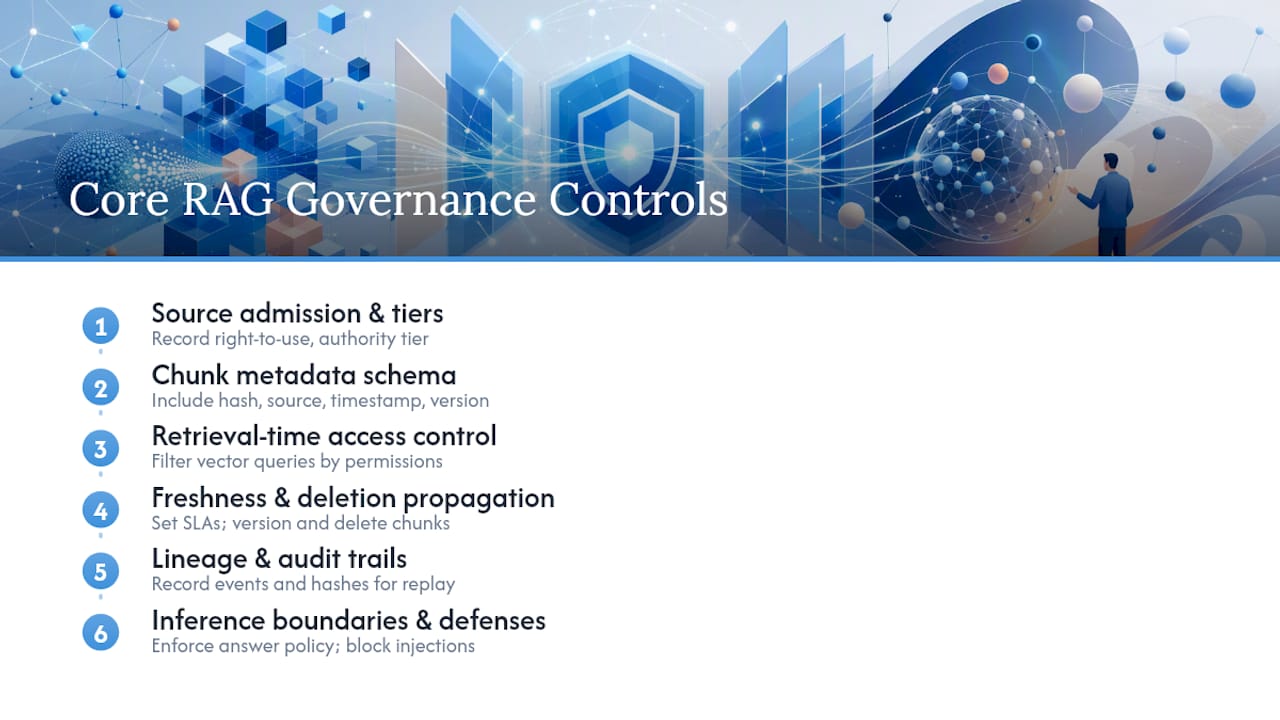
1. Source admission and authority tiers. Not every document deserves equal trust. A signed policy from legal is authoritative; a Slack thread debating that policy is context only. Define at least two tiers: authoritative sources can support direct, unhedged answers, while context-only sources require a caveat or get excluded from final-answer synthesis entirely. The GPT-RAG governance guide recommends recording right-to-use assertions and classification at admission time, before a single document gets chunked and indexed. Retrofitting authority tiers after 50,000 documents are already indexed is a multi-week project. Assign it before ingestion.
2. Chunk metadata schema. Every chunk needs, at minimum: source_owner, authority_level, classification, retention_policy, effective_date, hash, and indexed_at. The hash lets you detect drift between the indexed version and the live source. The effective_date field is what makes freshness checks possible instead of guesswork. Skip this schema and you cannot answer basic audit questions later, like "which chunks came from a document that's since been retracted."
3. Retrieval-time access control. This is where most RAG deployments actually fail. Permission checks that only happen at the application layer, upstream of retrieval, are not access control, they are a suggestion. Enforce RBAC or ABAC at the vector store query itself, filtering by permitted_subjects before results ever reach the ranking stage. Multi-tenant systems need hard tenant isolation baked into the same filter, not a separate index per tenant that someone forgets to provision correctly.
4. Freshness, versioning, and deletion propagation. A retracted document that still shows up in retrieval results three weeks later is a governance breach, not a bug ticket. Define an SLA for deletion propagation (same-day for legal holds, weekly batch for general content) and version every chunk so a superseded answer can be traced back to the document version it came from.
5. Lineage and replayable audit trails. You need enough recorded metadata to reconstruct exactly why the system said what it said. A workable event schema captures: request received, query generated, retrieval executed, chunk selected, prompt assembled, model called, answer generated, and response delivered. Store metadata and hashes rather than raw sensitive content, and apply redaction defaults so audit telemetry doesn't become its own compliance liability.
6. Inference boundaries and prompt-injection defenses. Retrieval success does not equal inference legitimacy. A model can retrieve the right chunk and still draw an unauthorized conclusion from it if the final-answer policy doesn't constrain what conclusions are permitted from single-source or low-authority context. Isolate retrieved content from system instructions at assembly time so an injected instruction inside a document can't override your prompt hierarchy, and enforce citation integrity, meaning every factual claim in the output maps to a retrieved chunk, not to the model's parametric memory.
Your eval suite needs to test all of this directly, not just answer quality. Build test cases for: unauthorized retrieval (does a user without permission ever see a restricted chunk), stale-source handling (does a retracted document still surface), injection resistance (does an instruction embedded in a document get followed), and citation mismatch (does the cited source actually support the claim attached to it).
Pro Tip: Run your eval suite against the permission matrix before you run it against answer quality. A brilliant answer built on unauthorized retrieval is a worse outcome than a mediocre answer built on the right chunks.
Who Should Own Each Piece of RAG Governance?
Governance without ownership is just documentation. Map responsibility explicitly, and tie it to how your organization already runs enterprise risk oversight.
- Board and senior leadership set risk appetite and receive escalation on material incidents, consistent with COSO's governance and culture principle.
- The knowledge governance committee (legal, compliance, subject-matter experts, and platform engineering) approves which sources get admitted and at what authority tier.
- The AI platform team owns the indexes, runtime access-control enforcement, the eval harness, and observability tooling.
- Data owners and product owners decide source authority for their domain and sign off on the final-answer policy for their use case.
- Security and IAM own identity propagation into the retrieval layer and run periodic access reviews.
- An incident playbook needs a named owner for retrieval failures and hallucination-driven incidents, with clear escalation paths back to the committee.
An 8 to 12 Week Rollout for RAG Governance
Don't try to govern the whole knowledge estate on day one. Pick a single domain, prove the controls work, then expand.
- Select one domain with a clear, motivated data owner, not your largest or messiest dataset.
- Define the chunk metadata schema before ingesting a single document.
- Ingest with metadata attached, never backfill it later.
- Connect identity context from your IdP into the retrieval layer so permission filters have something to check against.
- Enforce retrieval filters and run the eval suite against unauthorized access, staleness, and injection cases.
- Enable audit trace emission, sampling telemetry rather than capturing 100% if cost is a constraint, since sampling design still needs exporter health checks to stay meaningful.
Pro Tip: Keep a rollback switch on audit emission separate from the retrieval pipeline itself. If your telemetry pipeline breaks, you want retrieval to keep working while you fix logging, not the other way around.
How MLflow Maps to These Governance Artifacts
- MLflow's prompt registry gives you version control over prompt assembly, which supports the prompt-versioning and reproducibility artifacts your audit trail needs.
- LLM-as-a-judge evaluation can let you build the eval suite described above (unauthorized retrieval, staleness, citation mismatch) and store the results as evidence.
- For prompt-injection resistance testing specifically, MLflow's red-teaming guidance covers adversarial test design against assembled prompts.
What I've Learned Watching RAG Deployments Fail
Governance in regulated RAG deployments fails as an institutional problem long before it fails as an engineering one. The teams that get burned usually treated access control as a feature to add later, not a precondition for indexing anything.
The three costliest patterns I keep seeing: deletion that never actually propagates to the vector index, authority tiers that get set once and never revisited as sources age, and citation integrity that nobody checks until a regulator asks for it. The fix isn't complicated. Start with one narrow domain, default every new source to the most conservative authority tier until proven otherwise, and put your eval gates in place before you scale, not after an incident forces you to.
— Kevin
Put These Controls on a Platform Built for Them
Governance artifacts are only as good as the system that enforces and records them. MLflow gives enterprise AI teams a way to operationalize retrieval governance without stitching together custom tracing infrastructure. The AI observability platform records the request-to-answer trace your audit schema needs, the prompt registry version-controls the assembly step where injection risk and citation integrity get decided, and built-in evaluation tooling turns your governance test cases into repeatable checks rather than one-off manual reviews. If your team is moving a RAG system from prototype to something a compliance officer will actually sign off on, start by mapping your current pipeline against MLflow's AI observability tracing to see where your audit trail already has gaps.
Sources
- NIST AI Risk Management Framework (NIST.AI.100-1)
- COSO enterprise risk management update
- GPT-RAG governance overview