Why Audit AI Decision Making: A 2026 Guide

AI auditing is the process of systematically examining AI decision-making systems to verify their accuracy, fairness, transparency, and compliance with regulations. The industry term for this practice is AI governance auditing, and it covers everything from model behavior to the documentation trails that regulators and stakeholders demand. Data scientists and AI ethics professionals need to understand why audit AI decision making matters now more than ever. Regulators treat AI outputs as extensions of human decision-making authority, which means every automated decision carries legal and reputational weight. Frameworks like ISO/IEC 42001 and explainable AI techniques are no longer optional additions. They are the foundation of defensible, trustworthy AI systems.
Why audit AI decision making: the accountability case
Auditing AI decision making is the mechanism that converts a black box into a documented, challengeable system. Without it, you cannot prove that a model behaved correctly, fairly, or within its intended scope at any given moment. Regulatory focus in 2026 centers on traceability and proof bundles that link AI decisions to exact data inputs and model configurations at decision time. That shift means standard logging is no longer sufficient. You need layered evidence.
The core of a defensible AI audit involves three layers. First, the decision output itself: what the model produced and why. Second, the environmental context: which model version, which prompt, which data snapshot was active at that moment. Third, the oversight controls: who reviewed the decision, what approval process existed, and whether a human had the authority to override. Linking AI decisions to human approval and documented governance processes is required for accountability. This is not a best practice. It is the baseline.
Explainable AI, or XAI, plays a direct role in making audits work. XAI outputs become audit evidence that supports compliance and internal governance. The key requirement is that the reasoning must be usable by non-technical reviewers. A model that produces a confidence score without a documented rationale fails the audit test. Auditors, legal teams, and regulators need to challenge and sign off on decisions, and that requires plain-language documentation of the model's logic.
Both internal and external audits serve distinct roles. Internal audits catch problems early and build institutional knowledge. Independent external audits provide objective validation and build stakeholder trust in ways that self-assessment cannot. Boards that rely only on internal assertions of safety carry reputational risk.
- Decision output logging: Capture the exact model response, confidence level, and any intermediate reasoning steps.
- Environmental snapshot: Record model version, prompt template, data version, and configuration at decision time.
- Oversight documentation: Log human review actions, approval timestamps, and override events.
- XAI rationale: Attach a plain-language explanation of the decision logic to every audit record.
- Proof bundle assembly: Combine all of the above into an immutable record that can be reconstructed on demand.
Pro Tip: Design your proof bundle schema before you deploy. Retrofitting audit infrastructure onto a live production system is far more expensive and error-prone than building it in from day one.
Why continuous AI audits are critical for managing risk
AI behavior changes over time, and a model that passed its initial evaluation may fail silently six months later. Regular or continuous auditing is critical because AI performance can diverge due to data drift, distribution shift, or upstream pipeline changes. Think of it like mechanical maintenance. You do not inspect a system once and assume it will run correctly forever.
The risks that continuous auditing catches are concrete and costly. Model drift causes predictions to degrade without triggering obvious errors. Bias can emerge when real-world data distributions shift away from training data. Hallucinations in large language models can produce confident, plausible, and entirely wrong outputs. Each of these failure modes carries reputational and financial consequences that a one-time audit at deployment will never detect.
- Establish a monitoring baseline. Define fairness metrics, accuracy thresholds, and latency benchmarks at deployment. These become your audit reference points.
- Set automated drift alerts. Configure monitoring to flag when model outputs diverge from baseline by a defined threshold. Mlflow's continuous monitoring tools support this directly.
- Schedule periodic human review. Automated monitoring catches statistical drift. Human review catches contextual failures that metrics miss.
- Document every intervention. When you retrain, adjust thresholds, or roll back a model, log the reason, the reviewer, and the outcome. These records are your audit evidence.
- Test adversarial scenarios regularly. Red teaming exercises expose failure modes that standard monitoring overlooks.
Proactive auditing also creates competitive advantage. Organizations that can demonstrate continuous, documented oversight attract enterprise clients and institutional investors who require evidence of AI reliability. Independent audits build confidence among clients, investors, and leadership while mitigating increasingly complex AI risks. That confidence translates directly into contract wins and reduced regulatory friction.
What are the biggest challenges in auditing AI decisions?
The most common objection to AI auditing is that AI systems move too fast to audit effectively. That misconception misunderstands modern audit practice. Auditors do not inspect every individual output. They examine the governance framework: training objectives, evaluation criteria, monitoring processes, and human oversight structures. This approach scales to high-volume AI environments the same way financial auditing scales to millions of transactions.

Documentation is the real challenge. Standard logging captures what a model returned. It rarely captures the prompt variation that triggered an unexpected response, the intermediate reasoning steps in an agentic workflow, or the exact data snapshot the model used. Audit failures frequently arise from missing immutable records linking decisions to environmental context and model versions, not from poor model quality. The model may have performed correctly. The audit fails because the evidence was never captured.
Non-deterministic AI behavior adds another layer of complexity. A generative model does not produce the same output twice for the same input. This means you cannot reconstruct a decision after the fact from logs alone. Proof bundles capturing data, logic, model versions, and intermediate reasoning at the moment of decision are the only reliable solution. Retrospective logs are insufficient for legal defensibility.
- Embed audit readiness from day one. Audit infrastructure added after deployment is always incomplete. Build tracing, logging, and proof bundle generation into your pipeline architecture before the first production deployment.
- Adopt recognized standards. ISO/IEC 42001 provides a management framework for AI systems. ISO/IEC 42006 sets competence requirements for AI auditors. The AI audit profession is formalizing around these standards, and alignment with them reduces regulatory uncertainty.
- Use OPA frameworks. Frameworks that integrate explainability, monitoring, and audit trails enable organizations to address drift, bias, and compliance risks dynamically.
- Assign human accountability explicitly. Every AI decision in a regulated context needs a named human owner. Document who approved the model, who monitors it, and who has authority to shut it down.
Pro Tip: Treat your AI pipeline's observability layer as audit infrastructure, not just a debugging tool. Every trace you capture is potential evidence in a compliance review.
How does auditing AI benefit organizations and stakeholders?
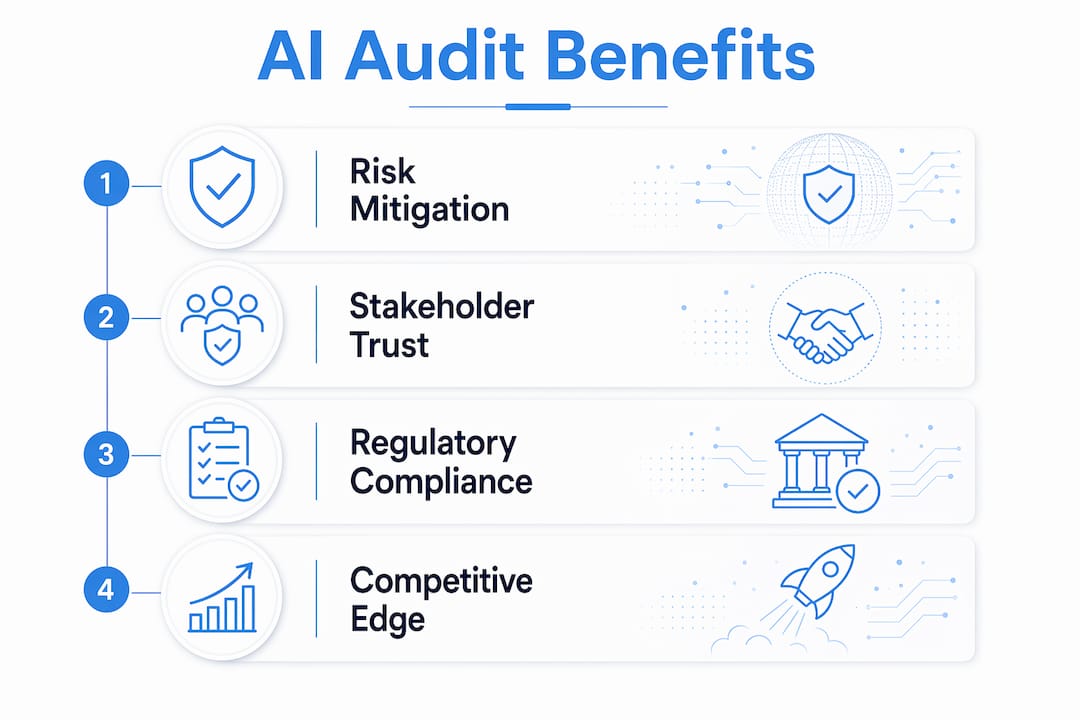
AI audits deliver benefits across four distinct dimensions. The table below maps each dimension to its practical impact.
| Benefit dimension | What it means in practice |
|---|---|
| Risk mitigation | Audits catch legal, reputational, and operational failures before they escalate to incidents. |
| Stakeholder confidence | Independently validated AI systems attract enterprise clients and institutional investors. |
| Regulatory compliance | Documented audit trails satisfy requirements under frameworks like the EU AI Act and ISO/IEC 42001. |
| Business continuity | Continuous monitoring with documented kill switches prevents single model failures from cascading. |
Risk mitigation is the most immediate benefit. A bias failure in a credit scoring model or a hallucination in a medical decision support system can trigger regulatory action, class action litigation, and immediate revenue loss. Audits catch these failure modes before they reach that threshold. AI audits provide improved risk management, regulatory compliance, and enhanced stakeholder trust, which together support competitive advantage.
Stakeholder confidence is the less obvious but equally valuable benefit. Clients in regulated industries, including finance, healthcare, and government, now require evidence of AI governance as a procurement condition. An organization that can produce a clean, documented audit history wins contracts that competitors without audit infrastructure cannot access. Effective AI audits require a blend of technical, organizational, and communication skills to produce evidence that stakeholders actually believe. Technical accuracy alone is not enough. The documentation must be readable and credible to non-technical decision-makers.
Regulatory compliance benefits compound over time. Organizations that build audit readiness into their pipelines early accumulate a documented governance history. When new regulations arrive, they have evidence to present rather than a remediation project to fund. Audit readiness embedded in pipeline design from deployment day, including automated drift and fairness monitoring, is the most cost-effective path to sustained compliance.
Key Takeaways
Auditing AI decision making requires immutable proof bundles, continuous monitoring, and documented human oversight built into the pipeline from day one, not added after deployment.
| Point | Details |
|---|---|
| Proof bundles are mandatory | Capture decision output, model version, prompt, and reasoning at decision time for legal defensibility. |
| Continuous audits catch drift | One-time deployment audits miss model degradation, bias emergence, and hallucination risks over time. |
| Governance, not output inspection | Modern AI audits examine training objectives and oversight frameworks, not every individual prediction. |
| Standards reduce regulatory risk | ISO/IEC 42001 and ISO/IEC 42006 provide recognized frameworks that satisfy regulators and enterprise clients. |
| Audit readiness drives business value | Documented AI governance attracts enterprise contracts and institutional investors who require evidence of reliability. |
The audit profession has not caught up yet, and that is the real risk
My honest view is that most data science teams are building AI systems that will fail an audit they have not yet been asked to pass. The audit profession is formalizing fast. ISO/IEC 42006 now sets competence requirements for AI auditors. The EU AI Act creates mandatory conformity assessments for high-risk systems. Enterprise procurement teams are starting to ask for audit documentation as a contract condition. The gap between where most teams are and where regulators expect them to be is closing quickly.
The deeper problem is cultural. Data scientists are trained to optimize model performance. Auditors are trained to verify governance processes. These two disciplines rarely talk to each other during system design. The result is production AI systems with excellent accuracy metrics and no defensible audit trail. When a regulator or a client asks for evidence of oversight, the team has to reconstruct it from incomplete logs. That reconstruction is expensive, often incomplete, and sometimes impossible for non-deterministic systems.
The fix is not complicated, but it requires a shift in how teams think about pipeline design. Audit infrastructure, including tracing, proof bundle generation, and human oversight documentation, needs to be a first-class citizen in the architecture review, not an afterthought. Data scientists who understand audit requirements will build systems that their organizations can actually defend. That skill is becoming a professional differentiator, not just a compliance checkbox.
The audit profession itself has something to learn here too. Financial auditing scaled to millions of transactions by examining governance frameworks rather than individual entries. AI auditing will scale the same way. The teams that figure this out first will define the standard for everyone else.
— Kevin
Mlflow gives your AI pipelines audit-ready infrastructure
Mlflow is built for teams that need production-grade observability across complex AI and agent workflows.
Mlflow's LLM tracing captures the full decision pipeline, including intermediate reasoning steps, prompt versions, and model configurations, at the moment each decision is made. That trace data forms the proof bundle your audits require. Mlflow's red teaming tools let you simulate adversarial scenarios to surface failure modes before regulators or clients do. Combined with LLM-as-a-Judge evaluation, you get automated, documented quality assessments that satisfy both internal governance and external audit requirements. If you are building AI systems that need to be defensible, Mlflow gives you the infrastructure to make that happen.
FAQ
What is AI decision-making auditing?
AI decision-making auditing is the systematic examination of an AI system's outputs, governance processes, and documentation to verify accuracy, fairness, and regulatory compliance. It covers the full decision pipeline, from training data to model version to human oversight records.
Why do AI audits require proof bundles?
Standard logs miss prompt variations, intermediate reasoning steps, and exact model configurations active at decision time. Proof bundles capture all of these elements together, making decisions legally reconstructable after the fact.
How often should AI systems be audited?
AI systems require continuous monitoring for drift and bias, supplemented by scheduled periodic reviews. A single deployment audit is insufficient because model behavior changes as real-world data distributions shift over time.
What is the difference between internal and external AI audits?
Internal audits catch problems early and build institutional knowledge. External audits provide independent validation that stakeholders, regulators, and enterprise clients trust in ways that self-assessment cannot replicate.
Which standards govern AI auditing in 2026?
ISO/IEC 42001 provides the AI management system framework, and ISO/IEC 42006 sets competence requirements for AI auditors. Alignment with both reduces regulatory uncertainty and supports enterprise procurement requirements.