The Role of AI Observability in Enterprise AI Systems

AI observability is defined as the continuous practice of monitoring, tracing, and evaluating AI models, decisions, and infrastructure to ensure transparency, trust, and operational control across enterprise environments. Unlike traditional application monitoring, AI observability captures not just system health but the quality and reasoning behind every AI output. Enterprises deploying large language models (LLMs), AI agents, and generative AI workflows face a new class of failure modes, including hallucinations, model drift, and silent quality regressions, that standard tools like Datadog APM or Prometheus were never built to catch. Frameworks such as OpenTelemetry and platforms like Mlflow are filling that gap by providing deep tracing, semantic evaluation, and cost attribution at the agent level. The role of AI observability in enterprise settings is no longer optional. Gartner predicts over 40% of agentic AI projects will be canceled by 2027 due to poor risk controls and unclear value from lack of observability. That number signals a structural problem, not a technical one.
What is the role of AI observability in enterprise governance and risk?
AI observability gives governance teams a clear view of how AI systems make decisions, where they fail, and what they cost. Without it, AI operates as a black box, and accountability becomes impossible to enforce across IT, security, risk, and product functions.

The risks are concrete. Model drift causes a production model to silently degrade over weeks without triggering any infrastructure alert. Hallucinations in a customer-facing LLM go undetected until a user complaint surfaces. Shadow AI, where teams deploy unapproved models outside sanctioned pipelines, creates compliance exposure that no firewall catches. Observability surfaces all three by continuously evaluating model outputs against ground truth and policy thresholds.
Cross-functional governance depends on role-specific visibility. A security team needs audit trails of every prompt and response. A risk officer needs drift detection dashboards tied to compliance thresholds. A product team needs latency and quality metrics per feature. Observability platforms that support role-based dashboards make this possible without forcing every team to build their own monitoring stack.
"CIOs should treat AI observability as a core design principle, embedding it across IT, security, compliance, and business functions — not as a bolt-on afterthought."
The practical implementation of governance through observability includes three components:
- Agent registries that serve as a single source of truth for every deployed model, version, and owner
- Continuous evaluation pipelines that score model outputs for faithfulness, relevance, and policy compliance on every request
- Circuit breakers that automatically switch AI systems to human-review mode when faithfulness scores drop below acceptable thresholds, preventing cascade failures before they reach end users
How does AI observability differ from traditional IT monitoring?
Traditional IT monitoring answers one question: is the system up? AI observability answers a harder question: is the system right? That distinction changes everything about how you instrument, collect, and interpret telemetry.
Standard application performance management (APM) tools track uptime, CPU utilization, memory, and latency. Those metrics tell you nothing about whether an LLM returned a factually correct answer, whether a reasoning chain followed the intended logic, or whether a prompt template introduced token bloat that inflated inference costs. Traditional APM tools are insufficient for generative AI systems prone to hallucinations and silent failures. The gap is not a configuration problem. It is an architectural one.
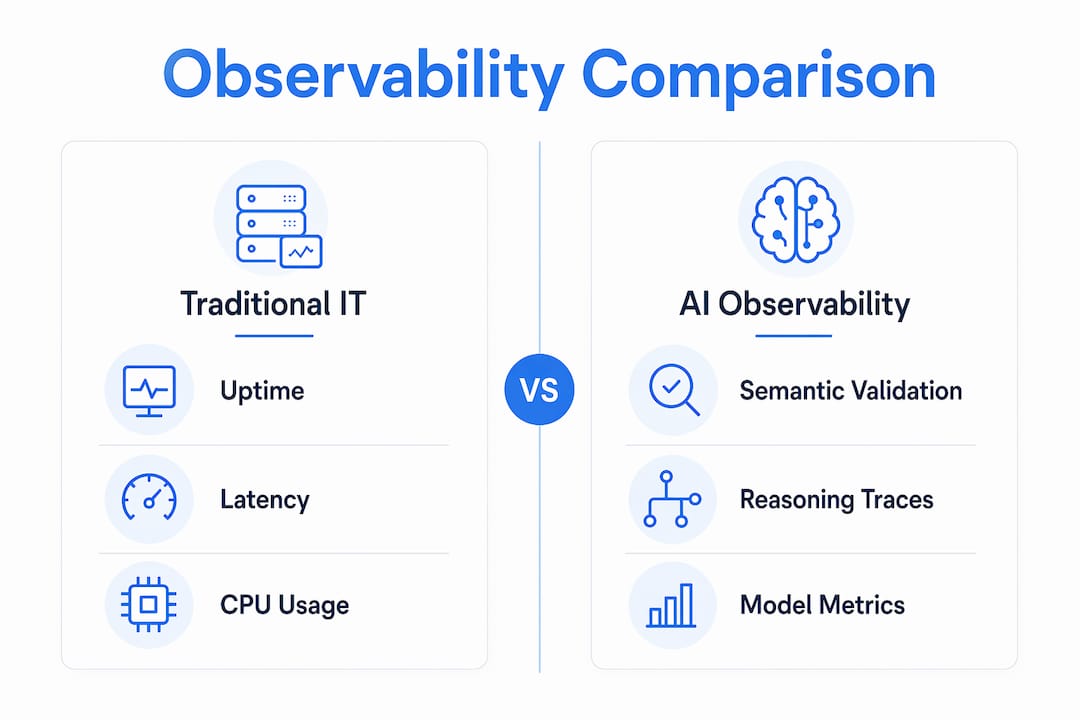
| Dimension | Traditional IT monitoring | AI observability |
|---|---|---|
| Primary signal | Uptime, latency, CPU | Model faithfulness, drift, semantic accuracy |
| Failure mode detected | Crashes, timeouts | Hallucinations, silent regressions, cost bloat |
| Evaluation method | Threshold alerts | LLM-as-a-Judge, semantic validation |
| Instrumentation layer | Infrastructure and application | Agent reasoning chains, prompt context, token usage |
| Governance output | Incident tickets | Audit trails, compliance dashboards, drift reports |
AI observability adds new telemetry layers that APM tools do not support. Reasoning chain traces capture every step an agent takes before producing an output. Prompt context monitoring flags duplicate or redundant context that inflates token counts. Semantic validation checks whether a response is grounded in the provided context, not just syntactically correct.
Pro Tip: Instrument your AI agents at the source using native telemetry rather than proxy-based interception. Native instrumentation avoids the latency and trace reliability issues that proxy-based methods introduce, giving you cleaner, more complete data for root-cause analysis.
What technical capabilities enable effective AI observability?
Effective AI observability in enterprises rests on four technical capabilities: agent registries, real-time analytics, distributed trace visualization, and automated evaluation pipelines.
-
Agent registries and asset inventories. Every deployed model, agent, and prompt template needs a versioned record with ownership metadata. Without a registry, teams cannot answer basic governance questions: which model is in production, who approved it, and when was it last evaluated?
-
Real-time performance and cost dashboards. Observability platforms must surface token usage, latency per request, error rates, and cost per inference in real time. Enterprises waste 15–25% of AI inference costs on redundant prompt context. A cost attribution dashboard identifies exactly which pipelines carry that bloat so engineering teams can act on it.
-
Distributed trace visualization. Multi-agent systems involve dozens of sub-agent calls, tool invocations, and retrieval steps per request. Visualizing those interactions as a connected trace, rather than isolated log lines, is the only way to diagnose where a reasoning chain broke down. Mlflow's multi-agent observability tooling renders these traces end-to-end, making root-cause analysis tractable for complex agentic workflows.
-
Automated evaluation pipelines. LLM-as-a-Judge frameworks score model outputs on faithfulness, relevance, and toxicity at scale. Manual review cannot keep pace with production traffic. Automated evaluation catches regressions before they compound.
| Capability | What it measures | Enterprise benefit |
|---|---|---|
| Agent registry | Model versions, ownership, approval status | Governance and audit readiness |
| Cost attribution | Token usage, inference spend per pipeline | Identifies 15–25% cost waste |
| Distributed tracing | Reasoning chains, sub-agent calls | Faster root-cause analysis |
| Automated evaluation | Faithfulness, relevance, toxicity scores | Continuous quality assurance |
Open standards matter here. OpenTelemetry provides a vendor-neutral instrumentation layer that enterprise teams can adopt without locking into a single observability vendor. Mlflow builds on these standards to provide production-grade tracing for LLMs and agents, including support for agentic reasoning visualization and cross-provider governance through its AI Gateway.
Pro Tip: Pair your observability stack with an LLM-as-a-Judge evaluation layer from day one. Waiting until production to add semantic scoring means you have no baseline to compare against when quality degrades.
What measurable benefits do enterprises gain from AI observability?
The business case for AI observability is direct: it reduces costs, shortens incident resolution time, and prevents project failures that destroy AI ROI.
Mean time to resolution (MTTR) is the clearest operational metric. Observability reduces MTTR from days of manual debugging to minutes through deep tracing and automated evaluation. When a production agent starts returning low-faithfulness responses, a trace-equipped team can pinpoint the failing retrieval step or malformed prompt within a single investigation session rather than across multiple days of log analysis.
Cost control is equally concrete. Redundant prompt context is a common and invisible cost driver in enterprise LLM deployments. Observability at the feature level identifies which pipelines carry duplicate context, which models are over-provisioned for their task complexity, and which retrieval steps return more tokens than the downstream model can use. Eliminating that waste directly improves AI unit economics.
The strategic benefit is competitive positioning. Investment in LLM observability will rise from 15% in early 2026 to 50% of GenAI deployments by 2028. Enterprises that build observability into their AI framework now will have two years of operational data, evaluation baselines, and governance infrastructure that late adopters cannot quickly replicate. That head start translates into faster iteration cycles, lower incident rates, and stronger compliance posture when regulators begin auditing AI systems.
- Reduced project cancellation risk. Proactive drift detection and circuit breakers prevent the quality failures that lead to executive loss of confidence in AI programs.
- Improved compliance readiness. Audit trails generated by observability pipelines satisfy regulatory requirements without manual documentation effort.
- Faster model iteration. Teams with evaluation baselines can safely promote new model versions knowing they have a quantified quality floor to compare against.
- Cross-team alignment. Shared observability dashboards give IT, product, and risk teams a common language for discussing AI system health.
Enterprises that integrate observability early establish competitive advantage through reliability and cost control. The teams that treat observability as a first-class engineering requirement, not a monitoring afterthought, are the ones that scale AI without the project cancellations Gartner warns about.
Key Takeaways
AI observability is the foundational practice that separates enterprise AI programs that scale reliably from those that fail silently, exceed budgets, and lose stakeholder trust.
| Point | Details |
|---|---|
| Governance requires observability | Role-based dashboards, agent registries, and circuit breakers give IT, risk, and compliance teams the visibility they need. |
| AI monitoring differs from IT monitoring | Semantic validation, reasoning chain tracing, and cost attribution go far beyond uptime and latency metrics. |
| Cost waste is measurable and fixable | Enterprises lose 15–25% of inference spend to redundant prompt context that observability tools can identify and eliminate. |
| MTTR drops from days to minutes | Deep tracing and automated evaluation cut incident resolution time dramatically compared to manual log analysis. |
| Early adoption creates competitive advantage | LLM observability investment will reach 50% of GenAI deployments by 2028; teams that start now build durable operational baselines. |
Why I think observability needs to be designed in, not bolted on
The most common mistake I see in enterprise AI deployments is treating observability as a phase-two concern. Teams ship a working prototype, get stakeholder approval, and then discover in production that they have no way to explain why the model returned a specific output, how much it cost, or whether quality has degraded since launch. Retrofitting observability into a live system is painful and incomplete. The instrumentation gaps you leave during development become the blind spots that cause incidents six months later.
The second mistake is treating observability as an infrastructure team's problem. Effective AI observability requires product managers who define quality thresholds, data scientists who build evaluation rubrics, and security teams who specify audit requirements. When those conversations happen after deployment, the observability system gets built around what is easy to measure rather than what matters to the business.
The teams I have seen succeed treat observability as a design constraint from the first sprint. They define faithfulness thresholds before writing a single prompt. They instrument agent traces before the first integration test. They build cost attribution into the architecture before the first production request. That discipline is harder to maintain under delivery pressure, but it is the only approach that produces AI systems you can actually trust at scale. The 2026 AI trends confirm this pattern: enterprises that embed governance and observability early are the ones that avoid the project cancellations Gartner predicts will claim 40% of agentic AI programs by 2027.
— Kevin
Mlflow gives enterprise AI teams the observability they need
Enterprise AI teams need more than dashboards. They need a platform that instruments reasoning chains, evaluates outputs automatically, and surfaces cost and quality signals in one place.
Mlflow is an open-source AI platform built specifically for LLM and agent lifecycle management. Its AI observability tools include end-to-end tracing for multi-agent systems, LLM-as-a-Judge automated evaluation, a centralized model registry, and an AI Gateway for cross-provider governance. Teams use Mlflow to move from experimental prototypes to production-grade agents with full transparency into every reasoning step, token cost, and quality metric. If your team is building or scaling AI agents, Mlflow's GenAI engineering platform gives you the instrumentation foundation to do it without flying blind.
FAQ
What is AI observability in an enterprise context?
AI observability is the continuous monitoring, tracing, and evaluation of AI models and agents to ensure transparency, quality, and cost control across enterprise deployments. It goes beyond infrastructure metrics to include semantic validation, reasoning chain analysis, and drift detection.
Why do enterprise teams need AI observability now?
Gartner predicts over 40% of agentic AI projects will be canceled by 2027 due to poor risk controls and lack of observability. Teams that instrument their AI systems now build the governance infrastructure needed to avoid those failures.
How does AI observability reduce costs?
Observability at the feature level identifies redundant prompt context and over-provisioned models that inflate inference costs by 15–25%. Cost attribution dashboards show exactly which pipelines carry that waste so engineering teams can eliminate it.
What is the difference between AI observability and traditional monitoring?
Traditional monitoring tracks uptime, latency, and CPU usage. AI observability adds semantic validation, faithfulness scoring, reasoning chain tracing, and cost attribution, which are the signals needed to detect hallucinations, model drift, and silent quality regressions.
How does Mlflow support AI observability for enterprises?
Mlflow provides production-grade tracing for LLMs and AI agents, automated LLM-as-a-Judge evaluation, a centralized agent registry, and an AI Gateway for cross-provider governance. It gives enterprise teams a single platform to monitor, evaluate, and govern complex AI workflows.