Prove HIPAA AI Logging Works: CI Tests, Break Glass, and MLflow

HIPAA-compliant AI logging means a Business Associate Agreement covering the model, audit logs capturing the required fields, encrypted append-only storage held for a retention period meeting HIPAA standards, and automated tests proving the logging actually runs in production. HHS enforcement now leans on the 2026 Security Rule update's push for testable technical controls, not policy documents. MLflow gives engineering teams a practical way to build that evidence trail.
TL;DR:
- AI audit logs must include detailed fields such as user ID, action, resource ID, timestamp, IP address, status, and purpose, with four additional AI-specific fields like model ID and prompt fingerprint.
- Logs should be stored on append-only, encrypted, separate storage with strict access controls and retention periods of at least six years, often extending to seven or ten.
- Implement a centralized inference gateway that routes all model calls, enforces logging, and fails closed if audit logging cannot be completed before responding.
- Testing controls through CI pipelines that verify field completeness, hash integrity, and retention compliance are now mandatory under the 2026 Security Rule update.
- For third-party vendors, SLAs and BAAs must explicitly cover model training, retrieval activities, and evidence of technical controls, not just policy adherence.
Table of Contents
- What HIPAA Requires When AI Processes PHI
- What Are the Seven Audit-Log Fields HIPAA Auditors Check?
- How to Log LLM Activity Without Overexposing PHI
- Where Should HIPAA Audit Logs Be Stored?
- Building the Inference Gateway as Your Single Logging Chokepoint
- What Do Auditors Expect From Testable Controls in 2026?
- Operational Controls: RBAC, Key Management, and Break-Glass Access
- How MLflow Supports HIPAA-Aligned Logging Architecture
- Impact of AI-Specific Data Processing on Audit Logging Requirements
- Anonymizing and De-identifying PHI in AI Logs
- Integrating AI Logs Into Existing HIPAA Logging Infrastructure
- Logging AI Model Updates and Training Data for Compliance
- Incident Detection and Response for AI System Logs
- Compliance Considerations for Third-Party AI Vendors Handling PHI
- What Most Teams Get Wrong About AI Compliance
- Get Traceable, Audit-Ready AI Logging With MLflow
- Sources
What HIPAA Requires When AI Processes PHI
Two provisions do the heavy lifting. 45 CFR §164.312(b) requires "hardware, software, and/or procedural mechanisms that record and examine activity" in any system that touches electronic PHI, and that includes an LLM pipeline, a RAG retriever, or an agent calling a clinical API. §164.316(b)(2)(i) requires you to retain the documentation of those controls for a minimum retention period defined by HIPAA regulations, whichever is later.
For AI systems specifically, this translates into two obligations most teams underestimate. First, if the model provider or hosting platform can see PHI in prompts, responses, or training data, you need a Business Associate Agreement with that vendor, and the BAA needs to explicitly address logging and retention provisions. Second, HHS has confirmed there is no such thing as federal "HIPAA certification" for software, so a vendor badge or compliance page proves nothing to an OCR investigator.
What actually gets checked:
- Signed BAAs naming the specific AI service, not just the cloud provider hosting it
- Audit logs that record access events with sufficient detail
- Documented retention policy matching HIPAA retention requirements
- Evidence the technical controls work, not just that they exist on paper
What Are the Seven Audit-Log Fields HIPAA Auditors Check?
Investigators reviewing an audit trail under §164.312(b) look for seven specific fields. Miss any of the first four and you likely have an audit finding on your hands.
- User ID and role. Who performed the action, and what role did they hold at that moment (clinician, admin, automated service account).
- Action taken. Read, write, generate, override, delete. Vague verbs like "processed" don't survive review.
- Resource type and ID. Which patient record, note, or document the action touched, using an internal identifier rather than free-text PHI.
- UTC timestamp. Standardized to UTC so cross-region deployments don't create timezone disputes during an investigation.
- Source IP and user agent. Ties the action to a specific device and session.
- Status code or success flag. Auditors want failed attempts logged too, not just successful ones.
- Purpose of use. Treatment, payment, operations, or research, tied to the minimum-necessary standard.
AI systems need four more fields layered on top: model ID and version, a prompt fingerprint (a hash, not the raw prompt), a response fingerprint, and any human override or rendering event when a clinician edits or rejects model output. Write one audit row per PHI record touched rather than one row per API call. A single prompt that pulls three patient records should generate three audit rows, each carrying its own resource ID. Use opaque identifiers everywhere instead of names or MRNs directly in the log line.
How to Log LLM Activity Without Overexposing PHI
HIPAA's minimum-necessary standard doesn't disappear because the system is a language model instead of a form. It gets harder to honor, because LLM inputs and outputs often are the clinical narrative, not a structured field you can redact cleanly.
The fix most engineering teams converge on is metadata-first logging: capture the shape of the interaction, not its clinical content, by default. A production event record should include a trace ID, tenant ID, model version, prompt template ID, the hashed identifiers of any retrieved documents, applicable policy flags, and a response hash. None of that requires storing the actual clinical text.
Layer a second, gated lane on top for the rare cases that need full content: a documented break-glass workflow, approved by a compliance officer, that unlocks the underlying prompt and response text for a specific incident investigation. Everything else stays metadata-only.
- Default lane: metadata, hashes, and IDs only, available to engineers and support staff
- Break-glass lane: full content, gated behind approval, logged with its own audit trail, retained for a shorter defined window
- Retrieval systems: log the document ID, chunk ID, and content version, not the retrieved snippet itself
For RAG pipelines specifically, an evidence-handle pattern works well: store a pointer to the exact chunk and version used, and fetch the underlying text later only under gated approval if a forensic review demands it.
Pro Tip: Hash prompts and responses with a keyed algorithm (HMAC, not plain SHA), and store the key separately from the log store. This lets you prove two prompts were identical without ever reconstructing the original clinical text from the log.
Where Should HIPAA Audit Logs Be Stored?
Audit logs need a fundamentally different storage architecture than your application's debug logs, and treating them the same is one of the most common failure points OCR investigators find. Four requirements define the difference.
- Append-only or WORM storage. Once a row is written, nothing (including admins) can edit or delete it before the retention clock expires.
- Encryption at rest with customer-managed keys. Not provider-default encryption. You control key rotation and revocation independently of the platform vendor.
- A store separate from observability. Your Datadog or ELK instance is built for debugging with short retention and broad developer access. Neither property fits an audit log's job.
- RBAC-audited access. Every query against the audit store gets logged too, including read access.
On retention, the federal floor is six years under §164.316(b)(2)(i), but that's a floor, not a target. State laws vary, medical malpractice statutes of limitations in some states run longer, and litigation holds can extend requirements further. Most healthcare engineering teams default to seven to ten years rather than tracking fifty state variations individually.
In practice: an INSERT-only database role for the audit writer, a prev_hash field on each row to build a tamper-evident chain, and object storage like S3 with SSE-KMS and lifecycle policies moving cold data to Glacier after 90 days. A generic observability stack built for engineers to grep through logs at 2 a.m. almost never satisfies these four properties simultaneously.
Building the Inference Gateway as Your Single Logging Chokepoint
Ad-hoc logging calls scattered across handler code guarantee gaps. Someone forgets a log line in the error path, someone adds a new endpoint without copying the audit boilerplate, and six months later you have inconsistent coverage nobody noticed until an audit surfaced it.
- Route every model call through a single inference gateway. No application code calls the model provider directly. Every request and response passes through one chokepoint, which is also where you enforce BAAs and rate limits.
- Split the gateway's output into two streams. A sanitized observability stream for latency, error rates, and debugging, and a full HIPAA-schema audit stream with all eleven fields covered above.
- Make audit writes synchronous with the response. The audit row gets written and confirmed before the API returns success to the caller. If the write fails, the call fails, because an unlogged PHI access is a compliance gap, not a performance edge case.
- Handle the audit-store-unavailable case explicitly. Fail closed for PHI-bearing operations rather than silently dropping the log and returning success. A brief service degradation beats an undocumented access event.
Middleware, not developer discipline, is what makes this durable. If logging depends on every engineer remembering to add three lines of code to a new route, you will eventually ship a route that skips it.
What Do Auditors Expect From Testable Controls in 2026?
The 2026 Security Rule update shifts the standard from documented intent toward demonstrable, automated evidence. A policy PDF stating "we log all PHI access" carries far less weight now than a passing CI job that proves it.
Build these into your pipeline:
- A synthetic-data test that runs against staging every 24 hours, generating fake PHI-like requests and asserting every resulting audit row contains all required fields
- A schema-compliance CI job that fails the build if a new endpoint's audit event is missing a required field
- Nightly signed hash snapshots of the audit store, proving the append-only chain hasn't been altered
- A retention-configuration verification report confirming lifecycle policies still match the documented retention period
A passing synthetic-data test run at 3 a.m. and logged in your CI history is a stronger audit artifact than a signed policy document, because it demonstrates the control fired under real conditions rather than describing an intention.
Your evidence package for an OCR request or a customer's security questionnaire should include: CI run logs from the schema-compliance job, sample queries against the audit store showing field completeness, the relevant BAA excerpts covering the AI vendor, and access logs for the audit store itself covering the review period. Complement this with a periodic algorithmic impact assessment, a practice policy researchers increasingly recommend for documenting AI-specific risks alongside standard technical audits.
Operational Controls: RBAC, Key Management, and Break-Glass Access
Logging infrastructure is only as trustworthy as the people who can touch it. Separation of duties matters here as much as the schema does.
- Give engineers, compliance staff, and incident responders distinct roles with no overlapping default access to the audit store
- Log every query against the audit store itself, including reads, so you have a chain of custody for who examined which record and when
- Use customer-managed keys through AWS KMS, Azure Key Vault, or GCP KMS, and audit key-usage events separately from data-access events
- Require documented, time-boxed approval for any break-glass request that unlocks full prompt or response content
- Set a short retention window specifically for break-glass-exposed content, distinct from your standard six-to-ten-year audit retention
Pro Tip: Route break-glass approvals through the same ticketing system your incident response team already uses. A break-glass event that isn't tied to a documented incident number is the first thing an auditor will flag.
How MLflow Supports HIPAA-Aligned Logging Architecture
MLflow's AI observability layer gives teams the tracing backbone this guide describes without building it from scratch. Deep tracing captures the full reasoning path of an agentic call, which maps directly to the model ID, version, and prompt fingerprint fields auditors expect.
- The prompt registry versions every prompt template, so you can prove exactly which template version produced a given response months after the fact
- Centralized AI Gateway support gives you the single chokepoint pattern described above, routing all model calls through one governed point rather than scattered client code
- Tracing hooks separate observability data from long-term audit needs, letting you sanitize what goes to your debugging dashboards
- Model registry features support the break-glass and access-governance patterns by tying model versions to explicit approval states
Review AI logging best practices and model security protocols for implementation patterns that pair directly with the schema and CI checks covered above.
Impact of AI-Specific Data Processing on Audit Logging Requirements
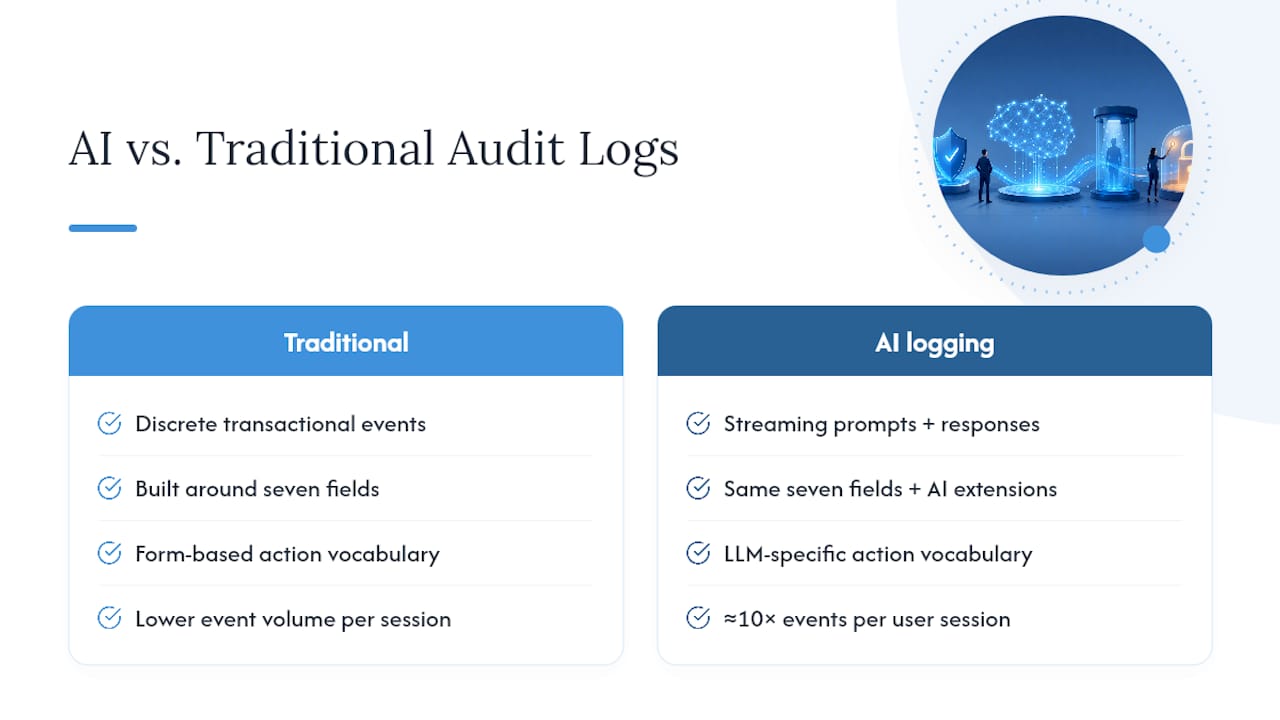
Traditional HIPAA audit logging assumed discrete, structured transactions: a user opened a chart, edited a field, printed a report. AI changes the shape of the transaction itself. A single inference call might synthesize information from a dozen underlying records, and the "action" isn't a clean CRUD operation but a probabilistic generation step that can vary between identical calls.
This forces two adaptations. First, a single AI request often needs multiple audit rows, one per underlying PHI record the model actually drew on, not one row for the API call as a whole. A summarization request touching five patient encounters should produce five linked audit entries, not one. Second, the "action" field needs new vocabulary: generate, retrieve, rank, override, and render each describe a distinct step in an AI pipeline that a simple "read/write" taxonomy can't capture.
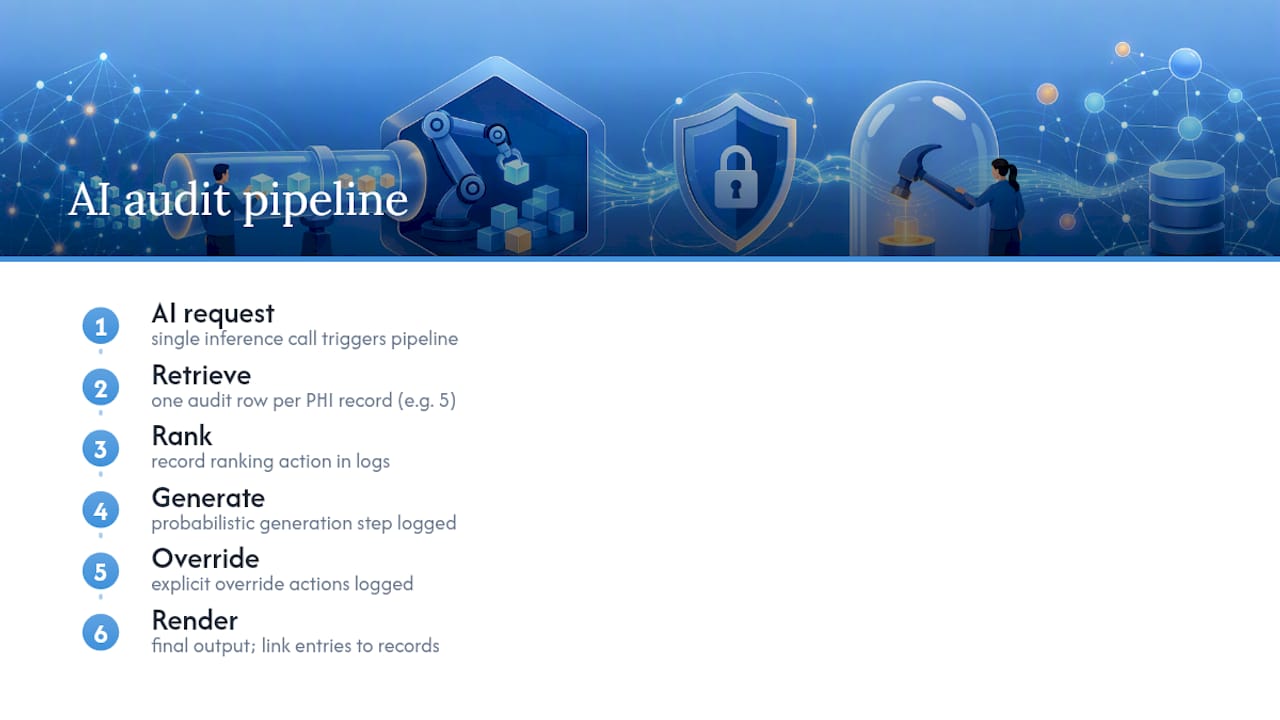
Training and fine-tuning activity adds a layer most teams miss entirely. If PHI was used to fine-tune a model, that use itself is a PHI processing event requiring its own audit trail, separate from inference-time logging. Retrieval-augmented systems compound this further: every document a retriever pulls into context counts as an access event, even if the model never surfaces that content directly in its response. Log the retrieval, not just the generation.
Anonymizing and De-identifying PHI in AI Logs
De-identification sounds like a clean solution until you try applying it to unstructured LLM prompts, where clinical narrative and identifiers are woven together in ways structured-field redaction never had to handle.
The core challenge: a prompt like "summarize the visit notes for a 34-year-old with a rare genetic condition seen at our clinic last Tuesday" can be re-identifying even without a name attached, particularly in a small patient population. Standard de-identification methods built for structured data (removing the eighteen HIPAA identifiers from a form) don't map cleanly onto free text generated dynamically at inference time.
Practices that hold up better in production:
- Hash rather than redact where you need to prove two interactions matched without storing the identifiable content
- Use tokenization for structured fields that flow into prompts, replacing MRNs and names with reversible tokens resolved only inside a gated system
- Treat de-identification confidence as probabilistic, not binary, and default to metadata-first logging rather than trusting an automated scrubber to catch every edge case in free text
- Test your de-identification pipeline against adversarial small-population scenarios, since rare diagnoses and small clinics are where re-identification risk spikes
No automated de-identification tool eliminates re-identification risk in unstructured clinical text. The metadata-first, evidence-handle pattern covered earlier exists precisely because de-identifying free text reliably at scale remains an unsolved problem, not a solved one.
Integrating AI Logs Into Existing HIPAA Logging Infrastructure
Most healthcare IT teams already run a mature audit logging setup for their EHR, billing systems, and clinical applications. The temptation is to bolt AI logging onto that existing pipeline as just another log source. Resist it, at least without adjustment.
Existing HIPAA audit infrastructure was built around discrete transactional systems with well-defined resource types (patient record, lab order, prescription). AI logging needs to feed into the same downstream retention and access-control systems, but the event shape upstream is different enough that a direct copy-paste integration creates gaps. The seven required fields still apply, but the "action" vocabulary, the volume of events per user session, and the need for prompt and response fingerprints don't fit neatly into schemas designed a decade ago for form-based systems.
The practical integration pattern: keep the inference gateway as the point of AI-specific event generation, then normalize its output into the same field structure (user ID, timestamp, resource ID, action, status) your existing SIEM or audit warehouse already ingests. Add the AI-specific fields as an extension, not a replacement, of your current schema. This lets your compliance team query across both traditional EHR access and AI-driven access using the same reporting tools, rather than maintaining two parallel audit systems that never talk to each other during an actual investigation.
Volume is the other integration challenge. An LLM-backed clinical assistant can generate ten times the audit events of a traditional form-based interaction in the same session. Make sure your existing audit store's throughput and query performance were sized for form-based volumes before assuming AI logs will fit without a capacity review.
Logging AI Model Updates and Training Data for Compliance
A model update is a compliance event, not just a deployment event, and treating it as purely an engineering release misses what an auditor will ask about later: which model version produced a specific clinical output, and what data trained that version.
Every model version deployed to production needs its own logged identity, tied permanently to the audit rows generated during the period it served traffic. When a clinician disputes an AI-generated summary from four months ago, you need to reconstruct exactly which model version, which prompt template, and which retrieval configuration produced that specific output. Version drift without logged linkage makes that reconstruction impossible.
Training data deserves separate documentation from inference logging. If PHI was used in fine-tuning, log what data sources contributed, under what authorization, and whether that use was covered by the relevant BAA. This matters more than most teams initially assume, because a vendor's standard BAA covering inference-time PHI handling doesn't automatically cover PHI used to fine-tune or evaluate a model, and those are legally distinct processing activities.
Practical steps: tag every production inference event with an immutable model version ID, maintain a separate training-data provenance log outside your inference audit trail, and require sign-off documentation whenever a model update changes behavior on PHI-adjacent tasks (diagnosis support, summarization, triage recommendations) significantly enough to warrant re-validation. Treat a model rollback the same way you'd treat a database schema rollback: as an event that itself gets logged, with the reason documented.
Incident Detection and Response for AI System Logs
AI-specific incidents don't always look like traditional security breaches. A model quietly hallucinating incorrect dosage information across hundreds of clinical summaries is an incident, even though no unauthorized party accessed anything and no traditional access-control failure occurred.
Detection needs to watch for patterns beyond the usual unauthorized-access signatures. Monitor for anomalous spikes in override or rejection events, which often signal a model version regression before anyone files a formal complaint. Watch for unusual retrieval patterns, where a single account suddenly pulls documents far outside its normal scope, since that can indicate either a compromised credential or a misconfigured retrieval permission.
Your incident response runbook needs an AI-specific branch. When something goes wrong, responders need to answer: which model version was active, what was the exact prompt and retrieved context (accessible only through the gated break-glass lane), and whether the issue affected one patient or a systematic pattern across a model version's entire deployment window. That last question is why per-record audit rows matter so much. Without them, you can't quickly scope how many patients a bad model version actually touched.
Document the break-glass access used during the investigation itself as part of the incident record, closing the loop between detection, gated review, and remediation. An incident response that skips logging its own forensic access creates the exact kind of gap OCR audits are built to catch.
Compliance Considerations for Third-Party AI Vendors Handling PHI
Every AI vendor touching PHI in your pipeline, whether it's the foundation model provider, a specialized clinical NLP service, or an analytics platform, needs a BAA that specifically addresses AI-relevant terms, not just a boilerplate agreement written for traditional SaaS.
Ask each vendor directly: does the BAA cover model training on your data, or only inference? What's their sub-processor chain, since a foundation model provider often relies on additional infrastructure vendors who may also technically touch PHI in transit? What's their own audit logging and retention posture, and can they provide evidence (not marketing claims) of it on request?
Vendor risk compounds when a provider chains multiple AI services together, a common pattern where a primary vendor's LLM calls out to a separate embedding service or a third-party retrieval index. Each link in that chain is a potential BAA gap if not explicitly covered. Push vendors for a data flow diagram showing every system PHI touches, not just the headline product name.
Recognize also that a signed BAA sets a legal obligation but doesn't verify technical enforcement. Ask vendors for the same category of evidence this guide describes for your own systems: schema-compliant audit logs, retention configuration proof, and encryption key management practices. A vendor unwilling to share evidence of their own testable controls is a warning sign regardless of what their contract says.
What Most Teams Get Wrong About AI Compliance
The conventional advice treats HIPAA compliance for AI as a checkbox exercise: sign the BAA, encrypt the database, write a retention policy, done. That misses what the 2026 Security Rule update actually signals, which is a shift toward evidence over intention. A policy document nobody has tested against real traffic is worth less to an investigator than a CI job that fails when a required field goes missing.
The bigger blind spot is treating AI logging as a smaller version of traditional audit logging rather than a genuinely different problem. Traditional systems log discrete transactions. AI systems generate probabilistic, multi-record, versioned outputs where the "action" itself resists the old CRUD vocabulary. Teams that bolt AI events onto an EHR-era logging schema without adjustment will pass a superficial review and fail a serious one.
Prioritize the metadata-first, two-lane model before anything else on this list. Get that pattern right, then build storage, retention, and CI verification around it. Everything else on this list is easier once that foundation is in place.
— Kevin
Get Traceable, Audit-Ready AI Logging With MLflow
Building the inference gateway, prompt versioning, and tracing infrastructure this guide describes from scratch takes months most healthcare IT teams don't have to spare. MLflow gives you that foundation already built: a prompt registry that versions every template change, deep tracing that captures model identity and reasoning steps automatically, and observability hooks designed to separate debugging data from long-term audit needs.
It fits teams moving an AI pilot into production under real compliance pressure, where the gap between "it works in a demo" and "it survives an OCR review" is exactly the gap this article walks through. Teams already running MLflow for model governance can extend the same registry and tracing layer to cover the audit schema fields this guide outlines, rather than standing up a parallel logging system.
If you're evaluating how your current AI pipeline would hold up under the seven-field audit test, start by reviewing AI observability for LLMs and agents and mapping your existing traces against the schema covered above.
This article is general information, not a substitute for advice from a qualified lawyer. Consult a qualified legal professional about your own circumstances before acting on anything here.
Sources
- Hhs
- Federalregister
- HIPAA Audit Logging: The 7 Fields That Pass § 164.312(b) (VertiComply)
- HIPAA for LLMs: Minimum Necessary Logging (Metadata-First, PHI-Safe) | Tanuj Garg
- Taction — HIPAA Audit Logging for AI Outputs: Engineer's Reference